AI financial close software is software in which agents do the watching, checking, planning and drafting of a period-end close, while accountants and actuaries keep the entries, the estimates and the signatures. In an insurer's quarter close the useful work for an agent is the mechanical part that eats the controller's week: noticing that a claims extract or a ceded loss file has arrived, been re-run or failed its control total; marking a task done only when its evidence exists; recomputing the critical path and the projected close; working out who is affected when something slips; and drafting the chasers and the status note. The work it should not do is anything an auditor or regulator would expect a named person to own: posting a journal, booking a reserve, moving the calendar, approving an estimate, or contacting a broker or third-party administrator. Botminds' Financial Close Management is built on that division. Its six agents prepare; the financial controller and the people on the close calendar decide and sign.
The examples below come from a fictional sample insurance group, Northvale Casualty Group, as it runs through the solution in its third-quarter 2026 close. The rules quoted come from the NAIC, the PCAOB and the U.S. Treasury.
One re-run file, from noticed to re-planned, in the sample close
2min
from the ceded loss file re-run at 08:40 to every moved task named at 08:42
12tasks
moved, 3 of them sign-offs
10notes
drafted for the owners who move, sent only when the controller sends them
0
entries posted, dates changed or outside parties contacted by an agent
What is AI financial close software, and what can it do in an insurer's close?
It is close software in which the status of the work is kept true by agents rather than by people updating a checklist. A conventional close tool holds the task list, the owners and the due dates, and relies on each owner to tick their task. Agents add three things a list cannot do on its own: they read the inputs directly, they apply rules about what counts as done, and they recompute the consequences when anything changes.
In an insurer's close those consequences run through a long chain. Claims and premium extracts feed the actuary's indication; the ceded loss file feeds the reinsurance accrual; the reserve committee waits for the net view; net reserves wait for the committee; consolidation waits for the journals; and the CFO waits for everything. In the sample group that is 186 tasks across three statutory companies and the group, owned by 14 people. A re-coded catastrophe in the ceded loss file on day +3 moves twelve of them. Seeing that within minutes, rather than when the person downstream asks where their input is, is the point of the software.
Six agents in Financial Close Management, and the one person who decides
Agent
File and extract watcherRecords each extract, bordereau, broker account and general ledger status with its row count and control total; lists what changed when a file is re-run.
Never: accepts a file that fails its control total, or marks a sign-off done
Agent
Task evidence checkerMarks a task done only when its evidence exists, and sets back work that used a void file.
Never: treats a tick as evidence
Agent
Critical path plannerRecomputes forecasts from inputs, fixed dates and past timing; finds the critical path and the projected close.
Never: changes the planned calendar
Agent
Ripple and recovery adviserLists every task and sign-off that moves, with its owner; scores ways to win the time back.
Never: applies a recovery, or proposes skipping a key control
Agent
Owner chaser and status writerDrafts the notes to the owners who move and the CFO’s status note, each statement cited.
Never: contacts an outside party without the controller
A person decides
Financial controllerChooses the recovery, sends the notes, owns the calendar and signs the controller review.
Can AI close the books?
No, and a vendor who says otherwise is describing a different product from the one an insurer can defend. Closing the books means recording entries, setting estimates and signing statements, and each of those is an act the law puts on management. The NAIC's Model Audit Rule, which states adopt for the annual audit, is explicit about the internal control report: it must carry the signatures of the chief executive officer and the chief financial officer, and "Management shall document and make available upon financial condition examination the basis upon which its assertions" are made. A model can help produce that basis. It cannot be the one who asserts.
The technical reason matches the legal one. The U.S. Treasury's 2024 report on AI in financial services records that generative models can be susceptible to hallucinations, "producing confidently stated but incorrect output". In a close, a confidently wrong number in a reserve journal is a misstatement. A confidently wrong line in a status note is a correction the controller makes before she sends it. The design question is which of those two an AI product lets happen.
The test for any AI in the close: if the agent is wrong, does a person catch it before it reaches the general ledger, a regulator or a counterparty?
What should AI never do in the close? The line, task by task
An agent should never post, approve, move a date, skip a control or speak for the company to an outside party. Everything short of that, watching, checking, recomputing, listing and drafting, is preparation, and preparation is where agents save the most time. The table draws the line for the tasks of an insurer's quarter close.
Agents prepare, people book: the line for each close task
Inputs: extracts, bordereaux, broker accounts
An agent mayLog each arrival with its row count and control total; flag a re-run and the tasks that used the old file.
A person mustAccept a file that fails its control total. (Nobody does: it is rejected.)
Task status
An agent mayMark a task done when its evidence exists: a posted journal, an account reconciled under threshold, a signed review.
A person mustSign a review. Override a status, with a reason, on the task’s history.
Critical path and projected close
An agent mayRecompute every task’s forecast start and finish, the slack, and the projected close.
A person mustChange the planned calendar or the close date.
Recovery when a task slips
An agent mayList what moves and whose; score ways to win the time back by days and cost.
A person mustChoose a recovery. Approve any estimate booked in the quarter.
Journal entries and reserves
An agent mayShow which journals wait on which task; draft nothing into the general ledger.
A person mustPrepare, approve and post every entry; sign the reserve view.
Chasing and outside parties
An agent mayRemind internal owners, at most twice a day each; draft notes to brokers, TPAs and custodians.
A person mustSend anything that leaves the company.
Status to the CFO
An agent mayDraft the note from the plan as it stands, every statement cited to a task or file.
A person mustSend it. Sign the close.
Two rows deserve a closer look. Marking a task done looks like a decision, but in a well-run close it is a fact about evidence: the journal is posted or it is not, the account reconciles under its threshold or it does not, the review is signed or it is not. Letting an agent mark that state from the evidence is safer than letting a person tick it, because the agent cannot tick without the evidence. The full argument is in month end close checklist software.
The recovery row is the opposite case. Choosing how to win back a day changes what the company books and when. In the sample close, one recovery booked the hail recoveries on the actuary's estimate and trued them up in October; it would have saved a day but needed a judgement memo signed by the controller and the CFO, disclosed to the auditors. That is a judgement about the financial statements, and the adviser scores it without applying it.
Can AI approve journal entries?
It should not, and in Financial Close Management no agent can. An approval is a control: a second person, other than the preparer, confirming that an entry is supported, authorised and correctly coded. Its value comes from the reviewer's independence and accountability. An agent can check that an entry's support exists, that it ties to the sub-ledger or the actuarial indication, and that the preparer and reviewer are different people, and it can show the reviewer what changed since the last version. It cannot be the reviewer.
The reserve entries make the point sharply. The quarter's IBNR journal for loss and loss adjustment expense, in the sample group, waits on the reserve committee; the ceded recoverables accrual waits on the ceded accrual. Both are estimates, and the numbers in them are management's, not a model's. How the actuary's figure becomes that journal is the subject of IBNR accrual meaning.
How does AI help the month end close? What the agents actually did on day +3
Mostly by turning a surprise into a list. At 08:40 on Monday 5 October the file and extract watcher saw the reinsurance system re-run the ceded loss file: 6,118 ceded claims, 41 of them from the 18 August Front Range hail event re-coded to the catastrophe code, moving $2,316,400 of ceded loss from the property per risk treaty to the property catastrophe treaty. The file the reinsurance accounting lead's accrual had used on Friday was void, and the re-run would land at 07:00 the next day.
The agents at work on the re-run, minute by minute
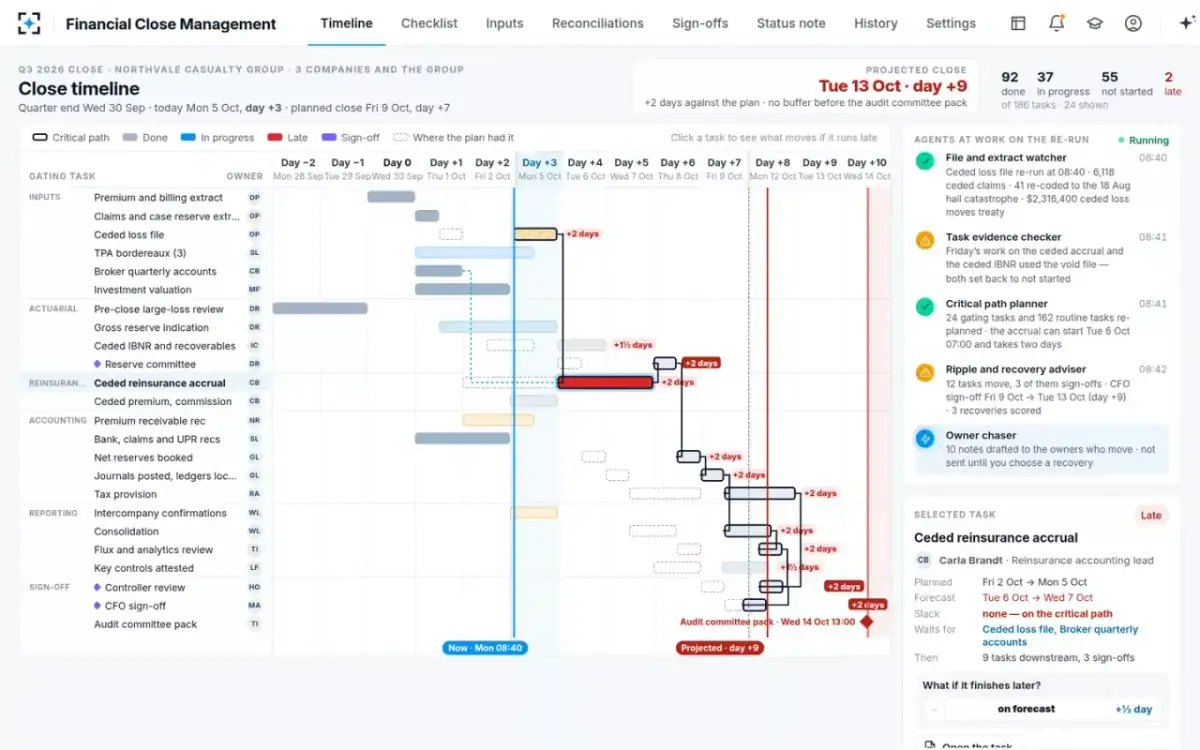
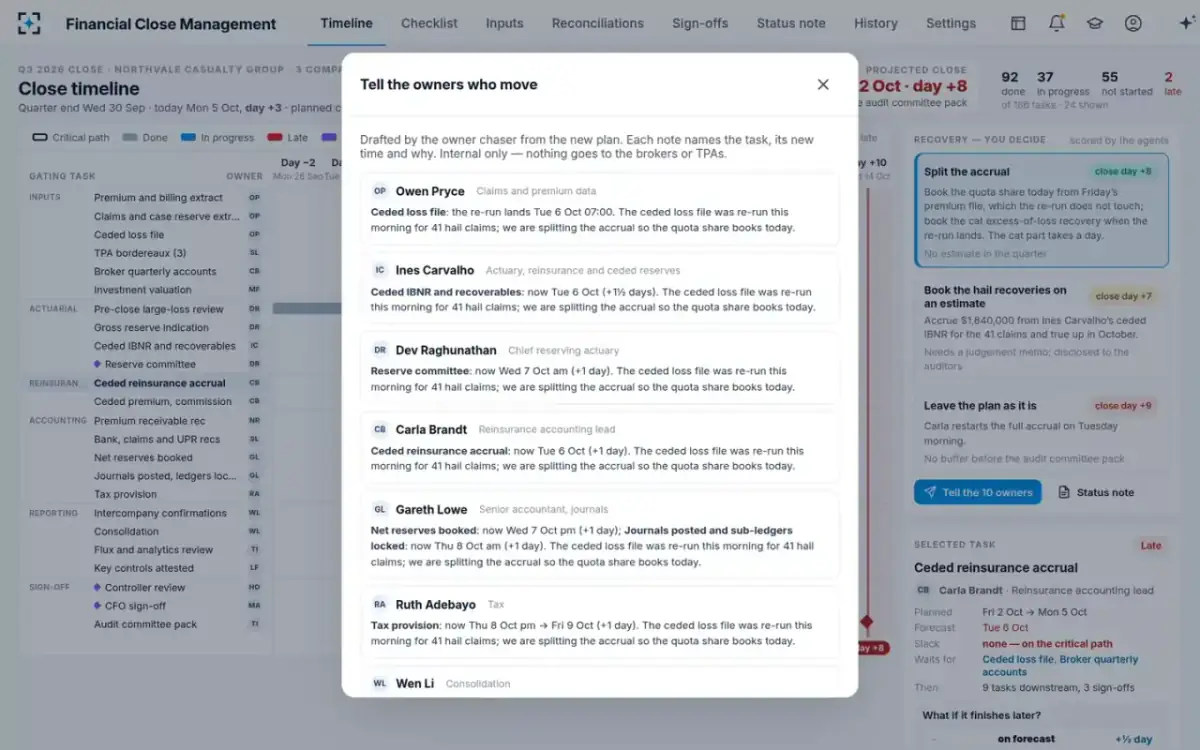
Within two minutes the evidence checker had set Friday's work on the ceded accrual and the ceded IBNR back to not started, the planner had re-planned the 24 tasks that hold up others and the 162 routine ones, and the adviser had named the twelve that move, three of them sign-offs, with the CFO sign-off sliding from Friday 9 October to Tuesday 13 October. It scored three recoveries. The owner chaser drafted ten notes and sent none.
The controller, Hannah Okafor, split the accrual: the quota share booked that day from Friday's premium file, which the re-run did not touch, and the catastrophe treaty's recovery when the re-run landed. The timeline re-planned to Monday 12 October, day +8. In Botminds' estimate for the sample controller's quarter, the days that go on chasing late inputs, confirming tasks are really done, re-planning, telling owners and waiting on inputs found late fall from about seven and a half by hand to about two and a half. That is an estimate for the sample close, not a measurement.
Can AI contact brokers or TPAs during the close?
Only through a person. Messages to a broker, a third-party administrator or a custodian speak for the company and can create obligations or set expectations, so in the solution the owner chaser drafts them for the controller's approval and the controller sends them. The setting has two values, "draft for my approval" and "never"; there is no option for an agent to send. Internal reminders are different: the chaser may send those itself, at most twice a day per person, when a task is at risk.
Ten notes, drafted, internal only
Is AI in the close auditable? What auditors will ask
It can be, if every output an agent produces can be traced to the input it read and every decision to the person who made it. Auditors already have a rule for this kind of material. Under the PCAOB's evidence standard, when an auditor uses information produced by the company, the auditor should "Test the accuracy and completeness of the information, or test the controls over the accuracy and completeness of that information", including where applicable information technology general controls and automated application controls. An agent's status, forecast or list of moved tasks is information produced by the company. If it supports a control, expect it to be tested.
That has practical consequences for what to buy. Every statement an agent makes should cite the task, file or row behind it. The history of each task should show who did what, and when, including each arrival, re-plan, recovery chosen and sign-off. The rules the agents follow, such as "done only on evidence" or the at-risk threshold, should be settings the controller changes, with each change kept as a new version. Those are the properties that let an auditor test the agent like any other automated control, rather than take its word.
Questions to put to any AI financial close software before it touches your close
- What can an agent change without a person?
The answer you want: statuses derived from evidence, forecasts, drafts. Not entries, dates, approvals or outside messages.
- Does every agent statement cite its source?
A task, a file, a row count. A projected close with no trail is a guess with a timestamp.
- Can a tick without evidence mark a task done?
If it can, the software reports what people clicked, not what happened.
- What does it do with a file that fails its control total?
Reject it, and show who is waiting on it. Never accept it quietly.
- How does it treat an estimate booked to save time?
It should require a named approver and a memo, and keep the choice on the task’s history.
- Who can change the rules the agents follow?
The controller, with each change versioned, so last quarter’s close can be read under last quarter’s rules.
- What does it never propose?
Skipping a key control, or a reviewer who is also the preparer.
Where Financial Close Management fits, and where it does not
The solution is a planning and evidence layer over the systems the close already runs on: policy, billing and claims systems, the reinsurance system, TPA bordereaux and broker accounts, the general ledger, custodians and banks, and the reserving models. It reads their arrivals and statuses; it does not replace them, post to them or recalculate their numbers. It does not compute reserves, perform reconciliations or prepare statutory schedules. It watches whether those tasks are done, on evidence, and what their timing does to the close date.
That makes it a fit for a group whose close is long and interdependent, with many inputs from outside parties and an actuarial chain on the critical path, where the controller's time goes on coordination. It is a weaker fit for a single-entity close that is short and runs inside one ERP's task list. For the evaluation criteria a buyer should apply to the software as a whole, rather than to its AI, see financial close management software for insurers.
Questions people ask
What is AI financial close software?
Close software in which agents keep the status of the close true: they read inputs as they arrive, mark tasks done on evidence, recompute the critical path and draft the chasers and status notes. People keep the entries, the estimates, the calendar and the signatures. In an insurer's close the agents' main value is following the chain from claims and ceded files to reserves, journals and sign-off.
Can AI approve journal entries?
It should not. An approval is a control whose value comes from an accountable reviewer who is not the preparer. An agent can check that support exists and ties out, and show what changed, but the approval belongs to a person.
What controls apply to AI in financial reporting?
The same ones that apply to any automated part of the close. If an agent's output supports a control, the auditor will test its accuracy and completeness or the controls around it, as the PCAOB's evidence standard sets out. Every output should therefore cite its source, and every rule the agents follow should be versioned.
Will AI close software contact our brokers or TPAs?
In Financial Close Management, never on its own. Notes to brokers, third-party administrators and custodians are drafted for the controller and sent only by her. Internal reminders go out automatically, at most twice a day per person.
Does AI make the close faster?
It shortens the time between a slip and the people who need to know, which is where much of a close's lost time sits. In the sample close, every moved task was named two minutes after a ceded file was re-run, and the controller's choice of recovery won back one of the two days lost. Gains in your own close depend on how much of it is waiting.