Fast close accounting is the discipline of finishing the period-end close, from the last day of the period to signed financial statements, in fewer working days, by removing waiting, moving work before the period end and running independent tasks in parallel, while keeping every review. For an insurer it is harder than for most companies, because its biggest numbers are estimates that pass through the actuary and a reserve committee, and many of its inputs come from outside parties: third-party administrators, brokers, reinsurers and custodians. There is no public benchmark from a regulator or a research body that says how many days an insurer's close should take, so the honest way to decide whether yours is too slow is to measure it and price it: count the working days to sign-off, find the chain of tasks that sets the date, and put a cost on each extra day. Botminds' Financial Close Management does the counting and the critical path for you. This guide shows the method, using a fictional sample insurance group, Northvale Casualty Group, as the worked example.
Every close figure on this page is sample data on that fictional group, or Botminds' estimate where it says so. Regulatory deadlines come from the SEC, the NAIC and state law, linked where they appear.
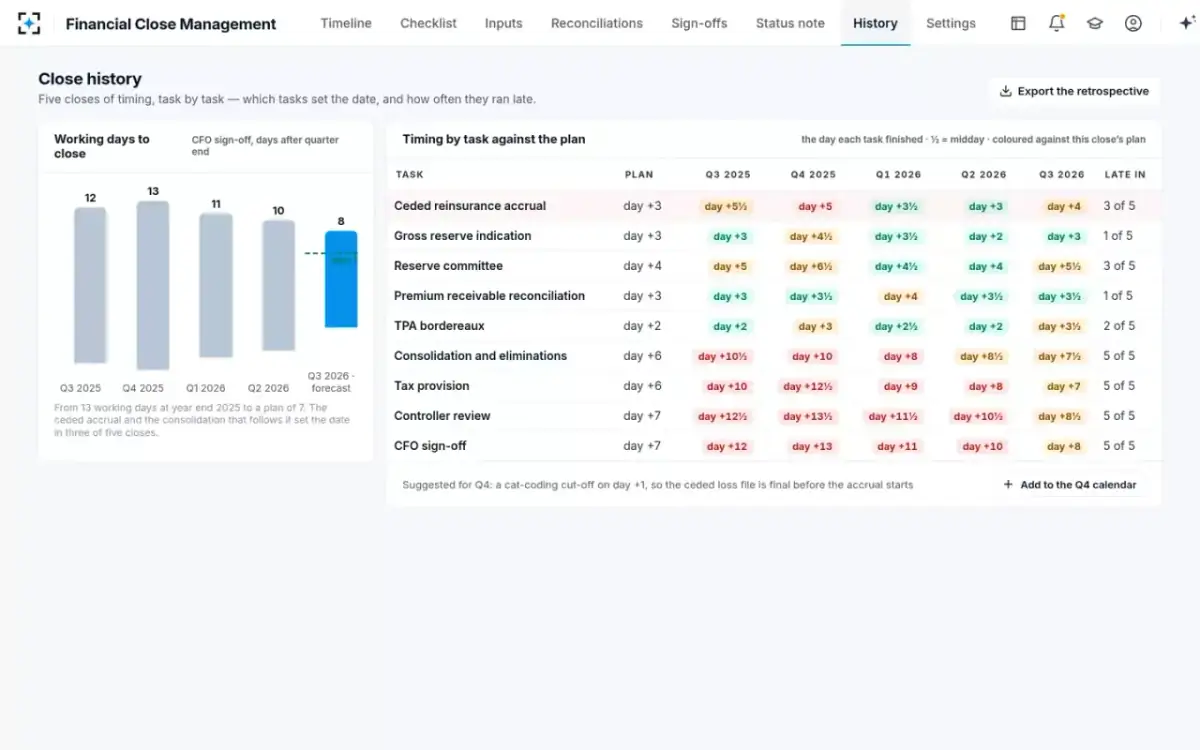
Five closes in the sample group, measured in working days to CFO sign-off
13days
the year-end close for 2025, the longest of the five
10days
the second quarter of 2026
8days
forecast for the third quarter of 2026, against a plan of 7
5 of 5
closes where consolidation finished later than planned
What is fast close accounting?
It is a programme rather than a technique: a set of changes that take days out of the close, measured against the same end point each period. The changes fall into four kinds. Work moves before the period end, such as reviewing large losses or reconciling stable accounts in the last week of the quarter. Waiting is removed, so a task starts the moment its input arrives rather than when someone notices. Tasks that do not depend on each other run in parallel. And rework is cut, so a file that changes after work has started does not restart a chain nobody saw coming.
Speed is never the only goal. A close that is fast because reviews were skipped or estimates rushed is not a fast close but a weak one, and the cost arrives later as corrections. The test of a fast close is that the same evidence and the same sign-offs are in place, in fewer days.
How many days does an insurance close take? The outer limits, and your own number
No regulator or independent study benchmarks insurers' close days, so the number to know is your own; the outer limits are set by filing deadlines. A public insurance group must file its 10-Q within 40 days of quarter-end if it is a large accelerated or accelerated filer, and within 45 days otherwise (Form 10-Q, General Instructions). Its annual 10-K is due 60 days after year-end for a large accelerated filer, 75 days for an accelerated filer and 90 days for others (Form 10-K, General Instructions). Every insurer, public or not, files statutory quarterly statements on or before the 45th day after the first three quarter-ends and the annual statement by 1 March, under state law such as Minnesota § 60A.13.
Those limits are far from the close itself, because the statements, schedules, notes, review and audit committee all sit between the close and the filing. The close's real deadline is the internal date that protects those steps: the audit committee pack, the reserve committee, or the date the statutory team needs the general ledger locked. In the sample group the planned close is day +7 and the audit committee pack is fixed on day +10, which leaves two working days of buffer. The full statutory calendar is laid out in NAIC quarterly statement due dates.
How do you measure close duration?
Count working days from the period end to one fixed end point, and record the same count for each task against its plan. The end point most groups use is the CFO's sign-off on the close, because everything else hangs on it; others use the general ledger lock or the delivery of the reporting pack. Pick one, write it down, and never change it between periods, or the trend will measure the definition rather than the close.
The total alone is not enough. The useful view is timing by task: the day each task finished against the day it was planned, over several closes. That shows which tasks are late often and by how much, and which of them sit on the path that sets the date. In the sample group, five closes of that view show the ceded reinsurance accrual late in three, the reserve committee late in three, and consolidation, tax provision, controller review and CFO sign-off late in all five.
Timing by task against the plan, five closes running
What is the critical path of a close?
The critical path is the longest chain of tasks in which each waits for the one before, from the first input to the final sign-off. Its length is the length of the close. A task on it has no slack: every hour it slips, the close slips. A task off it has slack, and can run late by that much without moving the date. Fast close work that shortens a task with slack saves nothing.
In an insurer's quarter close the critical path usually runs through the reserve chain. In the sample group's plan it runs from the ceded loss file to the ceded reinsurance accrual, then the reserve committee, net reserves booked, journals posted and sub-ledgers locked, consolidation and the tax provision, the flux review, the controller review and the CFO's sign-off. Bank reconciliations, investment valuation and most of the 186 tasks sit beside that chain with slack. The close timeline that runs through the actuary draws the whole chain day by day.
The sample close's critical path, and what one re-run file did to it
- Inputsto day +1
- Ceded accrualday +2 to +3
- Committeeday +4
- Journals to sign-offto day +7
- Waiting for the re-runlands day +4
- Ceded accrual restartsday +4 to +5
- Committeeday +6
- Journals to sign-offto day +9
- Inputsto day +1
- Ceded accrual, split in twoday +2 to +4
- Committeeday +5
- Journals to sign-offto day +8
What slows down an insurer's close?
Mostly waiting, and mostly at the joins between teams. An insurer's close passes work from claims and policy systems to the actuary, from the reinsurance system to reinsurance accounting, from the actuary to the reserve committee, from the committee to the accountants, and from three or four legal entities to consolidation. Each join is a place where an input can be late, re-run or wrong, and where nobody downstream knows until they go looking for it.
The sample group's history shows the pattern. The tasks that are late most often are not the ones that take longest; they are the ones at the end of a chain, which inherit every slip before them. Consolidation, tax, the controller review and the CFO sign-off were late in all five closes. The ceded accrual and the reserve committee, the two links where outside data and an estimate meet, were late in three.
How often each task finished later than planned, five closes
That is why the problem is usually found late. The calendar lives in a checklist and email, status is right only when someone updates it, and the dependencies live in people's heads. When a file that feeds the critical path is re-run, the person whose task moves learns it when they ask where their input is. By then the slack is gone. Fast close work that does not fix that visibility will save a day in one quarter and lose it in the next.
What does a late close cost? Pricing each extra day
Price a day of close by what it costs in people's time, by what it takes away from the review, and by what it risks at the filing; then decide how many days are worth buying back. None of those terms has a published industry value, so each has to come from your own payroll, calendar and audit history. The formula below is a method, not a benchmark.
The cost of one extra day on the critical path
People held on the close
people still on close work × loaded day rate
Count the owners of tasks after the slip who cannot move to other work. In the sample, one two-day slip moved 12 tasks owned by 10 people.
Controller, with payroll
Coordination time
controller days chasing, confirming and re-planning × day rate
Botminds’ estimate for the sample controller: about 7.5 days a quarter by hand, about 2.5 with agents. Measure your own for one quarter.
Controller
Review compressed
days taken from review and audit committee preparation
A day lost before the audit committee pack comes out of the review, not the deadline. Price it as the risk of a correction found later.
CFO and audit committee
Correction after filing
probability × cost of explaining it
A change found after the annual statement is filed has to be reconciled, with a written description, in the audited report.
Controller and auditor
The last term is the one most often left out. The Model Audit Rule requires the notes to the audited statutory statements to include "a reconciliation of differences, if any, between the audited statutory financial statements and the annual statement filed", with a written description of each difference. A year-end close that was fast because a review was cut does not avoid the work; it moves it to April and puts it in front of the commissioner.
In the sample close the choice was explicit. Three recoveries were scored when the ceded file was re-run. Booking the hail recoveries on the actuary's ceded IBNR estimate would have held the close at day +7 but needed a judgement memo signed by the controller and the CFO and a disclosure to the auditors. Splitting the accrual brought it to day +8 with no estimate in the quarter. Leaving the plan meant day +9 and no buffer before the audit committee pack. The controller bought back one day of the two at no cost to the review, and declined the second, whose price was an estimate in the quarter with a memo and a disclosure.
Can the reserve committee be moved earlier?
Partly, by moving the work that feeds it before the quarter end rather than by meeting earlier on the same inputs. Three levers do most of it. A pre-close review of large losses in the last days of the quarter means the committee is not seeing them for the first time. A roll-forward approach lets most of the actuarial analysis run on data from before the quarter end, with the final weeks added afterwards, which is how much year-end reserve work is already done; how the close books that rolled-forward number is covered in IBNR accrual meaning. And a cut-off for late changes, such as catastrophe coding, keeps the inputs stable once the analysis has started.
The sample group's retrospective proposes exactly that last lever for the fourth quarter: a catastrophe-coding cut-off on day +1, so that the ceded loss file is final before the accrual starts. In three of the last five closes, the late re-coding of catastrophe claims was what restarted the ceded accrual. A cut-off does not make anyone faster. It stops the same day from being lost again.
What is a continuous close, and how far can an insurer take it?
A continuous close spreads close work through the period, reconciling, accruing and reviewing as transactions happen, so that the period end has less left to do. Insurers can take it a long way for the mechanical work: bank and cash, premium receivable, claims payable, and the arrival and checking of inputs can all run daily. They cannot take it all the way, because the largest estimates are made at the period end on period-end data, and reinsurance and pooling balances settle on their own quarterly cycles.
The practical version for an insurer is a continuous watch rather than a continuous close: every input logged on arrival, every task's status kept true from its evidence, the projected close recomputed each time anything changes. That is what lets a late input be seen the day it slips, not the day it blocks; the solution's design target is that a late input is seen five days sooner than by hand. It is a target, not a measured result.
Fast close levers for an insurer, in the order to try them
- Measure working days to one fixed end point
CFO sign-off is the usual choice. Record timing by task against plan for at least four closes.
- Find the critical path from the history
The tasks late most often at the end of the chain point back to the one that sets the date.
- Remove waiting before shortening work
Log every input on arrival and start each task when its input lands, not when someone notices.
- Set cut-offs for inputs that change late
Catastrophe coding, large-loss updates, administrators’ bordereaux: a fixed day after which changes wait for next quarter or follow a named exception route.
- Move the reserve review before the quarter end
Pre-close large-loss review and a roll-forward of the analysis, with the changes after the cut-off documented.
- Split tasks that mix stable and unstable inputs
In the sample close, the quota share booked from Friday’s file while the catastrophe treaty waited for the re-run.
- Price any estimate used to save a day
A memo, a named approver and a disclosure. If the price is too high, take the day.
Questions people ask
What is fast close accounting?
Finishing the period-end close in fewer working days without weakening the review, by moving work before the period end, removing waiting between teams, running independent tasks in parallel and cutting rework. For an insurer the reserve chain and outside inputs usually decide how far it can go.
How many days does an insurance close take?
No regulator or research body publishes a benchmark, so measure your own: working days from period end to CFO sign-off, by task, over several closes. The outer limits are the filing deadlines, such as 40 or 45 days for a 10-Q and 45 days for statutory quarterly statements.
What is the critical path of a close?
The longest chain of tasks in which each waits for the one before. Its length is the length of the close, and a task on it has no slack. In an insurer's close it usually runs through the ceded accrual, the reserve committee, net reserves, journals, consolidation and the sign-offs.
What does a late close cost?
People held on close work, the controller's coordination time, review time taken from the audit committee pack, and the risk of a correction found after filing. A change found after the annual statement is filed has to be reconciled, with a written description, in the audited statutory report.
Can the reserve committee be moved earlier?
Partly. Review large losses before the quarter end, run most of the analysis on data rolled forward from before it, and set cut-offs for late changes such as catastrophe coding. The committee can then meet earlier without seeing new inputs for the first time.
What is a continuous close?
Close work spread through the period so that less is left for the period end. Insurers can run reconciliations and input checks continuously, but reserves and reinsurance balances are still set at the period end, so the realistic aim is a continuous watch on the close rather than a fully continuous close.