An IFRS 17 analysis of change, also called an analysis of movement, explains why an insurer's IFRS 17 balances moved between two reporting dates by splitting the movement into causes: new business, interest accretion, the release of the contractual service margin and the risk adjustment for services given, experience variances, changes in assumptions, changes in discount rates and cash flows. The standard does not use the phrase, but it requires the substance: reconciliations from opening to closing balances that show separately the changes relating to future, current and past service and the amounts not related to service. The hard part is not producing the table but explaining it, which is where Botminds' Statutory, GAAP & IFRS 17 Reconciliation works: its agents read the movement analysis, link each material step to the assumption memo or event behind it, and draft one plain sentence per step for the valuation actuary and the CFO to approve.
The sample figures come from a fictional life and annuity insurer as its third quarter of 2026 runs through the solution; the requirements are quoted from IFRS 17 as published by the IFRS Foundation.
What is an IFRS 17 analysis of change?
It is the attribution of a period's movement in the IFRS 17 measurement to its causes, and IFRS 17 prescribes the categories it must reach. Paragraph 104 requires the reconciliations of the estimates of future cash flows, the risk adjustment and the contractual service margin to show separately "changes that relate to future service", "changes that relate to current service" and "changes that relate to past service", and paragraph 105 adds the amounts "not related to services provided in the period": cash flows, the effect of changes in the risk of non-performance by reinsurers, and insurance finance income or expenses (IFRS 17, paragraphs 104 and 105).
Actuaries usually build the analysis in a fixed order of steps, changing one input at a time and measuring the change in each component, so that the steps add up exactly from opening to closing. The order is a modelling choice; the totals are not. Whatever the order, the analysis has to land in the standard's categories, because those are the lines the reconciliations disclose.
The sample quarter's CSM movement: what moved, and what explains it
What moved the margin (share of gross movement, $139.1m)
- Release for services · 56%
- Changes in estimates · 18%
- New business · 17%
- Interest at locked-in rates · 9%
Where the explanation comes from
- Coverage-unit plan · 54%
- Assumption memos, incl. release above plan · 20%
- Sales in the open cohort · 17%
- Locked-in rates · 9%
The second bar is the useful one. More than half of the gross movement is explained before the quarter starts, by the coverage-unit plan; most of the rest is explained by two kinds of document, the assumption memos and the sales figures. The only part that needed new evidence this quarter was the $2.9 million released above plan, and it traces to the same lapse memo as the change in estimates: faster surrenders in one cohort brought earning forward.
What are the steps in an IFRS 17 analysis of movement?
The steps follow the standard's categories, and each can be explained in one sentence if the evidence is at hand. The table gives each step, where IFRS 17 puts it, a sentence of the kind a CFO can repeat, and the evidence that keeps the sentence true.
Each step of the analysis, as a sentence and the evidence behind it
| Step | Where IFRS 17 puts it | One sentence (sample quarter) | Evidence |
|---|---|---|---|
| New business | ¶104(a)(iii), effects of contracts initially recognised; ¶107 | Third-quarter sales added $24.3 million of future profit to the 2026 cohort. | Engine output for the open cohort; sales report |
| Interest accretion | ¶44(b), at the rates locked in at recognition (¶B72(b)) | Interest added $12.0 million at each cohort's locked-in rate. | Rates by cohort; opening balances |
| Changes in estimates | ¶104(a)(i), changes that adjust the margin | A lapse study cut the 2023 cohort's future profit by $22.6 million; the change goes through the margin, not this quarter's profit. | Assumption memo; approved cohort note |
| Release for services | ¶104(b)(i), margin recognised for the transfer of services | The quarter earned $77.6 million against $74.7 million planned, mostly because surrenders brought earning forward in one cohort. | Coverage units by cohort; release plan |
| Risk adjustment release | ¶104(b)(ii) | The margin for risk released with the service given, as expected. | Risk adjustment roll-forward |
| Experience variance | ¶104(b)(iii), experience adjustments | Claims and expenses in the quarter differed from expectation by an amount that goes straight to profit. | Actual against expected cash flows |
| Finance effects | ¶105(c), insurance finance income or expenses | Interest-rate movements changed the liabilities, and the effect sits in finance results, not in the insurance service result. | Discount rate curves; the insurer's choice between profit or loss and other comprehensive income |
Two rules make the sentences reliable. Every figure in a sentence links to the step and the source row it came from, so the sentence can be checked by someone who did not write it; and every causal claim, such as "a lapse study cut future profit", links to the document that establishes the cause. A sentence that cannot meet both rules should not be in the commentary. The roll forward of the margin itself, cohort by cohort, is worked in the IFRS 17 CSM roll forward.
What is the difference between an analysis of change and a roll forward?
A roll forward shows how a balance got from opening to closing; an analysis of change says why. The two share totals, and in IFRS 17 the roll forward is defined by paragraph 44 for the margin and by paragraphs 100 and 101 for the disclosed reconciliations, but a roll forward can be complete and still uninformative: "changes in estimates, minus $25.2 million" is a correct line that answers nothing. The analysis attributes that line to its causes, here one lapse study on one product in one cohort, and to the cohorts and portfolios where it landed.
That distinction is where most quarter-end effort goes. The roll forward is produced by the engine; the attribution has to be assembled from the engine's steps, the assumption memos, sales and claims reports and the treaty files, then written down in words that do not require the reader to know the model.
Why are IFRS 17 results hard to explain?
IFRS 17 results are hard to explain because the standard separates two kinds of profit and routes changes between them by rules that are invisible in the totals. The IASB's project summary describes the split: "the insurance service result, which depicts the profit earned from providing insurance coverage", and "the financial result", which captures investment income and "insurance finance expenses from insurance obligations" (IASB, IFRS 17 Project Summary). A change in an assumption about future lapses moves the margin and affects profit only gradually; the same size of change in discount rates moves finance results at once.
The IASB amended the standard in June 2020 partly to address this, listing among the amendments' aims to "make financial performance easier to explain" (IASB, June 2020). European enforcers' review of 16 insurers' first-year reports suggests explanation remained the weak point, especially for accounting policies, judgements and estimates, where disclosures were often generic (ESMA, 2024).
ESMA expects issuers, their auditors and audit committees to consider the findings of this report when preparing and auditing the financial statements.
ESMA, From black box to open book? (2024)
How do you explain IFRS 17 results to a board?
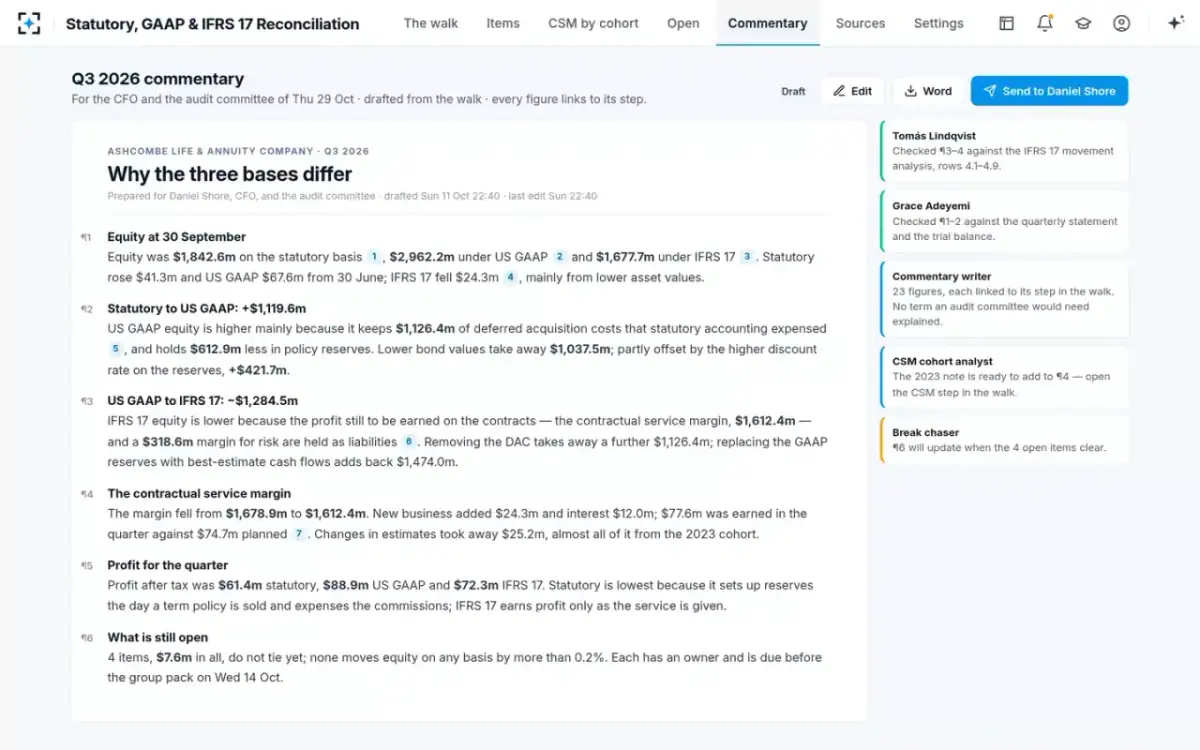
Explain IFRS 17 results to a board as a short sequence of claims, each with a number and a cause, in the order the board will ask: where equity stands on each basis, why the bases differ, what moved the margin, what profit was, and what is still open. The sample insurer's commentary does it in six paragraphs, with 23 figures, each linked to its step in the walk.
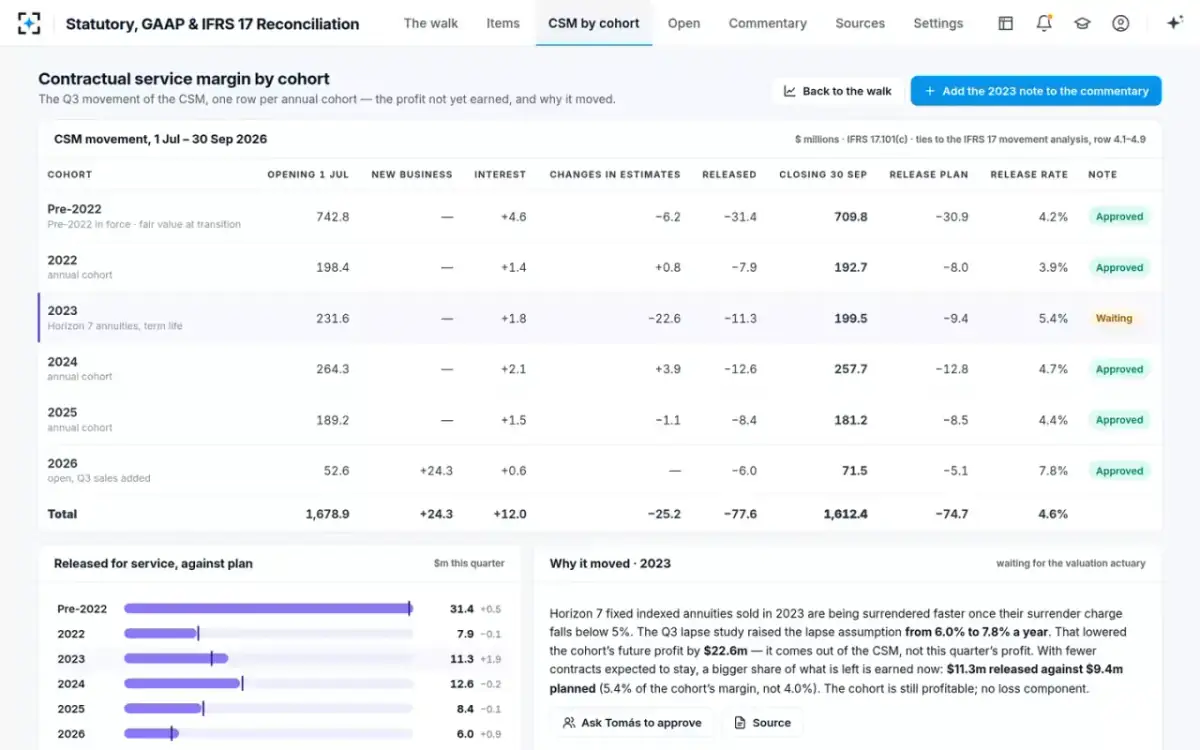
Its fourth paragraph is the analysis of change, compressed: the margin fell from $1,678.9 million to $1,612.4 million; new business added $24.3 million and interest $12.0 million; $77.6 million was earned against $74.7 million planned; changes in estimates took away $25.2 million, almost all of it from the 2023 cohort. A board member can repeat each clause, and an auditor can trace each figure.
Six paragraphs for the CFO and audit committee, every figure linked to its step
Who writes IFRS 17 commentary, and who checks it?
The reporting team usually owns the commentary and the valuation actuary owns the explanations of the measurement; the CFO approves what goes to the audit committee. The actuarial profession's standard for communications sets a useful bar for the actuary's part: findings and methods should be stated clearly enough for another actuary in the same practice area to judge, from the report alone, whether the work was reasonable (ASOP No. 41; the test is set out in ASOP 41 summary). A commentary sentence that a second actuary cannot check against its source does not meet that bar.
From a movement in the engine to a sentence the CFO approves
Agent
Read the movement analysisEvery row of the IFRS 17 movement analysis, tied to its total and to last quarter's closing balance.
Agent
Attribute each material stepLink each step above materiality to its cause: an assumption memo, a sales report, a treaty change or a rate curve.
Never: invents a cause the documents do not support
Agent
Draft one sentence per stepPlain words, no model terms, every figure linked to the step and source row it came from.
A person decides
The valuation actuary approves each cohort noteConfirms the cause and the classification of each change in estimates.
Agent
Assemble the commentaryEquity on each basis, the walks between them, the margin, profit and what is still open.
Never: sends the commentary
A person decides
The CFO approves for the audit committeeReads a draft whose every figure can be traced, with reviewers' checks in the margin.
How do you check IFRS 17 commentary against the numbers?
Check it the way an auditor would: every figure against its source, every total against the sum of its parts, every causal claim against its document, and every sentence against last quarter's version of it. The last check catches the most common error, a sentence copied forward that was true last quarter. In the sample, the margin notes show that the valuation actuary checked the margin paragraphs against the movement-analysis rows and the group accountant checked the equity paragraphs against the quarterly statement and the trial balance.
Arithmetic deserves its own pass. A commentary paragraph that names some steps of a movement should never imply that those steps add to the total. The sample's paragraph on GAAP to IFRS 17 names the margin, the risk adjustment, the deferred acquisition costs removed and the fulfilment cash flows added; the walk has two more steps, IFRS 9 effects on assets and deferred tax, which is why the paragraph gives the total separately rather than as a sum of the parts it names.
The CSM movement table the margin paragraph is written from
Keeping the sentence true when a number moves
Quarter-end numbers move after the first draft: a file is re-posted, a top-side entry is corrected, an open item clears. The commentary has to move with them, or it becomes the most persuasive wrong document in the pack. In the solution a re-posted file re-runs the walk and shows which steps changed, and each sentence that depends on a changed step is redrafted and returned for approval; the paragraph on open items updates as they clear.
The same discipline applies across bases. For a US subsidiary, the analysis of change in IFRS 17 sits beside a statutory reserve movement and a GAAP roll-forward that describe the same contracts; a lapse study that cuts the IFRS 17 margin also moves the GAAP liability and the statutory reserve, in different amounts and on different lines. One approved explanation of the cause, reused in each basis's commentary, is better than three explanations written separately. IFRS 17 automation covers which of these tasks agents take and which stay with people.
Questions people ask
Does IFRS 17 require an analysis of change?
Not by that name. It requires reconciliations from opening to closing balances that show separately changes relating to future, current and past service and amounts not related to service, under paragraphs 100 to 105. An analysis of change is how actuaries produce and explain those lines.
What is an experience adjustment in IFRS 17?
It is the difference between the cash flows expected for the period and those that actually occurred, such as claims paid. Experience adjustments relating to current or past service go to profit or loss and are disclosed under paragraph 104(b)(iii); in the IASB's Example 2A, claims of 150 against 200 expected produced a variance of 50 that did not touch the margin.
What is insurance finance income or expense?
It is the change in the carrying amount of insurance contracts arising from the time value of money and financial risk, under paragraph 87: "the effect of the time value of money and changes in the time value of money" and the effect of financial risk. Insurers choose, portfolio by portfolio, whether to present it all in profit or loss or partly in other comprehensive income.
How many steps does an IFRS 17 analysis of change have?
There is no fixed number; the standard fixes the categories, not the steps. Most analyses separate at least new business, interest accretion, release for services, experience variances, changes in non-financial assumptions, changes in financial assumptions and cash flows, and some split assumptions further by type or by study.
Why did the CSM release exceed plan when the CSM fell?
Because the release is set by coverage units. When an assumption change reduces the services expected in future, a larger share of the remaining margin belongs to the current period. In the sample, the 2023 cohort lost $22.6 million of margin to higher lapses yet released $11.3 million against $9.4 million planned.