An IFRS 17 CSM roll forward is the movement of a group's contractual service margin, the profit not yet earned, from the start of the reporting period to the end. For contracts without direct participation features, paragraph 44 of IFRS 17 fixes its steps: the opening balance, plus new contracts added to the group, plus interest accreted at the rate locked in when the group was recognised, plus or minus changes in fulfilment cash flows that relate to future service, less the amount released to insurance revenue for the services given in the period. The arithmetic is simple; the difficulty is that the same margin then appears in four more places, the reconciliation table, insurance revenue, the time-band disclosure and the commentary, and each must agree with the others. Botminds' Statutory, GAAP & IFRS 17 Reconciliation rolls the margin forward by annual cohort, ties it to each of those places and drafts the explanation for the valuation actuary to approve.
The sample figures come from a fictional life and annuity insurer as its third quarter of 2026 runs through the solution; the worked example is the IASB's own, from the Illustrative Examples published with IFRS 17.
What is a CSM roll forward?
A CSM roll forward is the reconciliation of the contractual service margin from opening to closing balance for a group of insurance contracts, and IFRS 17 requires both the calculation and its disclosure. The margin itself is defined in paragraph 43: "The contractual service margin at the end of the reporting period represents the profit in the group of insurance contracts that has not yet been recognised in profit or loss because it relates to the future service to be provided under the contracts in the group" (IFRS 17, paragraph 43).
Paragraph 44 then gives the roll forward as a formula. For a group of contracts without direct participation features, "the carrying amount of the contractual service margin of a group of contracts at the end of the reporting period equals the carrying amount at the start of the reporting period adjusted for" five items: new contracts, interest, changes relating to future service, currency differences and the release for services. Contracts with direct participation features follow paragraph 45, the variable fee approach, where the insurer's share of the underlying items replaces locked-in interest and "An entity is not required to identify these adjustments separately."
One margin, five places: where a correct number gets mis-explained
The roll forward is the first of five places the same margin appears, and most quarter-end errors in the CSM are not calculation errors but mismatches between those places. A release that is right in the engine can still be wrong in the reconciliation table if a cohort was regrouped, wrong in insurance revenue if a reinsurance group was netted, and wrong in the commentary if last quarter's sentence was copied forward.
One cohort's CSM release, from the engine to the audit committee
Agent
The cohort row in the engine outputOpening, new business, interest, changes in estimates, release and closing for one annual cohort. Opening must equal last quarter's signed close, to the cent.
Never: accepts an opening that differs from the prior close
Agent
The paragraph 44 roll forwardOpening + new contracts + interest at the locked-in rate ± changes for future service − release = closing, recomputed and compared with the engine.
Agent
The paragraph 101(c) reconciliation tableThe cohort rows aggregated to the portfolios disclosed, with the release shown separately under paragraph 104(b)(i) and the closing equal to the balance sheet.
Agent
Insurance revenue and the time bandsThe release appears again in the analysis of insurance revenue (paragraph 106) and the remaining margin in the paragraph 109 table of when it will be earned.
A person decides
The commentary, approved by the valuation actuary and the CFOOne plain sentence per material movement, every figure linked to the step it came from.
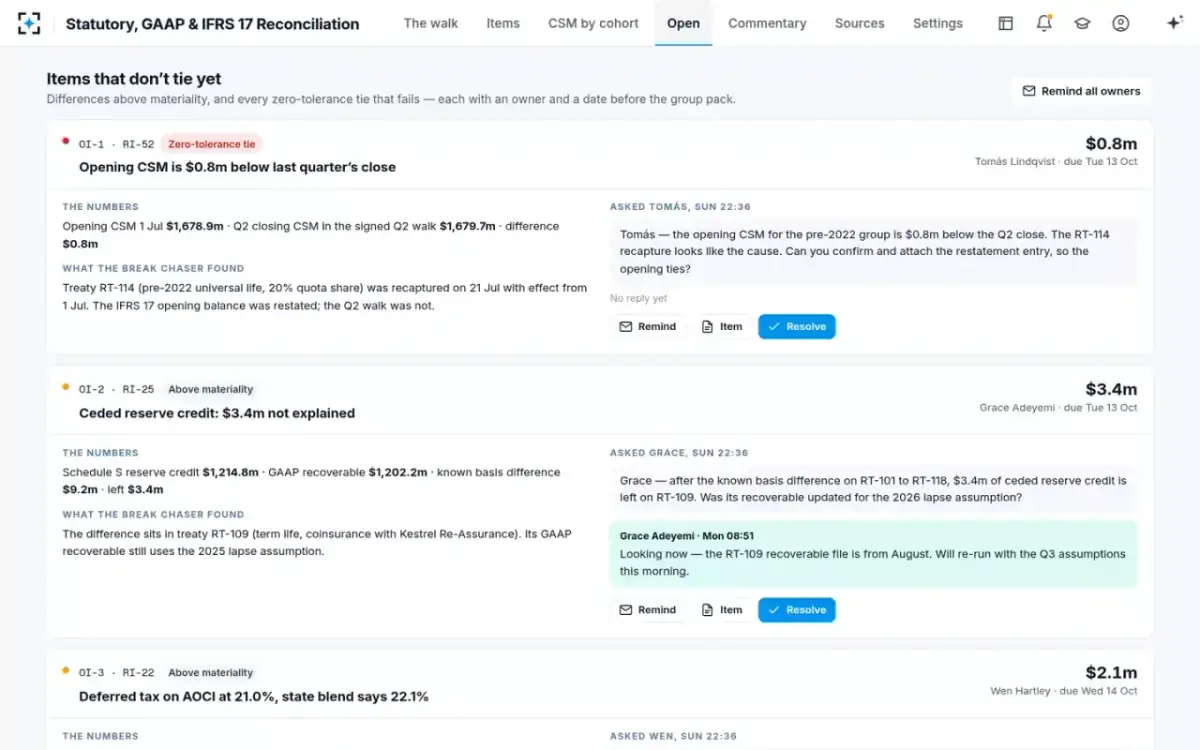
The first box carries the most weight. If the opening balance is wrong, every later place is wrong in the same way and will still agree with the others, which is why the opening tie is zero-tolerance in the solution rather than a matter of materiality. In the sample quarter it failed: the opening margin of $1,678.9 million was $0.8 million below the $1,679.7 million closing figure in the signed second-quarter walk, and the difference stayed open, with the valuation actuary named as its owner, until it was explained.
What are the steps in a CSM roll forward?
There are five steps for a group without direct participation features, each set by a sub-paragraph of paragraph 44, and each has its own driver and its own evidence. The table puts the standard's words beside what moves each step and the sample insurer's third-quarter total.
The five steps of a CSM roll forward, with the sample quarter's totals
| Step (IFRS 17 ¶44) | What the standard says | What drives it | Sample Q3 2026, $m |
|---|---|---|---|
| Opening balance | The carrying amount at the start of the reporting period | Last period's signed closing balance, by group | 1,678.9 |
| (a) New contracts | "the effect of any new contracts added to the group" | Contracts written in the period into the open annual cohort | +24.3 |
| (b) Interest accreted | "interest accreted on the carrying amount of the contractual service margin during the reporting period" | The discount rate locked in when the group was first recognised (¶B72(b)) | +12.0 |
| (c) Changes for future service | "the changes in fulfilment cash flows relating to future service" | Assumption changes such as lapse, mortality and expense, measured at the locked-in rate (¶B96) | −25.2 |
| (d) Currency | "the effect of any currency exchange differences" | Groups in a currency other than the functional currency | none |
| (e) Release | "the amount recognised as insurance revenue because of the transfer of insurance contract services in the period" | Coverage units provided in the period against those still to come (¶B119) | −77.6 |
| Closing balance | The carrying amount at the end of the reporting period | Must equal the balance sheet and the disclosure tables | 1,612.4 |
Two limits sit inside step (c). An unfavourable change larger than the remaining margin does not take the margin below zero: the excess is a loss in profit or loss, under paragraph 44(c)(i), and the group becomes onerous. And not every change in fulfilment cash flows is a change for future service: paragraph B97 excludes the effect of the time value of money and financial risk, which goes to insurance finance income or expenses instead. Getting that line wrong moves profit between periods without changing a single cash flow.
The IASB's own CSM roll forward, year by year
The clearest worked roll forward is the IASB's. In Illustrative Example 2A, a group of 100 three-year contracts is recognised with fulfilment cash flows of minus 235 currency units, so the margin at initial recognition is 235; a favourable change in year 2 then raises it (IFRS 17 Illustrative Examples, Examples 1A and 2A).
The IASB's example: a margin of 235 accreted, adjusted and released over three years
| Year | Opening | New contracts | Interest at 5% | Change for future service | Release | Closing |
|---|---|---|---|---|---|---|
| Year 1 | – | 235 | 12 | – | (82) | 165 |
| Year 2 | 165 | – | 8 | 68 | (121) | 120 |
| Year 3 | 120 | – | 6 | – | (126) | – |
Three details in the example are worth copying into any quarter's checks. Interest is accreted on the opening balance at the rate set at initial recognition: "the entity calculates interest accreted on the carrying amount of the contractual service margin of CU12 by multiplying the opening balance of CU235 by the discount rate of 5 per cent." The favourable change in year 2 goes to the margin, not to profit, because it relates to future coverage. And the experience variance in year 2, claims of 150 against 200 expected, does not touch the margin at all: under paragraph B97(c) it relates to current service and goes straight to profit or loss.
How is the CSM accreted?
The CSM is accreted with interest at the discount rate locked in when the group was first recognised, not at the current rate. Paragraph B72(b) specifies the rate "to determine the interest to accrete on the contractual service margin" as the "discount rates determined at the date of initial recognition of a group of contracts" (IFRS 17, paragraph B72). That is why each annual cohort carries its own rate and why accretion cannot be checked at portfolio level without knowing the cohort mix.
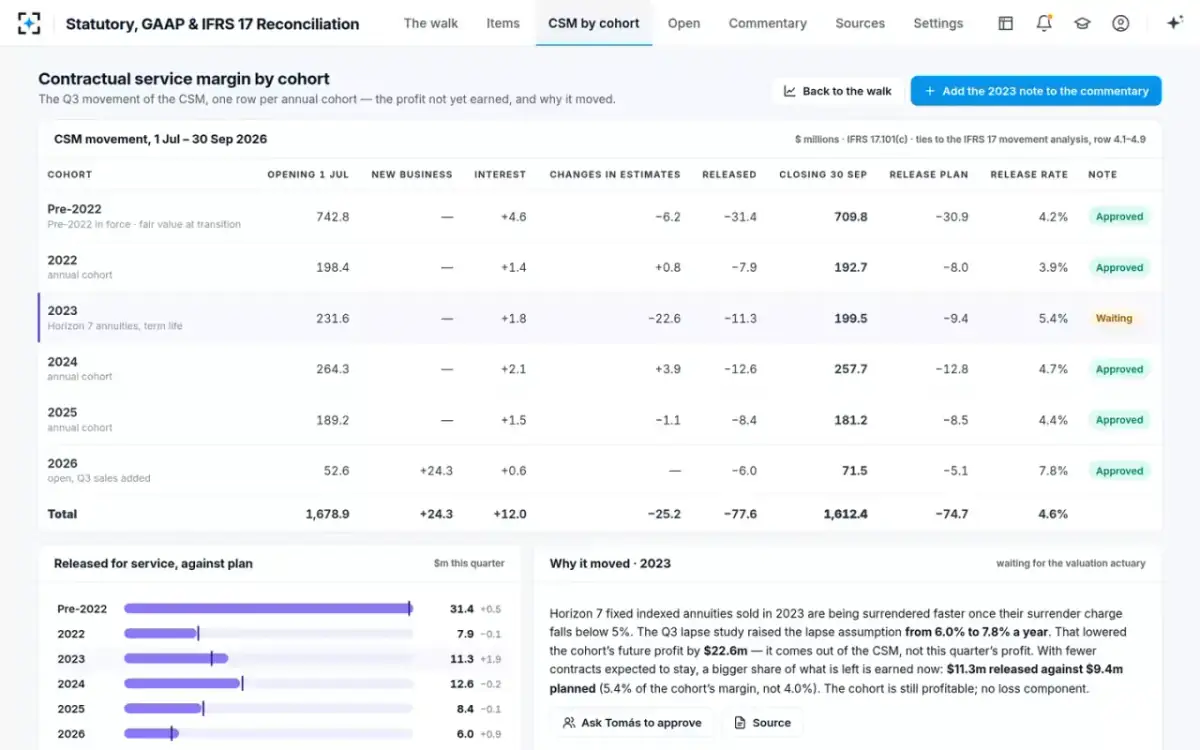
In the sample quarter, interest added $12.0 million to an opening margin of $1,678.9 million, about 0.7% for the quarter. The cohort detail explains the spread: the pre-2022 transition group accreted $4.6 million on $742.8 million, while the 2026 cohort, opened during the year, accreted $0.6 million on $52.6 million. A cohort whose accretion looks out of line with its locked-in rate is the first sign that either the rate or the opening balance is wrong.
What causes the CSM to change?
Outside new business, interest and release, the CSM changes when estimates of future cash flows or the risk adjustment change for reasons that relate to future service. Paragraph B96 lists them: premium experience that relates to future service, changes in estimates of the present value of future cash flows in the liability for remaining coverage, differences in investment components, and "changes in the risk adjustment for non-financial risk that relate to future service" (IFRS 17, paragraph B96).
In practice the driver is almost always an assumption study. In the sample quarter, changes in estimates took $25.2 million from the margin, and $22.6 million of it came from one cohort: the 2023 annual cohort of fixed indexed annuities and term life, after a lapse study raised the lapse assumption on one annuity product from 6.0% to 7.8% a year. The 2024 cohort moved the other way, up $3.9 million, on better term-life mortality. The paragraph 104(a)(i) line will show minus $25.2 million; the audit committee will want to know that it is one product and one study.
The CSM roll forward by annual cohort, with release against plan
What is CSM release, and why can it beat the plan?
CSM release is the part of the margin recognised in insurance revenue for the services given in the period, and it is set by coverage units. Paragraph B119 requires the insurer to identify the coverage units in the group, allocate the margin at the end of the period "equally to each coverage unit provided in the current period and expected to be provided in the future", and recognise in profit or loss the amount allocated to the units provided in the period (IFRS 17, paragraph B119).
That allocation explains a result that surprises boards: when an assumption change cuts the expected number of future coverage units, the release in the current period can rise even as the margin falls. The sample 2023 cohort lost $22.6 million of margin to higher lapses, yet released $11.3 million against $9.4 million planned, 5.4% of its margin rather than 4.0%, because with fewer contracts expected to stay, a larger share of what remains belongs to the current quarter.
Released for service in Q3 2026, by cohort: most on plan, one well above
European enforcers found coverage units to be one of the least explained judgements in first-year reports. ESMA's review of 16 insurers found that "75% of issuers provided some explanations (with varying level of details) of how coverage units are determined per contract/contract type", but only 38% explained how coverage periods are determined, and "Only 19% of issuers specified how they considered the bow wave effect" (ESMA, 2024).
How do auditors test a CSM roll forward?
Auditors test a CSM roll forward by re-performing its ties and challenging its judgements. The ties are mechanical and can be run on every cohort every quarter; the judgements, such as coverage units and the future-service classification, need evidence. A team that runs the five checks below before the auditors arrive has already answered most of the questions they will ask.
Five ties to run on every cohort before anyone reads the commentary
- Opening equals last period's signed close, by cohort, to the cent
A restatement of a prior period must be explained here, not absorbed into a movement.
- Interest equals opening balance times the cohort's locked-in rate
Paragraph B72(b). A cohort with an odd accretion has a wrong rate or a wrong opening.
- Each change in estimates links to an assumption memo, and its classification is approved
Paragraph B96 against B97: future service adjusts the margin; financial effects and experience do not.
- Release follows the coverage units, and any gap to plan has a reason
Paragraph B119. A release above plan with a falling margin is often right, but should be explained.
- Closing equals the balance sheet, the ¶101(c) table, revenue and the ¶109 time bands
Five places, one number. Differences here are presentation errors that a reader will find.
Transition groups need extra care, because their opening margins were set by a modified retrospective or fair value approach and must be shown separately. ESMA found that "54% of issuers that applied MRA disclosed the CSM-reconciliation applying paragraph 101(c) of IFRS 17 separately for insurance contracts that existed at the transition date", and half of those using the fair value approach did so. In the solution the transition group is held apart from the annual cohorts by default, so its reconciliation is never mixed into theirs. How the same movements are explained step by step is the subject of the IFRS 17 analysis of change.
The opening tie that failed, held open with its owner
A reader who wants to see where the CSM sits in the bigger picture, the walk from US GAAP equity to IFRS 17 equity, will find it in stat to GAAP adjustments, line by line, which continues from GAAP to IFRS 17 for the same sample insurer.
Questions people ask
What is an IFRS 17 annual cohort?
A group of contracts issued no more than a year apart. Paragraph 22 says an entity "shall not include contracts issued more than one year apart in the same group", so each year's new business gets its own margin, its own locked-in rate and its own roll forward. The IASB's reason was timeliness: without the requirement, profit from more profitable older contracts would be averaged with newer, less profitable ones and recognised over a longer period.
Can the CSM be negative?
No. If unfavourable changes exceed the remaining margin, the margin goes to zero and the excess is recognised as a loss in profit or loss, creating a loss component for the onerous group. Later favourable changes reverse that loss component first, under paragraph 50(b), before the margin is rebuilt.
How is new business CSM measured?
At initial recognition the margin is set so that no gain arises: paragraph 38 measures it at the amount that results in no income or expenses from recognising the fulfilment cash flows. In the IASB's Example 1A, premiums with a present value of 900, outflows of 545 and a risk adjustment of 120 give a margin of 235.
What is the difference between the CSM and the risk adjustment?
The risk adjustment is the compensation the insurer requires for bearing uncertainty about non-financial risk, and it is part of the fulfilment cash flows; the CSM is the unearned profit left over. The IASB's project summary describes the CSM as "the expected profit for providing future insurance coverage (ie unearned profit)". In the sample walk from GAAP to IFRS 17 equity, the margin removes $1,612.4 million and the risk adjustment $318.6 million.
Where is the CSM disclosed?
In the notes: the paragraph 101(c) reconciliation from opening to closing balance, the release within the analysis of insurance revenue under paragraph 106, the effect of new contracts under paragraph 107, and the paragraph 109 table showing when the remaining margin is expected to be recognised, in time bands. On the balance sheet it sits inside the insurance contract liability.
How does a VFA CSM roll forward differ?
Under the variable fee approach for contracts with direct participation features, paragraph 45 replaces locked-in interest with the change in the insurer's share of the fair value of the underlying items, and changes in financial risk on that share adjust the margin. Paragraph 45 also allows the adjustments to be combined rather than identified separately.