Stat to GAAP adjustments are the entries that convert an insurer's statutory financial statements into US GAAP statements, and together they form the reconciliation from statutory capital and surplus to GAAP equity. For a life and annuity writer the recurring lines are deferred acquisition costs, which statutory accounting expenses and GAAP capitalises; nonadmitted assets, which statutory accounting removes from surplus and GAAP keeps; policy reserves and guarantees, measured under different models; the asset valuation and interest maintenance reserves, which exist only in statutory statements; investments carried at amortized cost on one basis and fair value on the other; and the deferred tax on all of it. Botminds' Statutory, GAAP & IFRS 17 Reconciliation builds this walk every quarter: its agents map every line of the statutory statement and the GAAP trial balance to a step, tie each reconciling item to its rule and its journal, and leave nothing plugged.
The walk on this page belongs to a fictional sample life and annuity insurer at 30 September 2026, as it runs through the solution. Rules are quoted from NAIC statements and working-group documents, state law and SEC regulation.
What are stat to GAAP adjustments?
They are the differences between two sets of accounting rules applied to the same transactions, booked as adjusting entries so that GAAP statements can be produced from statutory books, or the reverse. They exist because the NAIC builds statutory accounting by taking US GAAP and changing it where solvency demands: each GAAP standard "may be adopted, adopted with modification, or rejected, depending on whether it aligns with statutory objectives such as solvency regulation and policyholder protection" (NAIC, Statutory Accounting Principles). Every modification or rejection becomes, in time, a line in somebody's stat to GAAP reconciliation.
Most of the lines trace back to two of the NAIC's three statutory concepts. Conservatism, caution in valuing assets and estimates, explains the reserves and acquisition costs; recognition, under which only assets available to pay policyholders are counted, explains nonadmitted assets. Statutory accounting principles, in plain words sets out all three.
From statutory surplus to GAAP equity: the sample insurer's walk
The sample insurer's statutory capital and surplus of $1,842.6 million became US GAAP equity of $2,962.2 million in nine steps. Five added to equity, four took away, and the walk foots to the cent with nothing plugged.
Statutory capital and surplus to US GAAP equity, in nine steps
Two features of the walk are typical of a life writer. The largest single adjustment, deferred acquisition costs, is entirely a timing difference: the commissions were paid, and the bases disagree only about when they become expense. And two large steps, bonds and the discount rate on reserves, sit in accumulated other comprehensive income under GAAP and partly offset each other, because rising interest rates lower both the fair value of the bonds and the GAAP value of the reserves they back.
Why are acquisition costs treated differently?
Statutory accounting expenses acquisition costs when they are incurred; GAAP defers them and spreads them over the life of the contract. The NAIC staff state the statutory rule without qualification: "Pursuant to SSAP No. 71, all policy acquisition costs and commissions shall be expensed when incurred" (NAIC SAPWG, agenda item 2019-06). GAAP balance sheets of insurers that file with the SEC carry "Deferred policy acquisition costs" as an asset caption (17 CFR 210.7-03).
For long-duration contracts, the FASB's 2018 improvements simplified the GAAP side. In the NAIC staff's summary, the ASU "requires that deferred acquisition costs be amortized over a constant basis over the expected life of the contract", and "the amortization pattern of deferred acquisition costs will no longer be impacted by investment performance or changes in expected future liability cash flows." The statutory side did not change at all: the staff noted that "this revision will not impact statutory accounting."
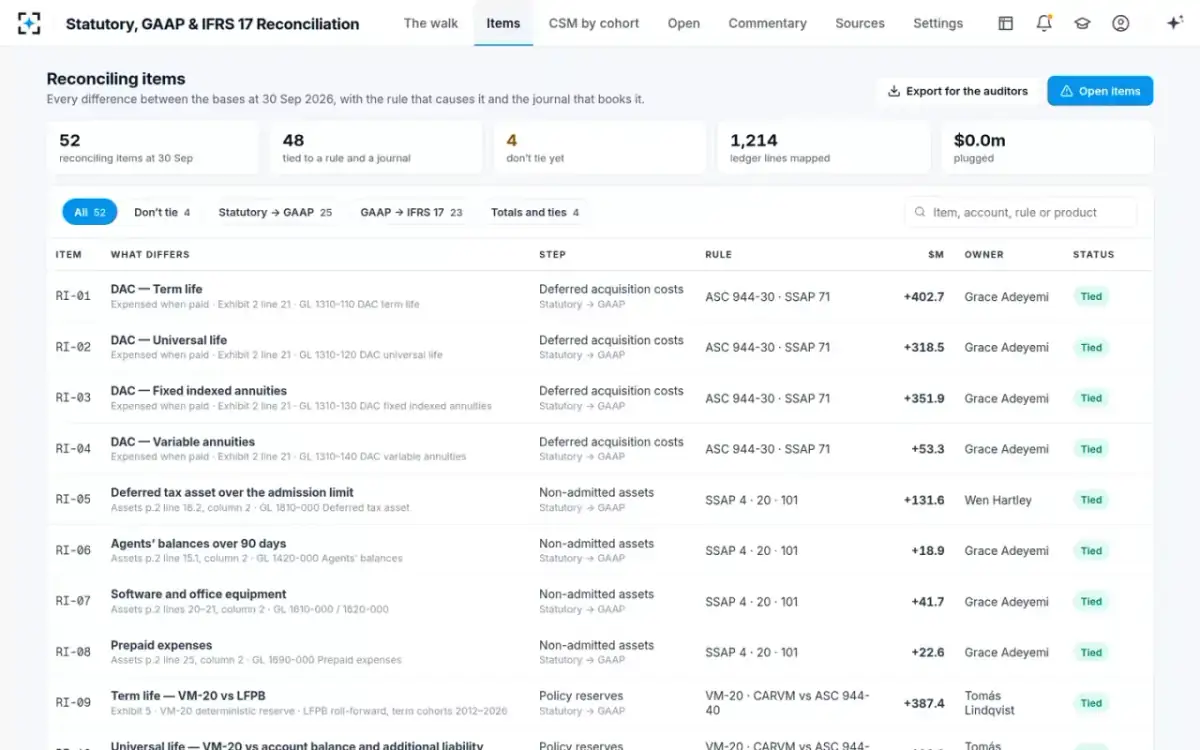
The acquisition-cost step opened: four items, one journal, one rule

What nonadmitted assets are added back under GAAP?
Every nonadmitted asset is added back, because GAAP has no concept of admission: an asset is an asset if it meets GAAP's definition. The NAIC defines nonadmitted assets as assets with economic value that cannot be used to pay policyholders, or that are tied up by encumbrances or third-party interests (NAIC glossary; the definition is quoted in nonadmitted assets). Statutory accounting charges them directly to surplus; GAAP keeps them on the balance sheet, subject to its own impairment and allowance rules.
What made up the sample insurer's $214.8 million nonadmitted step
The categories are statutory, not company choices. Florida's insurance code, for example, expressly disallows prepaid and deferred expenses and furniture, fixtures and supplies, and admits a data processing system only within a cap of 3 percent of capital and surplus. The full list, and why each category is excluded, is in nonadmitted assets: what statutory surplus leaves out.
Reserves, guarantees and the discount rate
Three steps come from the liability side, and for a life writer they are measured under different models rather than adjusted from a common figure. Statutory policy reserves follow the NAIC Valuation Manual; GAAP's liability for future policy benefits uses assumptions reviewed at least annually, a discount rate updated each quarter, and no provision for adverse deviation; guarantees on annuities are market risk benefits measured at fair value (NAIC SAPWG, 2019).
In the sample walk, GAAP held $612.9 million less in policy reserves, the current discount rate added a further $421.7 million through other comprehensive income, and market risk benefits at fair value took away $148.2 million, of which $121.6 million was variable annuity withdrawal guarantees. Reserves are the subject of the difference between stat and GAAP reserves; here the point is that each of these steps needs the valuation actuary's roll-forward on both bases as its evidence, not an accountant's reconciliation of two totals.
Investments: amortized cost, fair value and the statutory-only reserves
Statutory accounting carries most bonds at amortized cost, while GAAP commonly carries them at fair value with unrealized gains and losses in other comprehensive income. SSAP No. 26, effective 1 January 2025, says that for insurers that maintain an asset valuation reserve "the bonds shall be reported at amortized cost, except for those with an NAIC designation of 6, which shall be reported at the lower of amortized cost or fair value"; for insurers without one, bonds with NAIC designations 1 and 2 "shall be reported at amortized cost" (NAIC, SSAP No. 26).
In the sample quarter that difference took $1,037.5 million from equity, the largest negative step, because the bonds' fair value was below their amortized cost. Against it, the asset valuation reserve and interest maintenance reserve, liabilities that exist only in statutory statements, added $188.4 million when removed. The NAIC's SSAP No. 7 governs them and, as an NAIC working-group document notes, "points to the Annual Statement Instructions for the IMR and AVR calculation" (NAIC SAPWG, March 2023).
How are deferred taxes treated under statutory accounting?
Statutory accounting recognises deferred taxes, as GAAP does, but admits only part of a net deferred tax asset into surplus. SSAP No. 101 adopts the FASB's income-tax standard with changes for state income taxes, for when a deferred tax asset counts as realisable and for how changes in deferred tax balances are recorded (NAIC SAPWG, March 2023; the admission test is in nonadmitted assets), and the excess over the admission limit is nonadmitted. That is why deferred tax appears twice in the sample walk: $131.6 million of deferred tax asset over the admission limit inside the nonadmitted step, and a separate $246.3 million deferred tax step on all the other adjustments.
The second figure is mechanical once the others are right: every pre-tax adjustment carries tax at the applicable rate, and the step should be recomputable from the others. In the sample quarter it was not quite: one open item was a $2.1 million difference because tax on other comprehensive income had been provided at the 21.0% federal rate while the company's policy paper called for a 22.1% blend including state tax.
The nine steps, the rule behind each and the evidence it needs
| Step | Statutory rule | GAAP treatment | Evidence for the step |
|---|---|---|---|
| Deferred acquisition costs | Expensed when incurred (SSAP No. 71) | Capitalised and amortized on a constant basis over the expected life | DAC roll-forward by product; commissions in the statutory income statement |
| Nonadmitted assets | Charged to surplus (state law, SSAPs) | Kept as assets, subject to impairment and allowances | Column 2 of the statutory assets page; general ledger accounts |
| Policy reserves | Valuation Manual minimums | Liability for future policy benefits, current assumptions | Actuarial roll-forwards on both bases |
| Market risk benefits | Within the statutory reserve | Fair value | Market risk benefit roll-forward, split into market and own-credit parts |
| AVR and IMR | Statutory-only liabilities (SSAP No. 7) | Not recognised | Statutory reserve exhibits |
| Bonds | Amortized cost, with NAIC-designation exceptions (SSAP No. 26) | Fair value through other comprehensive income under the company's policy | Investment schedules; fair value report |
| Discount rate on reserves | Prescribed rates | Updated each reporting date; change through other comprehensive income | Rate memo; actuarial roll-forward |
| Deferred tax | Admission test on net deferred tax assets (SSAP No. 101) | Full recognition with a valuation allowance | Tax provision; rate by jurisdiction |
| Reinsurance and other | Net presentation and statutory provisions | Gross presentation with a recoverable asset | Treaty-by-treaty schedule |
How do stat to GAAP adjustments differ for property and casualty insurers?
A property and casualty insurer has the same asset-side lines, nonadmitted assets, bonds and deferred tax, but a much smaller reserve step, because both bases book management's best estimate of unpaid losses. Its reinsurance lines are more prominent: statutory statements carry provisions for reinsurance that GAAP does not, and the reinsurance side of that is covered in the Schedule F penalty for reinsurance.
The order of the lines in any walk is a choice, but it is worth fixing once and keeping. A walk whose steps change from quarter to quarter cannot be compared, and the comparison with last quarter is how most errors are found: in the sample, statutory surplus rose $41.3 million in the quarter and GAAP equity $67.6 million, and each step's change should explain part of the $26.3 million difference.
Who prepares the stat to GAAP reconciliation, and how do auditors review it?
The reconciliation is usually owned by the GAAP or group reporting team, built from the statutory statement that the statutory team owns and the actuarial roll-forwards the valuation actuary owns. Auditors review it as part of the GAAP audit, and the statutory side is audited separately: the NAIC's Model Audit Rule requires every insurer to file an audited statutory financial report by 1 June (NAIC Model #205). Some states add their own reconciliation duty; Texas required audited statutory statements to explain "the nature of these differences" from the annual statement filed (Texas Department of Insurance, 2000).
What a reviewer should be able to check on every stat to GAAP walk
- Both end points tie to their sources
Statutory capital and surplus to page 3 of the statement; GAAP equity to the trial balance and the balance sheet.
- Every line of both sources maps to exactly one step
An unmapped line is an unexplained amount; a line mapped twice is double counting.
- The walk foots with no plug
Any unexplained amount is shown as its own item with an owner, never folded into "other".
- Each step ties to a rule and a journal
The standard or policy paper that causes the difference, and the entry that books it.
- Each step's change from last quarter is explained
The movement of the walk is more informative than its level.
- Deferred tax recomputes from the pre-tax steps
A tax step that does not recompute points to a rate or a missing adjustment.
The reconciling items behind the walk, ready to export for the auditors
For an insurer whose parent reports under IFRS, the walk does not stop at GAAP equity. The sample insurer's continues for six more steps to IFRS 17 equity of $1,677.7 million, removing the deferred acquisition costs again and adding the contractual service margin and risk adjustment as liabilities; the IFRS 17 CSM roll forward explains the largest of those steps.
Questions people ask
How do you convert statutory surplus to GAAP equity?
Start from statutory capital and surplus, then reverse each statutory-only treatment: capitalise deferred acquisition costs, add back nonadmitted assets, replace statutory reserves with GAAP liabilities, remove the asset valuation and interest maintenance reserves, restate investments to their GAAP carrying values, and recompute deferred tax. The sample insurer's walk takes nine steps from $1,842.6 million to $2,962.2 million.
Is GAAP equity always higher than statutory surplus?
Usually, because most statutory differences are conservative, but not always. A large unrealized loss on bonds carried at fair value under GAAP can outweigh the other steps, as rising rates can produce; in the sample walk the bond step alone took away $1,037.5 million.
What is the difference between stat to GAAP adjustments and a stat to GAAP reconciliation?
The adjustments are the individual entries, each booking one difference; the reconciliation is the schedule that lists them from one equity figure to the other and proves the total. A reconciliation without the entries is a disclosure; entries without a reconciliation cannot be shown to be complete.
Why is there an AVR and IMR in statutory statements?
They are reserves that exist only in statutory statements: SSAP No. 7 governs them and points to the NAIC's Annual Statement Instructions for the calculation. GAAP has no equivalent liability, so both are removed in the walk; in the sample they added $188.4 million to equity.
Are stat to GAAP adjustments taxable?
The adjustments themselves are accounting entries, not tax events, but each changes the book basis of assets and liabilities and so the deferred tax. That is why the walk ends with a deferred tax step that should recompute from the pre-tax steps at the applicable rates.