A PBC request list is the auditor's list of items "prepared by client": schedules, reconciliations and support the company owes the audit team, each with an owner and a due date. On an insurer's audit, the reserve lines are the slowest to close, because each one asks why a number was chosen and the answer sits in several places at once: a selection workbook, a memo paragraph, a data cut, committee minutes, sometimes the email of an actuary who has left. Botminds' Actuarial Assumption Management exists for that gap. It traces every reserving pick to the cell, the paragraph and the data behind it, so the reserving team answers the auditor's actuary from the source instead of rebuilding it. This guide maps who waits on whom when a reserve request lands, what the actuarial standards expect of the person answering, and which waits disappear when every pick already carries its support.
One reserve line on the PBC request list, and the chain of people it waits on
A person decides
Auditor’s reviewing actuaryWrites the request: support for a selected factor, why the company’s own indication was not used, and whether the pick still holds on current data.
A person decides
Responding actuaryOwns the answer for the company. Starts by finding which year-end the pick was made in. Estimated 3 hours to the right memo paragraph.
A person decides
Workbook authorKnows which saved version of the selection workbook matches the memo, and which cell holds the pick. Estimated 4 hours, longer if the author has left.
A person decides
Data and claims ownersSupply the data cut the pick was made on and the claims-practice changes behind it. Estimated 3 hours with the committee minutes.
A person decides
Responding actuary againRe-runs the original method on today’s data, writes and cites the answer: an estimated 8 hours.
A person decides
Appointed actuaryReviews and signs what leaves the building: an estimated 2 hours.
What is a PBC request list, and which lines land on the reserving team?
A PBC request list is the audit team's inventory of what the company must provide, when, and who owes it. Most of it is accounting: trial balances, reconciliations, roll-forwards, confirmations. The reserve section is different in kind. Loss and loss adjustment expense reserves are estimates, so the auditor cannot test them against an invoice; it tests the process, the data and the assumptions, and it usually brings its own actuary to do so.
The audit is not optional. The NAIC's Annual Financial Reporting Model Regulation requires that "All insurers shall have an annual audit by an independent certified public accountant" and file the audited report by 1 June for the prior year (NAIC Model #205). The same model rule draws the line around the auditor's actuary: the accountant's actuary may opine on reserves only if, among other conditions, "The accountant's actuary tests the reasonableness of the reserves after the insurer's management has determined the amount of the reserves." The company sets the reserve; the auditor tests it. Every reserve line on the PBC list is the auditor asking the company to show its working.
That working rarely sits in one file. The selection is a cell in a workbook. The reason is a paragraph in a memo, written at the year-end the pick was made, which may be three year-ends ago. The data is a cut from a warehouse that has since been refreshed. The decision may have been taken in committee and minuted rather than written into the memo. The request lands on one person, but the answer is spread across five.
Who answers the auditor's actuary? Two roles ASOP 21 defines
Two actuaries meet across a PBC request, and the profession's standard names both. Actuarial Standard of Practice No. 21 defines the responding actuary as "An actuary who is authorized by the entity to respond to the auditor or examiner on behalf of the entity being audited, reviewed, or examined", and thereviewing actuary as the one "designated by the auditor or examiner to assist" with the elements "based on actuarial considerations" (ASOP No. 21, sections 2.10 and 2.11). The standard applies to financial audits, reviews and examinations for fiscal periods beginning on or after 15 December 2016.
The responding actuary is often the appointed actuary or the reserving director for the line, but the standard lets the role be shared: "Any given financial audit, financial review, or financial examination may involve one or more responding actuaries." In practice the auditor's request goes to whoever the company has named, who then becomes the hub of every wait that follows.
"The responding actuary should be appropriately responsive to requests from the auditor or examiner, including the reviewing actuary, within the scope of the financial audit, financial review, or financial examination."
ASOP No. 21, section 3.4
"Appropriately responsive" has content. Section 3.5.2 asks the responding actuary to consider "the extent to which the information requested is readily available" and, if it is not, "what other information is available or reasonably can be produced". Section 3.5.1 asks the reviewing actuary to communicate, "preferably in writing", what is requested and the time frame. That written request is the reserve line on the PBC list.
What reserve items are on a PBC list?
The reserve items follow the list of topics ASOP 21 says the responding actuary "should be prepared to discuss": the data, the methods and assumptions "and judgments applied, and the rationale for those methods, assumptions, and judgments", the source of any assumption the responding actuary did not set, the models, the controls, the significant risks and "the reasoning to support results and conclusions" (section 3.5.4). Section 3.5.5 adds changing conditions, such as trends in experience and changes in the entity's procedures. Mapped to a reserve audit, the requests take the shapes below.
The reserve lines on a PBC request list, who owns each, and where the answer usually lives
| Request | Owner | Where the answer usually lives | Why it waits |
|---|---|---|---|
| Reconciliation of reserving data to Schedule P and the general ledger | Reserving analyst, financial reporting | Reconciliation workbook; Schedule P Part 1 | Two teams own the two sides |
| Selected development and tail factors, with the basis for each | Responding actuary | Selection workbook, at the version the memo used | The latest save is often not the version that was signed |
| Support for a factor held from a prior year | Responding actuary | The memo of the year the pick was made | Later memos say “consistent with the prior year” |
| Expected loss ratios for immature years | Reserving and pricing actuaries | Rate indications, plan, committee minutes | The pick may have been agreed in committee after the memo |
| Changes in methods or assumptions since last year, and their effect | Responding actuary | Change-in-estimate exhibits; memo | Effects are often shown in total, not by segment |
| Claims-practice and case-reserving changes | Claims management | Bulletins to the field; claims committee notes | Outside the actuarial department |
| Controls over the reserving process | Reserving director, internal audit | Peer review notes; committee terms of reference | Evidence is spread across reviews |
| Management’s best estimate versus the actuarial central estimate | CFO, appointed actuary | Committee minutes; Actuarial Opinion Summary | A management decision needs its own support |
Two lines on that list cause most of the delay. The first is support for a factor held from a prior year, because the current memo says only that nothing changed, which is a statement, not support. The second is any pick that was agreed in committee and never written into the memo: the support exists, but in minutes nobody thought to index. The guide on the assumption register for reserving shows how one row per pick makes both visible before the auditor asks.
Who waits on whom: the chain behind one reserve request
The chain in the first figure is sequential because each link needs the previous one. The responding actuary cannot ask the workbook author for the right version before knowing which year-end the pick came from. The data owner cannot produce the original cut before knowing which cut the workbook used. Nobody can re-run the method on current data until the method, the weights and the data are all in hand. Every link is a handoff, and each handoff is a wait for someone with a day job.
The chain also reaches outside the actuarial department. The CAS study note on reserving techniques lists the questions an actuary should put to claims management, including a request for every bulletin to the field from the last five years that changed claims procedures (Friedland, Estimating Unpaid Claims Using Basic Techniques, CAS; what a claim department should keep ready is in claims reserving best practices). When the auditor asks why a factor moved, the reason is often one of those bulletins, and the claims department answers on its own timetable.
Five seats around one reserve request, and what each does today
Today
Sends a written request and waits; gets back a memo that says the pick is consistent with the prior year, and asks again.
With agents
Gets a signed note with the original pages and cells attached, in the form the request asked for.
Still theirs: the audit conclusion
Today
Searches the shared drive for the right year’s memo, then chases the workbook version, the data cut and the minutes.
With agents
Opens the cell and the memo paragraph together and starts from a cited draft.
Still theirs: the answer and every judgment in it
Today
Interrupted to remember which save matched which memo, if still with the company.
With agents
Not interrupted: the version link is kept with the pick.
Still theirs: future selections
Today
Asked for bulletins and practice changes, sometimes years old.
With agents
Asked only when the existing documents do not answer.
Still theirs: case reserving practice
Today
Reads a summary of the support, written under deadline.
With agents
Reads each sentence beside its source before signing.
Still theirs: the signature
How long does it take to answer a PBC request on a reserve pick?
No regulator or research body publishes turnaround times for reserve PBC requests, so any figure is an estimate. Botminds estimates about 20 hours of work for one request about a held pick worked by hand, with more elapsed time because of the waits. The split matters more than the total: most of the hours go to finding things, not to judgment.
Where an estimated 20 hours go on one reserve request, by hand
By hand (20 h)
- Find the memo paragraph · 15%
- Match workbook version and cell · 20%
- Find data cut and minutes · 15%
- Re-run the old method · 20%
- Write and cite · 20%
- Review and sign · 10%
Half of the estimated hours are retrieval: the memo, the version, the data, the minutes. Another fifth is re-running the original method on current data, the step most often skipped when a pick is held, and the one the auditor's question about "whether it remains appropriate" is really about. Only the last two segments need the responding actuary's judgment.
What is ASOP 21, and what does it expect of the responding actuary?
ASOP 21 is the actuarial standard for work with auditors and examiners. For the responding actuary it sets three expectations: be appropriately responsive within the scope of the audit (section 3.4), cooperate in compiling what the reviewing actuary needs (section 3.5), and be ready to discuss the data, methods, assumptions, judgments, controls, risks and reasoning behind the reserve (section 3.5.4). It also says the responding actuary "should consider documenting information provided to the auditor or examiner" (section 3.6.2).
That last line is easy to skip and expensive to skip. The same question comes back: from next year's auditor, from the internal auditor, and from the state examiner. NAIC Model #390 requires an examination of every licensed insurer at least once every five years (NAIC Model #390; the exam itself is described inthe risk-focused examination process), and the examiners can read the auditor's work: Model #205 requires the insurer to have the accountant make its work papers available to the department and keep them until the examination report covering the period is filed, "but no longer than seven (7) years from the date of the audit report". An answer given once and kept is an answer the next asker can be pointed to.
The standard is not the only text the responding actuary answers to. Communications to the auditor are actuarial communications, so ASOP No. 41 applies; its summary of the documentation test shows what a qualified peer must be able to appraise.
Where the waits come from: three missing links
Almost every long wait on a reserve request comes from one of three gaps between the pick and its support.
The author has left. The person who chose the factor knew which workbook save was final, which data cut fed it and which committee discussion settled it. When that person moves on, the knowledge goes with them unless it was written down where the next person can find it. ASOP No. 41 anticipates this: for recurring work, the actuary should consider keeping enough information for a successor to take the assignment over (ASOP No. 41, section 3.8; quoted in actuarial knowledge management software).
The pick was held, not re-made. A factor held at year-end with the words "consistent with the prior year" has its support in an older memo. The auditor's question is whether that support still holds on today's data, and only a re-run of the original method answers it.
The reason lives outside the memo. A pick revised in committee after the memo was issued, a claims bulletin that explains a change in development, a peer reviewer's note: each is support, and none is where the auditor will look first. Regulators make a similar point about the Actuarial Report: "A summary of final selections without supporting documentation is not sufficient" (NAIC Actuarial Opinion (C) Working Group, 2026 Regulatory Guidance).
How can you shorten the PBC process? Attach the source to the pick
The PBC process gets shorter when the retrieval half of the work is done before the request arrives. That means four habits, none of them new: link each selected factor to the workbook version and cell it lives in; link the cell to the memo paragraph that explains it; note the data cut and the committee decision beside both; and when data refreshes, re-run each held pick's own method so a change is known before anyone asks.
The habits are hard to keep by hand because the volume is large. A reserving department carries hundreds or thousands of picks across lines, segments and year-ends; the fictional book used below has 1,284. Keeping each one linked is clerical work at a scale that loses to every deadline, which is why the links break exactly when an auditor needs them.
The payoff reaches beyond the audit. NAIC regulators write that a well-documented Actuarial Report can stand in for the examiners' own reserve estimate, which shortens the examination and can save the company money (AOWG 2026 guidance; how examiners use it is in the risk-focused examination process). Where the report or its workpapers are missing or unacceptable, Model #745 lets the commissioner hire an actuary at the company's expense to redo them (NAIC Model #745). The cost of an unsupported pick is priced in the guide on what an unsupported change in actuarial assumptions costs.
Where Actuarial Assumption Management fits in the reserve audit
Take a sample request as it runs through Botminds' Actuarial Assumption Management, on a fictional insurer's commercial lines book: the auditor asks for support for a general liability tail factor of 1.12, held since year-end 2023 and chosen by an actuary who left in June 2025. The request arrives through the audit portal and is matched to the pick it names. One click opens the workbook cell and the year-end 2023 memo paragraph side by side; the lineage already runs to the data cut, the reserve committee minutes and a model validation note.
Every audit and exam request in Actuarial Assumption Management, matched to the pick it names
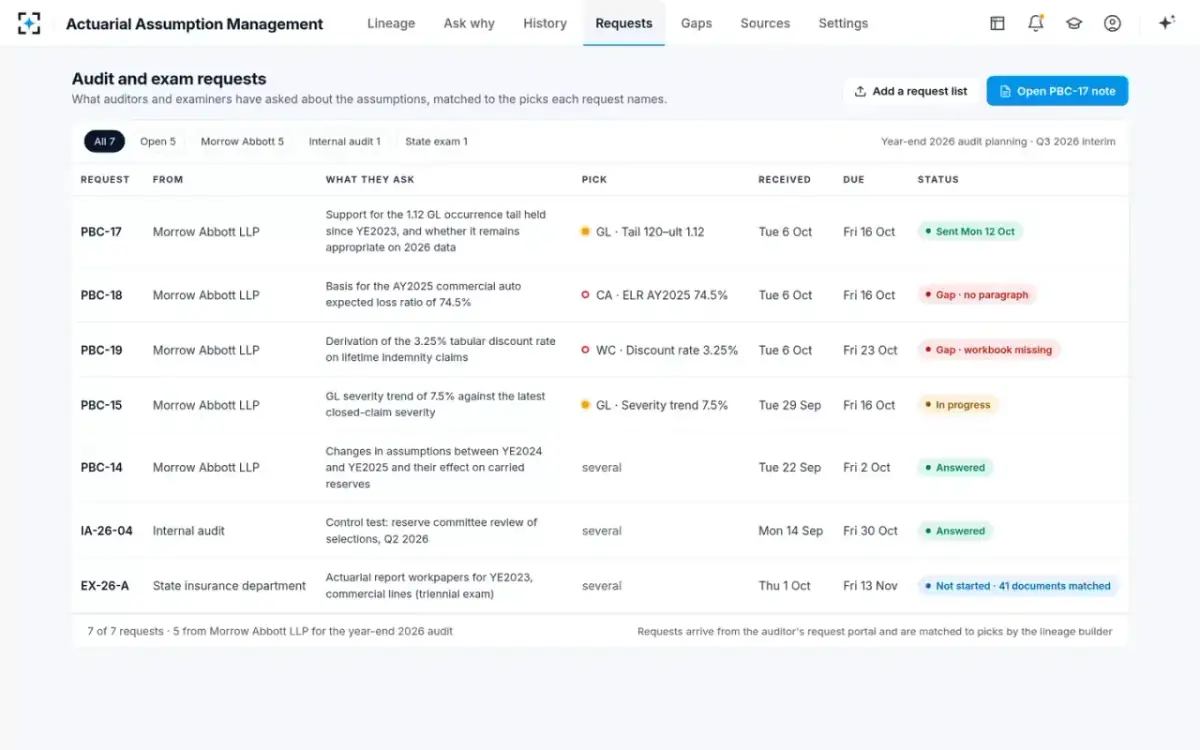
From there, six agents divide the retrieval. One reads every memo, workbook, set of minutes, audit answer and peer review note and keeps the page, paragraph, tab and cell of each statement. One builds the links between a pick and its sources. One re-runs the pick's original method and weights when data refreshes, and marks it stale when the indication moves past the company's threshold. In the sample, the June 2026 triangles move the tail's indication from 1.123 to 1.145, a 2.0% move worth about $4.7 million of IBNR. One drafts the answer one claim per sentence, one checks every sentence against its passage and removes what the source does not say, and one finds picks with no support at all.
The support note: drafted from cited sources, waiting for the appointed actuary
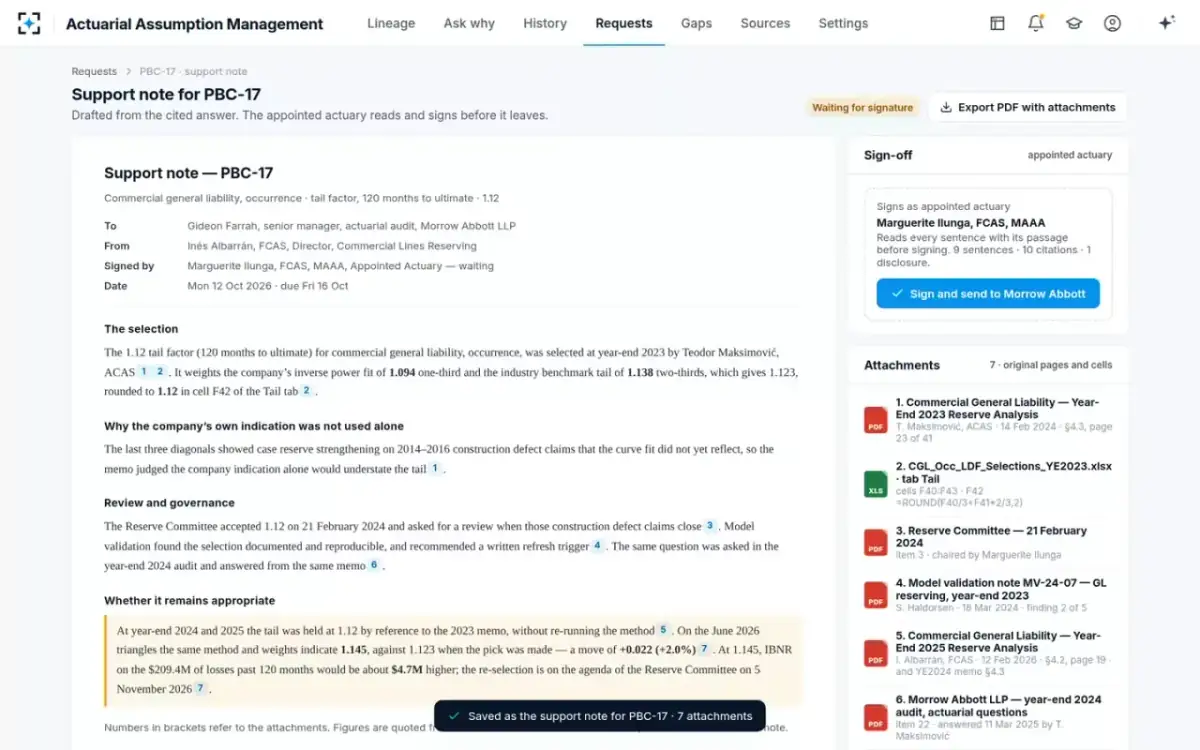
What the solution does not do matters as much to an auditor. It never changes a pick or proposes a new one; a re-selection is a person's decision, taken to the reserve committee. It never closes a gap by inventing a reason: a pick with no paragraph is reported as a gap, with a draft request to the line's owner built only from existing documents. Notes to auditors and regulators are signed by the appointed actuary. The responding actuary still owns the answer; what changes is that the 20-hour chain becomes a reading task. How that works inside the agents, and how a reviewer can check them, is set out in AI for actuarial documentation.
Questions people ask
What does PBC stand for in an audit?
PBC stands for "prepared by client": the items the audited company prepares for its auditor. A PBC request list sets out each item, its owner and its due date. For an insurer, the reserve section asks for the data, selections, assumptions and reasoning behind loss and loss adjustment expense reserves.
What does the external auditor's actuary review?
The reasonableness of the reserves the company has set, and the process behind them. NAIC Model #205 lets the accountant's actuary test reserves "after the insurer's management has determined the amount", never set them. ASOP 21 lists what the responding actuary should be ready to discuss: data, methods, assumptions and judgments, models, controls, risks and the reasoning for the results.
Who should be the responding actuary for a reserve audit?
Whoever the company authorizes to respond on its behalf; ASOP 21 allows more than one. It is often the appointed actuary or the reserving director for each line. The role works best when that person can reach the original support without depending on the pick's author.
How long must the auditor keep its work papers?
Under NAIC Model #205, the insurer must require the accountant to keep audit work papers and communications until the insurance department has filed the examination report covering the period, but no longer than seven years from the audit report. Examiners may review and copy them, so an answer given to the auditor can resurface in a financial examination.
Does a state examination ask the same questions as the audit?
Often, yes. Model #390 requires an examination at least once every five years, and examiners review reserves. NAIC regulators say they should be able to rely on a well-documented Actuarial Report instead of building their own estimates, which can shorten the exam and lower its cost.
What if the actuary who made the pick has left?
Then the support has to come from what was written down: the memo of the year the pick was made, the workbook version it cites, the minutes and any peer review. ASOP No. 41 asks actuaries to consider keeping enough on any recurring project for a successor to pick it up. Where nothing was written, the honest answer discloses the gap rather than reconstructing a reason.