The risk-focused examination process is the method the NAIC's Financial Condition Examiners Handbook sets for state financial examinations of insurers: seven phases that start with understanding the company and its governance, identify and assess its risks, test the controls that mitigate them, determine the residual risk, test in detail where risk remains, update the regulator's priority and supervisory plan, and end with a report and a management letter. Every licensed insurer is examined at least once every five years under the NAIC's model law, and the exam ends in a verified report, a 30-day window for the company's rebuttal, an order adopting it and an affidavit from each director. For the company, the exam is mostly a long sequence of requests that ask again for what it has already told its auditor, its actuary, its analyst and its rating agencies. Botminds' Rating Agency & Exam Response reads the examiners' request lists, matches each item to the earlier answer or document, and routes the rest to the owner who signs.
The financial exam's fixed points
5years
at most between examinations of a licensed insurer, under the model law
7
phases in a risk-focused examination
30days
at most for the company’s written rebuttal of the examination report
18months
after the as-of date, the latest a report should be filed, barring documented exceptions
What is a risk-focused examination?
A risk-focused examination is a financial condition exam that spends its effort where the insurer's risks are greatest, instead of verifying every account. The handbook describes it as "a structured methodology designed to establish a forward-looking view of an insurer’s risk profile and the quality of its risk management practices." The examiners still verify the financial statements, but they direct detailed testing to accounts at high risk of misstatement and to strategic and operating risks, and test fewer details where risk is low (NAIC Financial Condition Examiners Handbook, 2026).
State exam reports open with the same paragraph that explains it. A 2024 report by New Jersey's Department of Banking and Insurance, for example, says the handbook requires the department to plan and perform the exam "to evaluate the financial condition and identify prospective risks of the Company," by obtaining information on corporate governance, identifying and assessing inherent risks, and evaluating the controls used to mitigate them (New Jersey DOBI report on examination, 2024). The NAIC's accreditation standards expect departments to follow the handbook for exam procedures and risk assessment (NAIC accreditation standards, 2026).
How often are insurance companies examined?
At least once every five years, and more often where the regulator sees reason. The NAIC Model Law on Examinations directs the commissioner to examine "every insurer licensed in this state not less frequently than once every five (5) years," and to consider financial statement analyses and ratios, changes in management or ownership, actuarial opinions and the independent accountants' reports when deciding the nature, scope and frequency (NAIC Model #390, § 3A). The handbook adds that exams should be scheduled to reach likely troubled companies more often.
Exams look back over the whole period. The New Jersey report above covers 1 January 2020 to 31 December 2024 for a company last examined as of 31 December 2019, a five-year window ending on the "as-of" date. Insurers in a group are often examined together, on a coordinated basis led by one state, with other states relying on the lead state's work.
The exam from notice to adopted report
The exam runs on two clocks. The handbook's planning steps start months before the as-of date; the model law's report steps start when fieldwork ends. The timeline shows the second part, which is where the company's deadlines are.
After fieldwork: the model law's maximums against the handbook's target
- Verified report filed with the department60
- Company’s written submission or rebuttal30
- Commissioner’s order: adopt, reject or hold a hearing30
- Directors’ affidavits after the adopted report30
- Report filed (adopted) after the report date, the last day of fieldwork120
Before fieldwork the handbook's checklist has its own lead times. The company and its auditors hear of the exam, and of the request for the auditor's work papers, six months or more before the as-of date; the exam is logged in the NAIC's tracking system 90 days or more before it starts; and send preliminary information requests early enough for the company to answer before fieldwork. The handbook's first request list covers those requests item by item.
What are the phases of a financial condition examination?
The seven phases are the handbook's, and each puts different demands on the company. The table pairs what the examiners do with what the company is usually asked for, and who on the company side tends to answer.
The seven phases, what examiners do, and what the company provides
| Phase | What examiners do | What the company provides | Who usually answers |
|---|---|---|---|
| 1 · Understand the company and identify key functional activities | Meet the department’s analyst, gather information already held, assess corporate governance and the audit function, interview senior management. | The planning questionnaire, IT questionnaire, board and committee minutes, organisation charts, audit work papers; C-level interviews. | Exam coordinator, CFO, CRO, corporate secretary, internal audit |
| 2 · Identify and assess inherent risk in activities | Write specific risk statements for each key activity, including prospective risks. | Risk registers and ERM documentation, often the ORSA. | CRO and risk owners |
| 3 · Identify and evaluate risk mitigation strategies (controls) | Identify key controls and test whether they operate effectively. | Control narratives, SOX and internal audit testing, evidence of controls. | Process owners, internal audit |
| 4 · Determine residual risk | Combine inherent risk and control effectiveness into a residual risk rating. | Usually nothing new; questions on gaps. | Exam coordinator |
| 5 · Establish and conduct detail examination procedures | Test balances and estimates where residual risk remains, including reserves. | Samples, reconciliations, loss data, the actuarial report and its data. | Statutory reporting, reserving actuaries, claims, investments |
| 6 · Update prioritization and supervisory plan | Feed results to the analyst; set the insurer’s priority and ongoing supervisory plan. | Nothing directly; results shape later monitoring. | None |
| 7 · Draft examination report and management letter | Write the public report of findings and, where used, a management letter for matters not suited to the public report. | Responses to findings, the letter of representation, and any rebuttal. | CFO, general counsel, board |
The first phase is where the company's burden is greatest and most repetitive. Examiners are told to start from what the department already has and to request updates rather than duplicates, and to rely on the external auditor's and internal audit's work where they can. That makes the quality of what the company has already filed and answered, to the analyst, the auditor and the actuary, the main determinant of how many new requests follow.
What do examiners review in reserves?
Loss and loss adjustment expense reserves are usually among the highest-risk areas, and examiners review them with actuarial help. The handbook's planning checklist asks the exam team to meet the department's in-house actuary "to discuss the company’s historical reserving issues and the extent of data validation required," and many states engage independent actuaries; the New Jersey report above records consulting actuaries reviewing the group's reserves alongside the department's own actuarial unit.
A well-documented actuarial report can shorten that work. The NAIC's Actuarial Opinion Working Group says in its 2026 guidance that "State insurance regulators should be able to rely on the Actuarial Report as an alternative to developing their own independent estimates," which "expedites the examination process and may provide cost savings for the company" (NAIC Actuarial Opinion (C) Working Group, 2026). The examiners' questions on reserves then go to the company's responding actuary, a role the actuarial standards define; what the report itself must contain is set out in the actuarial report template.
Who pays for an insurance department exam?
The company, in most of its costs. The model law lets the commissioner retain attorneys, appraisers, independent actuaries, independent CPAs and other specialists as examiners, "the cost of which shall be borne by the company that is the subject of the examination" (NAIC Model #390, § 4D). Its cost section leaves the funding mechanism to each state, with a drafting comment that the way exams are funded should not influence "the scheduling, scope or conduct of examination." The handbook also carries salary and per diem guidelines for examiners.
The company also controls part of the cost through its responsiveness. The handbook says it plainly in its guidance on the examiner request log:
Lack of cooperation by the company can dramatically increase the cost of the examination.
NAIC Financial Condition Examiners Handbook, 2026, Section 1, Part IV(A)
Delays and incomplete answers are, in the handbook's words, "common issues experienced by examiners," which is why many exam teams keep a request log of every item and its status. Market conduct exams are billed and run differently; who pays for market conduct exams covers them.
How long does an insurance financial exam take?
The handbook's rule is about the report, not the fieldwork: a report of examination must be filed no later than 18 months after the as-of date, except in documented circumstances that the chief examiner explains to the other states. The report is dated the last day of fieldwork, the day the examiner is confident there is enough evidence, including subsequent events and the management representation letter, and should be filed within 120 days of that date. Fieldwork length in between depends on the company's size, complexity and risks, and on how quickly it answers.
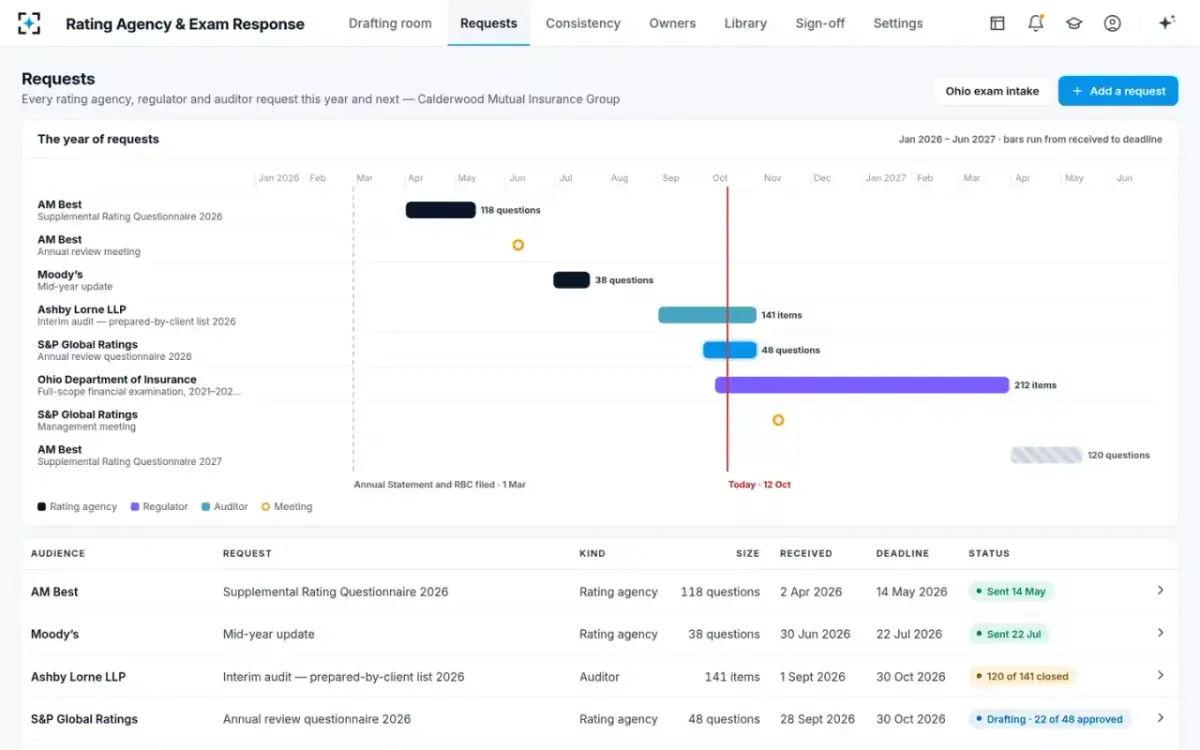
The exam on the same calendar as the rating agencies and the auditor
What happens after an exam report is issued?
The company gets the verified report and up to 30 days to respond in writing, and the commissioner then has 30 days to adopt the report, with or without changes, reject it and reopen the exam, or call an investigatory hearing on at least 20 days' notice. An adoption order is a final administrative decision that can be appealed. Within 30 days of the adopted report, the company must file affidavits from each director stating under oath that they received the report and the related orders (NAIC Model #390, §§ 5B–5D).
The report then becomes public after a confidentiality period set by each state, unless a court stays it, while the examiners' work papers stay confidential. Matters not suited to the public report go in a management letter; the NAIC's sound practices warn examiners against putting significant findings of fact in a management letter to keep them out of the public report. After the exam, the department's financial analyst becomes the main regulatory contact again and follows up on the company's responses.
Can an insurer rebut an exam report?
Yes, within the window the state allows, which the model sets at up to 30 days. The rebuttal is a written submission on any matter in the report, and the commissioner must consider it, together with the relevant work papers, before entering an order. If an investigatory hearing is called, the company's discovery is limited to the examiner's work papers that bear on its rebuttal.
A rebuttal is strongest when it rests on documents the examiners already had. That is one more reason to keep a single, dated log of every answer given during the exam: a response that contradicts an earlier answer, or a rating agency submission from the same period, weakens the company's position.
What to have ready before the examiners arrive
- The prior exam report and its follow-up
Every recommendation, and evidence of what was done about it; examiners check compliance first.
- The last five years of filings, indexed
Annual and quarterly statements, actuarial opinions and reports, audited reports and internal control letters, the RBC report, the ORSA and CGAD.
- Auditor and internal audit access agreed
Auditors notified, work papers available; examiners rely on them where they can.
- A named exam coordinator and a request log
One person who assigns every request, tracks its due date and keeps the answer history.
- Topic owners mapped to the exam’s areas
Reserves, investments, reinsurance, IT, governance, each with a named owner and a deputy.
- Earlier answers to other audiences at hand
Rating agency questionnaires and auditor support lists from the exam period, so the same question gets the same answer.
The last item is where Rating Agency & Exam Response does its work during an exam: each request-list item is matched to the earlier answer or document, items that ask for the same figure as a rating agency answer are linked so both say the same thing, and new items go to their owners with dates. To see it on one of your past request lists, start from Rating Agency & Exam Response.
Questions people ask
What is the difference between a full-scope and a limited-scope examination?
A full-scope exam follows the handbook's risk assessment procedures across the company and ends in an examination report. A limited-scope exam looks at particular risk areas with a known or suspected concern, chosen without the full risk assessment, and also ends in a report. Interim work between full-scope exams supports the next full-scope report rather than producing its own.
What is a coordinated examination?
One performed by examiners from more than one state, usually on a group of related insurers, with one state leading. The other states rely on the lead state's planning, risk assessment and testing rather than repeating it, which is why one group's exam report can list dozens of insurers examined at the same time.
Does a market conduct exam follow the same process?
No. Market conduct exams test how an insurer treats policyholders and claimants, using the NAIC's market regulation handbook, file samples and error tolerances. Financial condition exams test solvency. A company can face both, and the handbook asks examiners to take market conduct results into account when planning a financial exam.
What is the as-of date of an exam?
The balance sheet date the exam covers, usually the most recent year-end. Fieldwork happens later, and examiners also review events after the as-of date up to the report date. The 18-month limit for filing the report runs from the as-of date.
Are financial exam reports public?
The adopted report is opened for public inspection after a period set by state law, unless a court stays it; departments such as New Jersey's post them online. Work papers and other material produced in the course of the exam are confidential under the model law and may be shared only with regulators and others who agree to keep them confidential.