RFP response automation software keeps a library of approved answers, matches incoming questions to them, assigns the rest to experts and assembles the reply; it was built for sales proposals and security questionnaires, and it does that job well. An insurer looking at it for rating agency questionnaires and exam request lists should price the decision differently: not per seat, but per questionnaire, because that is where the cost sits. One rating questionnaire, in our estimate, takes about 145 hours across a liaison, statutory accountants, an actuary, seven topic owners and the CFO, and roughly half of those hours go to refreshing filed figures and checking them against what other audiences were told, two steps an answer library alone does not do. Botminds' Rating Agency & Exam Response exists for those two steps: it drafts from approved answers like an RFP tool, then refreshes every figure from the filed statements and compares the draft with everything sent to agencies, examiners, the auditor and the board.
One rating questionnaire, priced
145hours
of staff time for one 48-question questionnaire (our estimate)
$9,400
in wages alone at BLS May 2025 median pay, before benefits and overhead
52%
of those hours spent refreshing figures and checking them across audiences
24 → 5days
elapsed working days, by hand and with the solution (Botminds’ estimate)
What is RFP response automation software?
RFP response automation software is a category of tools that store approved answers in a searchable library, suggest the closest answer for each incoming question, route unanswered questions to subject experts, track who approved what, and export the response in the requester's format. Proposal teams use it for requests for proposal, due diligence questionnaires and security questionnaires, where the same questions recur across many buyers.
The category's core idea, an answer library with approvals, is sound for insurers too. The difference is in what the answers contain. A sales RFP answer describes a product or a control; it may be accurate for a year. A rating questionnaire answer is mostly statutory figures and the narrative around them, and the figures change every quarter. That is the gap this guide prices.
How much does one rating questionnaire cost?
No public study measures the hours insurers spend on rating questionnaires, so the cost has to be built. The model below is our estimate for one 48-question annual review questionnaire at a mid-sized insurer, priced at the U.S. Bureau of Labor Statistics' May 2025 median pay for the nearest occupations. It deliberately uses wages only; with benefits and overhead, your loaded cost per hour will be higher. Replace every input with your own.
The cost of one rating questionnaire, built by step (our estimate)
| Step | Who | Hours | Rate (BLS median, May 2025) | Cost |
|---|---|---|---|---|
| Splitting the questionnaire and finding last year’s answers | Rating agency liaison | 20 | $80.08 (financial managers) | $1,602 |
| Refreshing figures from the filed statements | Statutory reporting accountants; reserving actuary | 40 + 8 | $40.23 (accountants); $62.50 (actuaries) | $2,109 |
| Owners drafting and approving their answers | Seven topic owners, about 5 hours each | 35 | $80.08 (financial managers) | $2,803 |
| Checking figures against what other audiences were told | Liaison; accountants | 16 + 12 | $80.08; $40.23 | $1,764 |
| Assembling the pack and the CFO’s review | Liaison; CFO | 10 + 4 | $80.08 (financial managers, a floor for a CFO) | $1,121 |
| Total | All roles | 145 | Blended about $65 | $9,399 |
Read the table by its biggest rows, not its total. The two steps that touch figures, refreshing them and checking them across audiences, take 76 of the 145 hours. The owners' time is the second block, and it is mostly spent rewriting sentences they approved last year with new numbers in them. The CFO's four hours look small, but they are the hours that cannot move when the deadline does.
Multiply by the year. An insurer rated by two or three agencies, and answering examiners and auditors, carries several of these questionnaires a year; in the solution's sample data, one fictional insurer handled 559 questions and items from agencies, its regulator and its auditor in a single year. Elapsed time matters as much as hours: Botminds estimates four to six weeks to rebuild one questionnaire by hand, and the time of the people who own the answers is the scarce input.
Where the hours go: by step and by calendar day
Two views of the same questionnaire show where the time is spent. The first splits our 145 staff hours by step. The second splits the elapsed working days by step, from Botminds' own estimate for one rating agency questionnaire done by hand.
One questionnaire, by step: staff hours and elapsed working days
Staff hours (145, our estimate)
- Find last answers · 13.8%
- Refresh figures · 33.1%
- Owners · 24.1%
- Cross-checks · 19.3%
- Pack and CFO · 9.7%
Elapsed working days (24, Botminds’ estimate)
- Find last answers · 16.7%
- Refresh figures · 25%
- Chase owners · 29.2%
- Cross-checks · 16.7%
- Pack and CFO · 12.5%
The calendar view shifts weight to chasing owners, because waiting costs days but few hours. Botminds' estimate for the same questionnaire with the solution is about five working days instead of 24, with owners' review and the CFO's signature still taking most of what remains. That is a design estimate, not a customer measurement, and the shape is the useful part: figure work collapses, owner work shrinks, signatures do not.
Can RFP software answer rating agency questionnaires?
It can handle the library and the workflow: storing approved answers, suggesting matches, assigning questions and assembling the reply. Whether it can handle the figures depends on two capabilities that are not part of the category's core idea, so test them rather than assume. The comparison below sets out how the two kinds of questionnaire differ, which is what decides what a tool must do.
A sales or security questionnaire and an insurer's rating or exam questionnaire are different jobs
Sales RFP or security questionnaire: Descriptions of a product, a service or a control, stable for months.
Rating agency or exam questionnaire: Statutory figures and the narrative around them, which change every quarter and at year-end true-up.
Sales RFP or security questionnaire: Marketing or security documentation the answer owner maintains.
Rating agency or exam questionnaire: A filed statement, page and line: annual or quarterly statement, Schedule P, RBC report, ORSA summary.
Sales RFP or security questionnaire: Each buyer reads its own response; few compare across buyers.
Rating agency or exam questionnaire: Agencies compare with prior years and filings; examiners obtain credit rating agency reports and audit work papers.
Sales RFP or security questionnaire: A proposal manager and subject experts.
Rating agency or exam questionnaire: The owner of each topic, a chief risk officer for risk answers, and the CFO, who signs.
Sales RFP or security questionnaire: A lost deal or a clarification call.
Rating agency or exam questionnaire: A follow-up question that recurs, a credibility cost with the analyst, or an exam finding.
What is an answer library, and why "approved and sent" is the rule that matters?
An answer library is the store of past answers a tool reuses. For a rating or exam questionnaire, the rule that makes it safe is that only answers which were approved by their owner and actually sent to an audience count as the company's position. A draft that never left the building, a board paper or an email is useful context, but reusing it as if it were a position is how a company ends up telling an agency something nobody signed.
The library also needs history. When an answer was changed for one audience, the next match should carry that change and its reason. In Rating Agency & Exam Response the sample library holds 2,140 answers approved and sent since 2021, each with its versions, approver and the submissions it went into. That history is what lets the consistency check work: it compares a new draft with what was actually sent, not with what was once drafted.
Does RFP software check figures?
Ask the vendor to show it, on your data. A generic answer library treats an approved answer as text, so a figure inside it is reused as approved until someone edits it. Checking figures means two separate things: refreshing each number from its filed source, and comparing it with the same number told to other audiences. The first prevents stale numbers; the second prevents contradictions. A tool can do one without the other.
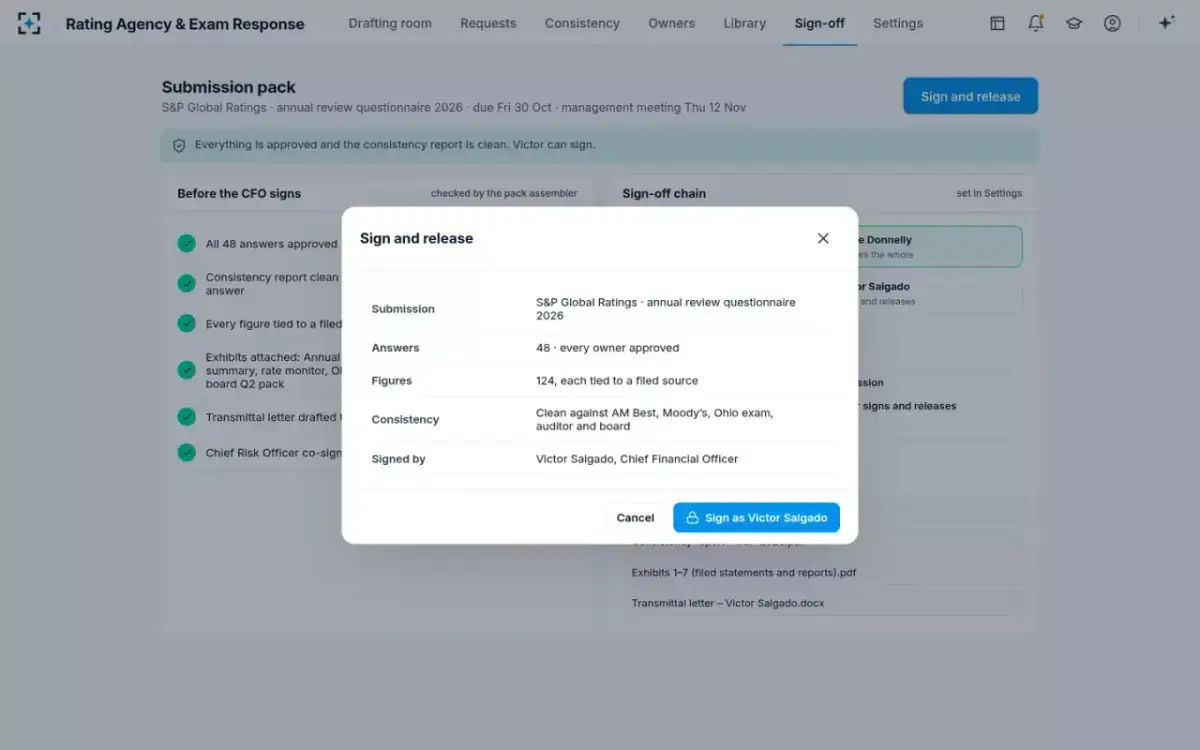
The CFO signs only when every figure is tied to a filed source
What is the ROI of questionnaire automation?
The return is the hours that disappear, plus the follow-up questions that do not get asked, minus what the tool and its setup cost. Write it with your own numbers; no published benchmark exists for insurers, and a vendor's ratio is not evidence of yours.
A return per year on questionnaire automation, written with your numbers
Hours saved
Questionnaires a year × hours per questionnaire × share removed × loaded hourly cost
Use the table above as a start: 145 hours at about $65 an hour in wages alone; the removable share sits mostly in the figure steps.
Liaison and finance operations
Follow-ups avoided
Contradictions caught × hours each follow-up costs
Count last year’s agency and examiner follow-ups that came from a figure mismatch.
Liaison
Subscription
Annual price
Price per company or per questionnaire, not only per seat, if owners rarely log in.
Procurement
Your setup time
Hours to load past answers, filed statements and topic owners
A pilot on last year’s questionnaire shows the true number.
Liaison and IT
The follow-up term is the one most buyers leave out, and it is often the larger. A contradiction caught before release costs a decision; one caught by an analyst costs a meeting slot, a written answer and, sometimes, the same question again next year. Count your own from last year's correspondence before you decide.
How is insurer questionnaire automation different from RFP software?
It adds the two figure steps and the cross-audience memory. An insurer-specific system starts from the same library idea, then treats every number as a slot to be filled from a filed statement, compares the draft with every answer sent to agencies, examiners, the auditor and the board, and routes each answer to the owner of its topic rather than to whoever is free. It also reads exam request lists and auditor support lists, which arrive as spreadsheets with the sender's numbering and are not RFPs at all.
That is also where Rating Agency & Exam Response does not fit. It is not a sales proposal tool and it is not built for security questionnaires, where a general RFP product is the better buy. If your rating questionnaires are short and your figures rarely change, a well-kept library may be enough. Getting owners to trust a drafted answer covers what happens after the purchase.
What to look for in RFP response software if you are an insurer
- Figures re-filled from filed statements
Each number tied to a statement, page and line, with the old value shown beside the new.
- Blanks, not guesses
No filed source, no number: the slot stays empty for the owner.
- Cross-audience comparison
A draft checked against everything sent to agencies, examiners, the auditor and the board in a window you choose.
- Reuse limited to approved and sent
Drafts and internal papers never treated as positions.
- Topic-owner routing and paragraph approval
Owners approve their own paragraphs; risk answers co-signed; only the CFO releases.
- Request lists, not only questionnaires
Exam request lists and auditor support lists read with the sender’s numbering.
- A history for each answer
What was reused, what changed, what was flagged and who decided, readable years later.
- A pilot on your last questionnaire
Run it on a past request with this year’s statements before you sign anything.
To price the decision on your own numbers, start from Rating Agency & Exam Response with one past questionnaire and the answers you already sent. The six agents and what none may send describes the drafting behind the hours.
Questions people ask
Is RFP response software the same as questionnaire automation?
They overlap. RFP software is the broad category, built around an answer library and a proposal workflow. Questionnaire automation is the same idea applied to recurring questionnaires; for insurers it needs figure refresh from filed statements and comparison with earlier answers to other audiences, which are not part of a generic library.
How much time does a rating questionnaire take?
No public benchmark exists. Our estimate for a 48-question annual review is about 145 staff hours, and Botminds estimates four to six weeks of elapsed time by hand. Measure your own: log hours by step on the next questionnaire, using the five steps in the table above.
What does a questionnaire cost in staff hours?
In our model, about $9,400 in wages at BLS May 2025 median pay, before benefits and overhead, for one questionnaire. The two figure steps account for 76 of the 145 hours. Your number will differ with the length of the questionnaire, the number of owners and your pay scales.
Can one tool handle rating questionnaires and exam request lists?
It should, because they share answers. Exam request lists ask for many of the same figures and documents as rating questionnaires and auditor support lists, often in spreadsheets with the examiners' own numbering. A tool that keeps one library and one history across all three avoids answering the same question three different ways.
Who should own the purchase?
Usually the CFO's office, with the rating agency liaison as the day-to-day owner and the statutory reporting manager as the owner of filed figures. The topic owners, from the chief reserving actuary to the chief risk officer, should see a pilot on their own answers before the decision, because their trust decides whether the tool is used.