A supplemental rating questionnaire is the detailed information request a rating agency sends a rated insurer each year to go with its public statutory filings; AM Best's version is known by that name, the SRQ, and its contents and dates are AM Best's own to publish. Whatever the agency, the answers are a mix of narrative and figures, and the failure that hurts is rarely bad prose. It is a figure that is out of date, or right but on a different basis from what the company told another agency or its examiners. This guide sets out four measures any liaison can apply to a draft before it goes: are the figures fresh, are they consistent with what every other audience was told, is each one tied to a filed source, and has the right person approved it? Botminds' Rating Agency & Exam Response scores every draft on those four, which is why it exists: the checks are mechanical, and doing them by hand is where the weeks go.
One sample submission at release
124of 124
figures tied to a filed statement, page and line
48of 48
answers approved by their topic owners
0
open contradictions with answers sent in the past 18 months
236
earlier answers to six audiences the draft was compared with
What is a supplemental rating questionnaire?
It is the annual information request from a rating agency that supplements what the agency can read in an insurer's filed statements. The insurer completes it and management stands behind every answer. AM Best calls its version the Supplemental Rating Questionnaire; other agencies use their own names and formats. This guide does not reproduce any agency's questionnaire, its questions or its due dates; those are each agency's to publish, and an insurer receives them with the request.
What can be said from public sources is why it matters in insurance. The SEC's Office of Credit Ratings, which oversees registered rating organisations, reports in its 2025 staff report: "For over ten years, AMB has reported more credit ratings outstanding in the insurance category than any other NRSRO" (SEC staff report on NRSROs, 2025). The same report notes that AMB "has traditionally focused on rating insurance companies and their" affiliates. For many insurers, the SRQ is the most detailed questionnaire of the year; the measures below apply equally to the others.
What does a rating questionnaire ask, and where do the answers already live?
In the sample agency questionnaire used in this guide, the sections run from capital and earnings through underwriting and pricing, reserves, and investments and liquidity, and almost every figure in the answers already exists in a filed statutory document. That is the point to build on. A combined ratio comes from the annual statement; surplus from its balance sheet; prior-year reserve development from Schedule P, Part 2; the risk-based capital ratio from the RBC report; risk appetite and stress results from the ORSA summary report.
The NAIC's own solvency screen reads the same pages. Its IRIS manual computes one-year reserve development from a single cell, "Page 34, Part 2, Line 12, Column 11" of the annual statement (NAIC IRIS Ratios Manual, 2025). A questionnaire answer about reserve development that does not agree with that cell is not a matter of wording; it is a different number from the one the regulator computes. The IRIS ratios, explained shows the other twelve figures regulators take from the same statements.
Four measures to apply before a draft reaches the CFO
The four measures below are designed to be counted, not judged. Each has a threshold a liaison can check in minutes, and each catches a failure the others miss. The thresholds are our recommendation and the solution's sample settings; an insurer can set its own tolerances.
Four measures of a draft rating questionnaire, and the threshold for each
- Freshness: 100% of figures refreshed or confirmed against the latest filed statement
Count the figures carried forward unchanged from an earlier answer without being re-read from this year’s source. The threshold is zero.
- Consistency: no unresolved difference beyond tolerance with anything sent in the look-back window
Compare each figure with every answer to agencies, examiners, the auditor and the board in, say, 18 months. Sample tolerance: 0.0 points on ratios, $0.1 million on amounts.
- Source coverage: every figure tied to a filed statement, page and line
Board papers and management reports may inform an answer but are marked unfiled and checked against the filed figure. Blanks are allowed; guesses are not.
- Sign-off: every answer approved by the owner of its topic before the liaison’s review
Risk management answers co-signed by the chief risk officer; the CFO signs last. In the sample: owners ten working days before the deadline, liaison seven, CFO five.
Measure 1: are the figures fresh?
Freshness asks whether each number was read again from this year's filing, or merely survived from last year's answer. Reused wording is the main risk: a sentence like "the fifth consecutive year of double-digit rate increases" is accurate in one year and wrong the next, and it reads equally well in both. Count figures, not paragraphs, and treat a figure as fresh only when its value has been compared with the latest filed source and either changed or confirmed.
The actuarial standard on data quality states the habit in a form that applies here. ASOP No. 23 asks actuaries reviewing data to look for questionable values and relationships that do not hang together (Actuarial Standards Board, ASOP No. 23; the standard is read in ASOP 23 data quality). A questionnaire answer is not an actuarial data set, but the discipline is the same: compare this year's values with last year's, and stop on the ones that changed by more than you expected or did not change when they should have.
Measure 2: what figures do rating agencies compare, and do yours agree?
An analyst compares what you said this year with what you said last year, with your filed statements, and, where it has them, with what you said elsewhere. The measure is simple to state: no figure in the draft may differ, beyond tolerance, from the same figure for the same period told to any audience in the look-back window, unless a later event explains it and the answer says so.
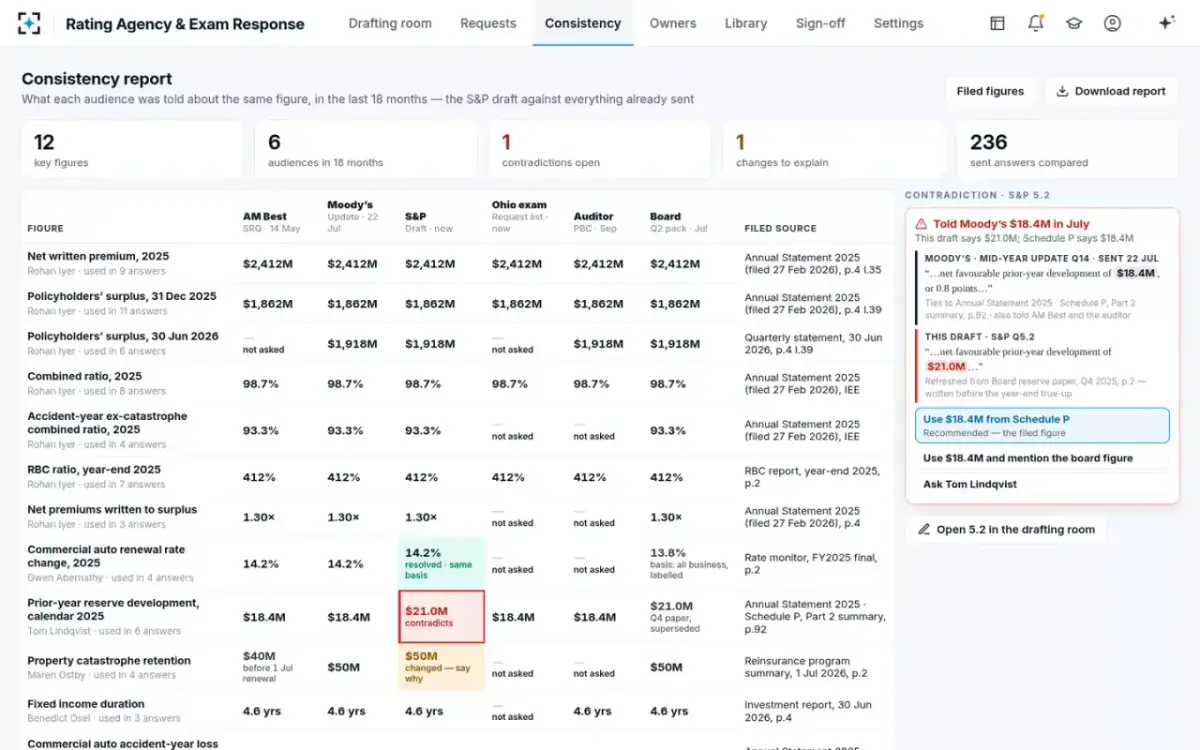
Two kinds of difference behave differently. A contradiction is the same line, the same period and two values, usually because one source was on a different basis: with or without an exited programme, before or after a year-end true-up. A change to explain is a real movement, such as a catastrophe retention that rose at the 1 July renewal. The first needs a decision; the second needs a sentence.
Twelve key figures across six audiences: where the sample draft stood
A board-paper figure stopped against Schedule P
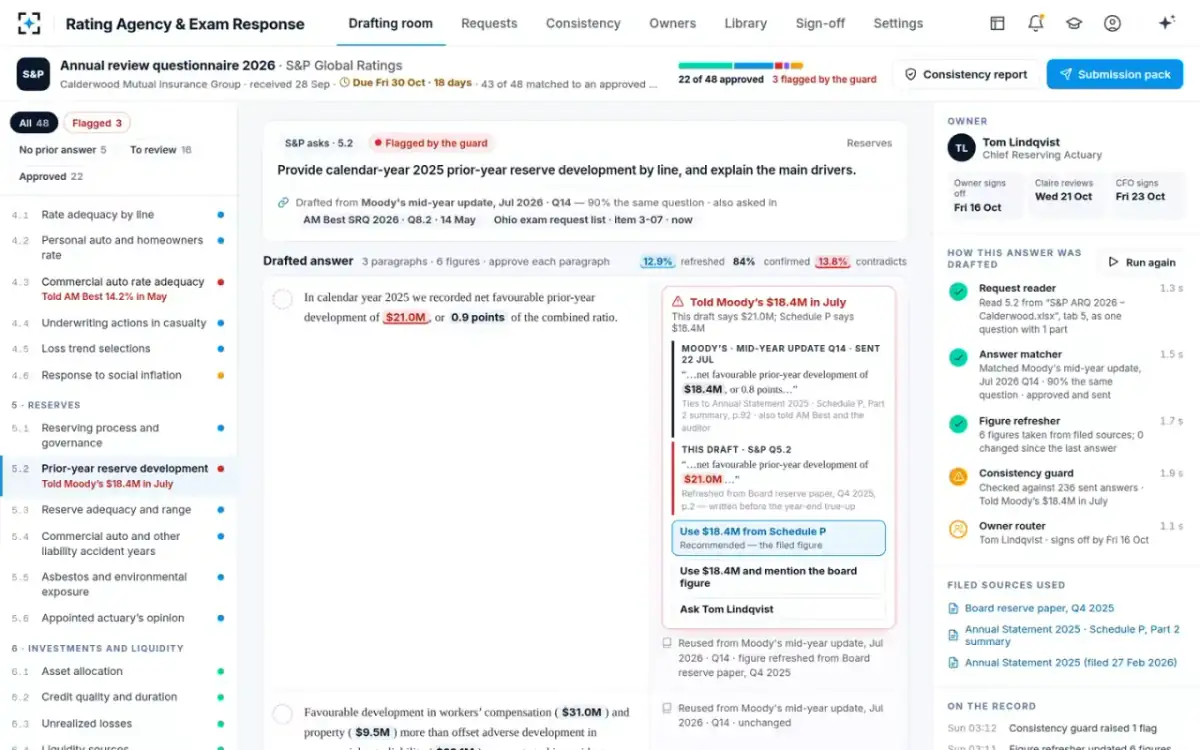
Why this matters beyond one follow-up question shows in an SEC case. In 2020 the SEC charged an insurer and its former CFO over reserve adjustments that departed from the company's actuarial estimates, and alleged the company kept too little support for management's best estimate (the case is read in top side entries meaning); the company and the former CFO settled without admitting or denying the SEC's allegations (SEC Litigation Release No. 24838). That case was about financial statements, not questionnaires, but the lesson carries: a reserve figure that departs from the actuarial or filed basis needs its reason written down, and a questionnaire is a place where an undocumented departure becomes visible.
Measure 3: is every figure tied to a filed source?
Source coverage is the share of figures in the draft that point to a filed statement or report, with page and line. The threshold is all of them, with one honest exception: where no filed source exists, the slot stays blank for the owner. Management reports such as a rate monitor or a reinsurance programme summary can be legitimate sources if the company decides so, but they should be named and kept distinct from statutory filings.
This measure also makes the draft auditable. When an agency analyst, an examiner or an auditor later asks where a number came from, the answer should already sit next to the number. The modelling standard ASOP No. 56 asks actuaries to check that a model's output fairly represents what it models (ASOP No. 56; how that applies to AI tools is in AI in actuarial reserving); a drafting system is a model in that sense, and source coverage is how its output is validated figure by figure.
Measure 4: who signs a rating questionnaire, and has each owner signed?
The CFO usually signs the submission, but no CFO can vouch for forty-eight answers alone. The measure is that every answer has been approved by the owner of its topic before the liaison reviews the whole, and that the CFO signs only when the first three measures are clean. Risk management answers often carry a second signature from the chief risk officer.
Timing is part of the measure. An owner who approves on the deadline has not reviewed anything; an approval chain set back from the deadline gives the liaison time to read the submission as a whole and the CFO time to ask questions. The sample sign-off chain runs owners ten working days before the deadline, the liaison seven and the CFO five.
How to score a draft: one table, four numbers
A scorecard that fits on one screen is more useful than a narrative review. The table shows how each measure is counted and what the sample submission scored when it was released.
A scorecard for one rating questionnaire draft
| Measure | How to count it | Threshold | Sample at release |
|---|---|---|---|
| Freshness | Figures re-read from the latest filed source ÷ all figures in the draft | 100% | Every figure refreshed or confirmed |
| Consistency | Open differences beyond tolerance with answers sent in the look-back window | 0 | 0 open; 1 change explained in a sentence |
| Source coverage | Figures tied to a filed statement, page and line ÷ all figures | 100% (blanks allowed, guesses not) | 124 of 124 |
| Sign-off | Answers approved by their topic owner ÷ all answers; CRO co-signature on risk answers | 100% before liaison review | 48 of 48; CRO co-signed section 8 |
A scorecard also shows where a submission is weak before it is late. A draft at 100% source coverage with three open contradictions is a reserving conversation, not a formatting task. A draft with every owner signed and figures carried forward from last year has a freshness problem that no amount of approval fixes.
The consistency report behind the second measure
How long does a rating questionnaire take, and where do the measures save time?
By hand, Botminds estimates four to six weeks of elapsed time for one rating agency questionnaire, much of it spent finding last year's answers, refreshing figures and checking them against other audiences; with the solution, the design target is a full first draft one day after the questionnaire arrives. Those are our estimate and our target, not a measured customer result, and the cost of one questionnaire breaks the hours down by step.
The measures are where the time goes because they are tedious by hand. Freshness means re-reading every number; consistency means opening every answer sent to five other audiences; coverage means writing a page reference beside each figure. A system that does those three mechanically leaves people with the fourth, which is the only one that needs them.
To see the four measures on one of your own past questionnaires, start from Rating Agency & Exam Response; the six agents and their limits explains how each draft is produced.
Questions people ask
What happens if figures differ between rating agencies?
An analyst who sees two values for the same line and year will ask which is right and why, and the question tends to recur at the next review. If the difference is a real change, such as a reinsurance renewal, one sentence in the later answer prevents the question. If it is a basis difference, pick one basis, label it and use it everywhere.
Should the answers use statutory or GAAP figures?
Use whichever basis the question asks for, and say which one each figure is on. Statutory figures tie to the filed annual statement and are what regulators and the NAIC's screens use; GAAP figures tie to audited GAAP statements where the group has them. Mixing the two without a label is the quickest way to create a contradiction with another audience.
Should board papers be used as sources in a rating questionnaire?
They can inform an answer, but they are unfiled and often written before year-end adjustments. Use them for narrative and forward-looking statements, and check every figure in them against the filed statement before it goes into an answer. In the sample, a fourth-quarter board paper's reserve figure was $2.6 million higher than Schedule P because it predated the true-up.
How often should the answer library be refreshed?
Every time an answer is sent. Each signed answer becomes a new version with its approver and the submissions it went into, so the next questionnaire starts from the latest approved position rather than from last year's file. Answers that were changed for one audience should carry that history.
What is the most common error in a rating questionnaire answer?
No public study counts errors in rating questionnaires, so treat any statistic you see with caution. The failures this guide's measures target are the mechanical ones: a figure carried forward from last year, a figure on a different basis from another audience, a figure with no source, and an answer approved by someone who does not own the topic.