The NAIC Financial Condition Examiners Handbook is the manual state insurance departments use to plan and run financial condition examinations of insurers. The NAIC releases it every year and lists the 2026 edition as a free download; it describes itself as a guide "to assist state insurance departments in establishing an effective examination system" (NAIC publications). The NAIC's model law tells examiners to observe its guidelines, and its accreditation program expects departments to follow it. For an insurer, the handbook matters most for one practical reason: its exhibits generate the first request list. Exhibit A sets the pre-planning steps, Exhibit B is the examination planning questionnaire, Exhibit C the IT questionnaire, and the request log tracks every follow-up. Much of what those requests ask for already exists, in filings, in the auditor's work papers and in answers given to rating agencies. Botminds' Rating Agency & Exam Response reads a request list in one pass, keeps the examiners' numbering, and matches each item to the earlier answer or document before routing the rest to its owner.
The handbook, from the company's side
2026
edition, released annually and listed by the NAIC as a free download
7
phases of the risk-focused exam the handbook sets out
6months
before the as-of date, the latest the company and its auditors should be told
38
items on one state regulator’s published preliminary request list
What is the NAIC Financial Condition Examiners Handbook?
It is the NAIC's standard for how a financial condition exam is planned, performed and reported. The 2026 edition has four sections: general examination guidance (scheduling, coordination of multi-state and group exams, staffing, materiality, sampling, the report and its timeliness, and the review of an insurer's ORSA); the seven-phase risk-focused examination process; examination repositories of risks and controls by key activity, such as reserves, investments, reinsurance and underwriting; and exhibits lettered A to DD, from the planning checklist to the issue and risk tracking template (NAIC Financial Condition Examiners Handbook, 2026).
Its authority comes through state law and accreditation. The NAIC Model Law on Examinations says examiners "shall observe those guidelines and procedures set forth in the Examiners’ Handbook adopted by the National Association of Insurance Commissioners" (NAIC Model #390, § 4A). The phases themselves are explained in the risk-focused examination process; this guide stays with the requests.
Where the first request list comes from: Exhibits A, B and C
The request list is built in pre-planning. Exhibit A, the examination planning procedures checklist, tells examiners to notify the company and its external auditors at least six months before the as-of date that an exam will take place and that auditor work papers will be requested, to call the exam in the NAIC's tracking system at least 90 days before it starts, and to send preliminary information requests "with sufficient lead-time to allow information to be provided prior to the start of examination fieldwork." Exhibits B and C are the templates for those requests, and examiners are encouraged to customise Exhibit B to the insurer, with the analyst's input, before sending it.
Exhibit B, the examination planning questionnaire, covers ownership and management, the board and its committees, corporate planning, organisation and personnel, internal audit, monitoring procedures from budgets to reinsurance and liquidity, legal and regulatory requirements, and the code of conduct. Its own instructions contain the sentence every exam coordinator should know:
"If information requested through the questionnaire has already been provided to the department, the company’s response should so state and reference when and how the information was provided." (Exhibit B, as posted by the Indiana Department of Insurance)
The questionnaire marks with an asterisk the requests "that may be collected through the financial analysis process," so the exam team can drop them if the analyst already has them; we counted 51 such marked requests in the copy Indiana posts. Exhibit C, the IT planning questionnaire, does the same job for information systems and is usually answered by IT with any SOC reports for key service providers.
What documents do insurance examiners request first?
The first documents examiners gather are ones the department already has; the first ones they request are governance records, policies, audit work and the detail behind the year-end balances. Exhibit A lists the existing documents to obtain, including the annual financial statements, the previous exam report, the CPA's audit report, the actuarial opinion, the RBC report, holding company registration statements, IRIS reports, credit rating agency reports, Form F and the ORSA summary report. The handbook's phase 1 guidance says the team "can request updates to existing information available to the department rather than duplicating requests for information already provided to the analyst."
What the company is then asked for shows in the request lists departments publish. Vermont's Department of Financial Regulation, for example, posts a preliminary request list that opens: "In keeping with the risk focused approach, we will utilize audit work papers when appropriate and possible" (Vermont DFR preliminary request list). Its 38 top-level items run from the two planning questionnaires and the corporate record book through committee minutes, policies and service agreements to the trial balance, investment schedules, reinsurance agreements, loss runs and the actuarial report.
Where the answers to one regulator's 38-item preliminary request list already live
Vermont DFR preliminary request list, 38 items
- Existing company records · 68.4%
- Auditor’s or actuary’s work · 18.4%
- Already with the regulator · 5.3%
- New work · 7.9%
The bar makes the case for a template. Only three items in 38 require new writing, and two of those are the questionnaires. The work is finding, pulling and labelling what exists, and answering consistently with what was said before: to the auditor, the actuary, the analyst and the rating agencies.
An exam request list template, item by item
A request list template should do three things the examiners' spreadsheet does not: say where each answer already lives, name its owner, and note when and how it was provided. The template below uses items from the published lists; the columns are our suggestion.
Exam request list template: where each answer already lives, and who owns it
| Item (examiners’ numbering) | Request | Where the answer already lives | Owner | Provided (when, how) |
|---|---|---|---|---|
| B-I.B.1 | Make-up of the board, directors’ affiliations and committees | The CGAD filed by 1 June; board minutes | Corporate secretary | Reference the CGAD filing and date, per Exhibit B |
| B-IV.B.4 | Management’s assessment of internal control over financial reporting, and the auditor’s opinion | Filed with the regulator with the internal control communication | Controller | Reference the filing |
| B-K | Rating agency, date of last report and rating; key liquidity findings | The agency’s latest report; the company’s answers to its questionnaire | Rating agency liaison | Quote the write-up, as Exhibit B allows |
| Prelim · 18 | Audit work papers as of the exam date, and the auditor’s communications | The CPA firm’s files, available to examiners under the audit rule | Controller with the CPA firm | Access arranged; index provided |
| Prelim · 35 | Actuarial report as of the exam date | Prepared to support the actuarial opinion | Appointed actuary (responding actuary) | Report and data provided; contact named |
| Prelim · 34 | Inception-to-date loss runs, open and closed claims, reserves and payments | Claims system; reconciles to Schedule P | Claims and statutory reporting | Extract with reconciliation |
| Prelim · 28 | All reinsurance agreements in force | Reinsurance contract files; programme summary | Head of reinsurance | Index of agreements |
| Prelim · 15 | ERM, ORSA and SOX documentation | The ORSA summary report and its support; SOX files | Chief risk officer; internal audit | Reference the ORSA filing |
The rating agency row is not hypothetical. Exhibit B's liquidity section asks a rated company to "Indicate the agency, date of last report and rating," and asks for the key findings of each agency's liquidity analysis, adding that "a quote from the detailed rating agency write-up will suffice." What the company told its agencies, and what they wrote back, is part of the exam file. An answer to the examiners that does not square with the agency's write-up is a question waiting to happen; the rating agency presentation shows where those figures were first told.
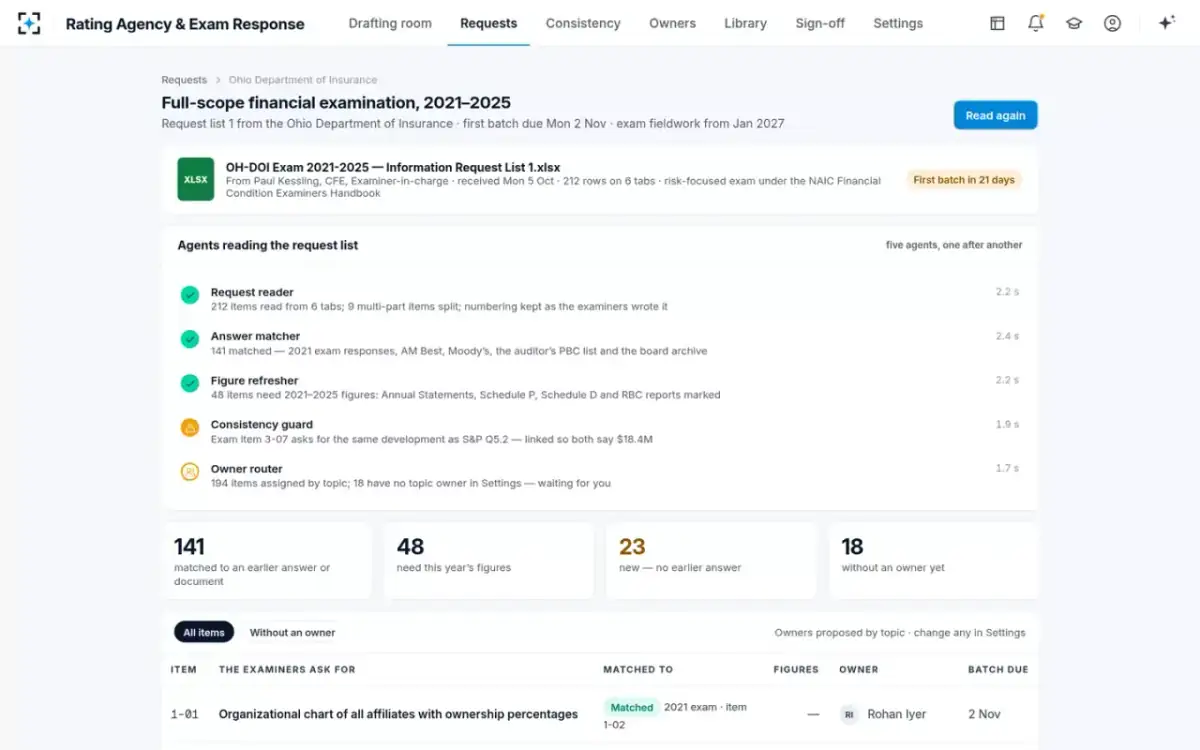
A 212-item request list, read in one pass
Can auditor workpapers be reused for an exam?
Yes, and the rules expect it. The NAIC's Annual Financial Reporting Model Regulation requires every insurer to have its CPA "make available for review by Insurance Department examiners, all work papers prepared in the conduct of the accountant’s audit and any communications related to the audit," and to keep them until the department has filed an exam report covering the audit period, but no longer than seven years (NAIC Model #205, § 13). The NAIC's 2025 sound practices tell examiners to notify auditors as early as possible and to rely on audit work where it addresses the exam's risks.
Exam reports show it in practice. A 2024 New Jersey report says relevant work by the company's CPA firm "was reviewed during the examination and incorporated into the examination work papers whenever feasible to facilitate efficiencies" (New Jersey DOBI report on examination, 2024). For the company, the implication is to arrange auditor access before the exam starts and to point requests at the audit work rather than recreating it.
Who coordinates an insurance exam, and who answers?
On the department's side, the examiner-in-charge runs the exam. On the company's side, an exam coordinator receives every request, assigns it, tracks it and keeps the log; the answers come from the owners of each area. Actuarial questions have a defined respondent: the actuarial standard on auditors and examiners defines the responding actuary as the actuary the company authorises to answer the auditor or examiner on its behalf (ASOP No. 21; both roles it defines are set out in the PBC request list for a reserve audit).
Who answers the examiners' requests, and what changes when matching is automated
Today
Splits the examiners’ spreadsheet by hand, emails each item to a guess at its owner, and chases.
With agents
Starts from a list already matched to earlier answers and documents, with owners proposed by topic and only unowned items to place.
Still theirs: the relationship with the examiner-in-charge and every judgement call
Today
Rebuilds five years of figures and reconciliations the examiners asked for at the last exam.
With agents
Sees which items need refreshed figures and which match an earlier response, with the filed source for each.
Still theirs: the filed figures and the reconciliations
Today
Receives reserve questions second-hand, sometimes already answered by someone else.
With agents
Gets reserve items routed directly, linked to the same figure given to rating agencies.
Still theirs: the responding actuary’s answers
Today
Is asked for ERM documentation the ORSA already contains.
With agents
Sees requests mapped to the ORSA summary report and its support, to reference rather than rewrite.
Still theirs: risk appetite and the ORSA
Today
Pulls minutes, charters and attestations for every year since the last exam.
With agents
Receives a list of exactly which records are asked for, with the CGAD cross-referenced.
Still theirs: the corporate record
How long do you have to answer an exam request?
No national rule sets a number of days; the examiners set dates, and the company is expected to meet them. The model law makes refusing a reasonable written request grounds for action against the company's licence, and the handbook warns that delays and incomplete answers are common and can sharply raise the cost of an exam. The actuarial standard gives a practical rule for disagreements over timing: the responding actuary should consider whether the information is readily available, what else could meet the examiner's need, and whether it is within the scope of the exam, and should work with the examiner "if there are conflicts or time frames that cannot be met."
The way to answer faster is not to work faster but to start further along. Items already provided can be answered by reference, as Exhibit B allows; items in the auditor's work can be answered by access; and items that repeat an answer given to a rating agency can reuse it, with the figures refreshed and checked.
How do you track exam requests?
With a request log that the examiners and the company can both read. The handbook suggests examiners keep an examiner request log "to proactively monitor the timeliness of company responses," and the same log, kept by the company, becomes its account of what was asked, what was given, when and by whom.
What an exam request log should hold for every item
- The examiners’ numbering, unchanged
Including multi-part items split into parts, so every answer maps back to the request.
- Where the answer already lives
Filed with the department, in the auditor’s work, an existing document, an earlier answer, or new.
- Owner and deputy
One named owner by topic; unowned items flagged to the coordinator, not guessed.
- Due date and batch
As the examiners set them, with internal sign-off dates set back from each.
- What was provided, when and how
The document or answer, its version, and the date it went to the examiners.
- Links to the same question elsewhere
The rating agency or auditor answer that states the same figure, so both agree.
- Follow-ups and their status
Each follow-up as a new line tied to the original item.
Rating Agency & Exam Response keeps that log as a by-product of answering: the request reader keeps the numbering, the matcher records the source of each match, the router records the owner and date, and every answer is filed with the submissions it went into. To see your last request list read that way, start from Rating Agency & Exam Response.
Questions people ask
Is the NAIC Financial Condition Examiners Handbook free?
The NAIC's publications listing shows the 2026 edition as a free download, released annually, with supplemental material available from its publications division. Check the listing for the current edition before relying on an older copy, because exhibits and guidance change from year to year.
What is the examination planning questionnaire?
It is Exhibit B of the handbook: a questionnaire on ownership, governance, organisation, internal audit, monitoring, reinsurance, liquidity, legal matters and the code of conduct, used to plan the exam and identify risks. Examiners customise it before sending, and requests the department may already have are marked with an asterisk.
What is a first day letter in an insurance exam?
The handbook does not use that term; it speaks of preliminary information requests built from Exhibit B and Exhibit C and sent before fieldwork. Whatever the name, it usually arrives with the planning questionnaires and a list of documents, as Vermont's published preliminary request list shows.
What is ASOP 21?
Actuarial Standard of Practice No. 21 governs actuaries who respond to or assist auditors and examiners in financial audits, reviews and examinations. It defines the responding actuary, who answers for the company, and the reviewing actuary, who works for the auditor or examiner, and sets expectations for information requests, disagreements and documentation.
Does the handbook apply to market conduct exams?
No. Market conduct exams follow the NAIC's market regulation handbook. The financial handbook does ask examiners to consider market conduct results when planning, and departments often run both kinds of exam; the market conduct examiner's view covers the other one.