A rating agency presentation is the set of slides an insurer's management presents at its meeting with a rating agency's analysts, often as part of the agency's review: strategy, operating results, reserves, capital, reinsurance, investments and risk management, told by the CEO, the CFO and the heads of the main functions. The deck is persuasive by design, but its figures are not new. Net written premium, surplus, the combined ratio, the RBC ratio, reserve development and the catastrophe retention have already appeared in the annual statement, the ORSA, the actuarial report, other agencies' questionnaires, examiners' request lists and the board pack. An analyst who finds a different number on a slide from one in a filing asks which is right, and the answer, however good, costs credibility. Botminds' Rating Agency & Exam Response exists to prevent that: it checks every figure and claim in a draft against what each audience was told, and quotes both statements when they differ.
One sample insurer's year of telling the same story
12
key figures checked across every audience
6
audiences in 18 months: three agencies, a state exam, the auditor, the board
236
answers already sent, compared with the new draft
1
contradiction found before release: a board figure written before the year-end true-up
What is a rating agency presentation?
It is management's own account of the company, given to the agency's analysts in a meeting that complements the questionnaire and the filed statements. The questionnaire answers the agency's questions; the presentation lets management explain the year, the plan and the risks in its own order. In insurance the audience matters: the SEC's Office of Credit Ratings reports that A.M. Best has had the most ratings outstanding in the insurance category for over a decade (SEC staff report on NRSROs, 2025), and an insurer rated by more than one agency tells its story to each.
How each agency runs its meetings, what it asks for and how it weighs what it hears are the agency's own to describe, and this guide does not. What any insurer controls is whether the numbers it presents agree with the numbers it has filed and told others.
What is included in a rating agency presentation?
Most decks cover the same ground as the agency's questionnaire, in management's voice: the business mix and strategy, the year's results against plan, underwriting and pricing actions, reserves and their development, reinsurance and catastrophe exposure, the investment portfolio and liquidity, capital and its adequacy, enterprise risk management, and the outlook. The narrative is new each year. The figures, almost all of them, come from somewhere already filed.
Where a deck's key figures come from: twelve sample figures by source
Twelve key figures in one sample insurer’s submissions
- Annual statement · 58.3%
- Quarterly statement · 8.3%
- RBC report · 8.3%
- Management reports · 25%
The management-report quarter is where most trouble starts. A rate monitor, a reinsurance summary or a board paper is not a filed statement, it is often prepared on a different basis, and it is updated on its own schedule. A deck that mixes filed and unfiled figures without labels invites exactly the question an insurer wants to avoid.
One figure, six audiences: where each number has already gone
The matrix maps six figures that appear in almost every deck against the documents that state them in a typical year. The filed document is the figure's source; every other appearance restates it and must agree with it, or say why it differs.
Six deck figures and the documents that already state them
Net written premium
Annual statementFiled
RBC report—
ORSA summaryRestated
Actuarial opinion and report—
Rating questionnaire or deckRestated
Exam request listRestated
Board packRestated
Policyholders’ surplus
Annual statementFiled
RBC reportRestated
ORSA summaryRestated
Actuarial opinion and report—
Rating questionnaire or deckRestated
Exam request listRestated
Board packRestated
Combined ratio
Annual statementFiled
RBC report—
ORSA summaryRestated
Actuarial opinion and report—
Rating questionnaire or deckRestated
Exam request listRestated
Board packRestated
RBC ratio
Annual statement—
RBC reportFiled
ORSA summaryRestated
Actuarial opinion and report—
Rating questionnaire or deckRestated
Exam request listRestated
Board packRestated
Prior-year reserve development
Annual statementFiled
RBC report—
ORSA summaryRestated
Actuarial opinion and reportRestated
Rating questionnaire or deckRestated
Exam request listRestated
Board packRestated
Catastrophe retention
Annual statement—
RBC report—
ORSA summaryRestated
Actuarial opinion and report—
Rating questionnaire or deckRestated
Exam request listRestated
Board packRestated
Two rows deserve a second look. Prior-year reserve development appears in more places than any other figure, including the actuarial report, and is the one most often restated on a different basis: before or after the year-end true-up, gross or net, calendar year or accident year. The catastrophe retention has no statutory source at all; it lives in the reinsurance programme and changes at renewal, so a deck in November and a questionnaire answer in May can both be right and still disagree unless the later one says what changed.
How do you keep figures consistent across audiences?
By keeping each figure once and reusing it everywhere. For every key figure, note the value, the period, the basis, the filed source with page and line, and the owner; every deck, questionnaire and request-list answer then draws on that entry, and a different value requires a deliberate decision and a label. Before a deck goes, compare each figure with everything sent to every audience in a look-back window, 18 months in the sample settings, and separate contradictions from changes a later event explains.
Twelve figures across six audiences, with the filed source of each
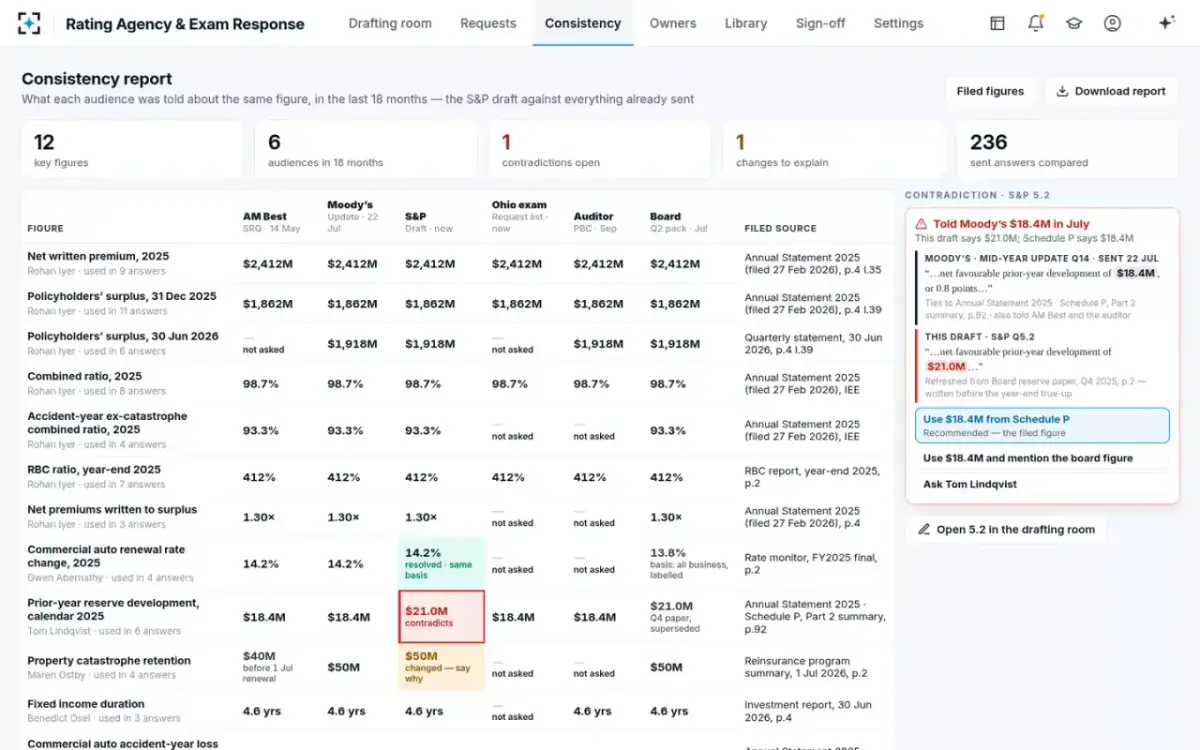
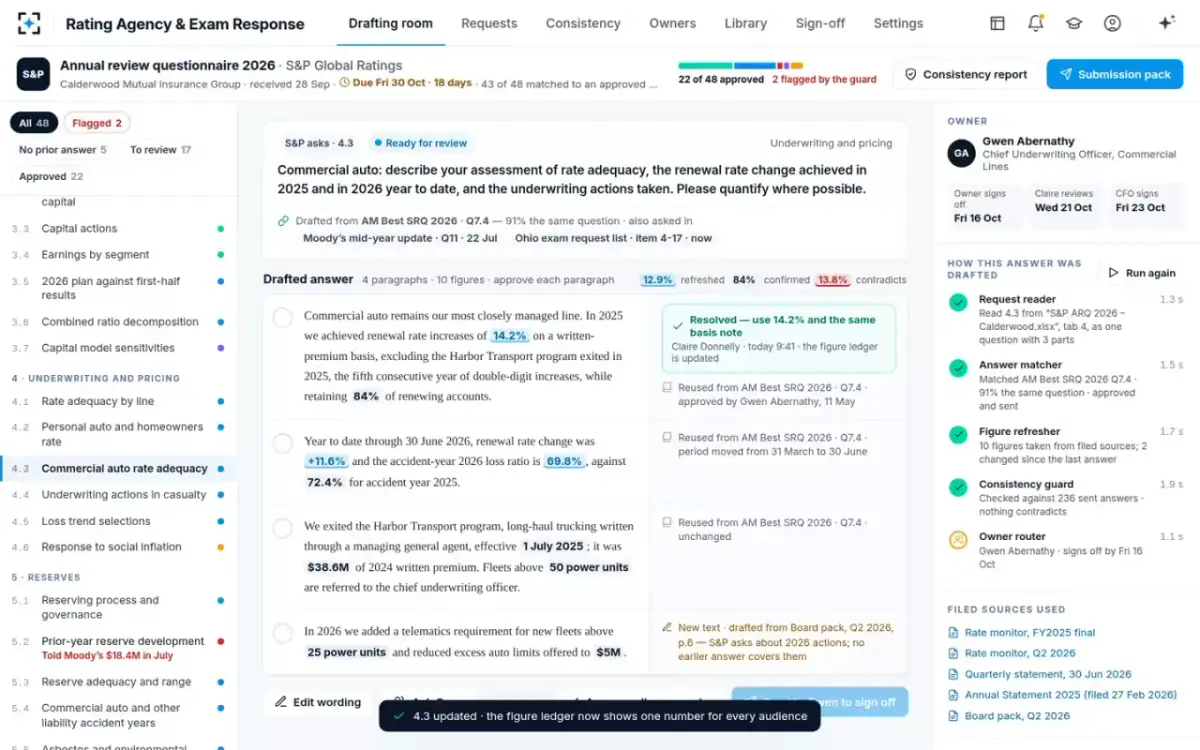
Labels do most of the work. "Renewal rate change of 14.2%, excluding the programme exited in 2025" and "13.8% on all business" are both true; presented without labels to two agencies, they read as two stories. The fix in the sample was to use the basis already given to the other agencies, with the same words, and to keep the all-business figure for the board, labelled.
The flag resolved: the same basis note every agency received
What happens if a rating agency finds an inconsistency?
It asks about it, and the question tends to persist: the next questionnaire, the next meeting and sometimes the next review return to the same figure until the explanation is settled. The cost is time and credibility rather than a rule broken, but it is not confined to the agency. The NAIC's examiners' handbook lists credit rating agency reports among the documents examiners gather when planning an exam, treats changes in rating agency ratings as one of the internal and external changes that feed a company's regulatory priority, and lists a material rating agency downgrade among the marks of the highest, "threatening", magnitude of impact when examiners assess a risk (NAIC Financial Condition Examiners Handbook, 2026). What an insurer tells an agency can therefore reach its regulator, and the other way round.
Examiners also treat what management says the way a careful analyst does. The handbook's guidance on examination interviews is direct:
interviews alone are not sufficient exam evidence and should be corroborated with other exam documentation to evaluate the accuracy of the information.
NAIC Financial Condition Examiners Handbook, 2026, Exhibit Y
A rating agency meeting is not an exam, but the logic transfers. Whatever management says in the room will be compared with what is on paper, and the cheapest time to find a gap is before the meeting.
Does Regulation FD apply to rating agency meetings?
For insurers or holding companies with securities registered with the SEC, it can. Regulation FD requires an issuer that discloses material nonpublic information to certain market professionals or holders to make it public. Until 2010 the rule exempted disclosures to rating agencies; the SEC removed that exemption as the Dodd-Frank Act required, effective for disclosures from 4 October 2010.
we are amending Regulation FD to remove the specific exemption provided to nationally recognized statistical rating organizations and credit rating agencies for disclosure made to them for the purpose of determining or monitoring a credit rating.
SEC Release No. 33-9146, September 2010
The same release notes that other exemptions were unaffected, including disclosures to a person who expressly agrees to keep the information confidential (SEC Release No. 33-9146). Whether Regulation FD applies at all depends on whether the company or its parent is an SEC reporting issuer; that, and how it applies to a given meeting, are questions for securities counsel, not for this guide. Either way, the consistency question is the same: a figure shown to an agency should match what has been filed.
How do you prepare for a rating agency meeting?
Start from the filed figures, not the slides. The checklist below is our preparation sequence; most of it is about figures and owners, because the narrative is the part management prepares best.
Preparing a rating agency presentation, in order
- Fix the figure list
Every number the deck will show, with its period, basis and filed source, owned by one person.
- Pull last year’s deck and this year’s answers
What the company told this agency last year, and what it told the other agencies, examiners and the auditor since.
- Compare every figure across audiences
Look back 12 to 24 months; separate contradictions from changes a later event explains.
- Write one sentence for each real change
A retention raised at renewal, a programme exited, a reserve true-up: say it once, the same way everywhere.
- Label every unfiled figure
Board papers, rate monitors and plans are management figures; mark them and check them against the filed figure.
- Align with the ORSA and the CGAD
Risk appetite, stress results and governance descriptions should not contradict the confidential filings.
- Have each owner approve their slides
Reserves by the chief reserving actuary, risk by the CRO, capital by the treasurer or CFO.
- Clear disclosure with counsel
For issuers with registered securities, confirm the Regulation FD position before the meeting.
- File the deck as an answer
Keep the final deck and the meeting’s follow-up answers with the other submissions, so the next request starts from them.
The last step is the one most often skipped, and it is what makes the next year cheaper. A deck kept with its figures' sources becomes the starting point for the next questionnaire; measuring a questionnaire draft applies the same checks to the written answers, and the six agents explains how drafts are produced.
Who presents to the rating agency, and how often?
Often the CEO and CFO lead, with the chief underwriting officer, the chief reserving actuary, the chief risk officer and the chief investment officer or treasurer taking their sections; the rating agency liaison prepares the material and the follow-ups. Frequency is set by each agency's review cycle and by events between reviews, such as an acquisition or a large loss; ask each agency's analyst for its schedule. In the solution's sample year, one fictional insurer had eight requests and meetings across three agencies, its regulator and its auditor.
The more people who present, the more important a shared source is: five presenters drawing their numbers from five different files is how a single deck ends up disagreeing with itself. To see one set of figures behind every deck, questionnaire and request list, start from Rating Agency & Exam Response.
Questions people ask
What is a rating agency presentation example?
Real decks are confidential, but most follow the same arc: company overview and strategy, the year's results against plan, underwriting and pricing, reserves, reinsurance and catastrophe exposure, investments and liquidity, capital, enterprise risk management and outlook. A useful internal example is your own last deck, annotated with the filed source of every figure.
What do rating agencies ask insurers?
Each agency publishes its own criteria and sends its own questionnaire, and this guide does not reproduce them. In practice the questions cover the same quantities regulators track, premium leverage, results, reserve development, capital, reinsurance and risk management, which is why one consistent set of figures serves every audience.
Should the deck use statutory or GAAP figures?
Use what the agency's analysis relies on, and label every figure's basis. Statutory figures tie to the annual statement and the RBC report; GAAP figures tie to audited GAAP statements where a group has them. The error is not choosing one basis; it is mixing them without saying so.
How long before the meeting should figures be frozen?
Long enough for owners to approve their slides and for one full consistency check after the last change. In the sample sign-off settings, owners approve ten working days before a deadline, the liaison reviews at seven and the CFO signs at five, a rhythm that works as well for a deck as for a questionnaire.
What if a figure has genuinely changed since we last told the agency?
Say so in the deck, in one sentence, with the reason and the date: a renewal, a true-up, a restatement. A change explained is information; a change unexplained is a question. Use the same sentence in every later answer that quotes the figure.