AI can answer a questionnaire well enough to save weeks, but only as a drafter: it should start from answers your company has already approved and sent, replace every figure with today's number from a filed statement, flag anything that disagrees with what another audience was told, and hand the draft to the person who owns the topic. It should never send. For insurers, the questionnaires that matter come from rating agencies, state examiners and auditors; they ask much the same questions every year, in new formats, with new numbers, and a single stale figure becomes a follow-up question. Botminds' Rating Agency & Exam Response is built on that division of labour: six agents read, match, refresh, check, route and assemble, while topic owners approve paragraph by paragraph and only the CFO signs and releases.
One sample questionnaire, drafted overnight
43of 48
questions matched to an answer already approved and sent
236answers
already sent to six audiences, compared with the draft
1day
from a received questionnaire to a full first draft (a design target)
0
answers the agents can send; the CFO releases
Can AI answer rating agency questionnaires?
It can draft them, and that is most of the labour. A rating agency questionnaire mixes narrative (how the company sets reserves, what its reinsurance programme protects) with figures (combined ratio, surplus, reserve development, catastrophe retention). Most of the narrative was approved last year or sent to another agency months ago; most of the figures sit in statements the company has already filed. The work that eats the calendar is finding the last answer, rebuilding it with this year's numbers, and chasing twenty people to approve it.
What AI cannot do is own the answer. The insurer is accountable for what it tells an agency, and in the insurance category those answers carry weight: the SEC's Office of Credit Ratings reports that one agency, A.M. Best, has led the insurance category by ratings outstanding for more than a decade (SEC staff report on NRSROs, 2025; quoted in the supplemental rating questionnaire). An insurer rated by more than one agency, and examined and audited as well, answers many of the same questions several times a year, which is why consistency across audiences matters as much as speed.
Why questionnaire answers are a good AI task, and a risky one
The good part is repetition. Questions recur with small changes of wording; an AI that recognises "describe your reserving process" and "explain how carried reserves are set" as the same question can surface the approved answer in seconds. The risky part is that generative models produce fluent text whether or not it is true. The U.S. National Institute of Standards and Technology calls the failure confabulation, a system confidently presenting false content, and warns that the reasoning offered can be as wrong as the answer:
For instance, LLMs sometimes provide logical steps for how they arrived at an answer even when the answer itself is incorrect.
NIST AI 600-1, Generative Artificial Intelligence Profile, July 2024, §2.2
NIST adds that confabulation includes outputs that contradict what the same system said earlier in the same exchange, and that the risk is sharpest where decisions are consequential. In a questionnaire that means two specific failures: a figure that looks right and is last year's, and a figure that contradicts what the company told another audience. Neither is fixed by a better prompt. Both are fixed by rules about where numbers may come from and what must happen when two statements disagree, which is how the six agents below are built.
The six agents, step by step, and the line each one may not cross
Each agent does one job and has a written limit. The people in the chain are where judgement and signatures stay. The order below is the order a questionnaire moves through the solution.
From received questionnaire to signed release: who does what, and what each agent never does
Agent
Request readerSplits the questionnaire, exam request list or auditor list into numbered questions, parts and topics, from Excel, Word, PDF or a portal export, keeps the sender’s numbering, and records the sheet, row or page each came from.
Never: drops or merges a question silently.
Agent
Answer matcherFinds the closest answer that was approved and sent, to any agency, the examiners or the auditor, scores how much the question is the same, and shows who approved it and when.
Never: reuses a draft that was not approved and sent.
Agent
Figure refresherReplaces every number in the reused wording with today’s figure from its filed source (annual or quarterly statement, Schedule P, RBC report, reserve report, reinsurance summary) and marks what changed; with no filed source, it leaves a blank.
Never: estimates or rounds a figure, or fills a gap with a guess.
Agent
Consistency guardCompares every figure and claim with everything told to agencies, regulators, the auditor and the board in the look-back window, and separates a contradiction from a change a later event explains, quoting both statements with source and signer.
Never: resolves a flag itself.
Agent
Owner routerSends each question to the owner of its topic and sets due dates back from the deadline; a question with no owner waits for the liaison.
Never: assigns a question outside the topic owners in settings.
A person decides
Topic owners and the liaisonOwners approve their answers paragraph by paragraph; the rating agency or exam liaison reviews the whole submission; the chief risk officer co-signs risk management answers.
Agent
Pack assemblerBuilds the submission pack in the sender’s format, with exhibits, the consistency report and a draft transmittal letter, and files signed answers back into the library.
Never: releases a submission, or assembles one before every answer is approved.
A person decides
Chief financial officerSigns and releases the submission.
Two design choices carry most of the safety. The first is that reuse is limited to answers that were approved and sent; drafts, board papers and emails can inform a new answer but are never treated as a prior approved position. The second is that the guard blocks rather than fixes. When it finds a contradiction it stops approval of that paragraph and offers the ways out, but a person picks one, because the right answer depends on things the agent cannot know, such as why a basis changed.
A drafted answer with the guard's flag beside it
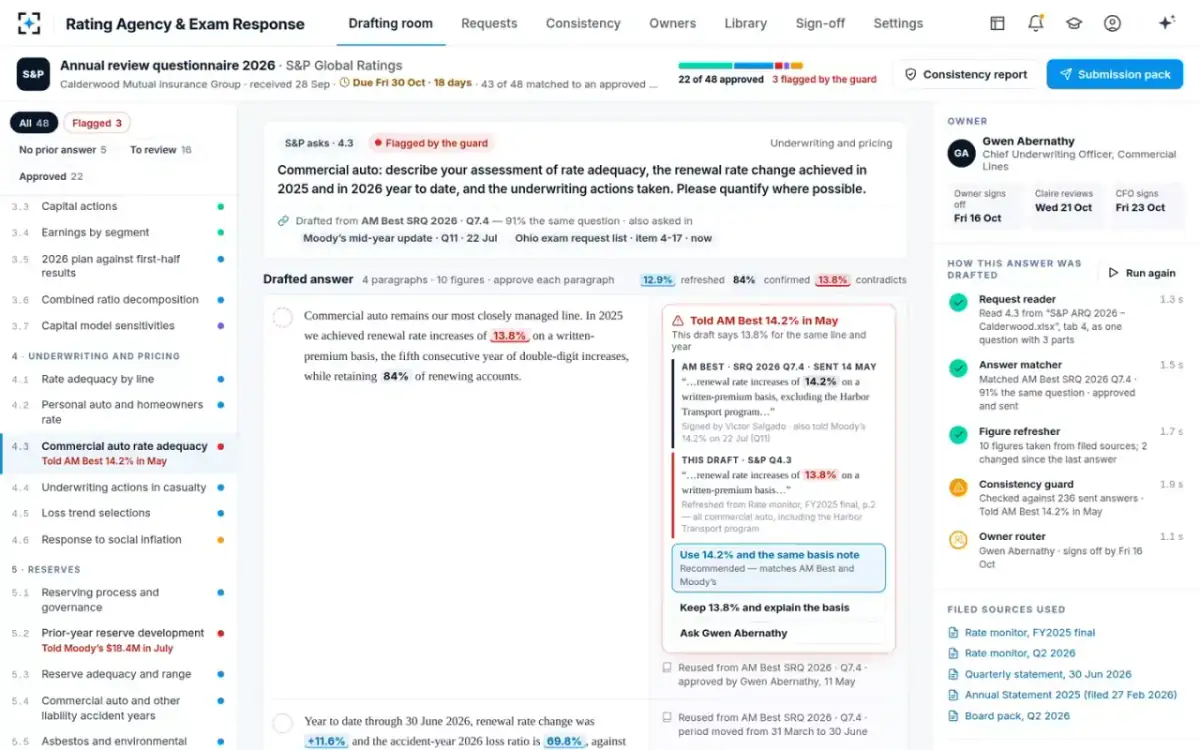
How does AI reuse past answers without reusing past numbers?
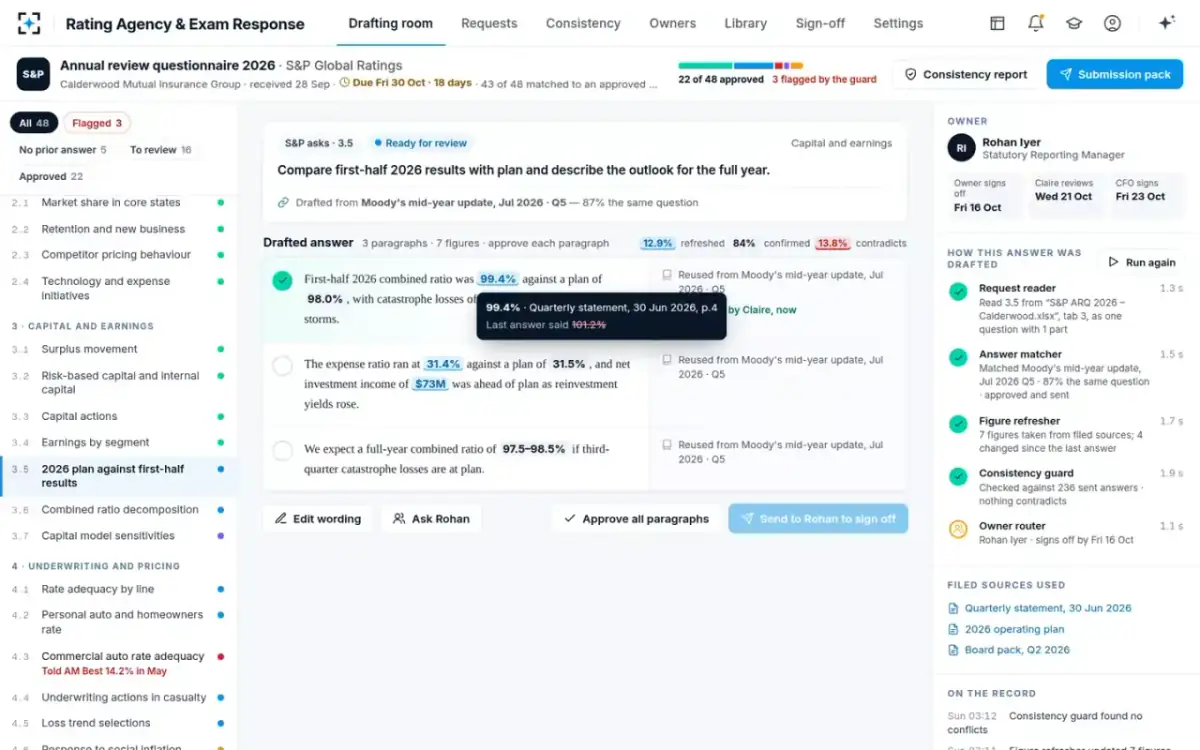
By separating words from figures. The matcher picks the wording; the refresher treats every number in that wording as a slot to be filled again from a filed source, page and line, and shows the old value beside the new one. The owner sees a sentence they approved last year with this year's numbers in it, each marked as refreshed, confirmed or contradicted.
The rule that matters most is the blank. When no filed source exists for a figure, the refresher leaves the slot empty for the owner instead of carrying last year's value forward or computing a plausible one. A blank is visible; a confidently stated old number is not. That is the practical answer to the confabulation risk NIST describes: the model is never asked to produce a number, only to place one that a filed document already contains.
Reused wording, refreshed figures, and the value the last answer used
Who approves AI-drafted answers?
The same people who would approve a hand-written one, with less to read. In Rating Agency & Exam Response the owner of each topic (pricing, reserves, capital, reinsurance, risk management) approves paragraph by paragraph; edits are kept as tracked revisions; the liaison reviews the whole submission; and only the CFO signs and releases. Sign-off dates are set back from the deadline; in the sample settings, ten working days for owners, seven for the liaison and five for the CFO.
Professional standards point the same way. The American Academy of Actuaries' professionalism committee, writing on generative AI, says that actuaries answer for their services, including the decision whether and how to rely on an AI tool (American Academy of Actuaries, 2024; quoted in AI for actuarial documentation). The paper is guidance, not a binding standard, but it describes the position a chief reserving actuary will take when asked to sign a reserve answer an agent drafted: the agent's work is input, and the signature is still theirs.
Can AI answer regulator exam requests?
It can draft them under the same rules, and the stakes of getting it wrong are higher. A state financial examination is compulsory. Under the NAIC's Model Law on Examinations the company and its officers must give examiners access to its records and "aid in the examination," and a refusal "to comply with any reasonable written request of the examiners" is grounds for action against the company's licence (NAIC Model #390, § 4B). An answer drafted by an agent is the company's answer once it is sent.
Exam request lists suit the same pattern because so much of what examiners ask for was already produced: a prior exam response, an auditor schedule, a board paper, a rating agency answer. The solution reads a request list in one pass, keeps the examiners' numbering, matches items to earlier responses and links items that ask for the same figure as a rating agency answer so both say the same thing. Market conduct exams, with their file samples and error tolerances, are a different discipline; market conduct exam management covers them.
What are the risks of AI in regulatory responses?
The risks are specific, and each has a control that can be tested. The table pairs them.
Five ways AI goes wrong in a regulatory or rating response, and the control for each
The risk: Last year’s number survives in reused wording because it reads naturally.
The control to look for: Every number re-filled from a named filed source, page and line; old value shown beside new.
The risk: The model fills a gap with a plausible value.
The control to look for: No source, no number: a blank for the owner, never an estimate.
The risk: A figure on a different basis from what another agency or the examiners were told.
The control to look for: Draft compared with every answer sent in the look-back window; approval blocked until a person decides.
The risk: A paragraph is approved by whoever happened to open it.
The control to look for: Routing by topic to named owners; unowned items wait for the liaison.
The risk: No one can say later which source or which earlier answer a sentence came from.
The control to look for: A history for each answer: when it was read, what was reused, figures refreshed, flags raised and who resolved them.
Governance of AI itself is a regulatory topic for insurers. Responding to the U.S. Treasury in 2024, insurance commenters pointed out that state insurance regulators oversee their use of AI (U.S. Treasury, AI in Financial Services, 2024), and many jurisdictions have adopted the NAIC's model bulletin on insurers' use of AI; where the bulletin has been adopted is tracked separately. A drafting tool used for regulatory answers belongs in that inventory.
Does AI keep an audit trail of answers?
It should, and the trail should be readable by someone who was not there. In the solution each answer carries its history: when the request was read, which earlier answer was reused and how similar the question was, how many figures were refreshed, what the guard raised and who resolved it and when. Signed answers go back into the answer library as new versions, with every submission each version was used in. When an examiner asks in 2029 why the company said 14.2% in 2026, the answer is a click, not an archaeology project.
The trail also makes reuse safer over time. An answer that was approved for one agency in May and then changed for another in October should not be matched next year without that history showing; measuring a draft before it goes turns the trail into four scores a liaison can read.
What to ask before you buy AI to answer questionnaires
Run the tool on your own last questionnaire, with this year's filed statements, before believing a demonstration. The tests below take a day and separate a drafting system from a text generator.
Eight tests to run on your own past questionnaire
- Change the year
Give it last year’s approved answers and this year’s statements. Every figure should change or be marked confirmed, each with a page and line.
- Remove a source
Take out one filed report. The figures that depended on it should come back blank, not estimated.
- Plant a contradiction
Put a different number for the same line and year into a past answer to another audience. The draft should be stopped, with both statements quoted.
- Add a basis change
Change a retention or a programme mid-year. The tool should ask for an explanatory sentence, not call it an error.
- Ask a new question
A question with no prior answer should be marked as such for its owner, not stitched together from neighbours.
- Keep the numbering
The output should follow the sender’s numbering and format, including multi-part questions.
- Try to send
No user other than the designated signer, and no agent, should be able to release a submission.
- Read the history
Pick one answer and reconstruct where every sentence and number came from, without asking the vendor.
The economics are worked through in RFP response automation software and the cost of one questionnaire, which builds the hours by step. To see the six agents on one of your own past questionnaires, start from Rating Agency & Exam Response.
Questions people ask
Can AI fill in a due diligence questionnaire?
It can draft one from approved past answers, with the same limits as a rating questionnaire: figures from filed sources only, blanks where none exists, and a named person approving each answer. Due diligence and security questionnaires are generic enough that general answer-library tools handle them; insurer rating and exam questionnaires add filed statutory figures and cross-audience consistency, which is where specialised checks matter.
How do you stop AI using stale figures?
Do not let it write numbers at all. Treat every figure in reused text as a slot, fill it from a named filed statement with page and line, show the previous value next to the new one, and leave the slot blank when no filed source exists. NIST's generative AI profile describes confidently stated false content as a natural result of how these models work, so the control has to sit outside the model.
Should AI-drafted answers be disclosed to the rating agency or the examiner?
That is a policy decision for the company and its counsel; no rule we know of requires an insurer to label how an answer was drafted. What matters more is that every answer is approved by an accountable owner and that the company can show where each figure came from if asked, which an answer history makes simple.
Does the AI learn from our answers?
In this solution, reuse comes from your own answer library: answers approved and sent, with their versions. That is retrieval of your past positions, not training a model on them. Ask any vendor the same question in writing, including where the answer library is stored and who can see it.
What happens to answers that change between agencies?
The guard compares a new draft with everything sent in the look-back window, 18 months by default. If a figure differs beyond tolerance it quotes both statements; if a later event explains the difference, such as a reinsurance renewal, it asks for a sentence saying so. Either way a person decides, and the decision is recorded with the answer.