Actuarial judgment is the actuary's reasoned choice among defensible options where data alone does not decide: which development factors to select, how much weight an industry benchmark deserves, whether a change in claims handling has distorted the triangle. Reserving cannot be done without it; ASOP No. 43 says assumptions "generally involve significant professional judgment". What regulators reject is the word standing in for the reason. NAIC's Actuarial Opinion Working Group tells appointed actuaries that writing "actuarial judgment" in a narrative or a footnote is not sufficient support. This guide sets six common beliefs about judgment against what regulators, the ASOPs and the research say, and shows how to document a judgment so it survives review. Botminds' Actuarial Assumption Management exists because those written judgments are hard to find again: it links each reserving pick to the paragraph that explains it, and reports the picks that have none. (In psychology the phrase means something else, statistical prediction set against clinical judgment; this page uses the actuarial profession's sense.)
Six beliefs about actuarial judgment, and what the guidance says
The belief: “Actuarial judgment” is an adequate explanation of a selection
What regulators, the ASOPs and research say: NAIC regulators: the phrase is not sufficient, in narrative or in footnotes; a descriptive rationale is needed
The belief: Judgment cannot be audited, because there is no single right answer
What regulators, the ASOPs and research say: ASOP 41: the work must be clear enough for another qualified actuary to appraise its reasonableness; ASOP 21: be ready to give the rationale for judgments applied
The belief: A judgment made once can simply be carried forward
What regulators, the ASOPs and research say: ASOP 43: consider whether chosen methods are still appropriate even when not changing them; explain material changes
The belief: Leaning cautious is good judgment
What regulators, the ASOPs and research say: ASOP 43: no known significant bias either way; research finds reserve error tracks incentives
The belief: “Reserve strengthening” or “adverse development” explains an unusual result
What regulators, the ASOPs and research say: NAIC regulators call such attributions insufficient and ask for company-specific factors
The belief: A good enough model removes the need for judgment
What regulators, the ASOPs and research say: Berquist and Sherman (1977) and Meyers and Shi (2011): methods break when conditions change; no model alone is enough
What is actuarial judgment?
Actuarial judgment is the part of an estimate that a qualified actuary supplies when the data admits more than one reasonable answer. ASOP No. 43 describes assumptions as involving "significant professional judgment as to the appropriateness of the methods and models used and the parameters underlying the application of such methods and models" (ASOP No. 43, section 3.6.2). The CAS study note on reserving puts the consequence plainly: selections "will likely differ from one actuary to another, perhaps materially, as the selection process involves significant actuarial judgment", and "It is important to appreciate that there is more than one reasonable selection of age-to-age and tail factors" (Friedland, Estimating Unpaid Claims Using Basic Techniques, CAS).
So judgment is not a gap in the method; it is part of it. The question regulators and reviewers ask is never whether judgment was used. It is whether the judgment can be seen: what the actuary observed, which options were weighed, and why one was chosen.
What do regulators say about actuarial judgment?
State regulators who read appointed actuaries' reports every year have written their expectation down. It appears under the heading "Support for Assumptions" in the NAIC working group's guidance for year-end 2026.
"Appointed Actuaries should support their assumptions. The use of phrases such as “actuarial judgment,” either in the narrative comments or in exhibit footnotes, is not sufficient. A descriptive rationale is needed."
NAIC Actuarial Opinion (C) Working Group, 2026 Regulatory Guidance
The same section singles out one pick: expected loss ratio selections, which the regulators say often need fuller documentation reflecting rate changes, frequency and severity trends and other on-level adjustments (AOWG 2026 guidance). The guide on the a priori loss ratio builds one line by line with that support.
Regulators apply the same logic to explanations of results. Where an insurer's IRIS reserve-development ratios are unusual, the working group will not accept strengthening or adverse development as the explanation and expects the appointed actuary to describe what at this company caused them (the guidance is quoted inwhat reserve strengthening is). A label that restates the result is not an explanation of it, whether the label is "judgment" or "strengthening".
Is actuarial judgment enough to support a reserve?
Judgment is necessary to a reserve; it is never sufficient as support. Support is the reasoning that connects the judgment to evidence another actuary can examine. ASOP No. 41 makes that the standard for any actuarial report: the methods, assumptions and data must be identified clearly enough for another qualified actuary to make an objective appraisal of the work (ASOP No. 41, section 3.2). An appraisal of "actuarial judgment" is impossible, because there is nothing to appraise.
The audit standard says the same from the other side. ASOP No. 21 asks the actuary answering an auditor or examiner to be ready to discuss the methods, assumptions and judgments used and the reasons for each (ASOP No. 21, section 3.5.4; the full list is in the PBC request list for a reserve audit). The rationale is the part that must exist on paper. Banks meet the same expectation for qualitative adjustments to credit loss allowances; the guide on CECL Q-factor documentation shows how one factor's support is written.
How do you document actuarial judgment?
Write down four things: what you saw, what the methods said, what you chose, and why the first made the third right. The table contrasts labels that regulators reject with rationales that pass, using the kinds of selections reserving actuaries make every year.
Documenting actuarial judgment: the label, and the rationale that replaces it
| Selection | A label (insufficient) | A descriptive rationale |
|---|---|---|
| Tail factor | Selected 1.12 based on actuarial judgment. | Company fit 1.094; benchmark 1.138. The last three diagonals show case strengthening on 2014–2016 construction defect claims that the fit does not yet reflect, so the benchmark is weighted two-thirds: 1.123, rounded to 1.12. |
| Development factor, 24–36 | Judgmentally selected; consistent with prior year. | Five-year average 1.302, selected as 1.31 because attorney representation rose from 41% to 46%. |
| Expected loss ratio | Selected based on judgment and pricing input. | Prior accident years on-levelled for filed rate changes and trended; the plan loss ratio agreed in committee is used for the latest year, as minuted. |
| Severity trend | Judgmentally selected trend. | Closed-claim severity fits indicate 7.6% annually; selected 7.5% pending one more quarter of closed claims. |
| Held selection | No change from prior year. | Held; the original method re-run on new data indicates a move within the 1.0% threshold, so the original support stands. |
Notice what the good rationales share: a number the reader can recompute, an observation the reader can check against the triangle or the claims department, and a choice that follows from the observation. They are also short. A descriptive rationale is rarely more than three sentences; what makes it hard is that it has to be written while the reason is fresh.
What is the difference between actuarial judgment and bias?
Judgment chooses among reasonable estimates for reasons tied to evidence; bias pushes estimates in a direction for reasons tied to outcomes. The reserving standard draws the line by asking for assumptions with "no known significant bias to underestimation or overestimation" of the intended measure (ASOP No. 43, section 3.6.2). That rules out reflexive caution as much as optimism: a deliberately conservative pick is a biased pick unless the intended measure itself is above the expected value.
Research shows why the distinction is policed. Studying property-liability reserve errors, Grace and Leverty found that financially weak insurers under-reserve more than others (their finding is quoted in adverse reserve development), and that insurers also raise reserves for tax purposes (Grace and Leverty, Journal of Risk and Insurance, 2012, CAS abstract). Incentives leave fingerprints in reserves. A written rationale for each judgment is how an actuary shows that the choice followed the evidence, not the incentive.
Does actuarial judgment have to be consistent year to year?
No, but every change has to be explained, and so does every decision not to change. Consistency is not a virtue in itself: conditions change, and a selection that was right at one year-end can be wrong at the next. ASOP No. 43 asks the actuary, when updating an estimate, to consider whether methods remain appropriate even when deciding to keep them (section 3.6.1), and to disclose material changes in assumptions with their reasons (section 4.2). ASOP No. 41 asks a later communication with materially different results to explain why the earlier ones no longer hold (section 3.5).
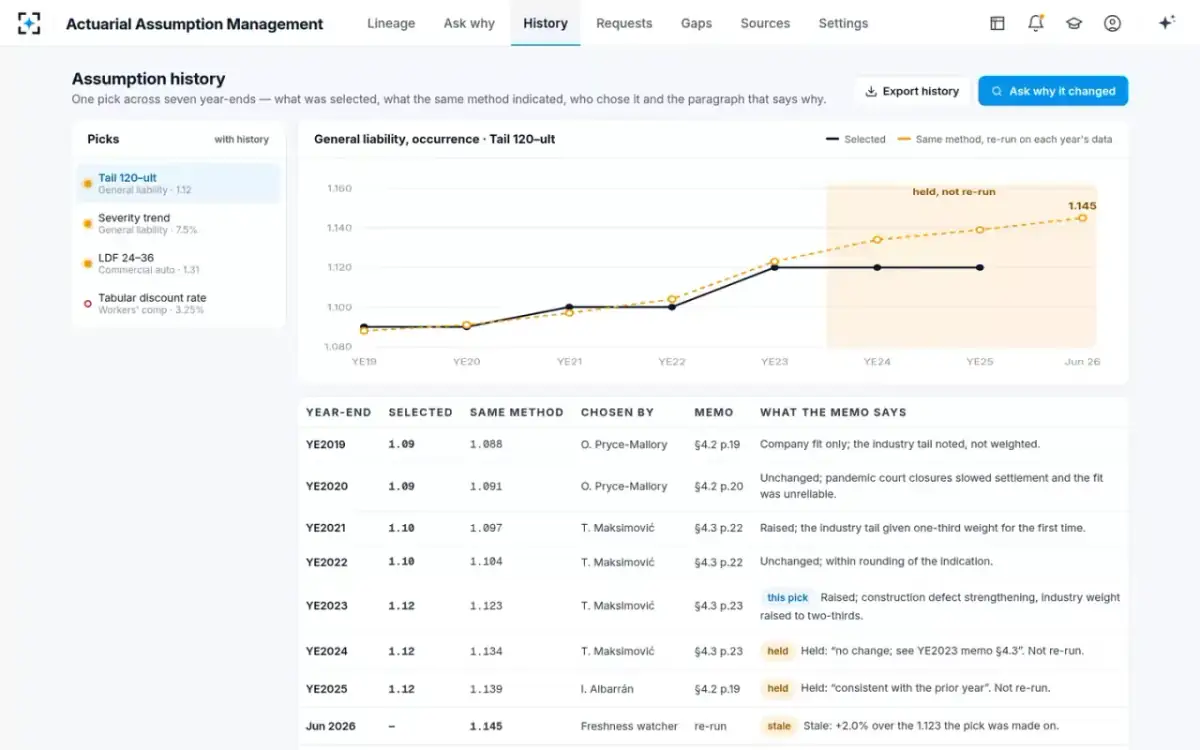
The failure mode is the judgment carried forward by reference. A pick explained once, then held for two years with "no change; see the prior memo", looks consistent and may not be. In the fictional sample book below, a general liability tail selected at 1.12 when its method indicated 1.123 was held twice while the same method rose to 1.134 and 1.139; on June 2026 data it indicated 1.145. The cost of that pattern is set out in what an unsupported change in actuarial assumptions costs.
Judgment over seven year-ends: each selection beside what its own method indicated
Can actuarial judgment be audited? How peer reviewers assess it
Yes. An auditor or peer reviewer does not audit whether the judgment was the one they would have made; they audit whether it was reasonable, supported and consistently applied. Berquist and Sherman set the expectation in 1977: "an evaluation of the extent to which the underlying assumptions of a method are violated should become a vital part of the process of making actuarial projections" (Berquist and Sherman, Proceedings of the CAS, 1977). They also warned against the shortcut that substitutes for judgment: "The mere taking of an average of the initial estimates may not be a satisfactory approach, although this procedure has more merit than the blind acceptance of the projections of only one method."
How a peer reviewer assesses an actuarial judgment
- Re-perform the indications
Compute the methods the memo names on the data it names. Do they match?
- Find the stated reason in the evidence
If the memo cites case strengthening, does the triangle or the claims department show it?
- Check the method’s assumptions still hold
Consistent case-reserve adequacy and settlement rates, as Berquist and Sherman asked.
- Test the direction of the judgments
Do the selections across lines lean one way without stated reasons?
- Compare with last year
Is each change explained, and is each hold supported by a re-run?
- Weigh sensitivity
Where reasonable alternatives move the estimate materially, is that disclosed?
- Look for picks without paragraphs
Selections agreed in committee and never written into the memo are the first an auditor finds.
The last belief, that a better model would make judgment unnecessary, has been tested on real outcomes. Meyers and Shi back-tested reserve models on Schedule P triangles whose later development was known, and concluded that some changes in the environment are invisible to any single model, so the profession cannot leave reserve risk to stochastic models alone (Meyers and Shi, CAS E-Forum, 2011; their words, and a back-test of our own on the same data, are in the CAS Schedule P back-test). Models narrow the range; judgment chooses within it, and the choice has to be written.
When judgment goes wrong: counseling, discipline and enforcement
Most failures of documented judgment end in a finding, a request or a rewrite. A few end in the profession's disciplinary process, which is small, confidential and active. The Actuarial Board for Counseling and Discipline handled 138 cases in 2025: 114 requests for guidance and 24 inquiry cases, of which nine were closed and two "resolved with a recommendation for discipline" (ABCD, Annual Summary 2025).
The profession's discipline body, 2025
138
cases handled by the ABCD in 2025
114
requests for guidance, confidential conversations about professional obligations
24
inquiry cases, nine closed during the year, two with a recommendation for discipline
Outside the profession, the risk is larger. In 2020 the SEC settled charges with an insurer and its former CFO over judgmental adjustments to loss reserves that, as alleged, diverged from the company's actuarial estimates without disclosed or documented support; the case is set out in what an unsupported change in actuarial assumptions costs. The common thread is not that judgment was used. It is that nobody could show, afterwards, what it rested on.
Making judgment visible with Actuarial Assumption Management
The solution does not exercise judgment and does not grade it. Agents never select, re-select or propose a value. What they do is make every written judgment findable and every missing one visible. Each pick in the book is linked to the memo paragraph that explains it, the workbook cell and version, the data cut, the committee decision and any peer review, and matched across year-ends so a reviewer sees each judgment in sequence. When data refreshes, each pick's own method is re-run, so a judgment carried forward is checked against the evidence it originally rested on.
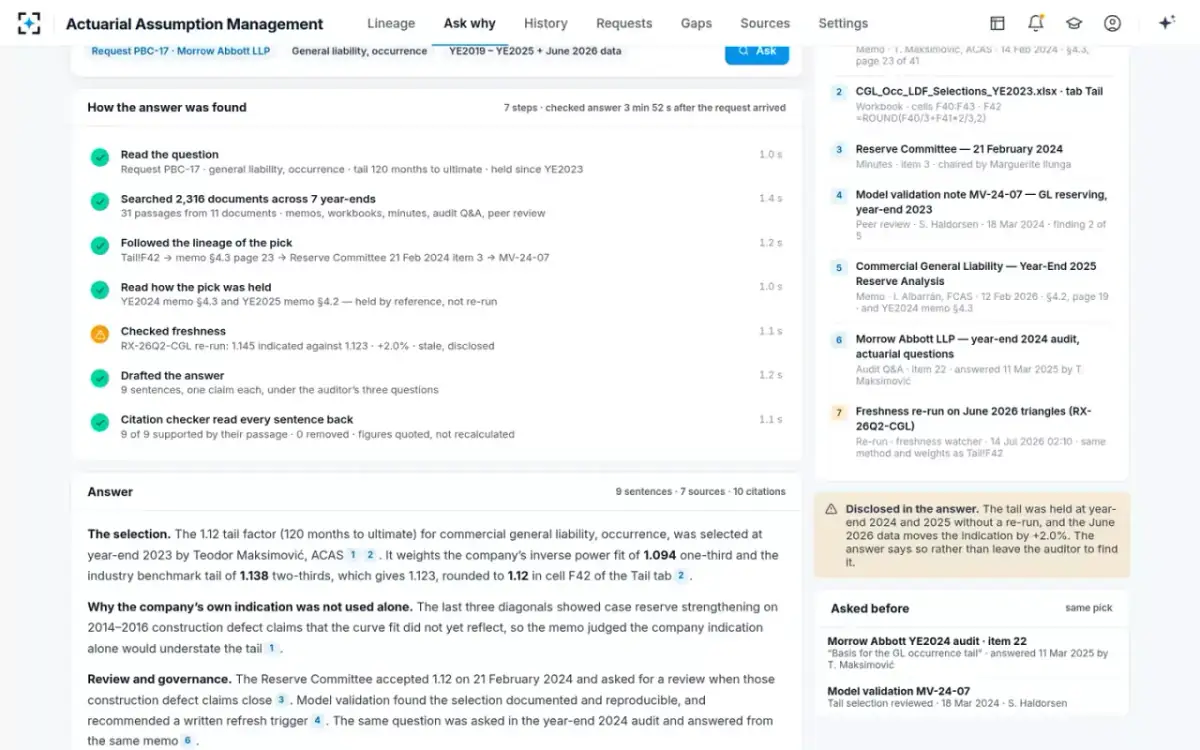
When an auditor or regulator asks why, the answer is drafted one claim per sentence, each with the passage behind it, so the actuary's own words are what the reader sees. In the sample, a question about the tail was answered from 31 passages in 11 documents, every sentence cited and checked, before the appointed actuary signed.
A judgment explained in the actuary's own words, every sentence cited
Questions people ask
Is "actuarial judgement" spelled with or without an e?
Both spellings are used; US actuarial standards and NAIC guidance write "judgment", while British usage often prefers "judgement". The meaning is the same: the actuary's reasoned choice where data alone does not decide.
Can actuarial judgment override the data?
It can depart from what a method indicates, for a reason the data cannot show yet, such as a change in claims handling the triangle has not absorbed. ASOP 43 asks the actuary to consider such changing conditions. The departure must be explained so another actuary can test the reason.
Is it acceptable to select between two methods by averaging them?
An average can be a reasonable selection if the reason for it is stated. Berquist and Sherman warned in 1977 that "The mere taking of an average of the initial estimates may not be a satisfactory approach", because it can hide the question of which method's assumptions still hold.
Who reviews actuarial judgment in a reserve study?
A peer reviewer inside the company, the external auditor's actuary, and in an examination the state's examiners or their actuary. ASOP 21 calls the auditor's or examiner's actuary the reviewing actuary and the company's spokesperson the responding actuary.
Does documenting judgment make it more likely to be challenged?
It makes it easier to accept. Regulators say a well-documented Actuarial Report lets them rely on it instead of developing their own estimates, which speeds up an examination and can reduce its cost. Undocumented judgment is challenged more, because the reviewer has to rebuild it.