CECL Q-factor documentation is the written support behind one qualitative factor, and a paragraph that survives an examination has four moving parts: the data, the date on it, the arithmetic that turns it into basis points, and the reason the model does not already carry the same risk. Miss any one and the number becomes an opinion with a decimal point. The work is not hard, but it is relentless — a bank with nine segments and nine factors has 81 of these paragraphs to re-argue every quarter, which is why most of them get rolled forward instead. CECL Allowance Management is Botminds' solution for that part of the close: it tests each cell, drafts the support with a numbered source on every figure, and hands the allowance manager a decision rather than a blank page.
What follows is one factor, in full, from a fictional sample bank running through the solution: Ashgrove Plains Bank, closing the third quarter of 2026. The bank, its properties, its appraiser and its people are invented, and the figures from them are sample data, not a customer's measured result. The regulators' words are real and linked where they appear. If you want the grid these 81 paragraphs sit in first, start with the nine factors and what each one needs.
What does CECL Q-factor documentation look like?
It looks like a short narrative, not a form. The interagency policy statement sets the standard in one line — allowances "should be well documented, with clear explanations of the supporting analyses and rationale" — and then says what has to be inside: "This documentation should include ACL calculations, qualitative adjustments, and any adjustments to the ACLs that are required as part of the internal review and challenge process" (Interagency Policy Statement on Allowances for Credit Losses). Qualitative adjustments are named in their own right, and so is the trail of what the review and challenge process changed.
The Comptroller's Handbook then scales the expectation to the bank. "For noncomplex banks," it says, "the documentation could be a simple narrative that describes recent trends and conditions and management's conclusions as to the factors' effect on charge-offs" (Comptroller's Handbook, Allowances for Credit Losses). A bank with greater analytical capability may support its adjustments with a regression or another modelling technique, and is then held to the assumptions behind it. Either way the test is the same: does the documentation show the relevant factors were considered, and does it give reasonable support for the conclusion about their effect?
Nothing in that requires a template, a scoring matrix or a page of boilerplate. What it requires is that a reader who was not in the room can follow the path from a fact to a number.
One factor, written out in full: office collateral values, 15 to 35 basis points
Here is the support for a single cell of the sample bank's grid — the collateral-value factor on the office commercial real estate segment, which the quarter's run proposed to move from 15 to 35 basis points. Each sentence is doing one job, and each number opens the document behind it.
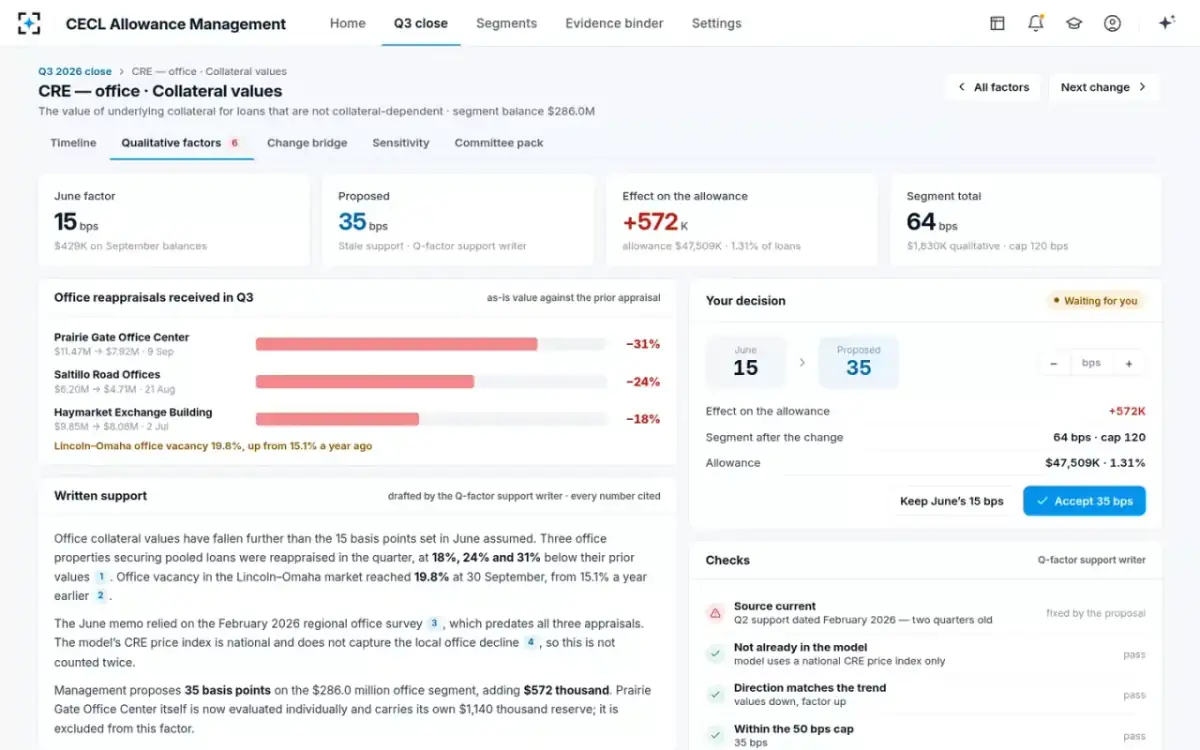
The drafted support for one factor, sentence by sentence
1
Office collateral values have fallen further than the 15 basis points set in June assumed.
The claim
2
Three office properties in the bank’s book were reappraised in the quarter, at 18%, 24% and 31% below their prior values.
The evidence · source 1
3
Office vacancy in the Lincoln–Omaha market reached 19.8% at 30 September, from 15.1% a year earlier.
The trend · source 2
4
The June memo relied on the February 2026 regional office survey, which predates all three appraisals.
Why the old number fails · source 3
5
The model’s commercial real estate price index is national and does not capture the local office decline, so this is not counted twice.
The overlap test · source 4
6
Management proposes 35 basis points on the $286.0 million office segment, adding $572 thousand.
The arithmetic, and the proposal
7
The loan secured by the office centre, the 31% fall, is now measured on its own with a $1,140 thousand reserve; its appraisal is evidence of the market, but the loan is excluded from this factor.
What the factor does not cover
Seven sentences, four of them carrying a cited figure. The paragraph is not an argument for a feeling about office property; it is a chain in which each link can be checked on its own. An examiner who doubts the conclusion can test any sentence without taking the whole thing on trust, and that — rather than length — is what makes support adequate.
The support beside the evidence it cites, and the four checks on it
How do you document a qualitative adjustment, in four parts?
Strip the prose away and every defensible factor paragraph contains the same four things. The order can vary; the presence cannot.
The paragraph taken apart: what each part is for, and what it has to open
| Part | What it is doing | What an examiner can open |
|---|---|---|
| The claim | States the risk in one sentence, in terms of the segment it applies to, and says the current factor is wrong. | Nothing yet — the claim is what the rest of the paragraph has to earn. |
| The data, dated | Names the evidence and when it arrived: appraisals, a vacancy series, a past-due report, a concentration calculation. | The appraisals themselves, the market report, the credit administration file. |
| The arithmetic | Turns the data into basis points and the basis points into dollars on a stated balance. | The segment balance, the factor, and the multiplication between them. |
| The overlap test | Shows the model does not already carry the same risk, by naming what the model does carry. | The model’s written driver list, and the validation that produced it. |
| The exclusions | Says what the factor deliberately does not cover, so the same loss is not reserved twice inside the bank. | The individually evaluated schedule, where a loan with its own reserve appears. |
The fifth row is the one teams forget, and it is the one that produces an embarrassing question in an audit. If a property has been moved out of the pool and given its own reserve, the pooled factor that covers that property's segment must not also be carrying it. At the sample bank the office centre behind the largest specific reserve is excluded by name in the paragraph, and the number — $1,140 thousand — appears on the individually evaluated schedule rather than in the factor. How that reserve is calculated is a separate piece of arithmetic with its own evidence.
How current does the support for a Q factor have to be?
There is no published shelf life. What the policy statement says is that the factors are judged at the reporting date, which makes the date of the evidence, not the date of the memo, the thing that matters. The practical answer most banks land on is a written staleness limit — a source older than one quarter, or two, or six months, is flagged and refreshed before the committee sees it — because that turns a judgement anybody can argue about into a check anybody can run.
Among the supporting documentation an examiner asks the bank's methodologies to carry: the “Date of information included in the analysis”.
Comptroller's Handbook, Allowances for Credit Losses, version 2.0, internal control questionnaire
That one line is the whole discipline. In the sample quarter the office factor failed exactly this check: June's 15 basis points rested on a regional office survey dated February 2026, two quarters old at the September reporting date, while three appraisals received in July, August and September said something sharper. The factor was not wrong because 15 was the wrong number in June. It was wrong because nothing behind it had been opened since.
The Federal Reserve's community banking review lists where documented support most often goes missing, and the list is mostly about dates and choices rather than conclusions: "Specific methodology areas requiring a bank's documented support include rationale for the selected calculation method(s), key assumptions specific to the calculation method(s), look-back period length, and segmentation" (Community Banking Connections, 2025). A look-back period and a segmentation are decisions made once and then inherited for years. They need re-stating in writing even in a quarter when nothing about them changed.
The arithmetic line: from a vacancy rate to basis points to dollars
The step everyone skips in writing is the one everyone asks about in the room: how did a vacancy rate and three appraisals become exactly 20 more basis points? Part of that step is judgement and will stay judgement. What documentation can do is make the rest of it reproducible, so the only thing under discussion is the judgement itself.
The sample factor, from the evidence to the dollars
| Line | Calculation | Result |
|---|---|---|
| 1. The segment the factor applies to | Office commercial real estate loans at 30 September | $286.0M |
| 2. June’s factor, on September balances | 15 bps × $286.0M | $429K |
| 3. The proposed factor | 35 bps × $286.0M | $1,001K |
| 4. The effect of the change | $1,001K − $429K | +$572K |
| 5. The segment’s nine factors together, after the change | 44 bps in June + 20 bps on this factor | 64 bps |
| 6. The headroom left under the bank’s own segment cap | 120 bps policy cap − 64 bps | 56 bps |
Writing the line out has a second effect that is easy to miss. It makes the factor falsifiable next quarter. If vacancy falls back to 16% and two appraisals come in flat, the same arithmetic argues for a smaller number, and the memo that documented the rise has already committed the bank to lowering it. A factor with no written derivation can only ever be defended, never retired.
How do you show a Q factor moved with its own trend?
By printing the trend, not describing it. Three reappraisals with their prior values and their dates, or four quarters of a past-due percentage, take two inches of a page and settle the question that otherwise consumes a committee meeting: is the factor following the data, or is the data being recruited to justify the factor?
The evidence behind one factor: three office reappraisals against their prior values
The direction test cuts both ways, and the quarter's other movements show it. Residential past dues of 30 to 89 days at the sample bank fell from 0.42% to 0.27% over four quarters with nonaccruals flat at 0.18%, and the factor on that segment came down from 6 to 3.5 basis points — documented in the same shape, with the same four parts. A grid in which every documented movement is upward is not a cautious grid; it is an undocumented one.
What a rolled-forward paragraph looks like from the other side of the desk
The alternative to all of this is the sentence that appears in thousands of allowance memos: the factor is held at its prior level, conditions having not materially changed. It is not a lie. It is simply unfalsifiable, and auditors are now being examined on whether they accepted it.
The same factor, two quarters, two kinds of paragraph
June · rolled forward
“Office collateral values remain under pressure in the bank's markets. The factor is held at 15 basis points.”
- No evidence named, so nothing to date.
- No arithmetic, so the 15 cannot be re-derived.
- No overlap test, so the model may carry it too.
- Unfalsifiable: no future data could argue against it.
September · cited
Seven sentences: the claim, three appraisals, a vacancy series, the stale prior source, the model's driver list, the arithmetic, and what the factor excludes.
- Four numbered sources, each openable.
- Dates on every piece of evidence.
- 35 bps × $286.0M, written out.
- Falsifiable: next quarter's data can argue it down.
The audit consequence is now explicit. Reviewing bank audits, the Public Company Accounting Oversight Board observed that testing of review controls over qualitative factors was sometimes limited to inquiries of management and comparisons with prior periods: "In these cases, auditors did not test the review procedures performed by control owners to assess the appropriateness of how qualitative factors were considered in their estimates" (PCAOB, Bank Financial Reporting Audits). A paragraph that only says the number has not changed gives an auditor nothing to test, which is increasingly the auditor's problem as well as the bank's — and a reason the requests arrive earlier each year. What the auditor asks for, item by item follows that thread.
Who writes the support, and who may change the factor
These are two different jobs and they should be two different hands. Drafting is clerical in the best sense: gather the evidence, date it, do the arithmetic, test the overlap, write the sentences. Deciding is not. Moving a factor from 15 to 35 basis points is a management judgement about the collectibility of a portfolio, and it belongs to a named person who can be asked about it a year later.
In the solution, the agents do the first job across all 81 cells and none of them does the second. The support writer checks each cell for a stale source, an overlap with the model and a move against its own trend, drafts the paragraph with a citation on every number, and stops. It proposes; only the allowance manager accepts, changes or rejects, and a rejection keeps the prior quarter's level with a written reason — which is itself a documented decision rather than an absence of one. The handbook's examination procedure points at the same split when it tells examiners to "Evaluate whether management consistently tracks and analyzes supporting data relevant to qualitative factors": tracking is a process you can automate, and consistency is what automation is good at.
The time it saves is the reason the discipline holds. At the sample bank the qualitative step of the close ran to five working days by hand; the planned quarter with the agents is two, an estimate rather than a measured result. The point is not the three days. It is that five days of manual gathering is what makes a team roll last quarter's memo forward in the first place.
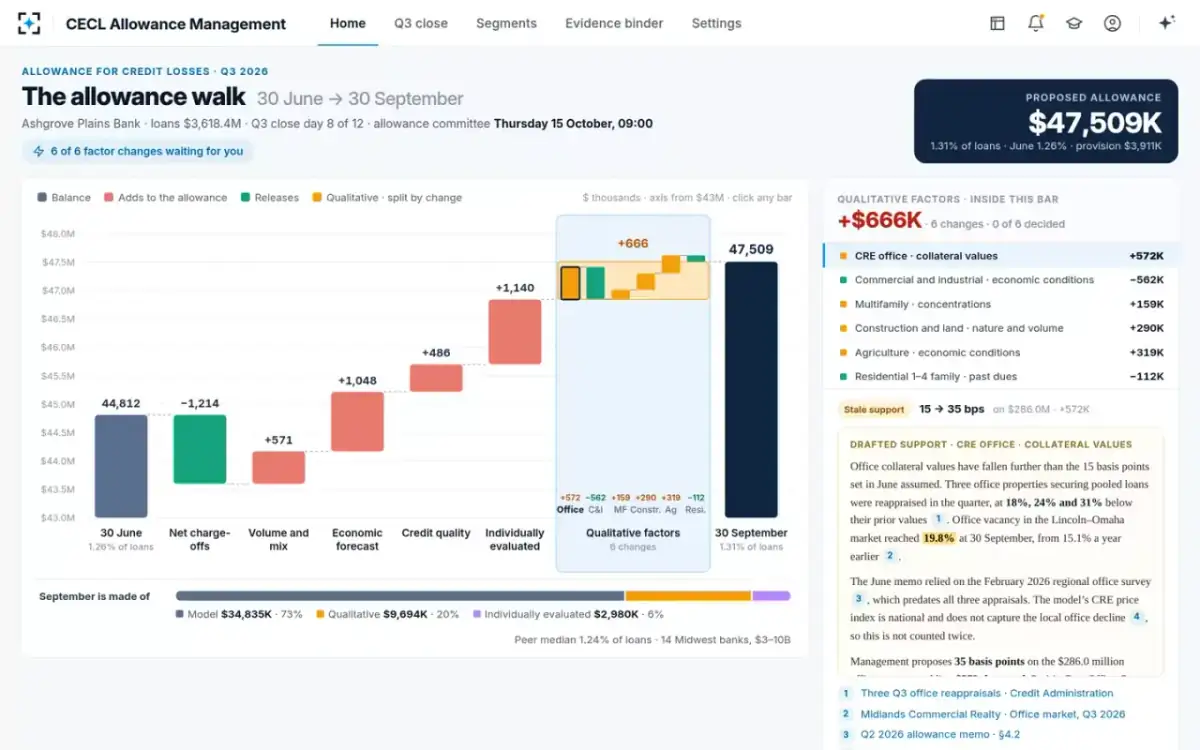
Where one paragraph sits in the quarter's number
A short template you can lift
Six lines, in any order that reads well. If a paragraph has all six it will not be the thing an examiner writes up; if it is missing one, that is the one they will ask about.
Six things a factor paragraph has to carry, and the question each one answers
- The segment and the current factor
Answers “which pool, and what are we changing?” Name the segment, its balance at the reporting date, and the factor in force.
- The evidence, each piece dated
Answers “where did this come from, and when?” Appraisals, market series, internal reports — with the date the bank received them, not the date they describe.
- Why the prior support no longer holds
Answers “what changed since last quarter?” Usually the shortest sentence, and the one that makes the change a decision rather than a drift.
- The arithmetic, written out
Answers “how did the evidence become this number?” Basis points on a stated balance, and the difference from the prior factor in dollars.
- The overlap test against the model
Answers “is this already in the estimate?” Name what the model carries for this segment, and say why this factor is not the same risk.
- The exclusions and the decision
Answers “what is not in here, and who decided?” Any loan reserved individually, and the named person who accepted the change, with the date.
To see all 81 paragraphs drafted in a single run, each with its evidence beside it and its checks shown rather than buried, start from CECL Allowance Management.
Questions people ask
What should a qualitative factor memo contain?
At the level of the whole memo: the segmentation and why it is drawn that way, the method and its key assumptions, the look-back period, each factor with its support, and the decisions taken on each one. At the level of a single factor: the segment and balance, the dated evidence, why the prior support no longer holds, the arithmetic, the overlap test against the model and the exclusions. The policy statement also asks that any adjustments arising from the internal review and challenge process be documented, so the memo should show what changed between draft and final.
Is there a standard template for Q-factor documentation?
No, and the agencies deliberately avoid prescribing one — the Comptroller's Handbook describes documentation ranging from a simple narrative at a noncomplex bank to the assumptions behind a regression at a more analytical one. What is effectively standardised is the content: the examination procedures ask whether the methodology documents how qualitative adjustments are derived and applied, and that question has the same answer whatever the format.
Does every number in the support need a citation?
Every number a reader could not reconstruct does. A balance from the loan tape and a factor from the grid can be checked inside the memo; a vacancy rate, an appraisal value or an unemployment figure cannot, and each needs to name its source and its date. The practical test is whether someone who disagrees with the conclusion can go and look. If a figure has nowhere to be looked up, it is not evidence.
How long should one factor's support be?
Long enough to carry the six parts, which is usually a paragraph of five to eight sentences. Length is not the quality signal — a page of adjectives about market conditions supports nothing, while four sentences with three dated sources and a multiplication support a great deal. Where the evidence is thin, say so plainly and let the factor be smaller, rather than padding.
What happens if the source cannot be refreshed before the close?
Say that in the paragraph and decide deliberately. Holding a factor on evidence a quarter old is a defensible choice if the memo says the evidence is a quarter old, explains why nothing more recent exists and why the factor is still appropriate. What is not defensible is a paragraph that reads as though the February data were current. The first is a documented judgement; the second is the finding.
How long does the qualitative step of a CECL close take?
It varies with how much of the support is gathered by hand. At the fictional sample bank the step ran to five working days of a 19-day close, and the plan with the agents drafting is two — our estimate, not a measured result. The ratio is the useful part: gathering and re-typing evidence takes several times as long as deciding what it means, which is why so many grids are inherited rather than re-argued.