Collateral dependent loans under CECL are loans whose repayment is expected to come substantially from the collateral rather than from the borrower, and their reserve is measured on the fair value of that collateral, less costs to sell, against the loan's amortised cost. Four lines of arithmetic. The difficulty is not the sum: it is that every input has a date, an author and an assumption behind it, and an examiner will ask about each one. CECL Allowance Management is Botminds' solution for the quarterly allowance close, and it opens each of these reserves to the dollar — the balance, the appraisal, the cost-to-sell deduction and the net value — beside the documents they came from.
The worked example comes from a fictional sample bank running through the solution: Ashgrove Plains Bank, third quarter of 2026, with seven loans measured one by one out of a $3,618.4 million book. The bank, the borrowers, the properties and the appraiser are invented, and their figures are sample data rather than a customer's measured result. The regulatory material is real and linked where it appears.
One loan, three numbers, and the gap between them
$8.42M
amortised cost of the loan at the reporting date
$7.92M
as-is appraised value of the office centre securing it, dated 9 September
$1.14M
the reserve, after an 8% deduction for costs to sell
What is a collateral dependent loan under CECL?
The accounting standard defines it by where the money is expected to come from. A collateral-dependent asset is one "for which the repayment is expected to be provided substantially through the operation or sale of the collateral when the borrower, based on management's assessment, is experiencing financial difficulty as of the reporting date" (Comptroller's Handbook, Allowances for Credit Losses). Two conditions, both judged at the reporting date: the borrower is in financial difficulty, and the collateral is substantially where repayment will come from.
The second condition has a test attached. Repayment "would be expected to be provided substantially by the sale or continued operation of the underlying collateral if cash flows to repay the asset from all other available sources (including guarantors) are expected to be no more than nominal." A guarantor with real capacity keeps a loan out of this category; a guarantor on paper does not. That is a credit judgement, and it should be written down with the names and the numbers behind it, because it is the judgement that decides which measurement method the loan is held to.
One regulatory reporting rule removes a choice that the accounting standard otherwise offers. For regulatory reporting purposes the allowance on a collateral-dependent loan is measured on the fair value of the collateral whether or not foreclosure is probable — the agencies require the practical expedient rather than leaving it elective, and they limit that requirement to loans rather than extending it to held-to-maturity securities. A bank that measures collateral-dependent loans on discounted cash flows because foreclosure is not probable will find its call report and its allowance memo disagreeing.
What are individually evaluated loans, and when does a loan leave the pool?
Individual evaluation is a consequence of risk characteristics, not of size. The policy statement puts it in two sentences: a loan that does not share similar risk characteristics with other loans is evaluated on its own, and a loan evaluated on its own is not also included in the collective assessment. What moves a loan out of its pool in the first place — most often a change in its risk rating, one of the characteristics the agencies list — is the subject of individually evaluated loans under CECL, and what moves one; this guide picks up where that one stops, at the measurement.
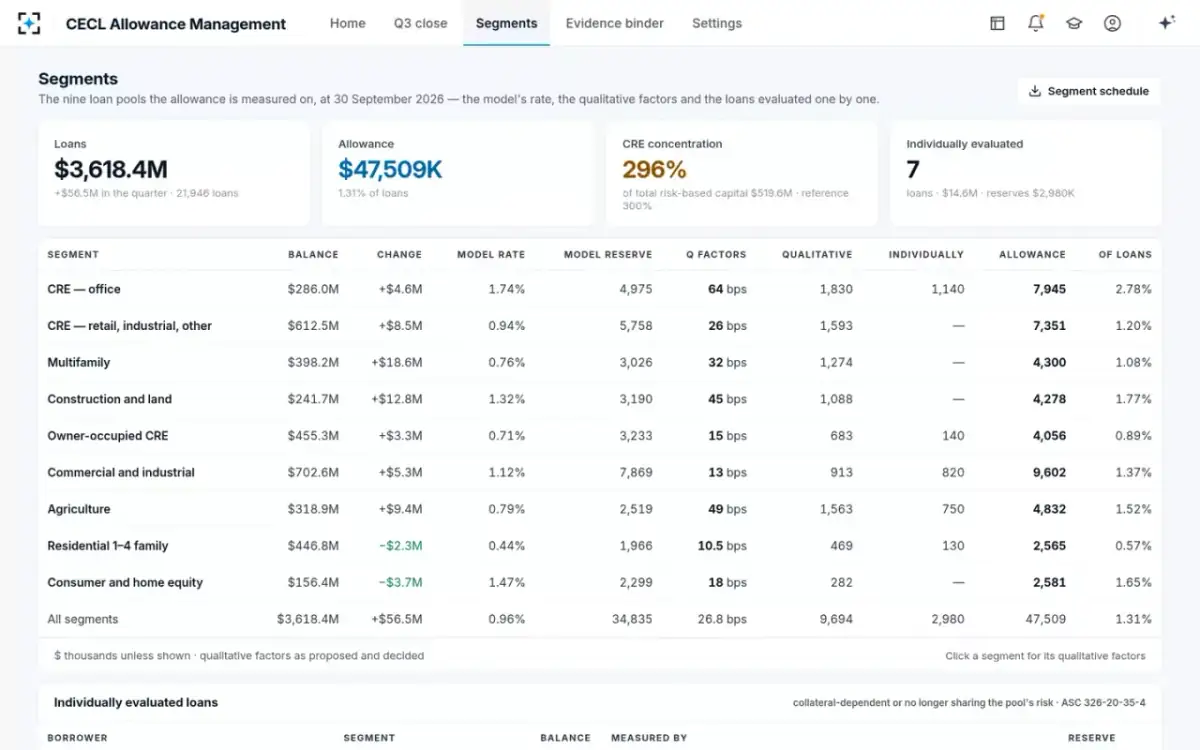
The second sentence is the one that gets broken in practice. A loan pulled out for its own reserve has to come out of the pool it was in, or the bank reserves for it twice — once specifically and once inside the segment's modelled rate and qualitative factors. In the sample quarter the office centre moved to individual evaluation on 8 October, and the factor paragraph covering the office segment names it and excludes it explicitly; that exclusion is part of the written support for the factor rather than a footnote somewhere else.
Most banks also set a size threshold below which a troubled loan stays pooled, because evaluating a $40,000 loan individually costs more than the answer is worth. That threshold is a policy choice — $500,000 at the sample bank, alongside a nonaccrual or substandard trigger — and it needs to be stated in the methodology rather than applied by habit. What it is not is a definition: a $200,000 loan whose risk characteristics have genuinely parted from its pool still has to be dealt with, usually by segmenting it with similar loans rather than by ignoring the difference.
How do you calculate the reserve on a collateral dependent loan?
Fair value of the collateral, less costs to sell where the sale is the repayment, compared with the amortised cost basis. Where the collateral is worth less, the shortfall is the allowance.
The specific reserve, as four terms
Fair value of the collateral
As-is value at the reporting date
From an appraisal or evaluation the bank has reviewed. The basis of value — as-is, as-stabilised, as-completed — matters as much as the figure.
Credit administration
Less estimated costs to sell
Fair value × the bank’s cost-to-sell rate
Required when repayment or satisfaction depends on the sale of the collateral. The rate is the bank’s own assumption and should be supported.
Allowance policy
Against the amortised cost basis
The loan’s carrying amount at the reporting date
Not the original note amount: charge-offs already taken reduce it, and cannot later be reversed.
The loan system
The reserve
Amortised cost − net collateral value
Recorded as an allowance where the difference is positive. Where the net value exceeds the balance, there is no reserve.
Allowance manager
Worked on the sample bank's largest individually evaluated loan, every line opens the document behind it.
One reserve, to the dollar
| Line | Where it comes from | Amount |
|---|---|---|
| Loan balance at 30 September | The loan system, tied to the general ledger in the close | $8,421,800 |
| As-is appraised value, 9 September | Appraisal by an external valuation firm, reviewed by credit administration | $7,915,000 |
| Less costs to sell, 8% | The bank’s own cost-to-sell assumption in its allowance policy | −$633,200 |
| Net collateral value | Fair value less costs to sell | $7,281,800 |
| Reserve: balance less net value | The difference, recorded as an allowance | $1,140,000 |
| Six other loans measured one by one, unchanged from June | Their own appraisals and evaluations, each dated | $1,840,000 |
The bar that opens its own arithmetic
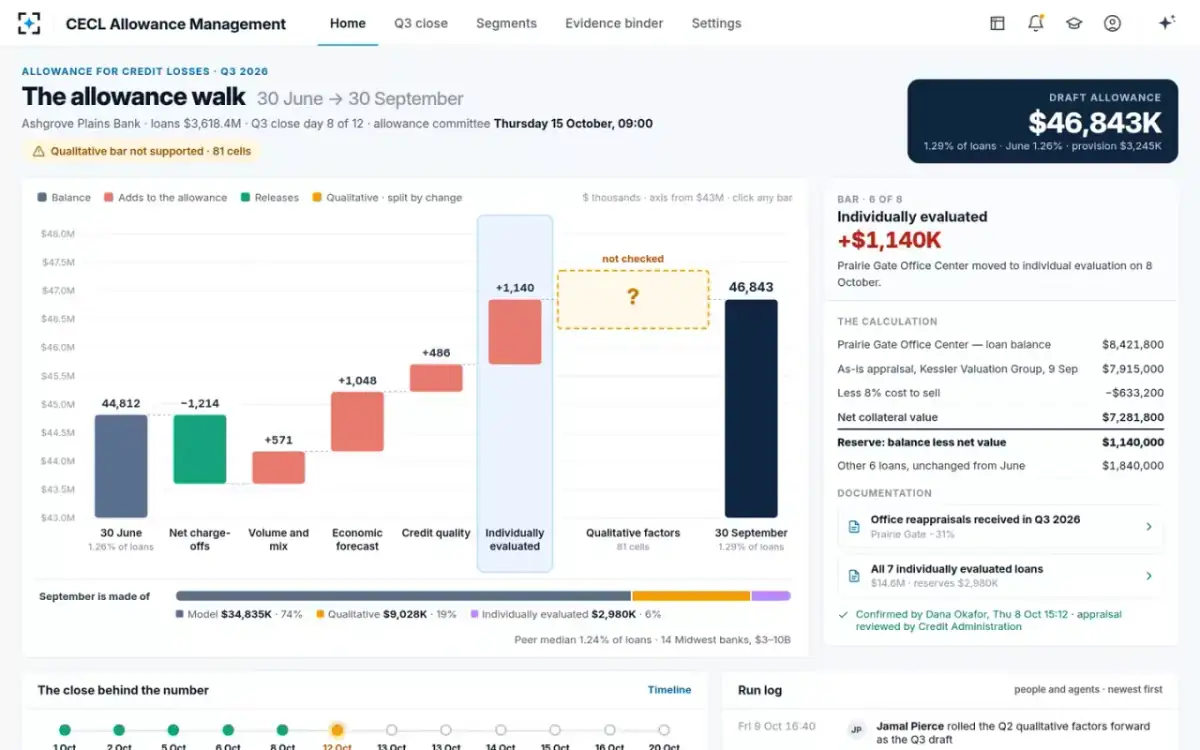
Do you deduct costs to sell from the appraised value?
Yes, when the sale of the collateral is how the loan gets repaid. The policy statement is specific about the condition: "When estimating the ACL for a collateral-dependent loan, FASB ASC Topic 326 requires the fair value of collateral to be adjusted to consider estimated costs to sell if repayment or satisfaction of the loan depends on the sale of the collateral" (Interagency Policy Statement on Allowances for Credit Losses). Where repayment is expected from the continued operation of the collateral — an income-producing property the borrower keeps running — the deduction does not apply.
The rate itself is the bank's assumption, and it is worth stating that plainly in the methodology because nothing in the standard supplies a number. Eight per cent, ten, six: each is defensible with support and indefensible without it. The support is ordinary evidence — brokerage commissions on comparable disposals, legal and closing costs, carrying costs through a realistic marketing period — and it should vary by property type and market rather than sitting as one rate for everything the bank holds.
Two mistakes recur. The first is deducting costs to sell from a value that already reflects a quick sale, which charges the discount twice. The second is applying the deduction to a loan being repaid from operations, which overstates the reserve and makes the schedule harder to defend as a whole, because an examiner who finds one line applied mechanically will test the rest.
How current does an appraisal have to be for CECL?
There is no fixed shelf life, and that is deliberate. The Interagency Appraisal and Evaluation Guidelines put the obligation on the bank to decide: each institution sets its own criteria for whether an existing appraisal or evaluation still reflects the property's market value, and expects those criteria to differ with the condition of the property, the state of the market and the nature of the transaction (Interagency Appraisal and Evaluation Guidelines).
They then list what triggers a new one. The list is worth reading as a quarterly checklist rather than as background, because most of it is observable without leaving the credit file.
When the agencies say an existing appraisal is no longer good enough
“A new appraisal or evaluation is necessary if the originally reported market value has changed due to factors such as:”
- Passage of time.
- Volatility of the local market.
- Changes in terms and availability of financing.
- Natural disasters.
- Limited or over supply of competing properties.
- Improvements to the subject property or competing properties.
- Lack of maintenance of the subject or competing properties.
- Changes in underlying economic and market assumptions, such as capitalization rates and lease terms.
- Changes in zoning, building materials, or technology.
- Environmental contamination.
Read against an office book in 2026, the second, fifth and eighth bullets are doing most of the work: a volatile local market, an oversupply of competing space, and changed capitalisation rates and lease terms. A bank whose criteria say "every three years for commercial property" and nothing else has a policy that cannot respond to any of them. A bank whose criteria add a market-condition trigger — a stated move in vacancy, in capitalisation rates, or a comparable sale materially below the carrying value — has one that can.
Note what the same guidelines ask the credit file to hold when the bank decides an old appraisal still stands: "The documentation in the credit file should provide the facts and analysis to support the institution's conclusion that the existing appraisal or evaluation may be used in the subsequent transaction." Deciding not to reappraise is a decision, and it is evidenced the same way as deciding to.
What happens when a reappraisal comes in lower than the last one
The reserve goes up, in the quarter the value falls, and the policy statement leaves no room for phasing it.
“If the fair value of the collateral as of the ACL evaluation date has decreased since the previous ACL evaluation date, the ACL should be increased to reflect the additional decrease in the fair value of the collateral.”
Interagency Policy Statement on Allowances for Credit Losses
The same passage then requires every such change in value to rest on recent appraisals or evaluations, and that requirement cuts both ways — the second direction is the one that catches teams out. A bank cannot raise a reserve on a general sense that values have fallen, any more than it can lower one on a sense that they have recovered; both movements need a recent appraisal or evaluation behind them. In the sample quarter three office reappraisals arrived at 18%, 24% and 31% below their prior values. One of those properties secured a loan large enough and troubled enough to leave its pool, which produced the $1,140 thousand specific reserve. The other two stayed in the pool, where their effect ran through the collateral-value factor on that segment instead.
That split is worth making explicit in the memo, because the same three appraisals are doing two different jobs. One is evidence for a specific reserve on a named loan; all three are evidence for a factor across a segment. Neither charges for the other, provided the individually evaluated loan is excluded from the factor by name.
When the collateral value rises: the cap nobody expects
If the collateral is worth more at this reporting date than at the last, the allowance comes down — "the increase in the fair value of the collateral is reflected through a reduction in the ACL" — but only so far. The handbook adds the limit in a single sentence: "Any negative ACL that results is capped at the amount previously written off."
In other words, recovery can unwind a reserve, and it can unwind a prior charge-off up to the amount charged off, and it stops there. A loan cannot be written up above its amortised cost basis because the property behind it has appreciated. The mechanism sits alongside the rule that a charged-off basis "cannot be increased at a later date", which exists to stop a bank reversing a charge-off when prospects improve — a practice the handbook calls unacceptable regardless of whether the asset is given a new account number or the borrower signs a new note.
Reserve or charge-off: the line the agencies draw
A specific reserve and a charge-off are not alternatives a bank chooses between on comfort. The handbook puts the trigger on classification: "any asset or portion of an asset that meets the federal banking agencies' loss classification definition should be charged off in the period in which it is classified as a loss", and more generally, "write-offs must be recorded in the period in which the financial assets are deemed uncollectible."
So the sequence is: measure the shortfall between amortised cost and net collateral value; ask whether any part of that shortfall is a confirmed loss rather than an expectation; charge off that part; and hold the rest as an allowance. A bank that carries a large specific reserve quarter after quarter on a loan whose collateral is sold and whose shortfall is known is holding an allowance where a charge-off belongs, and it is one of the simpler things for an examiner to spot, because the reserve's own history tells the story.
Where seven loans sit in a $3.6 billion book
What the examiner looks at in the valuation file
The Comptroller's Handbook sets out what examiners assess on a collateral-dependent asset, and it is short enough to use as the bank's own pre-close review. Three of the four items are about the people and the assumptions rather than about the number.
What examiners assess on a collateral-dependent asset
- How fair value was determined
Whether an appraisal, an evaluation or financial statements were used, and whether that choice fits the asset and the circumstances.
- The quality of the appraisal, and the appraiser’s independence
Not only the value: the expertise and independence of the appraiser or the person performing the evaluation. An appraisal ordered by the relationship manager is a different piece of evidence from one ordered by credit administration.
- The rationale for any adjustments
Where the bank has adjusted the appraised, evaluated or statement value, the supporting reasoning for doing so — written, not assumed.
- The determination of costs to sell
Where the deduction applies, how the rate was arrived at. A single rate used across every property type is the version of this that gets questioned.
- Whether the most recent value is still the fair value today
The handbook notes the most recent market value may differ from fair value at the balance-sheet date, depending on how current the valuation is and what has changed since. Changing market conditions, collateral condition or property use should prompt a review.
The specific reserve as one bar of the quarter
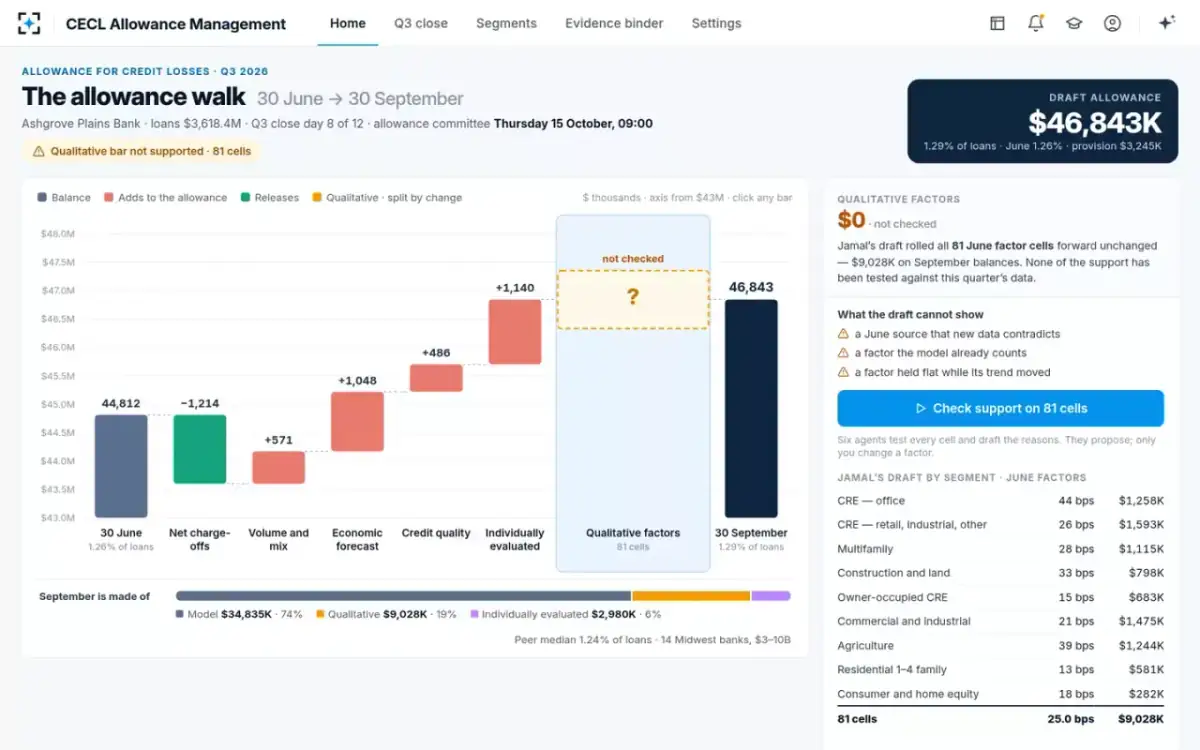
A specific reserve is the one number in the allowance that an examiner can test end to end in ten minutes, which is exactly why it repays being right. To see each of these reserves open its own arithmetic and the appraisal behind it, start from CECL Allowance Management.
Questions people ask
Is a specific reserve the same as a charge-off?
No. A specific reserve is an allowance held against an expected shortfall; a charge-off removes the amount from the loan's amortised cost basis. The agencies tie the charge-off to classification: a portion of an asset that meets the loss classification definition should be charged off in the period it is classified, and write-offs must be recorded in the period the asset is deemed uncollectible. A reserve that has sat unchanged for several quarters on a known, quantified shortfall is usually a charge-off that has not happened yet.
Does every nonaccrual loan have to be individually evaluated?
No. The test is whether the loan still shares similar risk characteristics with the pool it sits in, not whether it is on nonaccrual. Many banks use a nonaccrual or substandard trigger together with a size threshold as a practical screen, which is sensible as long as the methodology says so. What the standard forbids is leaving an individually evaluated loan inside the collective assessment as well.
How often does a collateral dependent loan need a new appraisal?
As often as the bank's own criteria require, and those criteria have to respond to the market rather than only to the calendar. The Interagency Appraisal and Evaluation Guidelines list the triggers — passage of time, volatility of the local market, oversupply of competing properties, changed capitalisation rates and lease terms, among others — and expect the credit file to hold the analysis supporting a decision that an existing appraisal remains valid.
Can the reserve on a collateral dependent loan go down?
Yes, where a recent appraisal or evaluation supports a higher collateral value; the increase is reflected as a reduction in the allowance. The limit is that any negative allowance arising is capped at the amount previously written off, and a charged-off basis can never be increased again. A reduction, like an increase, needs a dated valuation behind it rather than a view.
Do you use the as-is or the as-stabilised appraised value?
The basis of value has to match what the bank is measuring, which for a troubled loan at a reporting date is almost always the as-is value. An as-stabilised or as-completed figure assumes work and time that the reserve is not entitled to assume. Whichever is used, the basis should be named in the schedule beside the value and the date, because two appraisals of the same property on different bases are not comparable and a reader cannot tell them apart from the number alone.
Should the same appraisal support both a specific reserve and a qualitative factor?
It can, as long as the loan carrying the specific reserve is excluded from the pool the factor applies to, and the memo says so. In the sample quarter three office reappraisals supported a segment-wide collateral-value factor, while the one property securing an individually evaluated loan was named and excluded from that factor. The evidence is shared; the dollars are not.