CECL software is sold as one category and is really two. One half calculates the expected credit loss estimate — the segmentation, the loss rates or cash flows, the forecast applied to them. The other half runs the quarter around that calculation: tying the data out, re-proving every qualitative factor, pricing the change, assembling the committee package and leaving a file an auditor can read. Banks arrive in the market with a model that works and a close that does not, and are shown products that replace the half that was fine. CECL Allowance Management is deliberately the second half: it works around the model you already run, reading its results by segment and its driver list, and it does not calculate the model estimate.
Where a screen or a figure below shows numbers, they come from a fictional sample bank in the solution — Ashgrove Plains Bank, $3,618.4M of loans, third quarter 2026 — or are our estimates, marked as such. The regulatory material is quoted and linked at each point.
What is CECL software, and which half of the work does it do?
Start by asking what the product produces when it finishes. If the answer is a loss estimate by segment, it is a model, and everything you already know about model risk applies to it. If the answer is a committee package, a factor schedule with sources attached and an indexed evidence file, it is a process product, and what you should test is the evidence it leaves rather than the number it returns. A few products do both halves; most do one and gesture at the other.
The distinction is not academic, because the two halves fail differently. A model that is wrong produces an estimate nobody can support, and the failure surfaces at validation. A close that is wrong produces a defensible number with no file behind it, and the failure surfaces in the examination or the audit — which is where the sector's actual difficulties have been concentrated. Reviewing nearly 200 community bank examinations, Federal Reserve staff reported that most supervisory concerns and recommendations centred on inadequate documentation of the estimation process or on unsupported qualitative factors — the close half, not the model (Canova and Crouch, Community Banking Connections).
The model half against the close half: what each produces and what it costs you
The model half: A modelled estimate by segment — loss rates or discounted cash flows, with the forecast applied over the chosen horizon.
The close half: A defended estimate: the factor schedule with its support, the bridge, the sensitivity, the committee package and the evidence file.
The model half: Model risk and finance. Validated by an independent reviewer; re-validated when it changes or when its performance drifts.
The close half: The allowance manager and the committee. Tested as a control by internal audit and by the external auditor.
The model half: Mostly setup, then an hour a quarter to run it.
The close half: Most of the close: pulling trend data, re-proving every factor cell, explaining the change, assembling the package.
The model half: A model that does not fit the portfolio, or one validated for another purpose and reused here.
The close half: A number that is right and a file that cannot show why — stale support, a factor the model already carries, a quarter with no record of what was challenged.
The model half: Re-segmentation, parallel runs, a new validation, and a quarter or more of running both.
The close half: A connection to the model’s results and driver list, your policy written as rules, and your last close re-run to compare.
What should CECL software do in a quarterly close?
Six things, and they map onto the steps of a close rather than onto a feature list. It should tie the loan data to the general ledger and stop if it cannot. It should read the model's results and its driver list, so that what the model already carries is known before any adjustment is proposed. It should test every qualitative factor cell against this quarter's data and draft the support with a citation on each number. It should price the change and show it as a bridge that ties, with any unexplained difference displayed rather than absorbed. It should run sensitivity before the committee asks. And it should assemble the package and the evidence file, indexed, so an auditor can start by reading.
Two things it should not do, however capable it is. It should not set an assumption or approve an outcome — those are acts a policy assigns to a named person, and software that performs them removes the attribution a reviewer needs. And it should not post the entry: the provision is the Controller's, booked after the committee has voted.
One quarter as the solution runs it: six sources in, a defended estimate and a file out
Agent
Read six sources, tie out and mapReads the core loan tape, the general ledger, your CECL model’s results and driver list, economic forecasts, appraisals and credit reports, and the prior memos and policy; reconciles the tape to the general ledger by segment and maps new product codes.
Never: Nothing is calculated before the tape ties. A difference above $1 stops the close rather than being absorbed.
Agent
Read what the model carriesRecords the forecast vintage, the local indicators, and the drivers the model version already includes.
Never: Never chooses the scenarios or their weights.
Agent
Test 81 cells and draft the supportChecks each factor cell for a stale source, a driver already in the model and a direction against its own trend, then writes the support with every number citing its source.
Never: Never sets a factor, and never exceeds the caps in your rules.
A person decides
Decide, cell by cellThe allowance manager accepts, changes or rejects each proposed change on the evidence in front of her.
Never: A rejection keeps the prior level and carries a written reason — it is a decision, not a silence.
Agent
Price it, test it, assemble itBuilds the bridge and the ratios, runs the sensitivities, drafts the memo and the minutes, and indexes the evidence file for the auditor.
Never: Never marks anything approved, and never sends the package without the allowance manager.
A person decides
Approve and bookThe committee challenges and votes, by name and time; the Controller books the provision the day after.
Never: No agent posts or changes a journal entry.
Do CECL software vendors replace your model?
Many do, and that is the most consequential thing to establish in the first conversation. Replacing a model is not a configuration exercise: it means re-segmenting the portfolio, running parallel for at least a quarter, commissioning a validation of the new model for the allowance use specifically, and explaining the change in the quarter it lands. If the model you have is validated and fits the book, that is a large cost for no gain in the area where your difficulty actually is.
There is a second reason to be careful about which half you are buying, which the revised model risk guidance brings into focus. It replaced the earlier guidance with a risk-based approach, so the depth of review a model gets now follows the risk it carries (OCC Bulletin 2026-13). A product that produces the estimate brings that discipline with it, scaled to the model's risk. A product that runs the process around the model does not remove the discipline from your institution, but it does not add a second model to it either. Which of those you are signing up for is worth knowing before the proposal, not after. The fuller treatment is in what an independent review has to cover.
How do you choose CECL software: the questions that separate them
Feature lists converge; behaviour under pressure does not. The questions below are the ones whose answers differ most between products, and each has an answer that should give a buyer pause.
Eight questions to ask, and the answer that should worry you
- Which half do you do — the model, or the close around it?
Worrying answer: “both, seamlessly”, with no separate price or scope. Ask which one the implementation plan spends its weeks on.
- Show me a factor cell. Where does each number in its support come from?
Worrying answer: a well-written paragraph with no sources attached. Drafting without citation moves the work rather than reducing it.
- How do you know a factor does not repeat something the model already carries?
Worrying answer: “the analyst checks”. Ask to see the model’s driver list inside the product, and what happens when it changes.
- What does the product do when the bridge does not tie?
Worrying answer: it balances. A difference that disappears without explanation is the one finding you cannot defend.
- Who can change a qualitative factor, and what is recorded when they do?
Worrying answer: anyone with access, and only the new value. Ask whether a rejection is recorded as a decision with a reason.
- What does my external auditor see, and when?
Worrying answer: an export. Ask whether access is read-only, when it opens, and whether an item can be edited after the package is final.
- Which of my rules are settings, and who approves a change to one?
Worrying answer: “we can configure that for you”. A parameter you cannot see the history of is a parameter you cannot evidence.
- Can you run my last close and show me what you would have raised?
Worrying answer: a demonstration on the vendor’s data. Your own quarter is the only test that tells you anything.
Does CECL software handle qualitative factors, or just hold them?
Most products hold them: a grid where a person types basis points by segment, with a free-text box for the reasoning and perhaps a file attachment. That is a better spreadsheet, and a better spreadsheet does not address the finding. Holding a factor is storage; handling one means testing it against this quarter's evidence and saying what is wrong with it.
Three tests make the difference, and they are worth asking to see run live. Is the support current, measured against a staleness rule you set? Is the same information already in the model, measured against the model's own driver list? Does the factor move with its own underlying trend, or has it been held flat while the trend moved? A product that runs those three over every cell every quarter produces a short list of contestable changes; one that stores text produces a memo that looks the same as last quarter's because it is last quarter's.
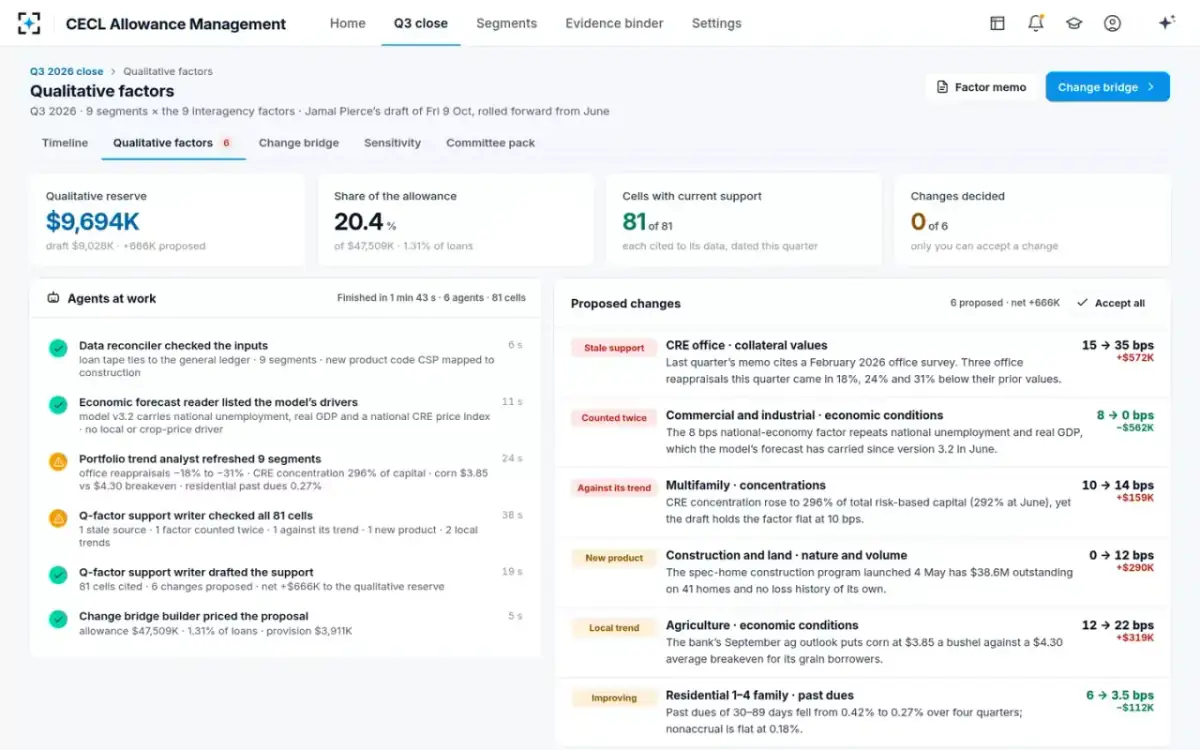
In the sample bank's third quarter all 81 cells are tested and six changes come back, each tagged with the reason it was raised — a source that has gone stale, a factor the model already carries, a factor against its trend, a new product and two local trends. The ones that did not move are evidenced too, which is the half that is usually missing. The underlying discipline is set out in the nine factors and the support each needs.
Eighty-one cells tested, six changes proposed, each with the reason it was raised
What do you need in place before it goes live?
Less than most implementations assume, and the list is worth checking against any proposal that runs to months. You need the model's results by segment and its driver list in a form that can be read each quarter. You need your allowance policy expressed as rules — the staleness limit, the caps per factor and per segment, the concentration reference, the forecast horizon, the individual evaluation threshold. You need last quarter's memo and factor schedule, so the first run has something to compare against. And you need the segment map, including the product codes that have appeared since it was written.
What you do not need is a data warehouse project. The close reads the tape and the general ledger that already exist, and the first useful output is a comparison: what this quarter's close would have raised against what was actually filed. That comparison is also the only honest acceptance test, because it is run on a quarter whose answer you already know.
What a close reads, and what it has to be able to tell you about each one
| What goes in | What it is used for | What the file has to show |
|---|---|---|
| The core loan tape | Balances, product codes, grades and past dues by segment. | That it ties to the general ledger, and how any difference was cleared. |
| The general ledger | The trial balance the tape is tied to. | The reconciliation as at the cut, with its date. |
| Your CECL model | Results by segment, and the driver list every factor is checked against. | Which model version was used, and which drivers it carried that quarter. |
| Economic forecasts | Scenarios, plus state and county indicators for local factors. | The vintage and the source of each series relied on. |
| Appraisals and credit reports | Reappraisals, concentration and delinquency reports behind the factors and the individually evaluated loans. | The date, the preparer and the basis of each one. |
| Prior memos and policy | Last quarter’s factor levels and the rules in force. | Which policy version was in force, and what changed since. |
Who is responsible if a vendor model is wrong?
You are. The handbook leaves no room on this, and it is worth reading before a procurement rather than after an examination.
The bank's use of third parties does not diminish the board and senior management's responsibility to ensure that the activity is performed in a safe and sound manner and complies with applicable laws and regulations.
Comptroller's Handbook, Allowances for Credit Losses, version 2.0, July 2026
The same booklet extends the point to the inputs a third party supplies, requiring that management "validate the relevance and appropriateness of any third-party-provided data or assumptions" (Comptroller's Handbook, Allowances for Credit Losses). A purchased forecast, a peer loss rate, a benchmark factor: each is an assumption you have adopted, and adopting it is your decision whatever the licence says. The booklet itself is current guidance, issued to reflect "the April 2023 revisions to the 'Interagency Policy Statement on Allowances for Credit Losses'" (OCC Bulletin 2026-33).
The practical reading for a buyer is to treat vendor documentation as evidence you have to test rather than as assurance you can rely on. Ask what the product assumes and where those assumptions can be seen. Ask what it would take to reproduce one quarter's output by hand. A product that cannot be re-performed is a product whose output you cannot defend, and the defence is not transferable.
Where this one fits, and where it does not
CECL Allowance Management sits on the close half, and the boundary is worth stating as plainly as the capability. It does not calculate the model estimate, and nothing in it validates your model: it reads the results by segment and the driver list and builds the quarter around them. It does not choose scenarios or weights. It does not change a risk grade, post a journal entry, set a factor or mark anything approved. And it does not make a file compliant with an audit standard — what it produces is evidence an auditor tests.
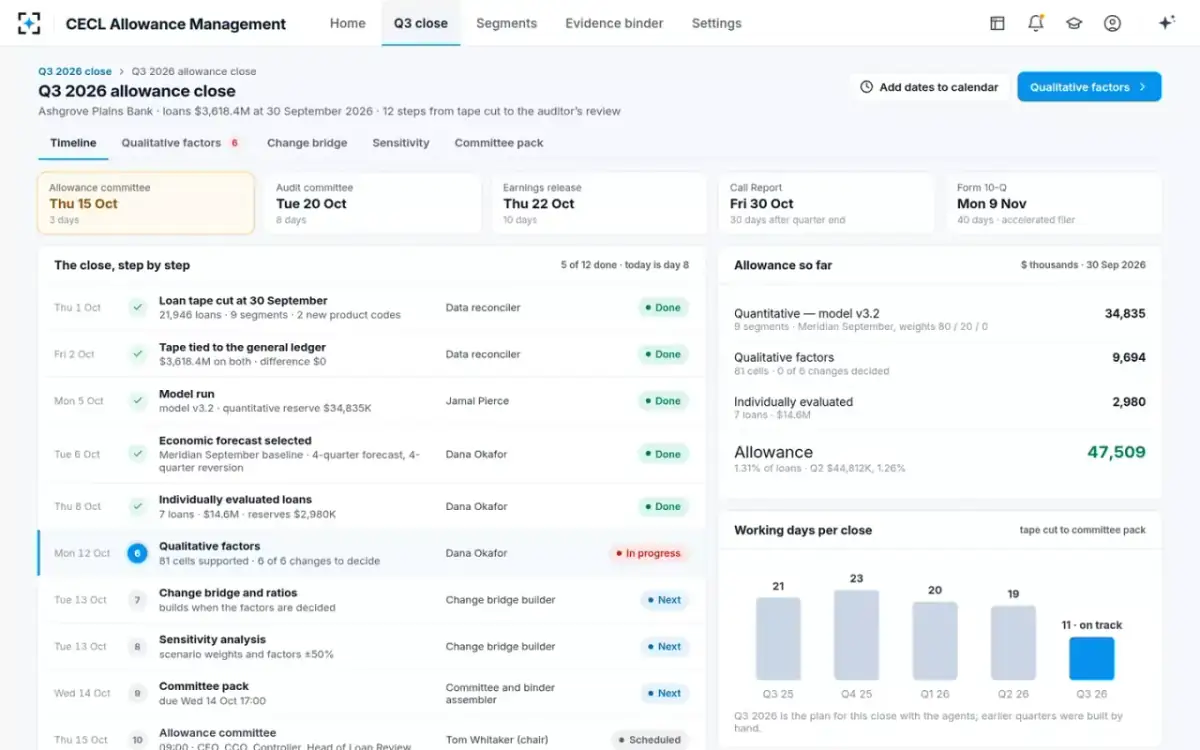
What it does is take the part of the close that consumes the days. In the sample bank, the estimated split of a close by hand runs to 19 working days, with five of them spent re-proving factor support that mostly had not changed; the planned close with the agents is 11, with that step down to two. The gain is not the arithmetic, which was always fast — it is that the quarter ends with the support written, the bridge tying and the file indexed, instead of with three of those still to do.
Where a close's working days go, before and after
Last quarter, by hand — 19 working days
- Tape and model · 15.8%
- Individually evaluated · 10.5%
- Trend data, nine segments · 21.1%
- Re-proving factor support · 26.3%
- Bridge and sensitivity · 10.5%
- Memo, package and file · 15.8%
This quarter, planned — 11 working days
- Tape and model · 27.3%
- Individually evaluated · 18.2%
- Trend data, nine segments · 9.1%
- Re-proving factor support · 18.2%
- Bridge and sensitivity · 9.1%
- Memo, package and file · 18.1%
The close as a calendar, with an owner and a date on every step
What a trial on your own last close should prove
Run it on a quarter you have already filed, and judge it on four things. First, what it raises: how many of the factor cells it flags, and whether the flags are ones you would have defended differently had you seen them in time. Second, what it cites: pick three numbers from the drafted support and follow them to their sources. Third, what it refuses to do: try to set a factor from the software, try to make the bridge tie, try to mark something approved. Fourth, what it leaves behind: open the evidence file as an auditor would, pick an open request from last year's list, and see whether it resolves to an item.
That last test is the one that predicts the next audit. The sector-level stakes are not small — the FDIC reports industry reserve balances "remained largely stable at $223.9 billion (down $153.5 million or 0.1 percent)" in the second quarter of 2026 (FDIC Quarterly Banking Profile, second quarter 2026) — but the stake for one bank is narrower and sharper: a quarterly estimate that has to be defended three times, to a committee, an auditor and an examiner. The file is the defence, and whether a product builds it as the quarter runs is visible in an afternoon on your own data.
The number the quarter has to defend, drawn as a walk
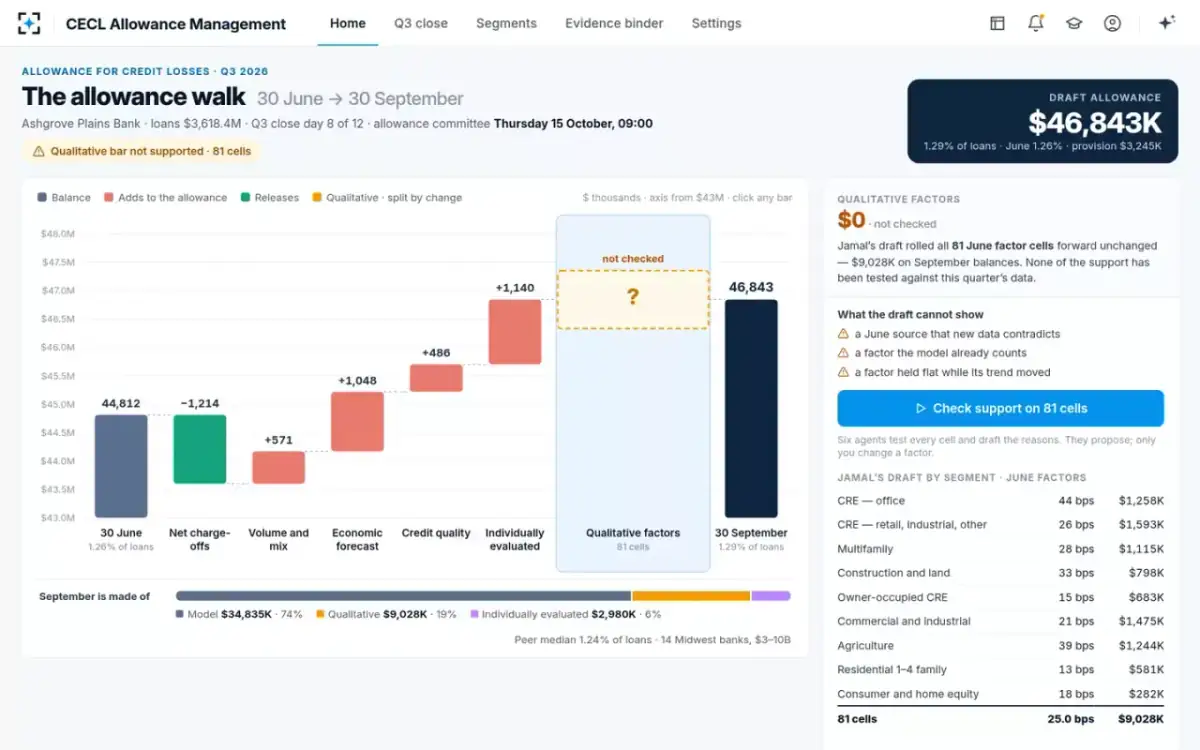
What the draft cannot show: a source that new data contradicts, a factor the model already counts, a factor held flat while its trend moved.
What the quarter leaves behind, and what the auditor opens first
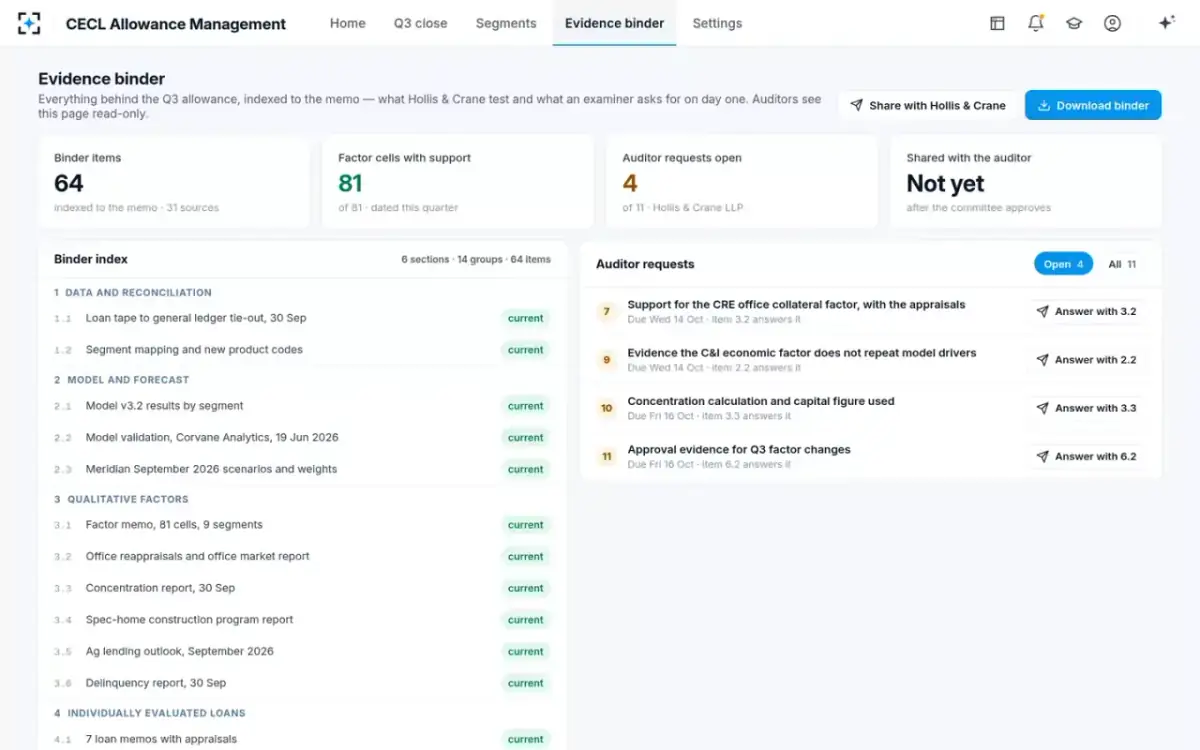
If the close is the half of the work that costs you the quarter, ask for it on your own last close and read what comes back. Start from CECL Allowance Management, or follow the request list your auditor works from to see what the file is judged against.
Questions people ask
Is CECL software required?
No. Nothing in the accounting standard or the agencies' guidance requires a particular tool, and many institutions run the estimate in spreadsheets. What is expected is that the estimate be supported and well documented — Federal Reserve staff reviewing community bank examinations found that most supervisory concerns centred on inadequate documentation of the estimation process or unsupported qualitative factors, which is a statement about evidence rather than about tooling.
How much of a close does a product actually save?
It depends entirely on which half it does. The steps built of re-derivation — pulling trend data, re-proving factor support, rebuilding the bridge, assembling the file — are the ones that compress. The steps built of judgement do not, and a vendor that claims they do is describing something you should not buy.
Can CECL software write the committee memo?
It can draft one from decisions that have already been taken, with each number citing the source it came from. The distinction that matters is the order: a memo drafted from the decisions is a record, while a memo written first and evidenced afterwards is an argument. Ask which way round the product works, and whether the draft can be sent without the allowance manager.
Does a product need access to our core system?
It needs the loan tape and the general ledger, plus the model's results and driver list, the forecast, the appraisal and concentration reports and the prior memo. That is usually a scheduled extract rather than a live connection, and the requirement that matters more than the plumbing is the tie-out: nothing should be calculated before the tape reconciles to the general ledger.
What should a proof of concept cover?
A quarter you have already filed, so you can compare. Look at what it flags and whether you would have wanted to know, follow three cited numbers to their sources, confirm the software refuses to set a factor or approve anything, and open the evidence file against a real request from your last audit.
Does CECL Allowance Management replace our CECL model?
No. It works around the model you already run, reading its results by segment and its driver list, and builds the qualitative factors, the bridge, the sensitivity, the committee package and the evidence file on top of them. It never posts a journal entry, changes a risk grade, sets a factor or marks anything approved.