CECL governance is the written answer to four questions about one number: who may propose a change to the allowance for credit losses, who may challenge it, who decides, and who approves the result. The agencies do not prescribe the structure, but they do say the board or a committee of it oversees management's judgements, and that the evidence of that oversight is examined. In most banks the chain itself is sound and the record of it is thin — a committee met, the allowance was approved, and the minute that survives cannot show what was questioned. CECL Allowance Management is built around that gap: six agents check, draft and assemble, every factor decision lands on an audit trail with a name and a time, and nothing in the software is allowed to approve anything.
The quarter used throughout is a fictional sample bank in the solution — Ashgrove Plains Bank, $3,618.4M of loans, with an allowance committee of four and an allowance of $47,509K for the third quarter of 2026. The people named are characters. The rules are the agencies' own, linked where they appear.
What does CECL governance mean in practice?
It means that every judgement inside the estimate has an owner, a challenger and a record, and that the three are different things. The interagency policy statement puts the top of the chain where it belongs: "The board of directors, or a committee thereof, is responsible for overseeing management's significant judgments and estimates used in determining appropriate ACLs" (Interagency Policy Statement on Allowances for Credit Losses). Oversight is not the same as approval and neither is the same as preparation; a bank whose chief financial officer prepares the estimate, chairs the committee that approves it and writes the minutes has one act performed three times rather than three acts.
Underneath the board, the useful unit of governance is the individual judgement, not the quarterly total. A qualitative factor that moves from 15 to 35 basis points is a decision with a dollar value, a maker, a reason and a date. An allowance that moves from $44,812K to $47,509K is an outcome. Governance that operates on outcomes approves a number; governance that operates on judgements can be tested, which is what a reviewer actually does.
Five seats around one quarter, and what each one owns
Today
Pulls trend data for nine segments and rolls the prior memo forward, then spends the close re-proving numbers nobody changed.
With agents
Hands over the draft and gets back every factor cell refreshed and cited, with only the ones that moved left to work on.
Still theirs: Owns the preparation. Proposes nothing to committee in his own name.
Today
Presents to the committee on support she has not had time to re-test, and defends it from memory.
With agents
Starts the qualitative step with all 81 factor cells checked and the proposed changes drafted with their sources.
Still theirs: The only person who accepts, changes or rejects a factor change. A rejection keeps the prior level, with a written reason.
Today
Waits on a spreadsheet bridge before the earnings release and the regulatory filing.
With agents
Sees a bridge that ties to the segment schedule with the unexplained difference shown, and books the provision the day after the committee meets.
Still theirs: Books the entry, and approves changes to the rules the factors are tested against.
Today
Gets a thick package the night before and asks what moved, in one page.
With agents
Reads one memo with every number citing its source and the sensitivity already run.
Still theirs: Chairs the challenge. Votes, by name and time, with the rest of the committee.
Today
Tests the qualitative factors as a critical audit matter, request by request, over several weeks.
With agents
Opens a read-only binder indexed to the memo, each open request answered by the item that supports it.
Still theirs: Tests the estimate and the controls over it. Never part of the chain that sets it.
Who approves the allowance for credit losses?
Management determines it; the board, or a committee the board has delegated to, approves and oversees it; and both halves are examined. The handbook's examination procedure is specific about the timing: "Determine whether ACL policies provide for a board review of management's assessment of the appropriateness of ACLs each quarter before completion of the call report" (Comptroller's Handbook, Allowances for Credit Losses). That sentence rules out two common arrangements — a board that reviews the allowance annually, and a board that reviews it after the regulatory filing has gone.
Between management and the board most banks put a management allowance committee, which is where the real challenge happens and where membership matters. A committee drawn entirely from finance will test the arithmetic; one that includes credit will test whether the factors match what the portfolio is doing. The sample bank's four seats — finance, credit, the controllership and loan review — are a workable minimum, and the quorum rule matters as much as the roster: a committee that can approve with one person present has a quorum rule that does nothing.
One quarter's chain of authority, step by step, with the line software may not cross
Agent
Reconcile the dataTies the loan tape to the general ledger by segment and maps new product codes before anything is calculated.
Never: Never posts or changes a journal entry. A difference above $1 stops the close.
Agent
Read the forecastRecords the forecast vintage, the local indicators and which drivers the model already carries.
Never: Never chooses scenarios or weights.
Agent
Refresh the trendsGrades, past dues, nonaccrual, growth, concentrations and new products by segment, quarter over quarter, each figure dated and cited.
Never: Never changes a risk grade.
Agent
Check and draft the supportTests every factor cell for a stale source, a driver the model already carries and a direction that contradicts its own trend, then drafts the written support with citations.
Never: Never sets a factor. Proposes only, and stays inside the caps.
A person decides
Decide each factorThe allowance manager accepts, changes or rejects every proposed change, one at a time, on the evidence in front of her.
Never: A rejection is a decision too: it keeps the prior level and needs a written reason.
Agent
Price it and test itBuilds the quarter-over-quarter bridge, the ratio analysis and the sensitivities to scenario weights and to all factors at ±25% and ±50%.
Never: Never forces the bridge to tie — an unexplained difference is shown, not absorbed.
Agent
Assemble the packageDrafts the committee memo and the minutes from the decisions, and indexes the evidence binder for the auditor.
Never: Never marks anything approved, and never sends the package without the allowance manager.
A person decides
Challenge and approveThe committee reviews, challenges and votes; each vote is recorded with its name and time, and the minutes move from draft to final.
Never: Never approves an estimate whose support it has not seen. The provision is booked by the Controller afterwards.
What is review and challenge, and what does it leave behind?
Review and challenge is the act of a second party testing management's assumptions before the estimate is approved, and the handbook describes it as part of what board or committee oversight consists of: these activities "may include reviewing and challenging the assumptions used in estimating expected credit losses and designing and executing effective internal controls over the credit loss estimation methods" (Comptroller's Handbook, Allowances for Credit Losses).
The word that carries the weight is challenge. A committee that receives a package, asks two clarifying questions and approves has reviewed. A committee that asks why the office collateral factor doubled when the national index barely moved, hears the answer, and either accepts it or sends it back has challenged. The difference is visible only in what is written down, which is why challenge and the record of it are, for practical purposes, the same control.
A useful discipline is to make the challenge visible in the package before the meeting. The sample bank's memo lists each proposed change with its tag — a source that has gone stale, a factor the model already carries, a factor moving against its own trend — so the committee arrives knowing which three of the quarter's six changes are contestable and why. The one that most often is contestable is the removal; the factor the model already carries is worked through there.
What should allowance committee minutes contain?
Enough for someone who was not in the room to re-perform the committee's judgement. The clearest statement of the standard comes from the other side of the table. In its review of bank audits, the PCAOB found that "some auditors limited their review to obtaining and reading copies of committee meeting minutes that did not provide sufficient detail to allow the auditor to evaluate the design and operating effectiveness of the control" (PCAOB, Spotlight: Bank Financial Reporting Audits).
Read that as a specification rather than a criticism. If the minute cannot show the control operating, the control did not operate as far as the file is concerned, however well the meeting actually went. Six things close that gap, and none of them lengthens a minute by more than a paragraph.
What a defensible set of allowance committee minutes records
- Who was present, and whether the quorum was met
By name and role, with absences noted. A committee of four with a quorum of three has to show which three.
- What was put in front of them, and when they got it
The memo, the bridge, the sensitivity and the factor schedule, with the date and time they were circulated. A package handed out in the room is not a reviewed package.
- What was challenged, by whom, and what the answer was
Named. "The chief credit officer questioned the office collateral factor" is a record; "the committee discussed the qualitative factors" is not.
- What changed as a result of the meeting
Including the changes that were not made, and why. A committee that changes nothing every quarter is a finding waiting to be written.
- The vote, by name and time
Who voted which way, not a collective assent. Dissent, if any, with the reason given.
- What the committee relied on that it did not see
Work taken on trust — the model validation, the appraisal review — named, so the chain to the evidence is unbroken.
The committee package, the approval list and the minutes, in one place
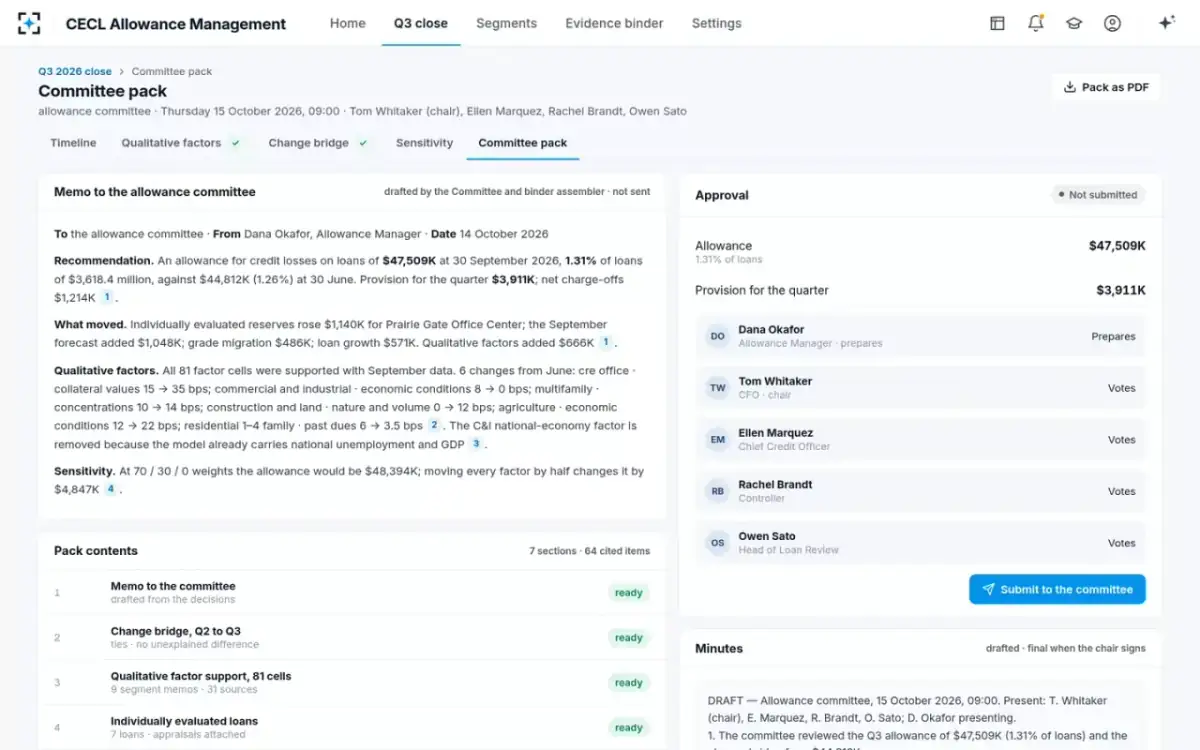
The assembler never marks anything approved — the committee's vote is recorded by name and time.
How often should the board review the allowance?
Every quarter, before the regulatory filing goes. That is the examination procedure quoted above, and the reason behind it is that the allowance is the estimate most exposed to management judgement in the financial statements; a board that sees it after the filing is reviewing a decision it cannot change. For a credit union the cadence is the same and the supervisory attention is current: the NCUA's 2026 priorities name, among the lending areas examiners may review, "the sufficiency of credit administration, including loan underwriting, loss mitigation programs (including loan modifications and workouts), Allowance for Credit Loss reserves and methodologies, and charge-off practices" (NCUA Letter to Credit Unions 26-CU-01).
What the board sees matters as much as how often. A single page showing the allowance, the change from last quarter with its causes, the qualitative share, the ratios and the sensitivity gives a non-executive something to challenge. A twelve-page appendix of segment tables does not. And the oversight is itself evidence: "Evidence of the board of directors' oversight activities is subject to review by examiners" (Interagency Policy Statement on Allowances for Credit Losses), which is a reminder that the board's minute is part of the allowance file, not a separate corporate record.
Who can change a qualitative factor — and who cannot
One named person, under the policy, on the evidence, with the change recorded. In the sample bank that is the allowance manager, and the rule is absolute in both directions: no agent sets a factor, and no one else accepts one. The analyst who prepares the schedules cannot move a cell; the committee can send a factor back but does not edit it in the meeting; the Controller approves changes to the rules rather than to the factors themselves.
The rejection path is the one worth building carefully, because it is where governance usually leaks. If rejecting a proposed change simply leaves the cell as it was, the file shows nothing and the examiner sees a factor that did not move. If a rejection is itself a decision — the prior level is kept, a written reason is attached, and the whole thing lands on the audit trail with a name and a time — then the quarter in which nothing changed is as well evidenced as the quarter in which everything did. That is the harder half of the support one factor owes.
Eighty-one cells, six proposed changes, and one person who may accept them
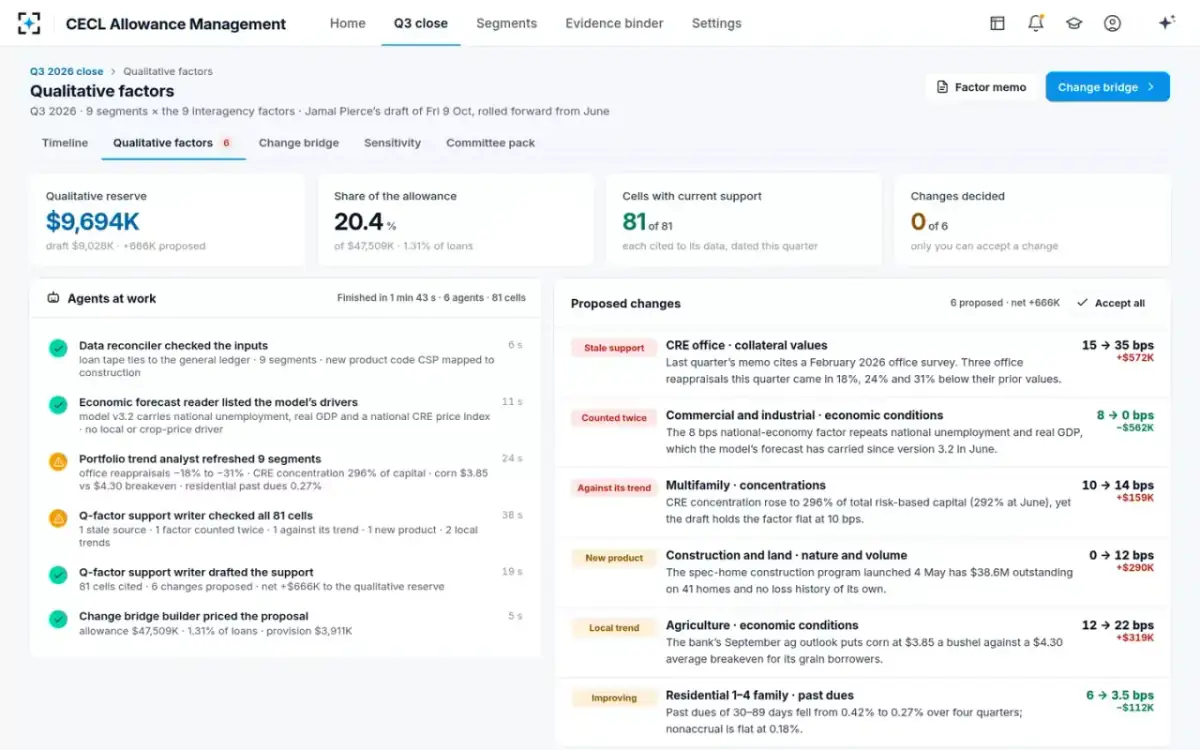
Where software stops: proposing is not deciding
The line that matters when agents enter a close is not technical but constitutional. Software may read, check, calculate, draft and assemble. It may not set an assumption, approve an outcome or post an entry. Those three are the acts a policy assigns to a person, and the reason has nothing to do with capability: an act that cannot be attributed to a named person cannot be challenged, and an estimate whose judgements cannot be challenged is not governed.
Written into a product, the line becomes a list of limits rather than a principle. The reconciler never posts or changes a journal entry. The forecast reader never chooses scenarios or weights. The trend analyst never changes a risk grade. The support writer never sets a factor and never exceeds the caps. The bridge builder never forces the bridge to tie; where there is an unexplained difference it shows it. The assembler never marks anything approved and never sends the package without the allowance manager. Each limit is negative, which is what makes it testable — a reviewer can look for the thing that should never appear.
What belongs in a CECL policy, and what belongs in a setting
A policy should carry the things that must not change quietly: who is on the committee and what its quorum is, who may accept a factor change, who approves the rules, what the board sees and when, the methodology by segment, and the principle that no factor may repeat something the model already carries. These are statements about authority, and a change to any of them is a change to the control environment.
A parameter is different. When a source goes stale, the cap on one factor, the cap on a segment, the concentration reference, the forecast horizon and the threshold above which a loan is individually evaluated are all numbers that should be reviewable, versioned and approved — but burying them in a policy document means they are revised once a year regardless of what the evidence says. The workable split is to name the parameter in the policy, state who approves a change to it, and hold the value where its history is visible.
Authority or parameter: where each decision should live, and who touches it
| The decision | Where it belongs | Who may change it |
|---|---|---|
| Committee membership and quorum | The written policy | The board, or the committee the board delegated to |
| Who may accept a factor change | The written policy | The board or its committee — never the person who holds the authority |
| When the board sees the allowance | The written policy | The board, against the quarterly examination procedure |
| When a source goes stale | A versioned parameter | The Controller, with the change on the audit trail |
| Cap on one factor, cap on a segment | A versioned parameter | The Controller, with the change on the audit trail |
| The reasonable and supportable period | A versioned parameter named in the policy | The Controller, after the assumption review |
| Individual evaluation threshold | A versioned parameter named in the policy | The Controller, with the effect on the estimate shown |
The rules the factors are tested against, each with its own history
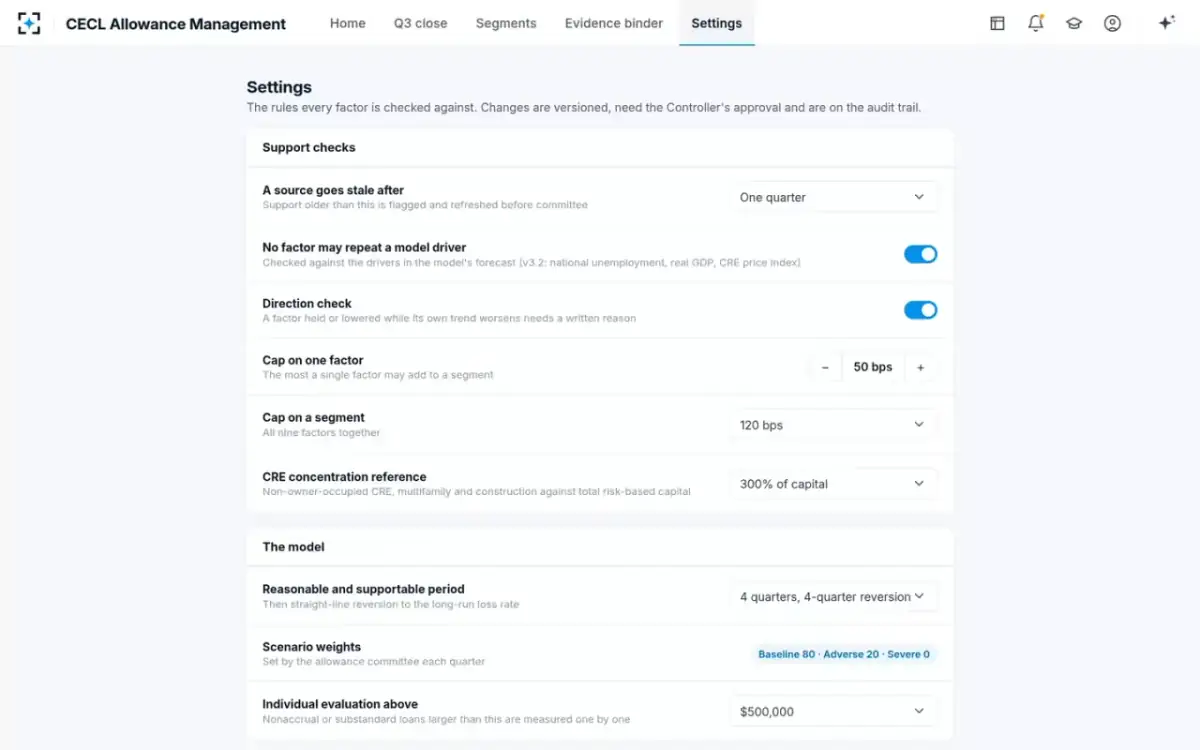
The audit trail the examiner reads before the memo
A memo is an argument; an audit trail is what happened. An experienced examiner or validator reads the second first, because the order in which decisions were taken often says more than the conclusion. A factor that was proposed on Monday, rejected on Tuesday, re-proposed at a different level on Wednesday and accepted on Thursday tells a story the memo will not. So does a quarter in which every proposed change was accepted without exception, and so does one in which the only changes accepted were the ones that lowered the allowance.
The policy statement sets the examiner's standing to look: "Management's evaluations are subject to review by examiners" (Interagency Policy Statement on Allowances for Credit Losses). The practical consequence is that a decision log should be designed to be read by someone sceptical, which means it has to keep the decisions that were not taken, carry a time as well as a date, and be impossible to edit after the fact. In the sample bank every factor decision — accepted, changed or rejected — goes to the trail, the trail goes into the evidence binder, and the external auditor sees the binder read-only from the day the package is final. What the auditor then does with it is the request list, item by item.
To see the chain run on one quarter — the proposals, the decisions, the votes by name and the trail underneath — start from CECL Allowance Management.
Questions people ask
Does the board have to approve the allowance, or just oversee it?
The policy statement makes the board, or a committee of it, responsible for overseeing management's significant judgements and estimates. The OCC's examination procedures go further on timing, asking whether policies provide for a board review of management's assessment each quarter before the call report is completed. Many banks delegate the detailed challenge to a management committee and keep a quarterly board review above it.
Can the same person prepare and approve the allowance?
It defeats the control. Preparation, challenge and approval are three different acts, and a reviewer tests whether they were performed by different people. Where a small institution cannot fully separate them, the usual answer is to strengthen what is compensating — an independent reviewer of the estimate, a credit officer outside finance on the committee, and minutes detailed enough to show the challenge actually happened.
What happens when a proposed factor change is rejected?
The prior level stands and the rejection is recorded as a decision with its reason, not as an absence; if the committee disagrees, it sends the factor back to the person who decides rather than editing it in the meeting. This matters because the file has to explain the factors that did not move as well as the ones that did; a cell that stayed at 15 basis points for four quarters with no written reason is indistinguishable, in a review, from one nobody looked at.
How detailed do allowance committee minutes have to be?
Detailed enough that someone who was not present can see the control operating: who attended, what they were given and when, what was challenged and by whom, what changed, and who voted which way. The PCAOB has reported auditors who could not evaluate the design and operating effectiveness of a control from the minutes they were given, which is the practical test to write against.
Can an agent set a qualitative factor?
Not in a governed process. Software can test a factor against this quarter's data, flag a stale source or a driver the model already carries, draft the support and price the change — all of which is preparation. Setting the factor is a judgement that has to be attributable to a named person, because an unattributable judgement cannot be challenged or examined.
Who is accountable when a third party does part of the work?
The board and senior management remain accountable. The OCC's handbook states that a bank's use of third parties does not diminish their responsibility to ensure the activity is performed in a safe and sound manner and complies with applicable laws and regulations. In an allowance context that covers vendor models, outsourced validations and any software that prepares the estimate.