The reasonable and supportable forecast in CECL is the part of a loan's remaining life for which a bank is willing to forecast economic conditions and show its work; beyond it, the estimate reverts to historical loss information. Nothing in the standard sets the length. Four quarters and eight are both defensible choices, and the risk is that whichever is chosen gets written once into a policy and never argued again — a problem, because supervisors treat it as an assumption with governance around it, not a policy election, and because the quarters after it often carry more of the allowance than the forecast itself. CECL Allowance Management runs the quarterly close around the model you already run, holds the forecast period and the reversion as versioned settings, and puts the sensitivity that tests both in front of the committee before it is asked for.
The worked figures on this page come from a fictional sample bank in the solution: Ashgrove Plains Bank, $3,618.4M of loans, third quarter 2026, with an allowance of $47,509K. The rules and the research are from the agencies and from published Federal Reserve work, linked where they appear.
What is the reasonable and supportable forecast period in CECL?
It is the horizon over which management believes it can make an economic forecast it can support with evidence, applied to the drivers the model uses — unemployment, GDP, property prices, whatever the segment's model takes. Inside the period, the estimate is forward-looking. Outside it, it is not. The interagency policy statement puts the boundary plainly: "When the contractual term of a financial asset extends beyond the reasonable and supportable period, FASB ASC Topic 326 requires reverting to historical loss information, or an appropriate proxy, for those periods beyond the reasonable and supportable forecast period (often referred to as the reversion period)" (Interagency Policy Statement on Allowances for Credit Losses).
Two things follow from that sentence, and both are easy to miss. The first is that the period is a property of the forecast, not of the loan: the same four quarters apply to a five-year term loan and a fifteen-year mortgage. The second is that the reversion is not an edge case to be handled later. On a portfolio with any duration at all, most of the quarters in the estimate sit beyond the forecast, and the assumption that governs them is the one nobody discusses at committee.
Where the quarters of a five-year estimate actually come from
- Forecast4 qtrs
- Reversion ramp4 qtrs
- Historical loss information12 qtrs
- Forecast8 qtrs
- Reversion ramp4 qtrs
- Historical loss information8 qtrs
- Forecast4 qtrs
- Historical loss information16 qtrs
How long should a reasonable and supportable period be?
Long enough that management can defend the forecast, and no longer. In practice that means asking what the bank actually has: a purchased or in-house forecast with a stated vintage, drivers that match the segments, and some history of how that forecaster has done. A bank that buys a four-quarter forecast and reads an eight-quarter one out of the same subscription has not extended its period; it has extended its exposure to a number it cannot support.
What the period may not be is zero. The OCC's handbook is direct about the floor: "It is generally inappropriate for management to assert that it cannot develop a reasonable and supportable forecast of any length of time and instead rely solely on historical loss information with no consideration of forward-looking information" (Comptroller's Handbook, Allowances for Credit Losses). A one-quarter period that is genuinely supported is an answer. A period of none is not.
Beyond that floor, the honest test is comparative. Set the two candidate settings side by side and ask what each obliges you to produce every quarter, for as long as you keep it.
Four quarters against eight: what each setting asks you to support, every quarter
Four quarters, four-quarter reversion: One year of each driver, with the vintage and the forecaster named — the horizon over which a forecaster’s track record is easiest to show.
Eight quarters, four-quarter reversion: Two years of each driver. The second year is where forecast error grows fastest, and where a reviewer will ask what the forecaster’s record is at that horizon.
Four quarters, four-quarter reversion: Larger. On a five-year term, twelve of twenty quarters sit beyond the ramp, so the historical loss information and its relevance carry most of the weight.
Eight quarters, four-quarter reversion: Smaller. Eight of twenty quarters, so the forecast carries more and the reversion carries less.
Four quarters, four-quarter reversion: The near-term forecast and the qualitative factors. The far tail is stable, which makes the estimate steadier but less responsive.
Eight quarters, four-quarter reversion: The forecast, including its second year. More responsive to a turn, and noisier when the forecast is revised.
Four quarters, four-quarter reversion: Mostly the reversion: when it starts, how it ramps, and whether the historical period used is relevant to today’s portfolio.
Eight quarters, four-quarter reversion: Mostly the forecast: back-testing at both horizons, and whether the second year is supported or extrapolated.
Four quarters, four-quarter reversion: A short period hands a large part of the answer to an assumption that is rarely re-argued.
Eight quarters, four-quarter reversion: A long period puts more of the answer in a forecast that is revised every quarter, and every revision has to be explained in the bridge.
Why the length is an assumption, not a policy election
This distinction decides who has to approve the number and how often it is revisited, and the Comptroller's Handbook draws it in a single sentence, which adds in brackets that the period should be governed the way management governs its other methodology assumptions.
The length of the forecast period is not an accounting policy election but rather an assumption in ACL methodologies that should be subjected to appropriate governance and controls …
Comptroller's Handbook, Allowances for Credit Losses, version 2.0, July 2026
An accounting policy election is chosen once, disclosed, and changed only with a reason and a trail. An assumption is tested every time the estimate is made. The practical difference shows up in three places: the period belongs in the quarterly assumption review alongside the loss drivers and the qualitative factors, not only in the annual policy refresh; a change to it is a change in estimate to be explained, not a restatement question; and the person who may change it is a named person under the policy rather than whoever is editing the spreadsheet. Who that person is, and what else they may and may not touch, is the subject of CECL governance: who proposes, who decides, who approves.
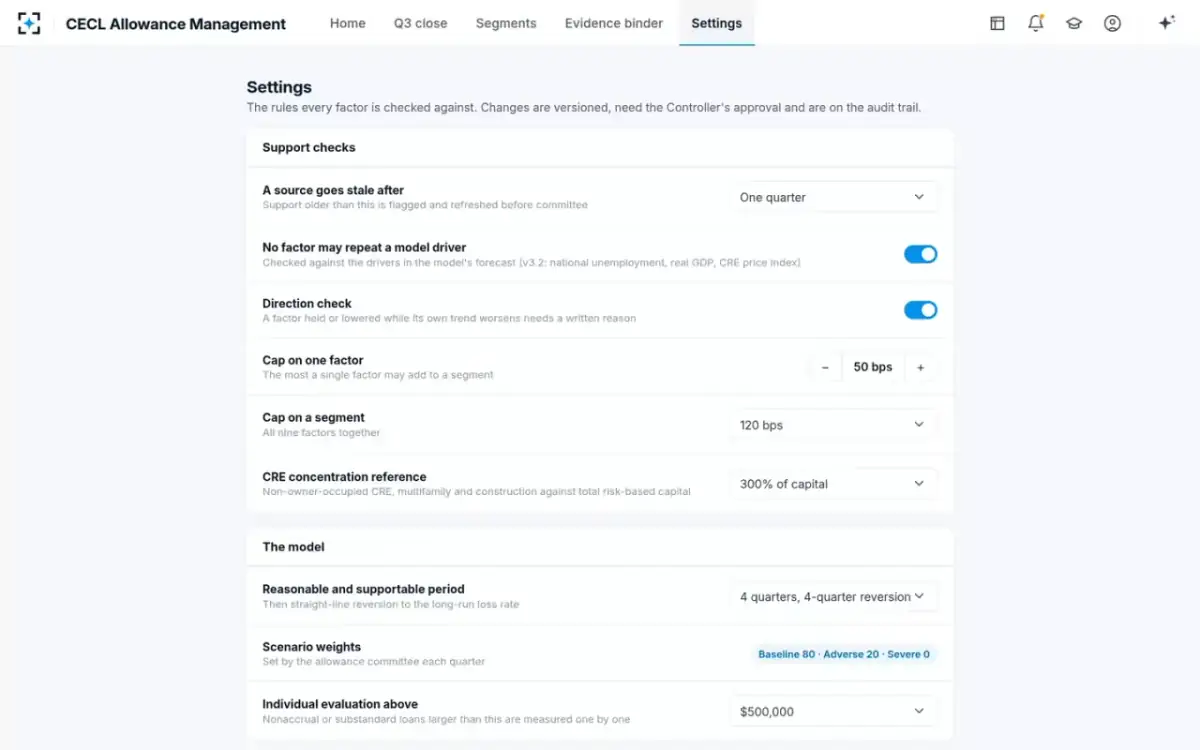
In the solution the period is a setting rather than a sentence in a document. The sample bank runs four quarters with a four-quarter reversion; the alternatives in the same row are eight quarters with a four-quarter reversion, and four quarters with immediate reversion. Changing the row is versioned, needs the Controller's approval, and lands on the audit trail that goes into the evidence binder — so the question "when did we move to eight quarters, and who agreed?" has an answer that is not a memory.
The forecast period as a setting with a history, not a line in a policy document
What is reversion in CECL, and where does it start?
Reversion is the return to historical loss information once the forecast runs out. Three choices make it up, and each is separately defensible or not. The first is when it starts — at the end of the forecast period, which is the common reading of the policy statement's sentence above. The second is how it gets there: immediately, so the quarter after the forecast is fully historical, or on a ramp, usually straight-line over a set number of quarters. The third, and the one most often left implicit, is what "historical" means: which years, which portfolio, and why that period is relevant to the loans on the books today.
The third choice is where reviewers spend their time. A bank reverting to a loss rate drawn from 2009–2013 is importing a portfolio and an underwriting standard that no longer exist; a bank reverting to 2021–2023 is importing an era of extraordinary support. Neither is wrong on its face, but both need a written reason, and that reason has to survive the next quarter's data as well as this one's.
The three choices inside a reversion, and the question each one has to answer
| The choice | Common settings | What has to be written down |
|---|---|---|
| When reversion begins | At the end of the reasonable and supportable period | That the forecast genuinely stops being supportable there — not that the subscription stops there. |
| How it reverts | Immediately, or straight-line over four to eight quarters | Why a ramp is more faithful than a step, or why a step is. A ramp is a smoothing assumption and should be named as one. |
| What it reverts to | A long-run average loss rate, a through-the-cycle rate, or a proxy where the bank’s own history is thin | Which years, why they are relevant to this portfolio, and what was done about the periods that are not. |
| Whether it is one setting or many | One for the whole book, or one per segment | If one, why the same horizon suits a 15-year mortgage pool and a 2-year equipment book. If many, how the differences are governed. |
The share of the allowance the reversion period quietly carries
The handbook flags the consequence directly: "It is important to recognize that the portion of the expected credit loss estimate generated from the reversion period may make up a significant portion of the overall ACL estimates of expected credit losses" (Comptroller's Handbook, Allowances for Credit Losses). On a book whose weighted average remaining life is several years, the arithmetic is unavoidable: a four-quarter forecast forecasts a minority of the quarters in the estimate.
That is not an argument for a longer period. It is an argument for giving the reversion the same quarterly attention the forecast gets. A committee that spends forty minutes on next year's unemployment path and no time on the loss rate the estimate falls back to for the following three years has allocated its attention in inverse proportion to the dollars. The practical fix is small: show the split. A segment schedule that states, for each pool, how much of the modelled estimate comes from the forecast window, how much from the ramp, and how much from the historical tail turns an invisible assumption into a number someone can challenge.
Do you need multiple economic scenarios under CECL?
No. The standard does not require more than one, and a single well-supported scenario is a complete answer. What the choice changes is what you have to defend. One scenario obliges you to say why that path is the expectation and to deal with the asymmetry of credit losses — the fact that a downturn costs more than an equivalent upturn saves. Several scenarios oblige you to defend the weights, which are an assumption in exactly the sense the handbook means, and which move the allowance more than most people expect.
Weights also age badly. A set chosen when the forecast was benign and left alone through a turn is a judgement that has quietly stopped being made. If a bank runs weighted scenarios, the weights belong in the quarterly assumption review with the forecast vintage, with a line in the minutes when they do not change as well as when they do.
One quarter's scenario analysis, and the question it exists to answer
The committee's weights, as set
$47,509K
1.31% of loans. The estimate taken to committee, and the one the provision is booked from.
The severe scenario alone
$61,434K
What the allowance would be if the severe path were the only one weighted. The gap, $13,925K, is the cost of being wrong about which path the economy takes.
The weights themselves
An assumption
Reviewed each quarter with the forecast vintage, changed by decision and not by drift, and recorded either way.
Should you use local or national economic data?
Whichever is more relevant to the pool being estimated, and the handbook says so with an example: "For example, if a bank has a narrow geographic footprint, local or regional data may be more relevant than nationwide data" (Comptroller's Handbook, Allowances for Credit Losses). For a bank lending inside two metropolitan areas, a national office vacancy index is a worse predictor of its own office book than the vacancy rate in those two markets, and using the national one because the model takes it is a modelling convenience wearing the clothes of an assumption.
This is also where the forecast period meets the qualitative factors, and where double counting starts. If the model's driver list carries national unemployment and real GDP for a segment, a qualitative factor on that segment for "softening national conditions" is the same information twice. If the relevant indicator is local and the model is national, the gap is real and a factor is the right place to put it — with the local series, dated, as its support. In the sample bank the forecast reader records which drivers each model version carries, so every proposed factor is checked against that list before it reaches the committee; the factor the model already carries works one such removal through end to end.
What is CECL sensitivity analysis, and what should it show the committee?
The handbook's definition is deliberately plain: "Sensitivity analysis of ACLs is the review of how changes to various scenarios or assumptions could impact loss estimates" (Comptroller's Handbook, Allowances for Credit Losses). The useful version answers the committee's real question, which is never "what is the allowance?" but "how wrong could this be, and in which direction?"
Three cuts cover most of it. Move the scenarios: run each path alone and show the spread. Move the qualitative factors together, up and down, by a quarter and by a half, because they are the most judgemental input and the one an auditor will press hardest. Move each proposed change on its own, so the committee can see which of this quarter's decisions is load-bearing. The sample bank's third quarter shows all three, and the middle one is the figure that usually lands: every qualitative factor moved together by 50% moves the allowance by $4,847K either way.
The allowance under each sensitivity band, against the estimate taken to committee
Sensitivity, ready before the committee asks for it
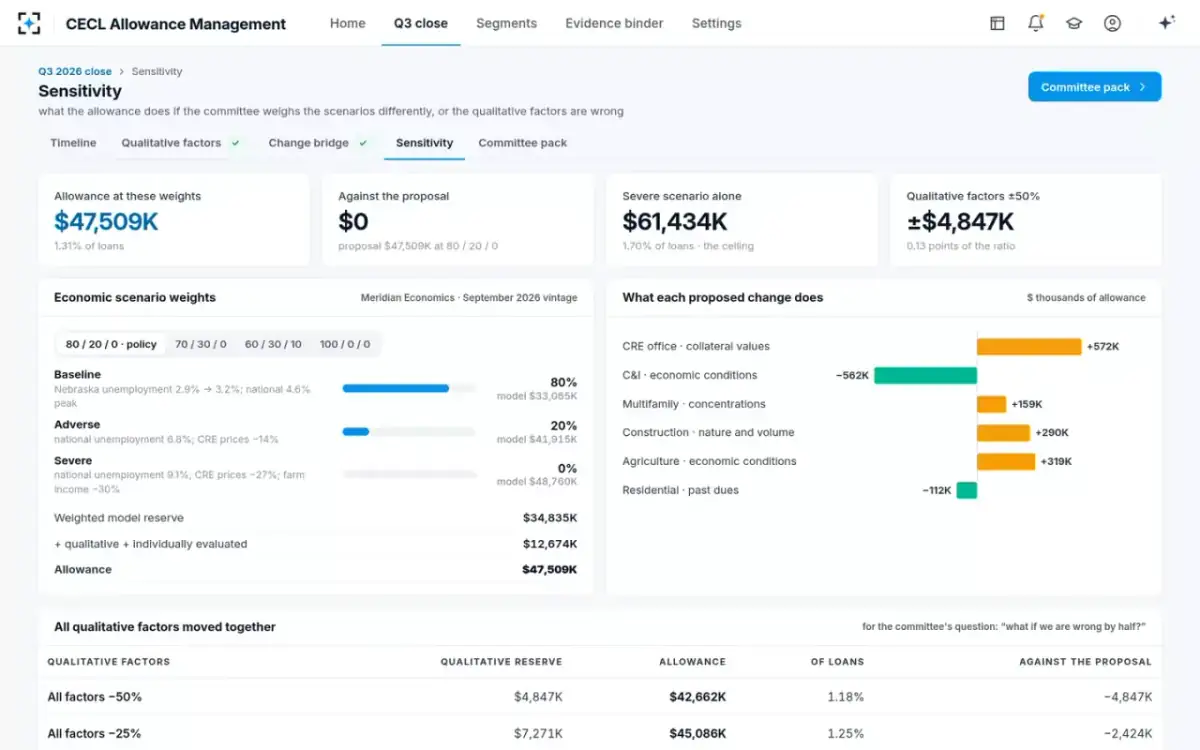
Every qualitative factor moved together by 50% moves the allowance $4,847K either way.
Changing the period: what has to be written down before you do
A change of horizon is a change in estimate with a large dollar effect and an obvious incentive attached, so it needs more of a record than a decision taken under time pressure in the last week of a close. Four things, written before the change rather than after it, cover what a reviewer will ask.
First, what changed in the evidence: a forecaster whose two-year horizon you now have a back-test for, a merger that changed the portfolio's duration, a data source that was withdrawn. Second, the effect, isolated: the allowance under the old setting and the new one on the same balances, so the change is not tangled up with the quarter's other movements. Third, the direction of the incentive, named out loud — a lengthening that happens to release reserve, or a shortening that happens to build it, deserves a sentence explaining why the evidence and not the outcome drove it. Fourth, the approval: who proposed it, who challenged it, who approved it, and when. The quarter in which you change the period is the quarter the bridge has to explain more than usual, and the rollforward that ties is where that explanation lands.
There is a wider reason to take the horizon seriously, beyond the file. A Federal Reserve Board staff working paper finds that CECL's effect on reserves fed through to lending: in the authors' sample, "the effect of CECL adoption on loan allowances reduced loan growth by approximately 77 basis points annually in the years following adoption" (Ranish and Vojtech, Finance and Economics Discussion Series 2026-066). An assumption that moves the allowance is an assumption that eventually moves what the bank lends, which is a reason to set it on evidence rather than on habit.
Where the assumption review sits in a twelve-step close
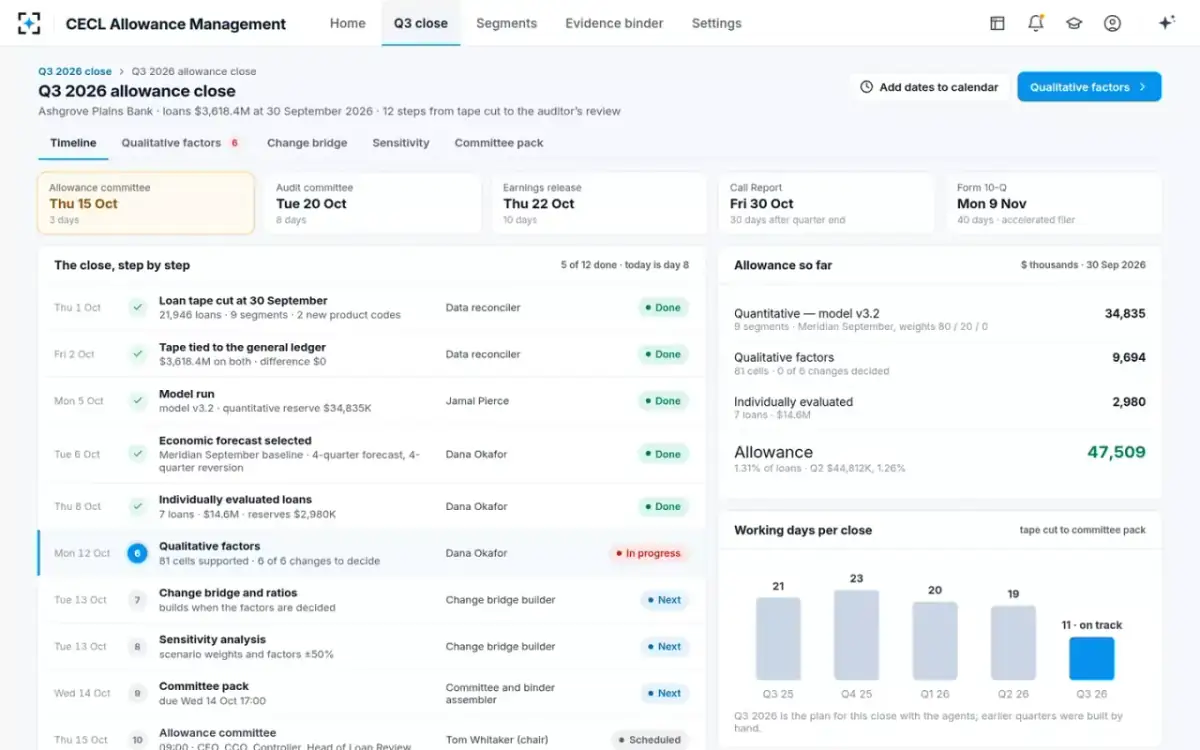
Seen from the committee's side of the table, the horizon is one of a small number of judgements that decide the number, and the only defence of any of them is a quarterly record that shows the judgement being made. To see the forecast period, the sensitivity and the bridge together on one quarter, start from CECL Allowance Management.
Questions people ask
Does CECL require a specific reasonable and supportable period?
No. ASC 326 sets no length, and the agencies have not set one. What they do require is that the period be supportable and that it be governed: the OCC's handbook describes it as an assumption subject to governance and controls rather than an accounting policy election, and says it is generally inappropriate to assert that no forecast of any length can be made.
Can you change the reasonable and supportable period?
Yes, with a reason that rests on evidence and a record of who approved it. Treat it as a change in estimate: show the allowance under both settings on the same balances so the effect is isolated, explain what changed in the forecast or the portfolio, and have the change approved by the person your policy names rather than absorbed into a quarter's other movements.
How do you weight CECL economic scenarios?
By judgement, documented, and reviewed every quarter. There is no prescribed set of weights. The defensible pattern is to state what each scenario represents, why the weights reflect management's expectation, and what the allowance would be under each path alone — then to revisit the weights with the forecast vintage, recording the review in the minutes even when nothing changes.
Does the reversion period have to be straight-line?
No. Immediate reversion and a ramp over several quarters are both used, and the standard does not prefer either. A ramp is itself a smoothing assumption, so it should be named as one and supported; what a reviewer tests is whether the method is applied consistently and whether the historical loss information it reverts to is relevant to the portfolio on the books now.
Is a longer forecast period more conservative?
Not reliably. Lengthening the forecast replaces historical loss information with forecast quarters, which raises the allowance when the forecast is worse than history and lowers it when the forecast is better. That is why the effect should be shown on the same balances before the change is made, and why a change whose direction happens to suit the quarter's earnings needs its evidence stated plainly.
How does CECL Allowance Management handle the forecast period?
It holds the period and the reversion as settings with a version history and the Controller's approval, records the forecast vintage and the drivers the model carries so no qualitative factor repeats one, and runs the scenario and factor sensitivities as a step in the close. It does not produce the forecast or calculate the model estimate; it works around the model you already run.