CECL qualitative factors are the adjustments a bank makes to its modelled expected credit losses for risks the model does not already carry, and the interagency policy statement names nine of them to consider — from concentrations of credit to local economic conditions — in a list it is careful to say is not closed. The arithmetic is trivial: a factor is a few basis points applied to a segment's balance. The work is the evidence. Each factor has to be relevant to this bank on this reporting date, supported by data with a date on it, and clear of anything the model already counts. CECL Allowance Management is Botminds' solution for exactly that work: it tests every factor cell against the quarter's data, drafts the written support with a citation on every number, and leaves the decision with the person who has to defend it.
The product examples below come from a fictional sample bank running through the solution: Ashgrove Plains Bank, $3,618.4M of loans in nine segments, closing the third quarter of 2026. The bank, its people, its properties and its appraiser are invented, and every figure from them is sample data rather than a customer's measured result. The regulatory material is real and linked where it appears.
Nine factors, every segment, one quarter
9
qualitative factors the agencies list — and the list is expressly not exhaustive
81
factor cells on a nine-segment book: nine factors against each pool (sample data)
Most
Federal Reserve CECL supervisory concerns were documentation or unsupported Q factors
What are qualitative factors in CECL?
Qualitative factors are the part of the allowance that is not produced by the model. A CECL estimate starts from historical loss information for each pool of assets with similar risk characteristics, adjusts it for current conditions and a reasonable and supportable forecast, and arrives at a modelled rate. The policy statement is blunt about what that rate is worth on its own: "Historical credit losses (or even recent trends in losses) generally do not, by themselves, form a sufficient basis to determine the appropriate levels for ACLs" (Interagency Policy Statement on Allowances for Credit Losses). The qualitative factors close the gap between what the data of the past few years measured and what management knows about the book today.
They have a boundary written into the same paragraph. Management, the agencies say, "should consider the need to qualitatively adjust expected credit loss estimates for information not already captured in the loss estimation process." The four words that do the work are not already captured. A factor exists to carry a risk the model is blind to; a factor that repeats a driver the model already uses inflates the allowance twice for one risk, which is the double-counting problem and the single most common reason a factor is removed rather than refreshed.
Most banks express each factor in basis points on the segment's balance, because that is the unit a committee and an examiner can both check. At the sample bank, the office commercial real estate segment carries $286.0 million of loans; a collateral-value factor of 35 basis points on that segment is $1.0 million of allowance, and the change from June's 15 basis points is $572 thousand. The whole qualitative reserve is $9,694 thousand of a $47,509 thousand allowance, or 20.4%.
The nine qualitative factors the agencies list, one by one
The policy statement introduces them with a sentence worth reading slowly, because it decides how closed the list is: "Management should consider the qualitative factors that are relevant to the institution as of the reporting date, which may include, but are not limited to:". The nine that follow are the ones almost every bank's grid is built on. They are not a statutory set and nothing stops a bank adding a tenth that its own book needs — a crop-price factor on an agricultural book, say, or a factor for a line of business opened this year.
The nine factors the policy statement lists, and the question each one asks of a segment
NV
“The nature and volume of the institution’s financial assets”
Nature and volume
CC
“The existence, growth, and effect of any concentrations of credit”
Concentrations
PD
“The volume and severity of past due financial assets, the volume of nonaccrual assets, and the volume and severity of adversely classified or graded assets”
Past due, nonaccrual, classified
CV
“The value of the underlying collateral for loans that are not collateral-dependent”
Collateral value
LP
“The institution’s lending policies and procedures, including changes in underwriting standards and practices for collections, write-offs, and recoveries”
Lending policies
CR
“The quality of the institution’s credit review function”
Credit review
SX
“The experience, ability, and depth of the institution’s lending, investment, collection, and other relevant management and staff”
Staff experience
EF
“The effect of other external factors such as the regulatory, legal and technological environments; competition; and events such as natural disasters”
External factors
EC
“Actual and expected changes in international, national, regional, and local economic and business conditions and developments”
Economic conditions
Two of the nine are about the bank rather than the borrowers, and they are the ones most often left at whatever number they were given at adoption. The quality of the credit review function and the experience, ability and depth of lending and collection staff move when people leave, when a reviewer's scope is cut, or when a loan review cycle slips. A grid where those two cells have not moved in three years is telling an examiner either that nothing changed or that nobody looked.
The ninth is the one that attracts the most scrutiny, because it is where the model and the overlay are most likely to collide. Changes in economic conditions are exactly what a reasonable and supportable forecast already carries, so an economic factor has to earn its place by pointing at something local or specific the forecast cannot see.
Why the list is a grid, not a list: nine factors across every segment
A bank does not have nine qualitative factors. It has nine factors for every segment it measures the allowance on, because each factor is evaluated against the risk characteristics of that pool. The sample bank's nine pools and nine factors make 81 cells, each of which is a judgement with a number and, if it is to survive, a paragraph of support behind it.
81 cells: nine segments down, nine factors across, and the six the agents proposed to change
CRE — office$286.0M
June44bps
September64bps
CRE — retail, industrial, other$612.5M
June26bps
September26bps
Multifamily$398.2M
June28bps
September32bps
Construction and land$241.7M
June33bps
September45bps
Owner-occupied CRE$455.3M
June15bps
September15bps
Commercial and industrial$702.6M
June21bps
September13bps
Agriculture$318.9M
June39bps
September49bps
Residential 1–4 family$446.8M
June13bps
September10.5bps
Consumer and home equity$156.4M
June18bps
September18bps
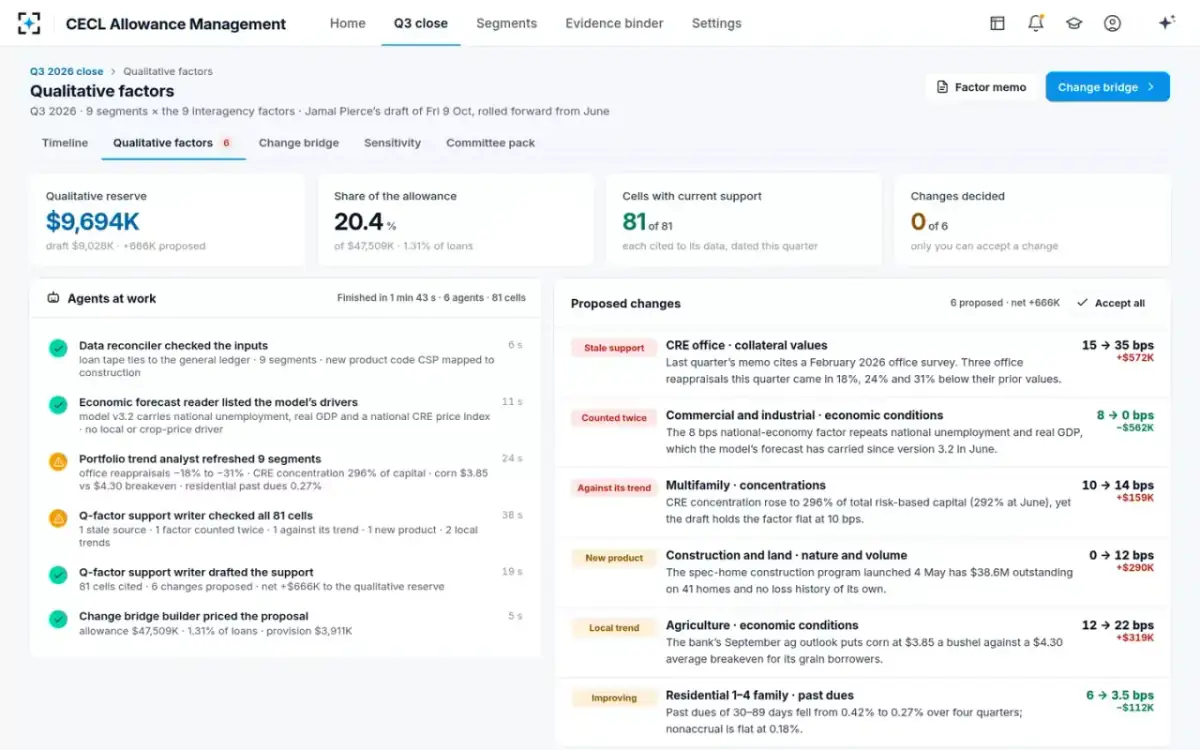
The grid is also where the real cost sits. Six cells moved this quarter; 75 did not. The analyst's quarter is spent proving that the 75 were still right, and it is the only part of the close with no arithmetic to hide behind. Last quarter's draft at this bank rolled all 81 cells forward unchanged — $9,028 thousand of allowance on September balances, none of it tested against September's data — which is the ordinary starting point at most banks and the ordinary source of findings.
The quarter's run: 81 cells checked, six changes proposed, each tagged with why
What “adequately supported” means for one factor cell
The standard a factor is held to is written in one sentence of the Comptroller's Handbook: all of the usual methods of reflecting expected credit losses are acceptable "provided the adjustments for qualitative factors are reasonably and consistently determined and are adequately supported" (Comptroller's Handbook, Allowances for Credit Losses). Three words, three tests. Reasonably determined means there is a path from a fact to a number. Consistently means the same method produced last quarter's figure and will produce next quarter's. Adequately supported means the fact is written down, dated and attached.
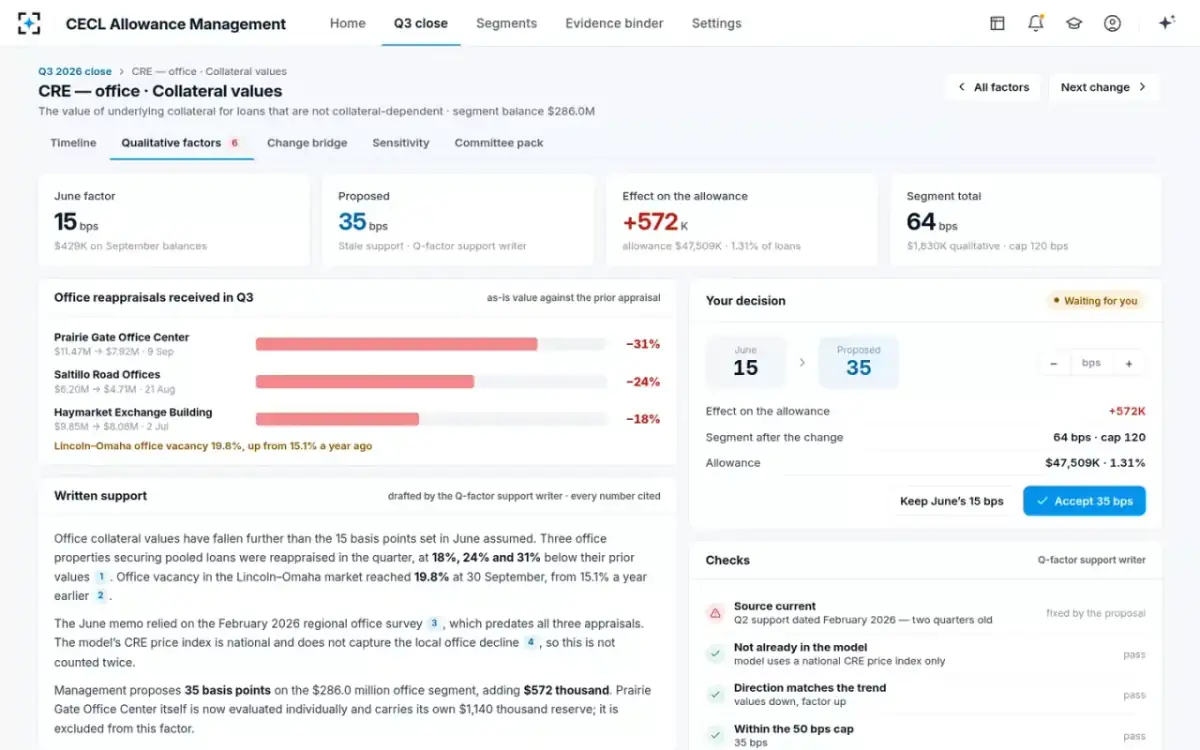
What that looks like in practice is less elaborate than most teams fear, and the handbook scales it to the bank: a straightforward narrative of recent trends and management's conclusions will do where the methodology is simple, while a bank running regressions is held to the assumptions behind them. A paragraph is enough, if the paragraph contains the data, the date, the arithmetic and the reason the model does not already carry it. One factor's support, written out in full takes a single cell apart line by line.
“The Q factors should address the risk of loss that may not be captured within the quantitative calculation.”
Canova and Crouch, “CECL at Community Banks”, Community Banking Connections, 2025
The handbook's own internal control questionnaire shows what an examiner will look for behind the number. It asks whether the bank's methodologies carry supporting documentation covering, among other things, the "Time frame covered by the historical data", the "Complete descriptions and definitions of items used in the analysis", the "Segmentation of portfolios and the rationale for the segmentations" and the "Reliability and integrity of the data used". Every one of those is a property of a document, not of a judgement — which is the point.
How many basis points should a qualitative factor be?
There is no published figure, no benchmark and no safe range; the agencies set a method, not a size. A factor should be the amount the bank can show the data implies, and that is an uncomfortable answer precisely because nothing stops the number being challenged. What makes a figure defensible is not its size but its derivation: a stated basis, a stated calculation and a result that moves when the basis moves.
Take the office collateral factor at the sample bank. Three office properties in the bank's book were reappraised in the quarter at 18%, 24% and 31% below their prior values, and office vacancy in the local market reached 19.8% at 30 September against 15.1% a year earlier. June's 15 basis points rested on a regional office survey dated February 2026, which predates all three appraisals. The proposal moves the factor to 35 basis points on $286.0 million, $572 thousand of allowance. One of the three secures the loan that has since been given its own reserve, so that loan is excluded from the factor while its appraisal still counts as evidence of the market. The number is arguable. The method — three dated valuations and a dated vacancy series, against a factor set before any of them existed — is not.
Two practical constraints are worth writing into policy rather than leaving to the quarter. The first is a cap on how much one factor may add to a segment, and another on all nine together, so a single judgement cannot quietly become most of a pool's allowance; at the sample bank those are 50 basis points per factor and 120 per segment, and they are the bank's own settings, not a regulatory limit. The second is a staleness rule: a source older than one quarter is flagged and refreshed before the committee sees it.
Do qualitative factors increase or decrease the allowance?
Both, and a grid that only ever goes up is itself a finding. The policy statement says plainly that qualitative adjustments "may increase or decrease management's estimate of expected credit losses." In the sample quarter four factors rose and two fell: residential past dues of 30 to 89 days had dropped from 0.42% to 0.27% over four quarters with nonaccruals flat, so that factor came down from 6 to 3.5 basis points, and the economic factor on commercial and industrial loans came out altogether.
There is a subtler point the handbook makes that is easy to get wrong in a committee memo. Changes in the allowance "may not always be directionally consistent with changes in the level of qualitative factor adjustments due to the incorporation of reasonable and supportable forecasts in estimating expected losses." Improving credit quality can pull the qualitative overlay down while a deteriorating forecast pushes the modelled rate up, and the allowance rises anyway. The memo has to explain both movements separately, which is one reason the quarter's bridge is built component by component rather than as a single net change.
A factor cell that holds, and a factor cell that gets written up
What survives the examination: Named, dated inside the staleness limit, and attached: three reappraisals received this quarter and a market report for the quarter just ended.
What gets a finding: A survey cited by last quarter’s memo, which cited the quarter before. Nobody has opened it since February.
What survives the examination: A stated path from the data to the basis points to the dollars: 35 bps on $286.0M is $1,001K, against $429K at 15 bps.
What gets a finding: A number carried forward because the committee was comfortable with it last time.
What survives the examination: Tested against the model’s driver list and the answer written down: the model’s price index is national; this is a local vacancy series.
What gets a finding: Never tested. The factor and the forecast may be charging for the same risk.
What survives the examination: The factor moves with its own trend, up or down, and a factor held against its trend carries a written reason.
What gets a finding: The trend worsened and the factor stayed flat, with nothing in the memo about why.
What survives the examination: A named person accepted the change on a dated decision that stays on the audit trail.
What gets a finding: The grid changed between drafts and no one can say who changed it.
Why examiners question qualitative factors more than any other part
Because that is where the judgement is, and the supervisory data says so directly. Reviewing nearly 200 community state member bank examinations conducted between May 2023 and May 2024, Federal Reserve staff reported that "most of the supervisory concerns and recommendations thus far have centered around either a bank's inadequate documentation of the ACL estimation process or unsupported qualitative factors (Q factors) used in determining the ACL estimate" (Community Banking Connections, 2025). The finding is almost never that the bank picked the wrong factor. It is that the bank could not show where the number came from.
The same review describes both halves of the failure. Some banks could not produce documented support for the assumptions behind their chosen method, whether the calculation came from a third party or was built in house. Others leaned so hard on the quantitative calculation that risks they had themselves identified were given too little weight in the estimate. Both are failures of the same discipline: the grid was not re-argued this quarter, so neither the numbers nor the silences could be explained.
There is a structural reason smaller banks feel this most. Looking at CECL adoption across community banking organisations, the Federal Reserve Bank of Kansas City found the effect on allowance levels smaller at smaller banks, and suggested why: "One possible explanation for the less pronounced impact to smaller institutions was their heavier usage of qualitative factors prior to CECL implementation, which resulted in higher ACL coverage ratios" (Community Banking Bulletin, 2023). A bank whose allowance was always substantially qualitative did not get a new problem at adoption. It got an old problem held to a new standard of proof.
The three questions to ask of every cell before committee
A grid of 81 cells cannot be argued from first principles every quarter, and it does not need to be. Three questions, asked mechanically of every cell, catch almost everything an examiner would raise, and each of them has an answer that is either in a document or is not.
Three tests on a factor cell, and the exam question each one answers
- Is the source current?
Name the most recent evidence behind the cell and look at its date. If it is older than the bank’s staleness limit — one quarter at the sample bank — the cell needs new data or a written reason why the old data still holds.
- Is it already in the model?
Compare the factor against the model’s written driver list. If the model carries national unemployment and the factor is about national unemployment, one of the two has to go.
- Does it move with its own trend?
A factor that stayed flat while its underlying measure worsened, or rose while its measure improved, is the pattern examiners read as a plug. Either move it, or write down why not.
- Is it inside the caps the policy sets?
A per-factor and per-segment ceiling keeps a single judgement from becoming most of a pool’s allowance. Breaching one is not forbidden; it is a decision that has to be taken deliberately and minuted.
- Can one person be named against the decision?
Proposing a change and accepting it are different acts. The audit trail should show who accepted each one and when, and a rejection should carry its reason as plainly as an acceptance.
One cell, its evidence, its arithmetic and its four checks
What a concentration factor needs that a judgement does not
Most of the nine factors are arguments. The concentration factor is a measurement, and that changes what good support looks like. The agencies' commercial real estate concentration guidance gives a reference point a bank can compute from its own call report: an institution may be identified for further supervisory analysis where "Total commercial real estate loans, as defined in the guidance, represent 300 percent or more of the institution's total risk-based capital, and the outstanding balance of the institution's commercial real estate loan portfolio has increased by 50 percent or more during the prior 36 months" (OCC Bulletin 2006-46). A second criterion covers construction, land development and other land loans at 100 percent or more of total risk-based capital.
Those are screening thresholds for supervisory attention, not limits and not allowance rules. But they give a concentration factor something the other eight rarely have: a ratio with an agreed definition, a denominator from the regulatory capital calculation, and a direction of travel measured over 36 months. At the sample bank the ratio was 296% of total risk-based capital of $519.6 million at 30 September, up from 292% in June — below the reference point and climbing, while the multifamily concentration factor sat unchanged at 10 basis points. That combination is what the direction check is for, and the proposal moved the factor to 14 basis points.
The general lesson applies to any factor with a measurable basis. Where a number exists — a concentration ratio, a past-due percentage, a vacancy series, a reappraisal — the support is that number and its history, and the only judgement left is how many basis points it is worth. Where no number exists, as with credit review quality or staff depth, the support has to be an argument from events: a vacancy in the loan review function, a change in approval authority, a new product with no loss history of its own. The sample bank's construction factor moved for exactly that reason — a programme launched on 4 May with $38.6 million outstanding on 41 homes and no loss history to model.
The grid priced: nine pools, their model rate and their qualitative factors side by side
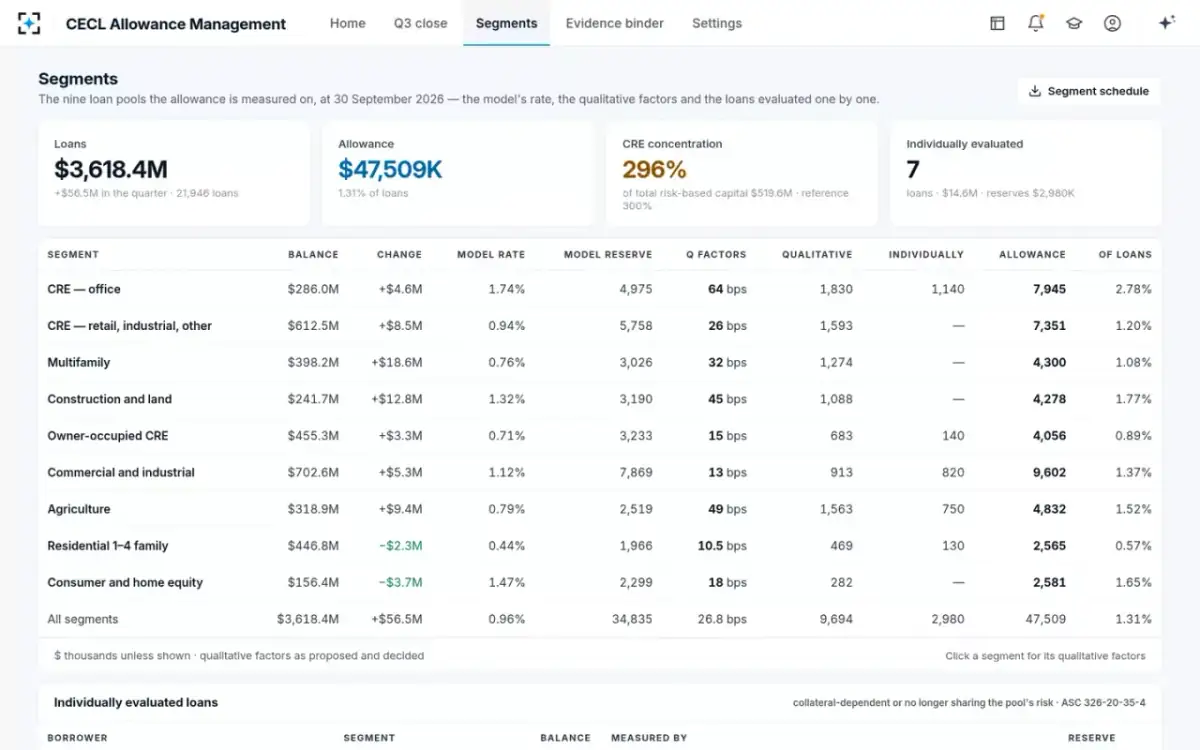
Seen whole, the qualitative grid is the part of the allowance that cannot be inherited. The model's rate carries forward with new data; the factors carry forward only with new argument. To see all 81 cells tested, drafted and priced in one run before the committee meets, start from CECL Allowance Management.
Questions people ask
Is a Q factor the same thing as a qualitative factor?
Yes. "Q factor" is the industry's shorthand for a qualitative factor adjustment, and supervisors use it too — the Federal Reserve's community banking review writes "unsupported qualitative factors (Q factors)". Older material may call them qualitative and environmental factors, or Q&E factors, a phrase that carried over from the incurred-loss allowance. All three names describe the same adjustment to a modelled loss estimate.
What are CECL qualitative and environmental factors?
They are the same nine areas of judgement under the name most banks used before CECL. The environmental half of the phrase referred to conditions outside the bank — the economy, competition, the legal and regulatory environment — which the policy statement now lists as the external factors and the economic conditions factors. Nothing in the standard requires the old label, and a grid built on the agencies' current wording is easier to tie to the policy statement in an examination.
Does every segment need all nine factors?
Every segment needs every factor considered, which is not the same as every cell carrying basis points. A zero is a legitimate answer where the factor is not relevant to that pool — but it is an answer, and it should be supported like any other. The practical risk is the reverse: a grid where all nine cells of every segment carry a non-zero number tends to mean the grid is a template rather than an assessment.
Can a qualitative factor be reduced to zero?
Yes, and it should be when the risk it carried is now measured elsewhere. In the sample quarter the economic factor on commercial and industrial loans went from 8 basis points to zero because the model's forecast had begun carrying national unemployment and real GDP for that segment since version 3.2. Removing a factor is a change like any other and needs its reason written down; what it must never be is a quiet deletion between drafts.
How often do qualitative factors have to be refreshed?
Every reporting date. The policy statement asks management to consider the factors "as of the reporting date", so a quarterly filer re-argues the grid quarterly. What varies is how much changes: most cells will carry the same number, with support re-dated to this quarter's data. A bank that sets a staleness limit — one quarter, two quarters, six months — turns that from a judgement into a check anyone can run.
Do credit unions use the same nine factors?
The policy statement was issued jointly by the Federal Reserve, the FDIC, the NCUA and the OCC, and it is written for institutions of all four, so the nine factors apply to federally insured credit unions as well as banks. The wording of the third factor shifts: for credit unions, adversely graded loans are the more severely graded categories under the institution's own credit grading system rather than loans rated substandard or worse.