An individually evaluated loan under CECL is one whose expected credit loss is measured on its own rather than inside a pool, because it no longer shares similar risk characteristics with the loans it used to sit with. The interagency policy statement puts the rule in two sentences, and the second one is the sharp half: once a loan is evaluated individually it comes out of the collective assessment altogether. What most teams miss is that the trigger is rarely an accounting event. It is a credit event, and second on the agencies' list of examples, straight after credit scores and ratings, is the loan's own risk rating. Botminds' Credit Risk Review re-grades every commercial loan from its credit file each quarter and tells the allowance team the moment a grade of record changes — which is the moment a loan may have to leave its pool. It supplies the grade and the cited evidence behind it; the allowance team measures.
The worked example on this page is a fictional sample bank as it runs through the solution: Northmere Bank & Trust, 1,418 commercial loans, $3.86 billion of commitments. Its borrowers, lenders and reviewers are invented. The regulatory rules, and the quotations, are real and linked where they appear.
One grade change, from a page in the credit file to a line in the quarter's provision
Agent
The file is readEvery document in the relationship file is gathered and spread on the credit agreement’s own definitions, and each number cites the page it came from.
Never: accepts an add-back the agreement does not allow
Agent
A grade is suggestedEight rating factors are scored against the bank’s scale, with a reason for each and a reason why the grade is not one notch better or worse.
Never: changes a grade of record
A person decides
A reviewer sets the review gradeAn independent loan review officer agrees, disagrees or asks for more, and the challenge goes to the lender with a clock on it.
A person decides
The grade of record changesWhen the challenge is settled, the grade on the loan changes and the watch list and the allowance team are told the same day.
A person decides
The allowance team decides on the poolThey judge whether the loan still shares risk characteristics with its segment. If it does not, it is measured on its own.
A person decides
The provision is bookedThe individually measured amount replaces the loan’s share of the pool, and the difference lands in this quarter’s provision for credit losses.
What is an individually evaluated loan under CECL?
It is a loan the bank measures on its own because it has stopped belonging to a pool. CECL measures expected credit losses collectively wherever loans share similar risk characteristics; the moment one stops sharing them, the pool arithmetic no longer describes it. The interagency policy statement on allowances for credit losses states the test in one sentence: "If a financial asset does not share similar risk characteristics with other assets, expected credit losses for that asset should be evaluated individually." The sentence that follows it is the one teams forget.
Two things follow. First, individual evaluation is not a penalty box for bad loans; it is what happens when a loan is no longer like its neighbours, which is usually but not always because it got worse. Second, the loan leaves the pool in both directions. Its balance comes out of the collective calculation as well, so a bank that measures a loan individually and leaves it in the pool has counted it twice.
"Individually evaluated assets should not be included in a collective assessment of expected credit losses."
Interagency Policy Statement on Allowances for Credit Losses, 85 FR 32991 (2020)
The old vocabulary still gets in the way. Under the incurred-loss model that CECL replaced, the equivalent idea was an impaired loan, and the trigger was a judgment that it was probable the bank would not collect all amounts due. CECL has no impairment threshold for this purpose. The question is similarity, not probability, and a loan can be individually evaluated while every payment is still being made on time.
The rule in two sentences, and the word that does the work
The word is "similar". The policy statement does not define it, and deliberately so: the agencies declined to narrow the standard's flexibility, leaving management to exercise judgment when establishing segments. What they did supply is a list of the characteristics worth segmenting on, and risk ratings sit near the top of it: "Examples of risk characteristics relevant to this evaluation include, but are not limited to: Internal or external credit scores or credit ratings; Risk ratings or classifications; Financial asset type; Collateral type; Size" — the list goes on to effective interest rate, term, geographical location, industry of the borrower and vintage.
Read that list against the life of a commercial loan and one thing stands out. Most of those characteristics are fixed at origination. Collateral type, industry, vintage and term barely move. The rating is the one that is designed to move, and it is the one a bank re-decides every time someone reads the file.
The characteristics the policy statement names, and which of them a grade change breaks
| Risk characteristic | What it groups together | What can change it after origination |
|---|---|---|
| Risk ratings or classifications | Loans the bank judges to carry the same risk of loss | A review grade the lender accepts, or a classification an examiner assigns — the characteristic built to move |
| Internal or external credit scores or credit ratings | Borrowers scored or rated on the same scale | A rescore, or an action by a rating agency on the borrower |
| Financial asset type | Term loans with term loans, revolving lines with lines | Rarely; a restructuring that changes the instrument can do it |
| Collateral type | Loans secured by the same kind of asset | A substitution, a release, or collateral that is sold |
| Size | Loans of a similar commitment | An advance, a pay-down, a split or a participation sold |
| Effective interest rate | Loans priced alike | A repricing, or a default rate taking effect |
| Term | Loans with a similar remaining life | Time passing, and a maturity that is extended rather than refinanced |
| Geographical location | Loans in the same market | A borrower that moves its operations or its collateral |
| Industry of the borrower | Loans to the same trade | A change of business, rare but real in middle-market credit |
| Vintage | Loans originated in the same period | Nothing, until the loan is refinanced into a new one |
That is why a loan review function is inside the allowance process whether anyone has drawn it that way or not. The segmentation is only as current as the ratings it is built on, and the ratings are only as current as the last time someone read the file. On the sample bank's book, the 1–9 grades drive segmentation directly: a pass 4 and a substandard 7 are not in the same pool, and never were.
When does a loan have to be evaluated individually?
When management can no longer say it is like the other loans in its segment. The policy statement sets up a two-step test rather than a single one. If a loan ceases to share risk characteristics with its segment, it should first be moved to a different segment with assets that do share them, if such a segment exists. Only if no segment fits does it go to individual evaluation.
In practice, a bank with granular pass pools and separate criticized pools will move most downgrades from one pool to another and measure very few loans individually. A bank with coarse pools — one commercial and industrial pool, one investor real estate pool — reaches individual evaluation faster, because a substandard credit in a pool whose loss rate was built from performing loans is plainly not similar to the rest. Either answer can be right; what cannot be right is leaving the loan where it was because nobody re-read it.
Collective measurement and individual measurement need different things
Collective: what the estimate rests on
- A segment of loans that share risk characteristics · 34%
- The bank’s own loss history for that segment · 26%
- Current conditions · 20%
- A reasonable and supportable forecast · 20%
Individual: what the estimate rests on
- This borrower’s cash flow, on the agreement’s definitions · 34%
- The fair value of this collateral, currently supported · 34%
- The guarantor, and whether support is enforceable · 16%
- The timing and source of repayment · 16%
The practical difference is where the evidence comes from. A collective estimate is built from portfolio data a controller can pull. An individual estimate is built from one credit file, and almost every line of it — the spread, the recomputed covenants, the appraisal date, the guarantor's statement — belongs to the loan review record rather than to the general accounting system. The handover is the whole job, and what a reviewer actually tests in the file is where that evidence is produced.
Do risk ratings drive the allowance for credit losses?
Directly and by name. Risk ratings and classifications are one of the segmentation characteristics the policy statement lists, so they decide which pool a loan sits in and therefore which loss rate applies to it. The credit risk review guidance closes the loop from the other end, listing among the objectives of an effective system that it "Provides management with accurate and timely credit quality information for financial and regulatory reporting purposes, including the determination of an appropriate ACL or ALLL, as applicable."
Both words in that phrase carry weight. Accurate makes the review an accounting control, not just a credit one. Timely puts a date on it: an allowance is struck as of a reporting date, and a rating that is right in November but was wrong on 30 September did not help the September close.
The same guidance is explicit that the credit risk review function is not the internal audit function, and that reviewers can rely on information from other units but have to keep their own view rather than adopting someone else's. An allowance team that asks loan review for a number, and a loan review team that produces the number the allowance team was hoping for, has quietly removed the control. Who assigns a loan risk rating, and who can change it, follows that independence question through the challenge process.
Collateral-dependent loans, and the appraisal behind the number
A collateral-dependent loan is one where repayment is expected substantially through the operation or sale of the collateral, and the borrower is experiencing financial difficulty at the reporting date. For these, the policy statement is unusually prescriptive: "For regulatory reporting purposes, the ACL for a collateral-dependent loan is measured using the fair value of collateral, regardless of whether foreclosure is probable." Costs to sell come off only where repayment depends on the sale rather than the operation of the collateral.
What a collateral-dependent measurement asks for, and who has to supply it
Fair value of the collateral
as of the evaluation date
Not the value at origination and not the value at renewal. A fall since the last evaluation increases the allowance; a rise reduces it, capped at what was written off.
Appraisal or evaluation, ordered by the bank
Costs to sell
deducted only if repayment depends on a sale
Where the repayment is expected from operating the collateral — a leased building that still pays — the deduction is not appropriate.
The allowance team’s judgment, on the credit’s facts
Amortized cost of the loan
the balance the measurement is compared with
The difference between fair value (less costs to sell where they apply) and amortized cost is the loan’s own allowance.
The core system
Support for the value
a recent appraisal or evaluation
The policy statement requires changes in the fair value of collateral to be supported and documented this way. An old appraisal is not support, however carefully it is cited.
Loan review flags the age; credit administration orders it
That fourth term is where quarters get lost. The policy statement is plain that "Changes in the fair value of collateral described herein should be supported and documented through recent appraisals or evaluations." On the downgrade at the top of the sample bank's review queue this quarter — Brennick Cold Storage, a $17.6 million relationship moving from pass 4 to substandard 7 — the file assembler flagged an appraisal 40 months old on two refrigerated buildings, valued at $24.8 million in June 2023 and carrying the loan at 67% loan-to-value on that number. The bank's own credit policy asks for a new appraisal on a criticized loan when the last one is over 36 months old. Nobody had asked for one, because nobody had criticized the loan.
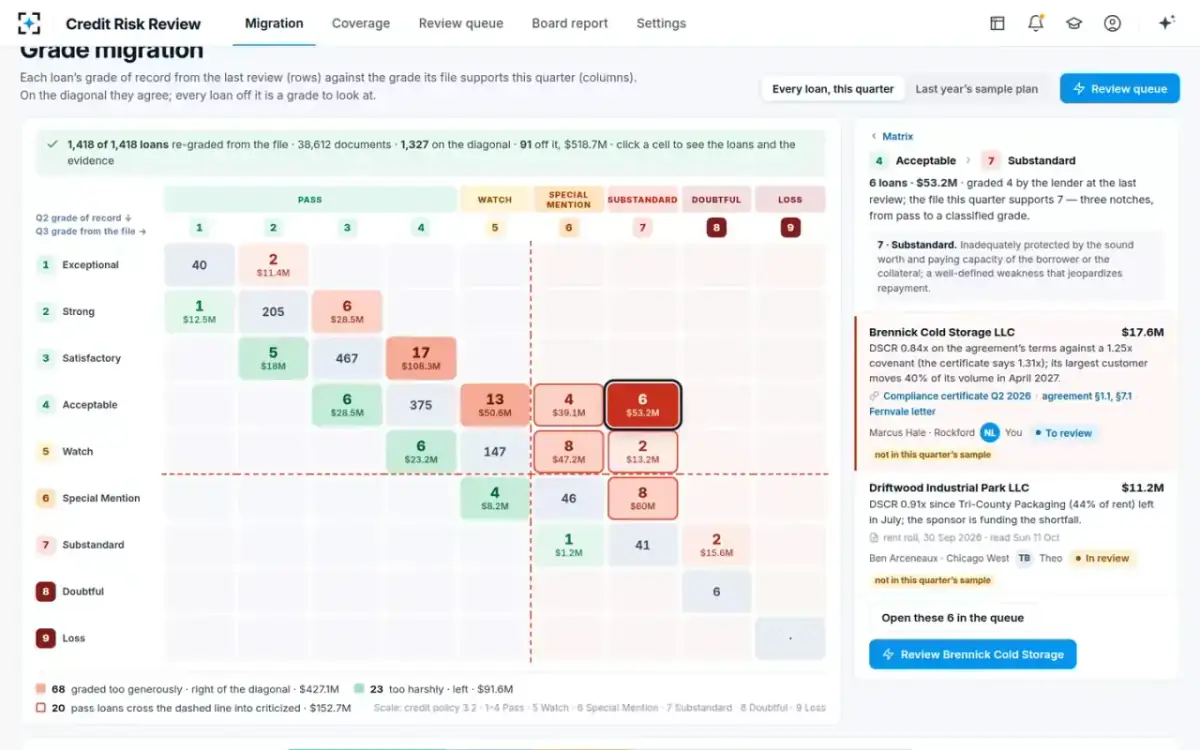
One cell of the grade migration matrix: six loans, three notches, $53.2M
What the allowance team needs from loan review, and when
Three things, in this order: which loans moved, what the file says, and whether the collateral number is still supportable. The first is a list. The second is the evidence behind each grade — the spread on the agreement's own definitions, the recomputed covenants, the correspondence the lender filed and forgot. The third is a date, not a number: how old the appraisal is, and whether the credit policy now requires a new one.
The timing is tighter than most calendars admit. A quarter-end is a position: the allowance is struck as of 30 September, so a downgrade agreed in October still matters to the September numbers if the facts behind it were already in the file on that date. That is why a loan review cycle that runs on an annual sample and a financial reporting cycle that closes every ninety days do not naturally meet.
A quarter, its close, and when the allowance team has each answer
- The quarter the allowance is struck for, to 30 September92 days
- Quarter-end grades settled before the board risk committee on 22 October22 days
- About 78 loans read through the quarter: the large ones, the watch list and a slice of the restabout 78 loans
- By the committee, 27 of the 91 questioned grades reached; 64 keep the lender’s grade27 of 91
- Statements and certificates arrive through the quarterto 30 September
- Quarter closed; grades of record taken as of 30 September10 days
- Every commercial loan re-graded from its file on Sunday 11 October3 h 42 min
- Reviewers work the 91 disagreements before the committee11 days
Why a late downgrade costs twice
The first cost is obvious: a loan that should have been measured individually, or in a criticized pool, spent the quarter inside a pool whose loss rate was built from performing credits. The allowance was understated by the difference, and the catch-up lands in a later provision.
The second cost is the one that surprises people. Historical loss rates are computed by segment, and the segments are defined by rating. A bank that downgrades late does not only misplace the loan — it teaches its own model the wrong lesson, because the charge-off, when it comes, is attributed to whatever pool the loan was sitting in. Years of late downgrades produce a pass pool with an unexpectedly high historical loss rate and a substandard pool with a flattering one, and the next quarter's collective estimate is built on both.
The interagency guidance expects the historical loss experience to be evaluated for each group of loans with similar risk characteristics into which the portfolio has been segmented. That evaluation is only meaningful if loans were in the right group while the losses were being incurred, which is a statement about the speed of the review function, not about the model.
What examiners look at when they test the allowance
They look at the credit work behind it. The policy statement describes the examiner's assessment of board and management effectiveness in identifying, measuring, monitoring and controlling credit risk, and says it "may include, but is not limited to, a review of underwriting standards and practices, portfolio composition and trends, credit risk review functions, risk rating systems, credit administration practices, investment securities management practices, and related management information systems and reports".
Credit risk review functions and risk rating systems are the third and fourth items on that list; the loss model itself is not on it. The safety-and-soundness standards say the same thing in fewer words, requiring an institution to "Estimate the inherent losses in those assets and establish reserves that are sufficient to absorb estimated losses" as part of an asset quality system, alongside the requirement for independent, ongoing credit review.
The practical form this takes in an examination is a sample. Examiners re-rate loans themselves and compare their grades with the bank's; where the grades differ materially, the allowance built on the bank's grades is in question too. A bank that can show the file behind every grade, with the date it was read and the page each factor rests on, is answering a different conversation from one that can show a spreadsheet of grades.
A grade change, followed from the file to the quarter's provision
Take the sample bank's Brennick file through it. On the lender's grade of record the loan was a pass 4, set at renewal in November 2025. Reading the file, the agents found debt service coverage of 0.84x for the twelve months to June 2026 on the credit agreement's own definition, against a 1.25x covenant — where the borrower's signed certificate claimed 1.31x. The difference was a $680,000 add-back for replacing compressors, which section 1.1 of the agreement allows only with the bank's written approval, absent from all 34 documents in the file, plus $710,000 paid out to the members that section 7.1 requires to be deducted.
The spread the measurement would start from, on the agreement's definitions
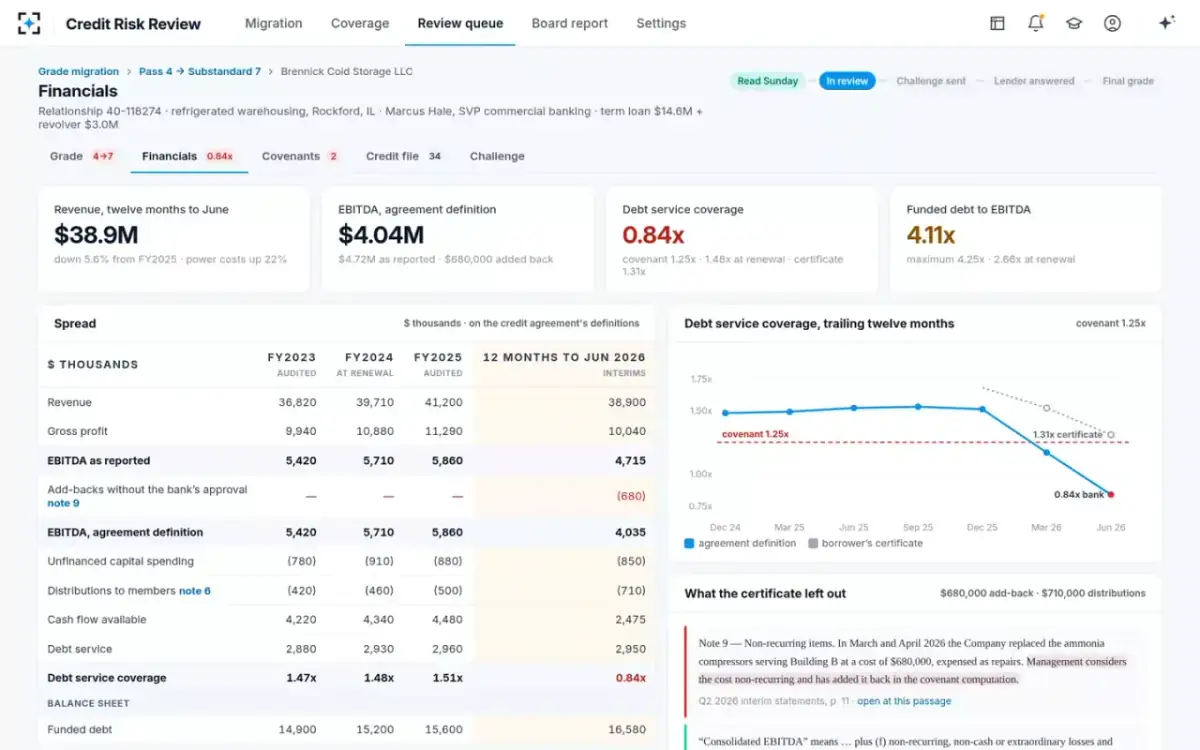
A reviewer agreed with the suggested grade of 7. The lender agreed within the ten-business-day clock, and the grade of record changed from 4 to 7. At that point three things followed at once: the watch list picked the loan up, the allowance team was told, and the loan stopped being similar to the pass pool it had been measured in.
What the allowance team then had to decide is not a loan review question. Does a 7 belong in the bank's criticized pool, or is this credit different enough from the rest of that pool to stand alone? Is repayment now expected substantially through the collateral, which would make it collateral-dependent and send the measurement to fair value? And if so, can a June 2023 appraisal support a value at a September 2026 reporting date? On these facts the honest answer to the last question is no, and the appraisal became the first of four conditions in the challenge to the lender, with a 60-day deadline.
Note what the solution did not do. It did not compute an allowance, assign a pool or decide that the loan was collateral-dependent. It produced a grade, every reason behind it cited to a page, and told the people whose decision each of those is.
What this looks like when every loan is read every quarter
On the sample book, the quarterly read put 91 loans — $518.7 million of commitments — off the diagonal of the grade migration matrix, 68 of them graded more generously than the file supports. Twenty pass loans, $152.7 million, crossed into criticized. Those twenty are the population the allowance team cares about most, because each one is a candidate to change pools or leave them.
Run the same quarter through last year's sample plan and the picture changes. The plan reads about 78 loans a quarter — the large relationships, the watch list, insider loans and a slice of the rest. By the committee date it would have reached 27 of the 91. The other 64, $329.1 million, would keep the lender's grade until their annual review, including all six of the three-notch moves from pass 4 to substandard 7. None of those 64 is a modelling error. Each is a loan the allowance was estimated for without anyone having read its file this year.
The quarter's newly criticized loans, as the board committee sees them
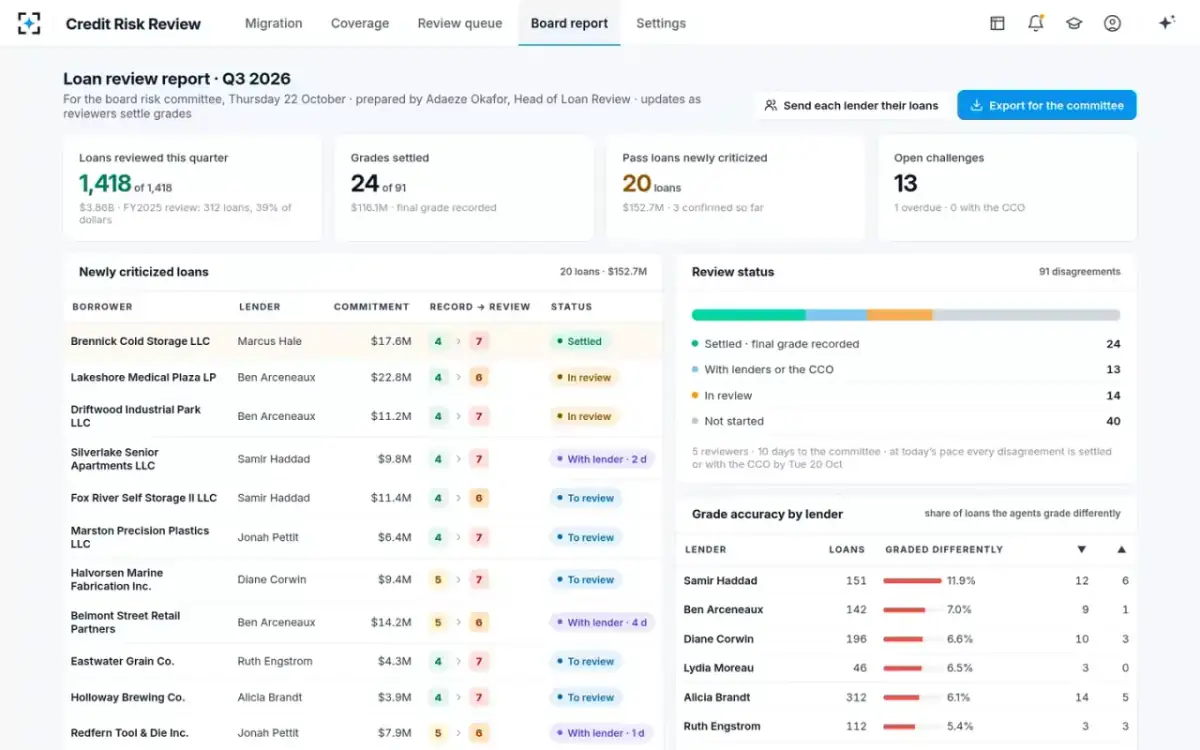
The argument for reading everything every quarter is not that a quarterly grade is more accurate than an annual one on the loan the annual sample happened to pick. It is that an allowance struck on 30 September should rest on files read against 30 September, and a sample plan can only promise that for the slice it reached. The classified-assets ratio the board is judged on has the same dependency, one layer up.
Questions people ask
What is the difference between collective and individual evaluation?
Collective evaluation estimates expected credit losses for a pool of loans that share similar risk characteristics, using the bank's loss history for that pool adjusted for current conditions and a reasonable and supportable forecast. Individual evaluation estimates the loss on one loan from its own facts — cash flow, collateral value, guarantor support. The policy statement requires the second whenever a loan does not share similar risk characteristics with others, and takes that loan out of the collective assessment entirely.
Who decides a loan no longer shares risk characteristics with its pool?
Management does, and the decision is an accounting one made by whoever owns the allowance — usually the controller or a credit risk officer, approved through the bank's allowance governance. Loan review supplies the fact that changes the answer, which is normally the grade, and the evidence behind it. Deciding the pool is not loan review's call, and a review function that makes it has stepped out of its independent role.
What happens to the allowance when a loan is downgraded to substandard?
It depends on the bank's segmentation. If the bank pools by rating, the loan moves to a pool with a higher loss rate and the allowance rises by the difference. If the loan no longer fits any pool, it is measured individually, and where repayment is expected substantially from the collateral the measurement uses the fair value of that collateral, regardless of whether foreclosure is probable. A downgrade does not have a fixed allowance consequence; it has a fixed requirement to look again.
Does an individually evaluated loan stay in the pool as well?
No. The policy statement is explicit that individually evaluated assets should not be included in a collective assessment of expected credit losses. Keeping the loan in both places double-counts it. The practical trap is a loan that is measured individually in a memo but never removed from the data extract that feeds the pool calculation.
Is an individually evaluated loan the same as an impaired loan?
No, though the populations often overlap. Impairment was a concept of the incurred-loss model, triggered by a judgment that it was probable the bank would not collect all amounts due. CECL asks a different question — whether the loan still shares risk characteristics with others — and a performing loan can fail that test, for instance because its collateral type or its size no longer matches anything else in the book.
Does Credit Risk Review calculate the allowance?
No. It re-grades every commercial loan from its credit file each quarter, shows which grades of record the file no longer supports, carries each disagreement through the reviewer's decision and the challenge to the lender, and tells the allowance team and the watch list when a grade of record changes. The measurement, the segmentation and the provision stay with the people who own them. To see the grades and the evidence behind them, start from Credit Risk Review.