A 1–9 loan risk rating scale is the grid a commercial bank uses to say how likely each loan is to be repaid, running from the strongest credit at 1 to a loan written off at 9. Almost every bank that uses one lays it out the same way — four or five pass grades, then watch, special mention, substandard, doubtful and loss — and the hard part is not reading the grid but putting a real loan on it, because only four of the nine rungs have a definition anyone outside the bank wrote. The rest are yours. Credit Risk Review is Botminds' software for the loan review team that has to defend those choices: it re-grades every commercial loan from the documents in its file each quarter, scores each factor of the bank's own scale, and cites the page behind every reason.
The worked example on this page is sample data from the solution running on a fictional bank — Northmere Bank & Trust, its lenders, its borrowers and its credit policy are all invented. The regulatory definitions are real and quoted from the agencies' own publications, linked where they appear.
What is a 1–9 loan risk rating scale?
It is an ordinal scale: a set of ranked buckets, each with a written definition, into which every commercial loan is placed at origination, at renewal and whenever something changes. Nine is the most common length in US commercial banking, but it is a convention and nothing more. The Federal Reserve, FDIC, NCUA and OCC say plainly that a bank may run a framework of its own and simply has to be able to translate it: a bank "may have a credit risk rating framework that differs from the framework for loan classifications used by the federal banking agencies", and "such banks and savings associations should maintain documentation that translates their risk ratings into the regulatory classification framework".
What the scale is for decides how it is built. A grade drives the watch list, the allowance, pricing and approval authority, and it is the number an examiner reconciles to the agencies' own categories. So a scale with one pass grade satisfies the letter of the rules and is useless for every other purpose, while a scale with twenty grades is precise in a way no credit file can support.
The four rungs the regulators define, and the five a bank invents
Four classification definitions are written down for you, in materially the same words at every agency: special mention, substandard, doubtful and loss. Everything above special mention is a single undivided category. The OCC's handbook is explicit that credits not covered by those definitions are "pass" credits, "for which no formal regulatory definition exists", and that regulatory ratings "do not distinguish among pass credits".
Credits that are not covered by these definitions are “pass” credits, for which no formal regulatory definition exists.
OCC, Comptroller’s Handbook — Rating Credit Risk
That single sentence explains most of the confusion about 1–9 scales. Grades 1 to 5 are a private language. Two banks can both run a nine-point grid, agree on every classification, and disagree completely about whether a particular loan is a 2 or a 4 — and neither is wrong, because there is nothing to be wrong against except their own credit policy. Grades 6 to 9 are a shared language, and an examiner will hold you to it.
The nine rungs of one bank’s scale, against what the agencies define
| Grade | Band | The agencies’ category | What the file has to show | What moves it down |
|---|---|---|---|---|
| 1 · Exceptional | Pass | Pass — no regulatory definition | Cash flow, leverage and liquidity far stronger than policy, or the loan is fully secured by cash at the bank. | Almost nothing short of the cash leaving. |
| 2 · Strong | Pass | Pass — no regulatory definition | Coverage above 2.0x for three years, leverage under 2.0x, ready access to capital. | A year of thinner coverage, or a capital market the borrower can no longer reach. |
| 3 · Satisfactory | Pass | Pass — no regulatory definition | Coverage above 1.5x, leverage within policy, sound collateral and a real guarantor. | Coverage drifting toward the covenant, or a guarantor whose own statement has thinned. |
| 4 · Acceptable | Pass | Pass — no regulatory definition | Coverage above the covenant minimum, with some weakness the file shows is mitigated. | The mitigant failing: the contract that was going to renew, the buyer who was going to close. |
| 5 · Watch | Pass, monitored | Still pass — “watch” is the bank’s own word | Pass, but an adverse trend or event that needs looking at every quarter. | The trend continuing for another quarter without an answer from the borrower. |
| 6 · Special Mention | Criticized | Special mention | A potential weakness that deserves management’s close attention and could weaken repayment if left alone. | The potential weakness becoming definite — a covenant actually breached, a customer actually gone. |
| 7 · Substandard | Criticized and classified | Substandard | A well-defined weakness: the borrower’s worth and paying capacity, or the collateral, no longer protect the debt. | Collection in full becoming questionable rather than merely at risk. |
| 8 · Doubtful | Criticized and classified | Doubtful | Everything substandard shows, plus collection in full that is highly questionable and improbable. | The pending event — the sale, the injection, the new lien — failing to arrive. |
| 9 · Loss | Criticized and classified | Loss | Uncollectible, and not worth carrying as a bankable asset. | Nothing. It is charged off. |
Where does pass end and criticized begin?
Pass ends at the line between 5 and 6 on this scale — between the bank's own watch grade and special mention. That line matters more than any other on the grid, because crossing it puts the loan in the criticized population a bank reports to its board and an examiner totals at every examination. The second line, between 6 and 7, puts the loan in the classified population, which is the one compared against capital.
Two words do a lot of work here, and they are not interchangeable. Criticized means special mention or worse. Classified is narrower: the OCC's handbook confines it to substandard, doubtful and loss, and leaves pass and special mention outside it by name. A loan at 6 is criticized but not classified. A loan at 7 is both. The arithmetic that follows from those definitions — and the ratio a board is handed because of them — is worked through in the guide to classified assets against capital.
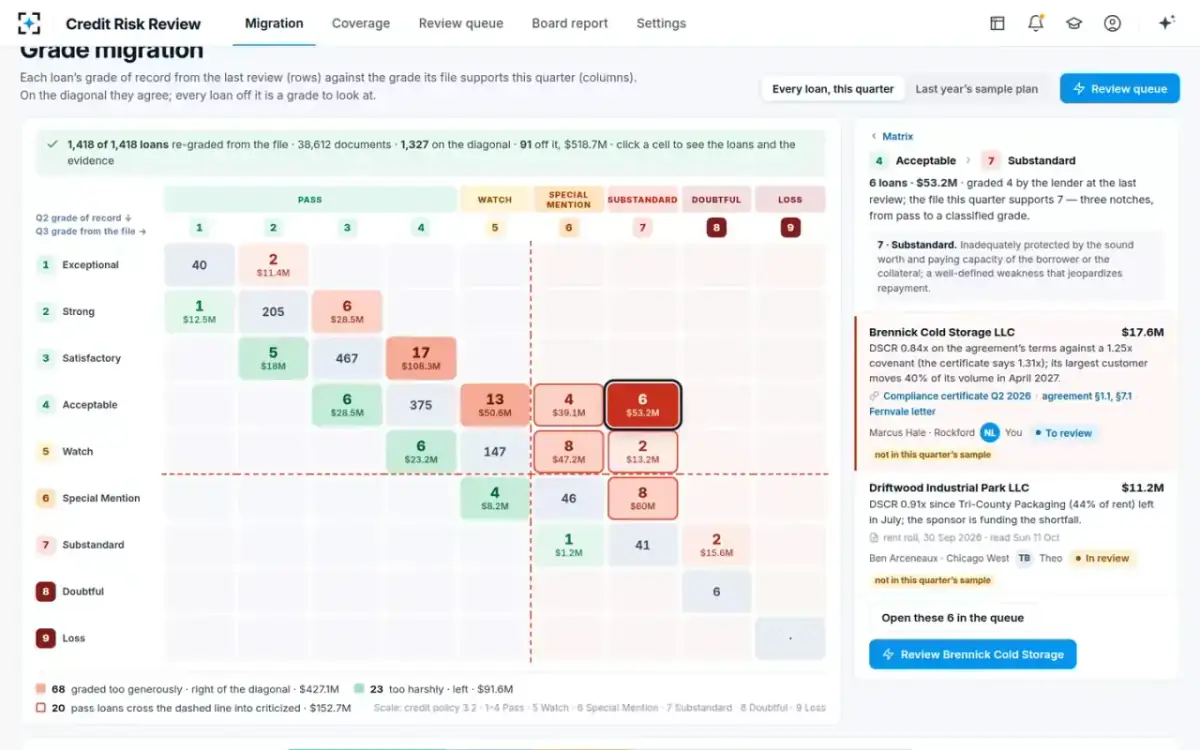
One cell of a quarter’s grade migration, opened in Credit Risk Review
Is special mention a classified loan?
No. Special mention is criticized but not classified, and the distinction is not academic: it decides whether the loan appears in the adversely classified total examiners compare with capital. It also decides the tone of the conversation. A 6 says the bank has noticed something and wants it watched; a 7 says the bank has concluded the credit is impaired in a definite way.
The handbook also warns against the use loan committees most often put the grade to: special mention is not a halfway house between pass and substandard, and it is not to be used to put off the decision. A 6 assigned because the room could not agree between 5 and 7 is a 6 with nothing behind it, and it is the easiest finding in the world for an examiner to make.
Grade by grade: 1 to 4, the pass band
In practice the pass band is a strength ladder, and most banks define it on coverage, leverage and the quality of the secondary source of repayment. On the sample bank's scale, 1 is reserved for cash-secured credits and borrowers whose cash flow, leverage and liquidity are far stronger than policy; 2 wants coverage above 2.0x sustained for three years, leverage under 2.0x and ready access to capital; 3 wants coverage above 1.5x, leverage within policy and sound collateral and guarantor.
Grade 4 is where the arguments happen. The sample bank defines it as coverage above the covenant minimum with "some weakness the file shows is mitigated", and that last clause is the one a reviewer tests. A mitigant that exists in the file — a contract that runs for four more years, a guarantor with real liquidity, a lease that has been signed — supports a 4. A mitigant that exists only in the approval memo's optimism does not. Brennick Cold Storage, at the head of the sample bank's six three-notch falls this quarter, is that case exactly: a 4 whose mitigant — a customer contract the memo said ran through 2029 — quietly stopped being true when the customer gave notice that it was moving 40% of its volume in April 2027.
5 and 6: watch, then special mention
Grade 5 is the most misunderstood rung on a nine-point scale, because it is not a regulatory category at all. "Watch" is a bank's own label for a credit that still passes but has an adverse trend or event somebody should look at every quarter. Nothing in the agencies' framework corresponds to it, and translating it as if it were a weak special mention is a mistake that moves loans into the criticized total that do not belong there.
Grade 6 is where the shared language starts. In the agencies' definition a special mention asset carries potential weaknesses that deserve management's close attention and that, left alone, may damage the repayment prospects or the bank's credit position later. The test is about potential: something has appeared that could damage repayment, and has not yet. The agencies' exact wording for all four categories, and what follows from each, is laid out in Risk Rating Validation's guide to commercial loan risk rating definitions.
7, 8 and 9: substandard, doubtful, loss
At 7 the potential becomes definite. A substandard asset is one that neither the borrower's present worth and ability to pay nor the collateral adequately protects, and the definition insists on a weakness that is well-defined and that puts collection of the debt at risk. Cash flow that does not cover debt service on the agreement's own definitions is well-defined. A worry about an industry is not.
At 8 the question changes from whether there is a weakness to whether the bank will be repaid at all. A doubtful asset, the handbook explains, "has a high probability of total or substantial loss, but because of specific pending events that may strengthen the asset, its classification as loss is deferred" — a sale, a merger, a capital injection, a lien being perfected on more collateral. Without such an event in prospect, a credit that bad is a 9. At 9 the asset is uncollectible and worth too little to keep carrying on the books, and it is charged off.
Special mention against substandard: the test that separates 6 from 7
6 · Special mention: Potential weaknesses that deserve close attention and could, left alone, weaken repayment at some later date.
7 · Substandard: Not adequately protected by the borrower’s present worth and paying capacity or by the collateral, with a well-defined weakness that puts collection at risk.
6 · Special mention: Future. Something could go wrong with repayment.
7 · Substandard: Present. Something already has, and it is identified.
6 · Special mention: The borrower’s largest customer has given notice for next year, but coverage is still 1.4x and every covenant is met.
7 · Substandard: The same notice, and coverage recomputed on the agreement’s terms is 0.84x against a 1.25x minimum.
6 · Special mention: Criticized. Not in the classified total compared with capital.
7 · Substandard: Criticized and classified. In the total.
6 · Special mention: Using 6 as a compromise when the committee cannot agree between 5 and 7.
7 · Substandard: Holding at 7 after full collection has become improbable, because 8 feels drastic.
Where a real loan sits between those two columns is the argument reviewers have most often, and it rarely turns on the definitions alone. Annual Credit Review's guide to special mention vs substandard argues one loan both ways and shows how to test whether two reviewers draw the line in the same place.
How many pass grades should a bank have?
More than one, and fewer than you think. The handbook's guidance is a principle rather than a number: "the risk rating system should assign an adequate number of ratings," it says, and "to ensure that risks among pass credits (i.e., those that are not adversely rated) are adequately differentiated, most rating systems require several pass grades."
The only broad count published by a standards body is old but still the honest answer to the question. When the Basel Committee surveyed banks on how their internal rating systems were built, it found that "the average number of grades reported by the banks as covering non-impaired corporate loans is 10, including 'auxiliary' grades, that is, '+' or '-' modifiers on some or all grades. The range fell between 2 and 20." Problem grades were far fewer: an average of about three, from a high of six to a low of zero.
How many grades banks actually run, against the sample bank’s nine
Two readings follow. The first is that nine is on the thin side for a bank that wants its pass band to mean something: five non-impaired grades against a survey average of ten. The second is that adding grades buys nothing unless each new grade has a written test the credit file can answer. A bank that splits 3 into 3+ and 3− without saying what distinguishes them has bought itself a longer argument, not a sharper one.
Translating your scale to the agencies’ framework
The documentation the guidance asks for is a one-page map and a set of worked examples, and it is worth more than its size suggests. It is what lets an examiner "reconcile the totals for the various loan classifications or risk ratings under the institution's system" to the agencies' categories. Where a bank cannot produce it, the examiner builds their own map from the loans in front of them, and that map rarely flatters the bank.
The translation grid Credit Risk Review keeps behind the scale
1 · 2 · 3 · 4 · 5
Pass
That watch at 5 is a pass grade in the agencies’ framework, not a lighter special mention — the commonest translation error, and the one that inflates a criticized total.
6
Special mention
That the rung’s own wording tracks the potential-weakness test, so a loan at 6 is criticized but stays out of the classified total.
7
Substandard
That the rung requires a well-defined weakness, named in the file, rather than a general concern about the borrower or its industry.
8
Doubtful
That the specific pending event deferring a loss classification is identified and dated, not assumed.
9
Loss
That the charge-off timing follows the classification rather than the budget.
Eight factors, one grade: how a rung is argued from a file
A grade is a conclusion, and a conclusion needs an argument. The sample bank scores eight factors on a commercial and industrial scorecard — repayment capacity, customer concentration, liquidity, leverage, management and reporting, collateral, guarantor and payment performance — each weighted, each with what the file shows now against what it showed at renewal, and each linked to the document it rests on. The handbook's requirement is the simple one: the grade has to be well supported, and the support has to sit in the credit file where someone else can read it.
Eight factors behind one grade in Credit Risk Review, each cited to a page
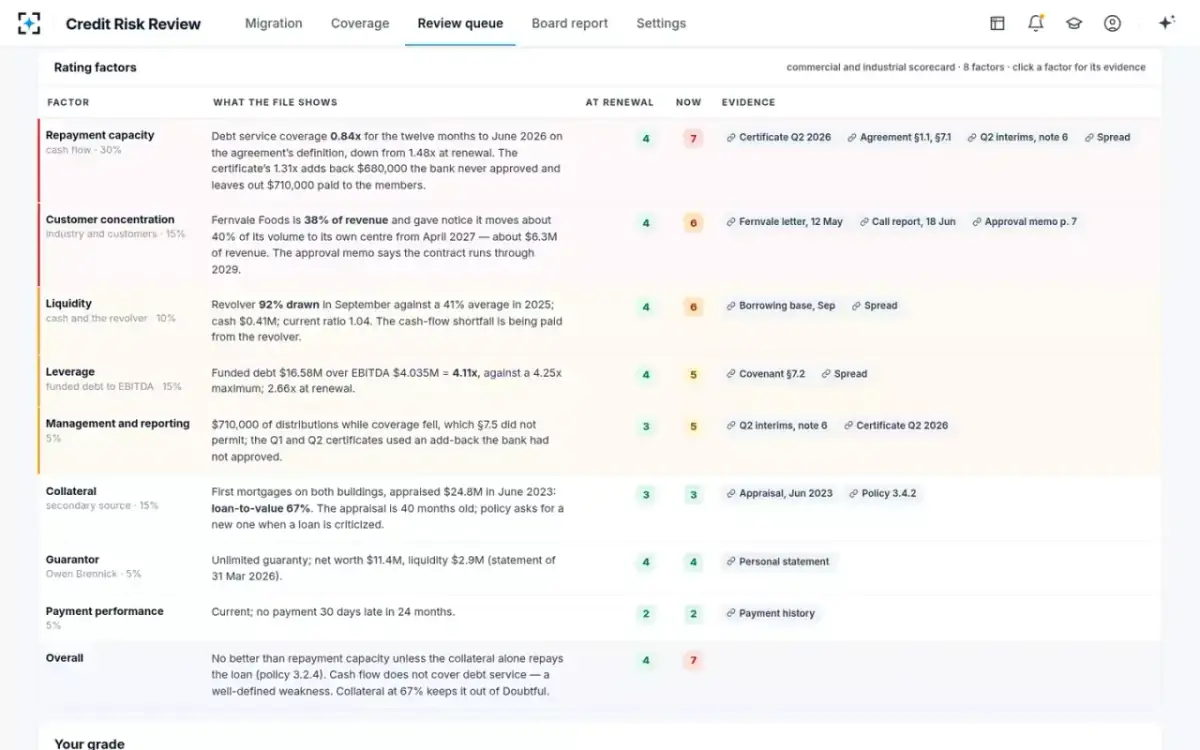
Read down the factor column and the shape of the argument appears. Five of the eight factors moved; three did not. Collateral held at 3 because first mortgages on both buildings still cover the loan at 67% loan-to-value, and payment performance held at 2 because nothing has been thirty days late in two years. Those two held factors are why the loan is a 7 and not an 8: there is a well-defined weakness, but full collection is not improbable.
That is the second half of a defensible grade, and the half most write-ups skip. Saying why a loan is not one rung better and not one rung worse forces the reviewer to name what would have to change, which is the sentence the lender will actually argue with. Who gets to make that call, and what happens when the lender disagrees, is the subject of who assigns a loan risk rating.
Five questions that decide whether a loan sits at 6 or 7
- Is the weakness named, or only felt?
Write it as a sentence with a number in it. “Coverage of 0.84x against a 1.25x minimum” is a well-defined weakness. “Pressure in the sector” is not, however true.
- Has it already happened, or might it?
Special mention is about a potential weakness that may damage repayment later. Substandard is about one that is damaging it now.
- Does the primary source of repayment still work?
If operating cash flow no longer services the debt on the credit agreement’s own definitions, the primary source has failed, whatever the collateral says.
- Is the collateral doing work the cash flow cannot?
Many credit policies cap a grade at the repayment-capacity factor unless the collateral alone repays the loan. Check yours before you lean on an appraisal — especially a stale one.
- Would you write the same grade if the borrower were new?
A useful test for the grade that has drifted. If you would not approve this credit as a 4 today, it is not a 4 today.
Do all banks use the same risk rating scale?
No, and the guidance does not ask them to. Scales differ in length, in where the pass band stops, in whether watch is a grade or a list, and in whether the grade attaches to the borrower, the facility, or both. Two banks lending to the same company can hold different grades on the same credit without either being wrong, because each is scoring against its own written definitions.
What they do share is the bottom four rungs and the duty to translate. That is why the comparison worth running is not "what do our peers grade this" but "does our 6 behave like the agencies' special mention and our 7 like their substandard, loan after loan". A quarter of grades in which every criticized loan can be shown to meet the definition it was assigned to is worth more than a scale that looks like everyone else's.
The rating scale as a setting in Credit Risk Review, not as code
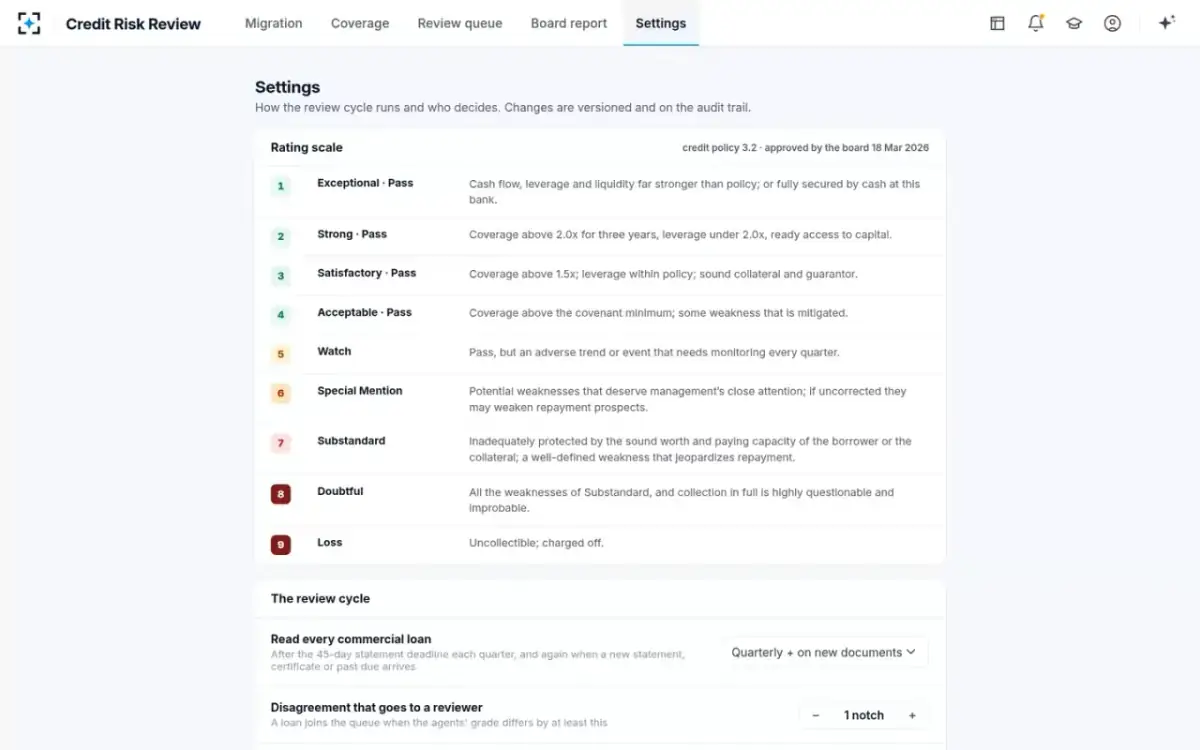
Keeping the scale as a setting rather than as something fixed in the product matters for a reason that has nothing to do with convenience: the definitions a grade is argued against have to be the bank's own, approved by its board, and visible to the reviewer at the moment of the decision. A scale that lives in a vendor's code is a scale nobody can defend to an examiner. The same holds for the review cycle, the response clock and the independence rules behind them, which the same screen holds.
Questions people ask
What does a risk rating of 5 mean on a commercial loan?
On a typical nine-point scale, 5 is the bank's watch grade: the loan still passes, but something has happened — a thinner quarter, a customer lost, a late statement — that the bank wants looked at every quarter rather than once a year. It carries no regulatory meaning, because the agencies' framework does not divide pass credits at all. If your scale is different, read your own credit policy's wording for the rung; the number alone tells you nothing.
What is the difference between a bank grade and a regulatory classification?
A bank grade is a rung on the bank's own scale and can be as fine as the bank wants. A regulatory classification is one of four categories — special mention, substandard, doubtful, loss — defined by the agencies in words a bank cannot vary. Pass is everything else, undivided. A bank running its own framework keeps documentation that translates one into the other so an examiner can reconcile the totals.
Who decides which grade a loan gets?
The lending staff assign the grade first — the agencies' guidance places primary reliance on them for accurate and timely ratings — and an independent reviewer then validates or adjusts it. Where the two disagree, the lower rating typically prevails unless new information persuades the independent reviewer otherwise; the whole route, seat by seat, is in who assigns a loan risk rating.
Is a watch grade the same as special mention?
No. Watch is a bank's own pass grade for a credit with an adverse trend that it wants looked at every quarter; special mention is one of the agencies' four defined categories and puts the loan in the criticized total. A bank that maps its watch grade to special mention inflates the criticized population it reports to its board, which is why the translation documentation has to say plainly that watch is still pass.
How many grades should a pass band have?
Enough to differentiate risk among credits that are not adversely rated — most systems use several, and a Basel Committee survey of internal rating systems found an average of about ten non-impaired grades, with a range from two to twenty. The practical limit is evidence: add a grade only when you can write the test that separates it from its neighbours and the credit file can answer that test.
Does a loan have to be downgraded the moment a covenant is breached?
Not automatically. A breach is evidence, not a classification, and what it proves depends on which covenant and by how much. A reporting breach may say little; a coverage covenant missed by a third of its limit on the agreement's own definitions is usually a well-defined weakness. What the agencies expect is that the grade reflects the file promptly once the facts are in it — which is why a review that reads files only once a year tends to carry stale grades.