Commercial loan risk rating definitions are the written criteria that say what each grade on a bank's scale means — and only four of them were written by anyone outside the bank. Special mention, substandard, doubtful and loss are the federal banking agencies' own words, published decades ago and still in force; every grade above them is the bank's own vocabulary, defined by the bank, for the bank. That is why one bank's grade 4 is not another's, and why the hard part of a rating system is not the scale but the map between the two. Botminds' Risk Rating Validation re-scores every rated commercial loan on the bank's own scorecard each night, pairs each borrower with look-alike borrowers graded by other lenders, and reads the write-up behind each grade, so a credit team can see where one definition is being applied two ways.
The bank, borrowers and people in the examples below are fictional sample data from the solution: Kestrel Valley Bank, 2,305 rated commercial loans, $13.67 billion of commitments. The regulatory definitions and the research figures come from the agencies and from central-bank research, linked where they appear.
What commercial loan risk rating definitions actually define
A definition looks like a paragraph of description. It behaves like a price list. The grade a definition places a loan in decides, at most banks, who may approve it, what it is priced at, how often somebody has to look at it again, and how much of the allowance it carries. The Comptroller's Handbook is blunt about the last one: the allowance rests on the ratings of individual credits and has to move with the risk they indicate, a link worked through in what one grade is worth. Write a definition loosely and you have not written a vague sentence; you have mispriced a loan and under-provided for it.
So a definition has to do three jobs at once. It has to place the loan — this borrower, these numbers, this structure, that grade. It has to carry the consequence — the allowance, the pricing, the approval authority, the frequency of review that follow from the grade. And it has to bind two different raters in two different regions to the same answer on the same facts. The third job is the one that fails quietly, because nothing in the bank's own reporting shows it failing. A region whose grades all sit a notch high looks, on every report, like a region with better credits.
The four grades the regulators wrote, in their own words
Four categories have definitions the agencies published and expect to see applied the same way in every bank. Special mention came from an interagency supervisory definition in 1993; substandard, doubtful and loss come from the uniform classification definitions that predate it. They are short, and every clause in them does work.
The four definitions nobody at your bank wrote — and the one tier that has none
| Category | The definition the agencies published | What follows from the word |
|---|---|---|
| Pass | None. The agencies define the other four and label everything not adversely rated "Pass"; the words that distinguish a 2 from a 4 are the bank’s own. | Whatever the bank’s policy says: pricing, authority, review frequency and a pooled allowance rate per grade. |
| Special mention | "A special mention asset has potential weaknesses that deserve management’s close attention. If left uncorrected, these potential weaknesses may result in deterioration of the repayment prospects for the asset or in the institution’s credit position at some future date." | Criticized but not classified. Normally still accruing, because an asset here "has a higher probability of default than a pass asset" but "its default is not imminent". |
| Substandard | "A substandard asset is inadequately protected by the current sound worth and paying capacity of the obligor or of the collateral pledged, if any. Assets so classified must have a well-defined weakness, or weaknesses, that jeopardize the liquidation of the debt. They are characterized by the distinct possibility that the bank will sustain some loss if the deficiencies are not corrected." | Classified. "For some substandard assets, the likelihood of full collection of interest and principal may be in doubt; such assets should be placed on nonaccrual." |
| Doubtful | "An asset classified doubtful has all the weaknesses inherent in one classified substandard with the added characteristic that the weaknesses make collection or liquidation in full, on the basis of currently existing facts, conditions, and values, highly questionable and improbable." | Classified, and "because of high probability of loss, nonaccrual accounting treatment is required for doubtful assets." |
| Loss | "Assets classified loss are considered uncollectible and of such little value that their continuance as bankable assets is not warranted. This classification does not mean that the asset has absolutely no recovery or salvage value, but rather that it is not practical or desirable to defer writing off this basically worthless asset even though partial recovery may be effected in the future." | Charged off. "Losses are to be recorded in the period an obligation becomes uncollectible." |
Read the special mention paragraph again and notice what it does not say. It names no ratio, no number of days past due, no coverage threshold. It says potential weaknesses, and it says they deserve attention. A borrower whose coverage has slipped below the bank's guide while its liquidity holds and its sponsor is good is the paragraph's home ground. So is a borrower with an ineffective loan agreement and perfectly adequate numbers: the handbook lists "an ineffective loan agreement or other material structural weakness" among the non-financial reasons for a special mention rating.
And notice what the handbook adds immediately after the definition, because it is the sentence that gets ignored most often in practice.
Special mention is not a compromise between pass and substandard and should not be used to avoid exercising such judgment.
OCC, Comptroller's Handbook, ‘Rating Credit Risk’
That line exists because special mention is the easiest downgrade in a bank. It criticizes the credit without classifying it, which means it moves no loan to nonaccrual and asks for no individual allowance measurement. A rating system in which the special mention population grows while substandard stays flat is usually a system in which judgement is being deferred, not exercised — and that pattern is visible from the grade history alone, which is why it is one of the first things a validation looks for.
Criticized or classified loans: the difference the line makes
Criticized and classified are not two words for the same thing, and the line between them is the single most consequential line on a bank's scale. The handbook draws it in two sentences: "Classified assets are exposures rated substandard, doubtful, or loss. Classified assets do not include pass and special mention exposures." Criticized is the wider circle — it takes in special mention as well as the three classified categories. So every classified loan is criticized; a special mention loan is criticized and not classified.
What changes at that line is not the vocabulary but the arithmetic. A special mention credit usually keeps accruing interest and keeps its allowance in a pool. A substandard credit whose full collection is in doubt goes to nonaccrual, which stops interest income, and its allowance moves to a pool built for weaker credits or is measured on the credit itself. The capital ratios examiners watch, including the ratio of adversely classified items to capital, count the classified dollars and not the criticized ones. One notch moves a loan across all of that at once.
Pass, criticized, classified: what changes at each line, and who wrote the words
Pass
The bank writes every word of it
Who defines itThe bank. The agencies simply label everything not adversely rated "Pass".
AccrualInterest accrues normally.
The allowanceProvided on a pooled basis, by the loss rate the bank attaches to that grade.
How often it is looked atA formal review at least annually; higher-risk pass credits more often.
Approval authoritySet by the bank, usually by grade and size together.
Special mention · criticized
The agencies wrote the definition; the loan is not classified
Who defines itThe federal banking agencies, in a 1993 interagency definition.
AccrualNormally still accruing: default "is not imminent".
The allowanceStill pooled, but at the loss rate of a weaker pool.
How often it is looked atMore often than a pass credit, and named on a watch list.
Approval authorityThe downgrade itself usually needs a credit officer, not the lender alone.
Substandard · doubtful · loss — classified
The agencies wrote all three, and the consequences follow the word
Who defines itThe federal banking agencies. These three are the classified categories.
AccrualNonaccrual where full collection is in doubt; required for doubtful.
The allowanceIn a pool built for weaker credits, or measured on the credit itself once it resembles no pool.
How often it is looked atIntensive supervision, often by workout specialists.
Approval authorityOut of the lender’s hands; the credit is managed, not sold.
This is also where the sample bank's quarter gets interesting. Of fourteen Mountain-region trucking loans graded at least two notches better than the bank's own scorecard, the calibration note proposes three for special mention — $31.4 million of commitments that would move from criticized-by-nobody to criticized, with everything that follows. The other nine proposed regrades stay inside the pass grades, where the only thing that changes is the bank's own pricing and its own allowance rate. Same exercise, two very different conversations at committee.
Does a grade mean the same thing in two regions?
It should, and it is the property of a definition least often tested. A grade means what the bank's own written definition says it means — on a nine-point scale a 5 is usually the last comfortable pass grade or the first watch grade, and on a scale with four pass grades it is already criticized; Credit Risk Review's guide to the 1–9 loan risk rating scale walks the rungs one by one. The number is a label on a locally defined box.
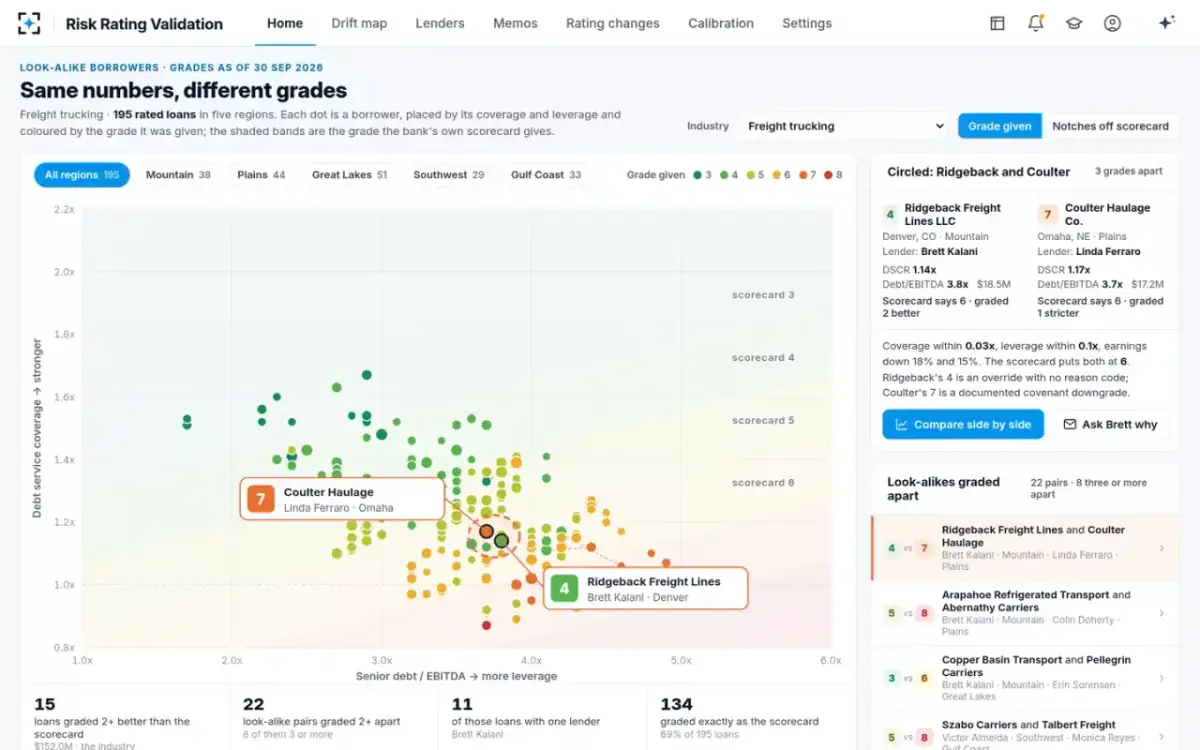
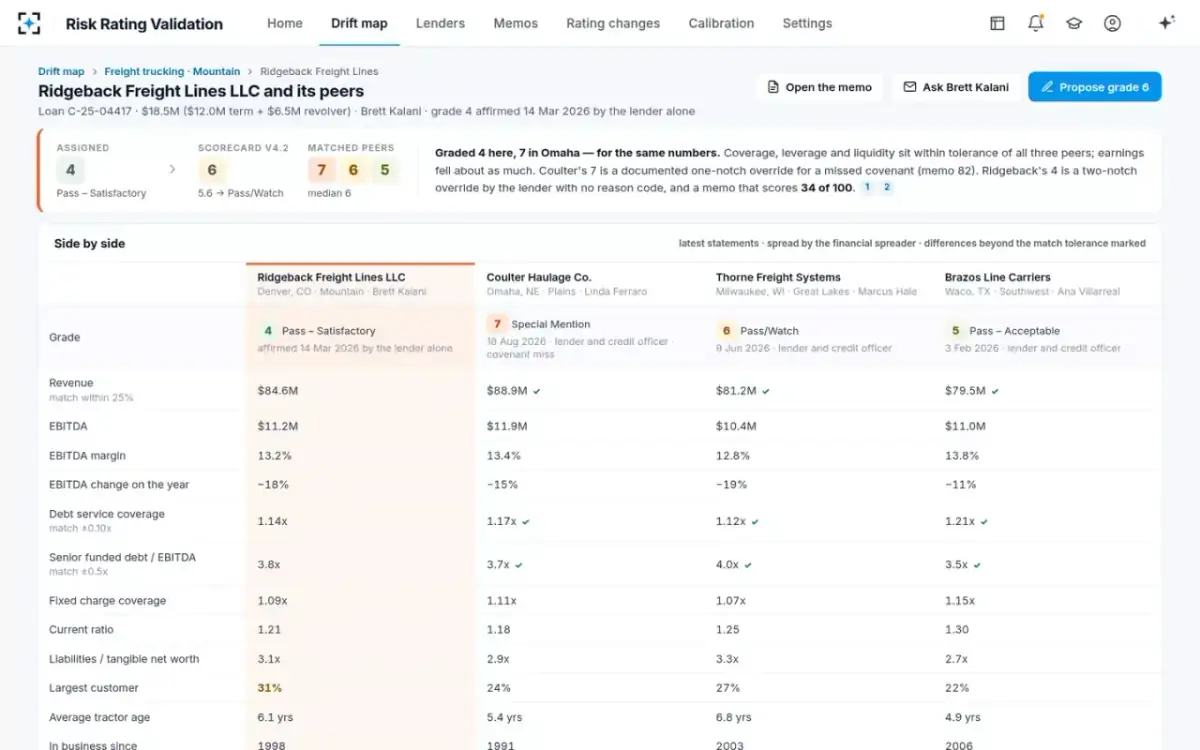
So the useful question is not what a grade means on paper but whether it means the same thing in Denver and in Omaha. At the sample bank, Ridgeback Freight Lines carries grade 4 and the bank's scorecard, version 4.2, scores it 5.6 — a grade 6. Its three closest peers, graded by other lenders in other regions, carry 7, 6 and 5. Five of those six numbers are defensible readings of the same borrower under the same written definitions. That spread, not the definitions, is what a validation is for; how the grade is worked out factor by factor takes the same borrower through the scorecard and the override.
The pass grades are the bank's own, and so are their definitions
Almost every commercial loan a healthy bank owns is a pass credit, so almost all of the rating work happens in the tier nobody outside the bank has defined. The agencies' only published expectation is that there be enough grades to tell pass credits apart: the OCC's handbook observes that most rating systems need several pass grades to differentiate the risk among credits that are not adversely rated.
How many is "several" is a decision each bank makes, and the spread is wide. The classic survey of the practice, by William Treacy and Mark Carey of the Federal Reserve Board, counted the grades on the scales of the fifty largest US banks and found the number of pass grades ran "from two to the low twenties", with a median of five including a watch grade, and a median of six among the ten largest banks.
How many pass grades a large bank uses, as counted at the fifty largest
More grades are not free. The paper notes that systems with more grades "are more costly to operate because of the extra work required to distinguish finer degrees of risk" — every extra grade is another definition two raters have to read the same way, another boundary an override can cross, and another row in every report. The bank that gains most from twenty pass grades is the one with a large investment-grade book to tell apart. A middle-market lender that splits its pass tier five ways and writes each split well is in better shape than one that splits it twelve ways and writes none of them.
Why are two banks' grade 4s not the same loan?
Because the number is a position on a locally defined scale, and the scales are built from different materials. Treacy and Carey put it plainly, and the sentence is worth reading twice before anyone benchmarks their grade distribution against a peer's.
even where the number of grades is identical on two different banks’ scales, the risk associated with the same grades (for example, two loans graded 4) is almost always different.
Treacy and Carey, Federal Reserve Bulletin, November 1998
Three things differ underneath. The number of pass grades differs, so the same risk range is cut into different slices. The reference point differs: some banks anchor their grades to agency ratings or to a default probability band, others to a verbal description of the borrower's condition. And the horizon differs — a grade meant to describe risk over the life of the facility is not a grade meant to describe the next twelve months, and two banks can use the same word for both.
The practical consequence is that grade distributions do not travel. A bank cannot learn much from the fact that its 4s are 22% of its book and a peer's are 31%. What it can learn is whether its own 4s mean the same thing in Denver and in Omaha, which is a question about its own definitions and can be answered with its own data.
Mapping your scale onto the agencies' categories, and keeping the map
Because the pass tier is private and the adverse tiers are public, every bank needs a translation between the two, and the expectation has hardened over time. In 1998 Treacy and Carey recorded that the supervisory agencies "do not specifically require that banks maintain regulatory categories on an internal scale but do require that recordkeeping be sufficient to ensure that loans in the regulatory categories can be quickly and clearly identified" — all but two of the fifty largest banks simply carried the regulatory grades on their own scale.
The 2020 interagency guidance on credit risk review systems is more specific. A bank whose own framework differs from the regulatory one "should maintain documentation that translates their risk ratings into the regulatory classification framework used by the federal banking agencies". Note the verb: maintain. A map written when the scale was designed and never revisited is the thing that breaks, because scorecards get new versions, policy raises a threshold, and a watch grade quietly starts being used as a parking space for credits a region does not want to classify.
Two rules keep a map honest. First, the map is between tiers, not between numbers: a bank's grade 7 is not "special mention" because somebody once wrote that on a slide, it is special mention when the loan meets the agencies' published definition. Second, the map is testable. If grade 7 is supposed to map to special mention, then the population of 7s should look like the definition — potential weaknesses, attention deserved, default not imminent — and a 7 sitting beside a classified peer with the same numbers is evidence that the map is not holding.
What a definition has to carry before two raters can use it the same way
A written definition that two raters apply the same way on the same facts is a short, specific, testable paragraph. The Basel framework's minimum requirements for an internal ratings-based approach set the bar for banks that use one: "To meet this objective, a bank must have a minimum of seven borrower grades for non-defaulted borrowers and one for those that have defaulted." Most US commercial banks do not run that approach, but the shape of the requirement travels: enough grades to discriminate, and each one defined well enough that a third party could place a borrower without ringing the lender.
Six tests a grade definition should pass before it goes into policy
- It names the measures, with a range
Coverage, leverage and liquidity bands belong in the definition, not only in the scorecard. A definition made entirely of adjectives cannot be applied twice the same way.
- It says what the grade is about
Default risk over the next twelve months, or loss over the life of the facility. Two raters with different horizons will disagree forever and both be right.
- It distinguishes itself from its neighbours
The useful sentence in a definition of grade 5 is the one that says what makes a borrower a 5 rather than a 4 or a 6.
- It says what structure and collateral may and may not do
Whether a guarantee or a lien can move the grade, and by how much, decides half the arguments at committee.
- It maps to a regulatory category, explicitly
For any grade at or past the criticized line, the definition should quote the agencies’ words rather than paraphrase them.
- It can be tested on last year’s book
Take fifty loans already graded, apply the words as written, and see how many land where they sit. A definition no one can test is not a definition.
Risk Rating Validation: every trucking borrower by its numbers, coloured by the grade it was given
What happens when the examiners read your definitions differently
An examination does not test your definitions in the abstract. It takes a sample of credits, grades them under your own written criteria, and compares. That is why a loose definition is dangerous in a specific way: it does not produce an argument about wording, it produces a list of loans the bank graded one way and the examiner graded another, and that list is arithmetic.
The sample bank runs its own version of the same test. Loan review covers 401 of 2,305 rated loans in a quarter — 17% of the book — and the loans it does not reach are graded by whatever the definitions mean to the lender who wrote them. Re-scoring every rated loan nightly and pairing each borrower with look-alikes graded elsewhere turns the untested 83% into something a credit officer can look at before anyone else does. What the Comptroller's Handbook asks of a rating system sets out the lines examiners use when the two readings differ, and who stands behind a grade follows the chain of people who have to agree before one changes.
One borrower, its three matched peers, and five defensible readings of the same definitions
Questions people ask
What are the regulatory risk rating definitions?
There are four: special mention, substandard, doubtful and loss. Special mention comes from an interagency supervisory definition published in June 1993; the three classified categories come from the agencies' uniform classification definitions, which the OCC booklet cites from Banking Circular 127 as revised in April 1991. The OCC's "Rating Credit Risk" booklet reproduces all four. There is no regulatory definition of any pass grade.
What is a special mention loan?
One with "potential weaknesses that deserve management's close attention" which, "if left uncorrected", may hurt the repayment prospects or the bank's credit position later. It is criticized but not classified: default is not imminent, the loan usually keeps accruing, and its allowance is usually still pooled. The handbook warns it is "not a compromise between pass and substandard".
What does substandard mean on a bank loan?
That the loan is "inadequately protected by the current sound worth and paying capacity of the obligor or of the collateral pledged", and has a well-defined weakness that puts repayment of the debt in jeopardy. Substandard loans are characterised by "the distinct possibility that the bank will sustain some loss if the deficiencies are not corrected" — and where full collection of interest and principal is in doubt, they should be on nonaccrual.
Does a bank have to use the regulators' categories on its own scale?
Not literally, though most do. Treacy and Carey found that all but two of the fifty largest US banks carried grades corresponding to the regulatory problem-asset categories on their internal scales, and that the agencies required only that loans in those categories "can be quickly and clearly identified". The 2020 interagency guidance expects a bank whose framework differs to keep documentation that translates its ratings into the regulatory framework.
How do you map an internal grade to a regulatory classification?
Grade by grade, in writing, and then test it. For each internal grade at or past the criticized line, state which regulatory category it corresponds to and quote the agencies' definition in the policy. Then check the populations: if the loans sitting in that grade do not look like the definition, the map has drifted. Re-grading a sample and comparing is the only evidence that the translation still holds.
How does a loan's risk rating affect the allowance?
Directly. The OCC booklet ties the allowance to the ratings: each credit's inherent loss belongs in its grade, provided for individually or in a pool, and the allowance has to move with the risk the grades indicate. Pass and special mention credits are normally provided for in pools at a loss rate per grade; classified credits sit in weaker pools or are measured individually. A notch of optimism across a region is therefore an under-provision, not an opinion.