Risk-based pricing for bank loans is the practice of letting the borrower's risk grade set the rate it pays, so that the spread covers funding, the expected loss the grade implies, the capital the loan consumes and the cost of administering it. The Comptroller's Handbook puts the principle in one line — "risk ratings should guide price setting", and "the price for taking credit risk must be sufficient to compensate for the risk to earnings and capital" (Rating Credit Risk). What follows from that is less often said out loud: if the grade sets the price, a grade that runs a notch optimistic is not a documentation problem, it is foregone revenue and an understated allowance, repeated across every loan the lender touches. Botminds' Risk Rating Validation exists for that second sentence — it re-scores every rated commercial loan nightly on the bank's own scorecard, compares each borrower with look-alikes graded by other lenders, and puts the proposed regrades and their estimated allowance effect in front of the people who sign.
The bank figures on this page come from a working demonstration on sample data: Kestrel Valley Bank, a fictional commercial lender with 2,305 rated loans and $13.67B of commitments. The sample bank publishes no pricing, so every price on this page is either a published research figure or our own arithmetic, labelled where it appears.
What the grade moves: four measured and estimated figures
1.5pts
measured gap in interest rates between the riskiest and least risky farm loans at the same banks (Federal Reserve working paper, 2003)
8.6%
of 2025 Shared National Credit commitments rated non-pass — special mention or classified
$31.4M
of the sample bank's loans proposed for special mention in one quarterly note (demo)
+$2.9M
estimated allowance effect of the twelve proposed regrades — the solution's own estimate, for the allowance committee to measure
What risk-based pricing for bank loans means in practice
In practice it means a pricing sheet with the grade as one of its inputs, and a credit committee that can see what the grade did to the number. The OCC lists loan pricing among the functions a rating system exists to serve, alongside approval authority, relationship management and the allowance — the rating process, in its words, "allows bank management to manage risk to optimize returns". It also names the failure mode in the same breath: "incorrect pricing can lead to risk/return imbalances, lost business, and adverse selection".
Adverse selection is the word worth pausing on. A bank that under-prices its riskier grades does not merely earn less on them; it wins a disproportionate share of exactly those borrowers, because the lenders competing for the good ones are pricing them properly and the bank is not. Over a few years the mix of the book changes without anyone deciding that it should. That is a pricing error turning into a portfolio strategy by accident.
Risk ratings should guide price setting. The price for taking credit risk must be sufficient to compensate for the risk to earnings and capital. Incorrect pricing can lead to risk/return imbalances, lost business, and adverse selection.
Comptroller's Handbook, Rating Credit Risk
From grade to price: the four terms in the spread
Every risk-based price is a sum of four things, and the grade touches two of them directly. Write the terms out and the argument about a notch becomes arithmetic rather than opinion.
The four terms of a risk-based price, and who owns each
Cost of funds
matched-term funding + liquidity premium
What the money costs the bank for the life of the facility. Independent of the grade: a grade 7 borrower does not make deposits more expensive.
Treasury
Expected loss
probability of default × loss given default × exposure
The grade sits here. On a borrower-and-facility scale the borrower grade drives the first term and the structure drives the second.
Credit risk
Cost of capital
capital allocated to the loan × target return above funding
The grade sits here too, through the capital the bank chooses to hold against a riskier asset. This is the term most pricing sheets omit.
Finance
Operating cost
origination, servicing and monitoring over the life
Rises with the grade as well, because a worse grade is reviewed more often. The handbook is explicit that a credit's rating should determine how the relationship is administered.
Lending operations
The fourth term is the one lenders argue about and the one that is easiest to verify. "A credit's risk rating should determine how the relationship is administered," says the handbook; "higher risk credits should be reviewed and analyzed more frequently, and higher risk borrowers normally should be contacted more frequently." A grade is therefore also a work order. Grading a borrower better than it is does not only under-price the loan; it buys the relationship manager a quieter year, which is part of why optimism is not randomly distributed.
How much is a notch worth?
It depends where on the scale you stand, and that dependence is the whole point. Because expected loss rises faster than linearly down a rating scale, the gap between adjacent grades widens as the grades worsen. Worked on one facility with the four terms above, a notch near the middle of a pass scale is worth a third of a percentage point, and the step out of pass is worth four times that.
One $18.5M facility, priced at four grades: the all-in rate
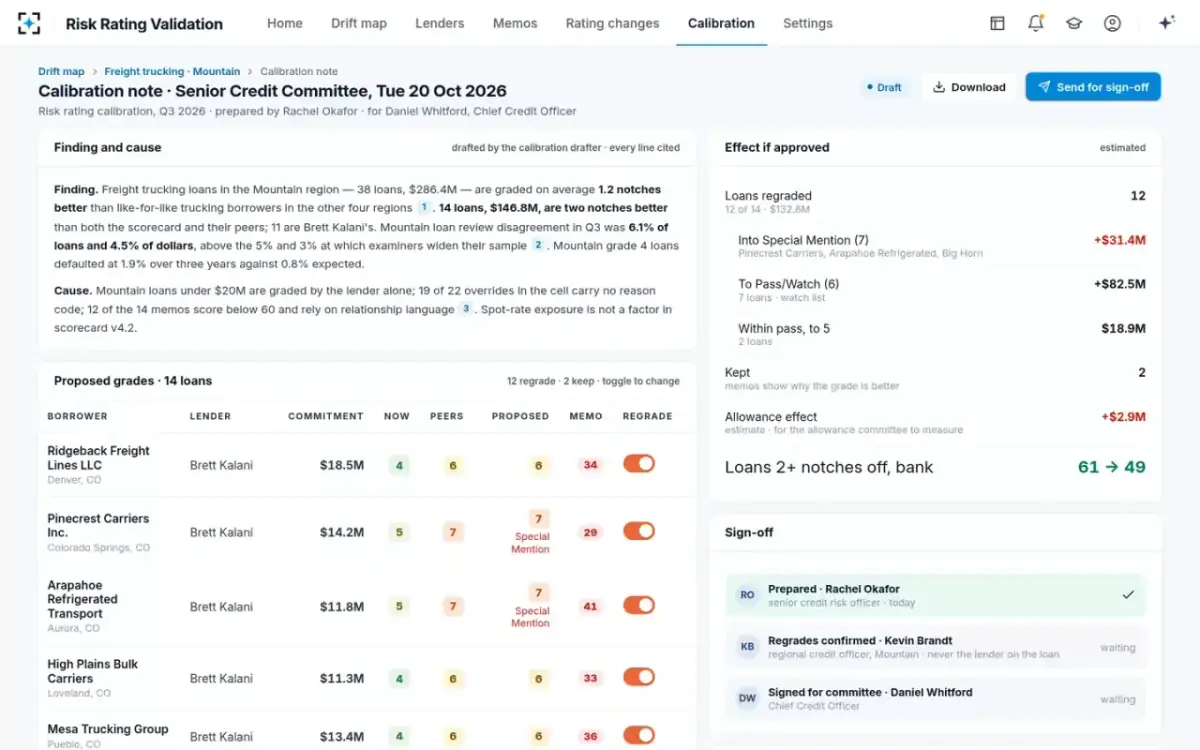
Put the two-notch figure against a real disagreement and the money shows itself. In the sample bank's demonstration, Ridgeback Freight Lines carries a grade 4 on an $18.5M commitment while the bank's own scorecard scores it 5.6 — a grade 6 — and its three closest matched peers are graded 7, 6 and 5. On the arithmetic above, 100 basis points on $18.5M is $185,000 of margin a year on one loan. Across the fourteen loans the demonstration finds graded two or more notches better than their peers, $146.8M of commitments, the same hundred basis points is about $1.5M a year. Neither number is the sample bank's; both are our arithmetic, shown to give the argument a size.
Where the spread goes on the same loan priced as a grade 6
All-in rate 6.84%
- Cost of funds 4.40% · 64.3%
- Expected loss 1.05% · 15.4%
- Cost of capital 0.84% · 12.3%
- Operating 0.55% · 8%
The same loan as a grade 4, 5.84%
- Cost of funds 4.40% · 75.3%
- Expected loss 0.28% · 4.8%
- Cost of capital 0.61% · 10.4%
- Operating 0.55% · 9.4%
What the grade does to the allowance, and when
It does not wait for the loan to go bad. The handbook is unambiguous that the grade is where the allowance starts: "risk ratings of individual credits underpin the ALLL. Every credit's inherent loss should be factored into its assigned risk rating with an allowance provided either individually or on a pooled basis. The ALLL must be directly correlated with the level of risk indicated by risk ratings."
The interagency guidance on credit risk review makes the timing explicit as well, and gives the reason a quarterly rating exercise is worth more than an annual one: ongoing review of the loan portfolio "is particularly important to the estimation of ACLs or the ALLL because loss expectations may change as the credit quality of a loan changes" (Interagency Guidance on Credit Risk Review Systems). A grade that is six months stale is an allowance input that is six months stale. The arithmetic is unforgiving in both directions: a book graded optimistically carries an allowance that is too small, and the correction arrives as a provision in a single quarter rather than as a drift across four.
The sample bank's demonstration ends with a number of exactly this kind and labels it carefully. Of fourteen flagged loans, twelve regrades are proposed — seven to grade 6, two to grade 5 and three into special mention, $31.4M — and the note puts the allowance effect at +$2.9M, labelled an estimate for the allowance committee to measure. That hedge is the right one, and worth copying. A rating system can tell the allowance committee which loans moved and why; it cannot compute the allowance, because the allowance depends on segmentation, loss history and forward-looking adjustments the credit risk function does not own.
The quarterly note Risk Rating Validation drafts, with the proposed grade on every loan
What a notch does to the classified total examiners read first
Because it compares the bank's bad assets with the capital standing behind them, in one figure. The FDIC's Office of Inspector General sets out the arithmetic in a failed-bank review: "the ACI coverage ratio is a calculation of Adversely Classified Items divided by Capital plus the Allowance for Loan and Lease Losses (ALLL)", and it "is a measure of the credit risk and ability of capital to protect against that risk. A higher ratio indicates exposure to poor quality assets and less ability for the bank's capital to absorb any losses associated with those assets" (FDIC OIG, Failed Bank Review FBR-21-001). In the bank that review examined, the ratio reached 641%.
The numerator is built out of grades. Classified assets are the exposures rated substandard, doubtful or loss; special mention sits above them, criticized but not classified. The substandard definition is the hinge: a loan that neither the borrower's worth and paying capacity nor the collateral adequately protects, with a well-defined weakness that puts collection at risk. Every loan a lender keeps out of that category by a notch is a loan that never reaches the numerator. One loan does not matter. A region's worth does. How the ratio is built term by term, and what a board should read beside it, is set out in Credit Risk Review's guide to classified assets to capital.
The asset-quality component of a bank's supervisory rating is assessed on a list of factors, and the FDIC's examination manual puts two of them next to each other: "the adequacy of underwriting standards, soundness of credit administration practices, and appropriateness of risk identification practices", and "the adequacy of the allowance for loan and lease losses and other asset valuation reserves" (RMS Manual of Examination Policies, section 1.1). Risk identification is the grading system by another name. A bank can hold perfectly adequate capital against the loans it has identified and still be marked down for not having identified them.
What a one-notch change moves, and how long each takes to show
| What moves | How the grade moves it | When it shows up |
|---|---|---|
| The rate the borrower pays | Directly, through expected loss and allocated capital in the pricing sheet. | At origination or renewal only — an existing facility keeps its contracted rate. |
| The allowance | Through the risk the grade indicates, individually or in a pool. | The next allowance run after the grade changes. |
| Capital held against the loan | Through the bank's internal allocation, and through regulatory classification once a loan is adversely rated. | The next capital planning cycle; immediately in internal profitability. |
| Approval authority | Rating-based limits decide who may approve the next extension. | At the next credit request from the same borrower. |
| How often anyone looks | Worse grades are reviewed and the borrower contacted more often. | At the next review cycle — which is why a stale grade stays stale. |
| The classified asset ratio | Only once the grade reaches substandard; special mention is criticized, not classified. | The quarter the grade crosses the line, and at the next examination. |
Why would a lender want a better grade?
Because almost everything a grade does, it does to the lender as well as to the borrower. A better grade prices the deal more competitively, keeps the approval inside the lender's own authority, keeps the relationship out of a workout group, and buys a longer interval before anyone reads the file again. None of that requires dishonesty; it requires only that the lender's judgement, exercised in a grey zone, drift consistently in one direction.
The handbook treats this as a structural risk to be examined for, not as a character flaw. Among the impediments examiners are told to be alert for, it lists "compensation programs that fail to reinforce lenders' and management's responsibility to properly administer, analyze, and report the risk in their portfolios", and "relationship management structures that may encourage lenders and management to 'hide' problems for fear of losing control over a customer relationship (e.g., having to transfer management responsibilities to a workout division or specialist)". Both describe an incentive, not an intention.
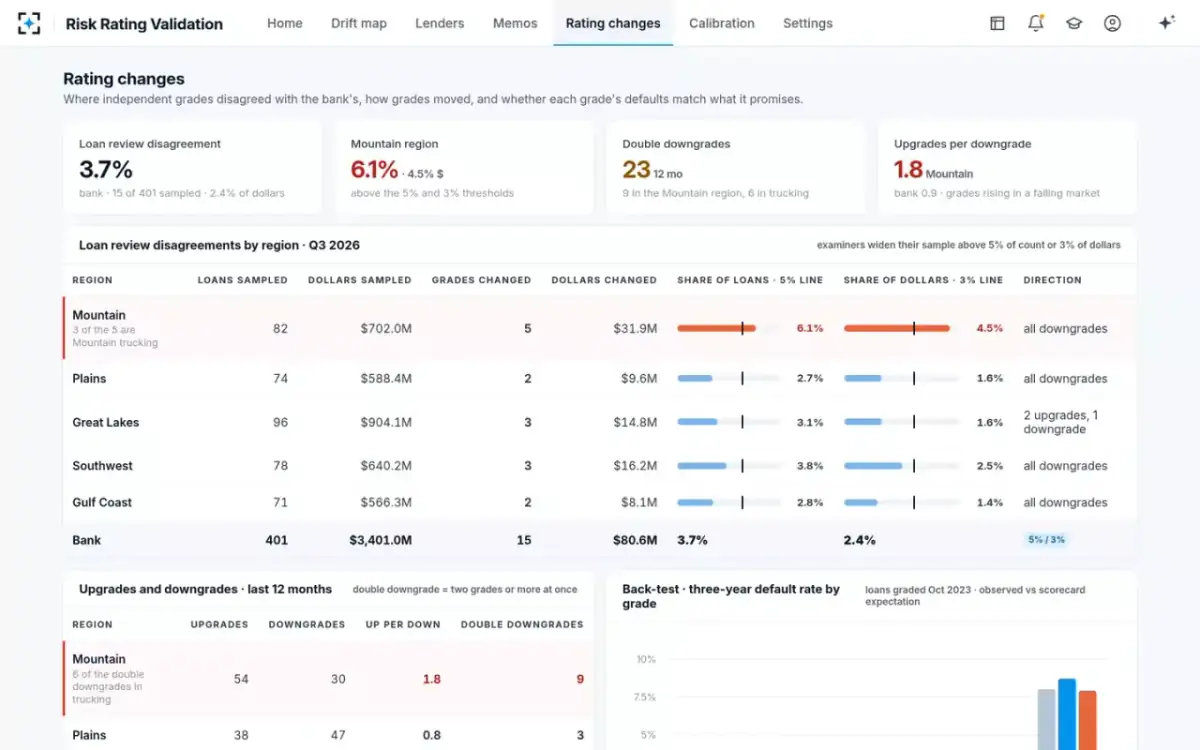
The sample bank's demonstration shows what it looks like when the drift is real rather than suspected. In the widest cell of its map, one lender's grades sit 1.6 notches better than matched peers, a second's 1.0 and a third's 0.7; none of the cell's 38 trucking loans is graded stricter than the scorecard; and nineteen of twenty-two overrides of the scorecard carry no reason code at all. A one-sided distribution is the signature. A lender who is simply a better judge of credit than the scorecard would be stricter sometimes.
Lenders, regions and the examiners' lines, as Risk Rating Validation reports them
What a notch of optimism is worth across a whole book
Multiply, and then discount the multiplication. The honest version of the calculation has three parts and only the first is arithmetic. The arithmetic: fourteen loans at $146.8M, two notches better than their peers, at roughly a hundred basis points a notch-pair on our inputs, is about $1.5M a year of margin not charged. The second part is the allowance, which the demonstration estimates at $2.9M for twelve regrades and refuses to assert. The third part has no number at all — the loans that were never written because a competitor priced them properly, and the loans that were written because this bank did not.
What a credit committee can do with that is decide how big the question is before deciding how much work it deserves. A book of $13.67B with one drifting cell of $286.4M is not in trouble. A bank that discovers one such cell every quarter, always by sampling, has a system that finds drift at the speed of its sample rather than at the speed of its lending — and the gap between full-scope examinations is twelve to eighteen months.
The published figures, and what they do and do not tell you about your bank
Two public figures are worth knowing and neither is a benchmark for your book. The first is that risk-based pricing demonstrably happens: controlling for bank size and performance and for as many non-price loan terms as the data allowed, Walraven and Barry found that "banks consistently charged higher rates of interest for the farm loans that they characterized as riskier, with an average difference in rates between the most risky and least risky loans of about 1-1/2 percentage points" (FEDS working paper 2003-53). That is a measured spread between the extremes of a scale, on agricultural loans, two decades ago — not the value of one notch today.
The same paper carries a second finding that matters more to anyone building a rating system. Reviewing the Federal Reserve's survey panel between 1997 and 2002, the authors report that "adoption of risk rating procedures held about steady over the period, with a little less than half the banks on the panel either not using a risk rating system, or reporting the same rating for all their loans in the survey". Reporting the same grade for every loan is the extreme form of the problem this page describes: a scale that does not separate anything cannot price anything.
The second public figure is the level of non-pass credit in the largest shared loans. In the 2025 Shared National Credit review, "the percentage of loans that deserve management's close attention ('non-pass' loans rated 'special mention' and 'classified') decreased to 8.6 percent of total commitments from 9.1 percent in 2024" — and the agencies added that the decline was "primarily due to growth in new commitments rather than an underlying improvement in credit quality". The industry-wide picture in the same period was benign: the FDIC reported for the second quarter of 2026 that "asset quality metrics improved, as both the past-due and nonaccrual and net charge-off rates declined from the prior quarter" (FDIC Quarterly Banking Profile). Benign aggregates are exactly the conditions in which a single cell can lean for a year without anything in the monthly reporting looking wrong.
What to measure every quarter instead of once a year
Five things, all of which exist in systems a bank already runs, and none of which requires a default to occur first.
Before you believe your own pricing is risk-based
- The realised spread by grade, on loans written this year
If the average spread on grade 6 originations is not materially above grade 4, the pricing sheet has a grade input that the pricing conversation overrides.
- The distribution of grades at origination, by lender
A lender whose originations cluster in two pass grades is not grading; the agricultural panel found banks reporting one rating for every loan.
- Overrides of the scorecard, with and without a reason
An override is legitimate and an unexplained one is not auditable. Count them separately, by lender, and track how the overridden loans perform.
- The share of exceptions that are one-sided
Judgement that is better than the model is sometimes stricter. Judgement that is only ever softer is a price concession wearing a grade.
- The allowance effect of the quarter's grade changes, as an estimate
Stated as a range with its assumptions, and handed to the people who own the allowance rather than asserted by the people who own the grades.
The reason to run these quarterly rather than annually is that all five are leading indicators and the default back-test is not. A one-sided override pattern is visible within a quarter of it starting; the default experience that confirms it arrives three years later, by which time the loans have been priced, reserved and in some cases repaid. To see a quarter's grade changes, the overrides behind them and the estimated allowance effect on one book, start from Risk Rating Validation; to compare the ways a bank can keep its grades right in the first place, read the four approaches side by side.
Questions people ask
What is risk-based pricing for bank loans?
It is pricing a loan so that its rate reflects the risk of the borrower and the facility, rather than applying one spread to everyone. The grade enters the price through two of the four terms in a spread — the expected loss it implies and the capital the bank allocates against it — while funding and operating cost come from elsewhere. The Comptroller's Handbook treats loan pricing as one of the core functions a rating system exists to support.
How does a risk rating affect a loan's interest rate?
Through expected loss and through capital. A worse grade raises the probability of default the pricing sheet assumes, and usually raises the capital the bank holds against the loan, so both the loss term and the capital term rise together. On our own illustrative inputs, one notch in the middle of a pass scale is worth about 32 basis points and two notches about 100, which is $185,000 a year on an $18.5M facility — your bank's numbers will differ, but the widening shape will not.
How does a downgrade affect the allowance?
It raises it, at the next allowance run rather than at the next default. The handbook requires the allowance to be directly correlated with the risk the ratings indicate, and the interagency credit risk review guidance notes that loss expectations change as credit quality changes, which is why a stale grade is a stale allowance input. How much it raises it depends on the bank's segmentation and loss history, so a rating system should offer the number as an estimate for the allowance committee, not as a result.
What does a one-notch error cost a bank?
Three costs, arriving at different speeds. Margin first: on our illustrative inputs, the fourteen loans the demonstration finds two notches generous, $146.8M, forgo about $1.5M a year, and the price can only be corrected at renewal. Then the allowance, which the demonstration estimates at +$2.9M for twelve regrades and which corrects the quarter the grades change. Last, once the honest grade would be substandard, a loan missing from the classified total examiners compare with capital — the cost that arrives at the examination.
Why would a lender want to understate risk?
Because a better grade prices the deal more competitively, keeps the approval within the lender's own authority, keeps the relationship out of a workout group and delays the next file review. The Comptroller's Handbook asks examiners to look for compensation programmes that fail to reinforce the responsibility to report portfolio risk properly, and for relationship structures that encourage hiding problems for fear of losing a customer. The signature is one-sidedness: grades that are softer than the scorecard and never stricter.
Does a grade affect how much capital a loan uses?
Internally, almost always: banks that allocate capital by risk hold more against worse grades, and that allocation is a term in the price. Externally, the grade matters once a loan is adversely classified, because classified assets are what supervisors measure against capital and the allowance. The practical consequence is that a notch of optimism understates both the price and the capital the business line is charged for, which flatters its measured return twice.