A dual risk rating model gives every commercial borrower one grade and every facility to that borrower another. The borrower grade answers a single question — how likely is this obligor to default? — and belongs to the obligor, not to any one loan. The facility grade answers a different one: if it does default, how much would the bank actually lose on this particular loan, given its collateral, its guarantees and its place in the capital structure? One grade cannot do both jobs, and a bank that asks it to cannot afterwards tell an optimistic view of a borrower from a generous view of its collateral. Botminds' Risk Rating Validation re-scores the borrower dimension of every rated commercial loan each night and pairs each obligor with look-alike obligors graded by other lenders, which is where that confusion shows up as a number.
The worked example is fictional sample data from the solution: Ridgeback Freight Lines at Kestrel Valley Bank, $18.5 million committed across a $12.0 million term loan and a $6.5 million revolver. The rules come from the OCC's booklet on rating credit risk, the Basel framework and Federal Reserve research, linked where they appear.
What a dual risk rating model is
Two scales, applied to two different objects. The obligor is graded once, however many facilities it has. Each facility is graded separately, on what would be recovered if the obligor failed. The OCC's booklet describes the arrangement in one sentence: "Dual rating systems typically assign a rating to the general creditworthiness of the obligor and a rating to each facility outstanding."
The reason banks moved this way is not elegance. It is that one number was being asked to serve purposes that pull in opposite directions. The same booklet is explicit: "Dual rating systems have emerged because a single rating may not support all of the functions that require credit risk ratings." Obligor grades support deal structuring and credit administration; facility grades support allowance and capital estimates, which in turn drive pricing and portfolio decisions. Fold them together and every one of those uses gets an average of two answers.
One borrower, two facilities: what a single scale hides and a dual scale shows
A single grade per loan: The loan. Each facility gets one number that mixes the borrower’s condition with the structure protecting that loan.
A dual model: The borrower once, and each facility separately.
A single grade per loan: A grade that could be read as either a view of the obligor or a view of the security behind this loan.
A dual model: Borrower grade, plus a facility grade reflecting the equipment and real property securing it.
A single grade per loan: A second number for the same obligor, with no rule about how far it may differ.
A dual model: The same borrower grade, and a facility grade reflecting whatever secures the line — which is rarely the same thing.
A single grade per loan: Both numbers move for mixed reasons, and nobody can say how much was the obligor.
A dual model: The borrower grade moves once, for every facility. Facility grades move only if the loss protection changed.
A single grade per loan: Whether this loan’s grade looks right. A judgement about a judgement.
A dual model: Whether this obligor is graded like obligors with the same numbers — and, separately, whether the collateral behind each facility is worth what the grade assumes.
The borrower grade: ability and willingness to repay
The borrower grade is a statement about an obligor's capacity and intent, over a stated horizon, on the strength of its own cash flow. Everything that belongs to the loan rather than the company is out of scope: the collateral, the guarantee, the covenant package, the position in the waterfall. What is in scope is the coverage, the leverage, the liquidity, the quality of the earnings, the management, the industry and the borrower's record of paying.
Two rules follow, and both are easy to break. The first is that the borrower grade must be the same number everywhere the obligor appears. The Basel framework states it flatly for banks on an internal ratings approach: "Separate exposures to the same borrower must be assigned to the same borrower grade, irrespective of any differences in the nature of each specific transaction." A bank with one obligor graded 4 on its term loan and 5 on its revolver does not have a dual system with a disagreement; it has no obligor grade at all.
The second is that the borrower grade must not quietly absorb the collateral. This is the common failure in banks that believe they run a dual model: the rater starts from the obligor's numbers, then nudges the grade up because the loan is well secured. The improvement belongs in the facility grade. Once it has been moved into the obligor grade, the obligor's grade stops being comparable with any other obligor's, and the whole point of the first dimension is gone.
The facility grade: what the structure and the collateral are worth
The facility grade prices the structure. The OCC's description is precise about its ingredients: "The facility rating considers the loss protection afforded by assigned collateral and other elements of the loan structure in addition to the obligor's creditworthiness." Note the last clause — in most US dual systems the facility grade is not loss severity on its own but the combination, which is why facility grades so often look like borrower grades with a notch of movement.
The Basel framework allows both readings, and says which is which. A rating dimension may reflect expected loss: "For example, a rating dimension that reflects expected loss (EL) by incorporating both borrower strength (PD) and loss severity (LGD) considerations would qualify." But for banks on the advanced approach the second dimension is narrower: "For banks using the advanced approach, facility ratings must reflect exclusively LGD." A bank that has never decided which of the two its facility scale means will find its raters using both, a notch apart.
Treacy and Carey found the practical pattern in their survey of the fifty largest US banks: "In two-dimensional systems, one grade typically reflects PD and the other EL." Banks, they wrote, usually set the borrower grade first and then "set the facility grade equal to the borrower grade unless the structure of the facility is such that" loss in the event of default is substantially better or worse than normal. That default-to-equal convention is sensible, and it is also the reason a facility scale can look busy while carrying almost no information: if nobody ever moves it, it is a copy of the first column.
Why do banks use two ratings instead of one?
Because the two questions have different answers, different evidence and different owners. The chance that a borrower fails is a fact about a company: its cash flow, its balance sheet, its market. What the bank would lose if it did is a fact about a contract: a lien, an appraisal, a guarantee, a position behind or ahead of other creditors. Mixing them produces a number that cannot be checked against anything, because the only comparable is another loan with the same borrower and the same structure, and there usually is not one.
A qualifying IRB rating system must have two separate and distinct dimensions: the risk of borrower default; and transaction-specific factors.
Basel Framework, CRE36, minimum requirements for the IRB approach
The two words that matter are separate and distinct. Separate means two grades, recorded apart. Distinct means they must measure different things — a second scale that moves only when the first one moves is not a second dimension, it is a decoration.
There is a quieter reason too, and Treacy and Carey name it: a two-dimensional system "can promote precision and consistency in grading by separately recording a rater's judgments about PD and EL rather than mixing them together". The gain is not only better numbers. It is that the rater has to say which of the two they are forming a view about, and an opinion stated separately can be argued with separately.
PD, LGD and expected loss, and where the regulatory words sit
Three terms carry most of the arithmetic. The probability of default is the chance the obligor fails within the horizon. Loss given default is the share of exposure the bank does not recover when it does. Expected loss is the product of the two and the exposure at default. A dual model maps the first onto the borrower grade and the second onto the facility grade; expected loss is what falls out.
Expected loss, term by term, and which grade carries each one
Probability of default
PD
The chance the obligor defaults within the horizon the scale states — usually one year.
The borrower grade
Loss given default
LGD
The share of exposure not recovered after collateral, guarantees and the costs of collection.
The facility grade
Exposure at default
EAD
What is actually owed when default arrives — for a revolver, more than today’s balance.
The facility, and the commitment behind it
Expected loss
EL = PD × LGD × EAD
The number the allowance, the capital allocation and risk-based pricing all want. It cannot be produced by one grade.
Both dimensions together
One point of vocabulary saves a great deal of confusion at examination time. These are not the regulators' words. The OCC's booklet says so directly: many firms use probability of default, loss given default and expected loss when defining credit risk, and "while these terms are not used in the regulatory rating definitions, the concepts are inherent to the regulatory ratings". Substandard, doubtful and loss are descriptions of condition, not parameters; the concepts underneath them are the same ones. A bank that reports in one vocabulary and is examined in the other needs the translation written down, which is the subject of what each grade on your scale means.
A two-dimensional grid, and what each pair of grades is actually used for
| Borrower grade (the chance of default) | Facility: strong loss protection | Facility: ordinary protection | Facility: thin or none |
|---|---|---|---|
| Strong pass | Lowest expected loss in the book. Pricing competes hardest here; the allowance rate is thinnest. | The ordinary case. Pricing follows the borrower grade almost entirely. | Watch the exposure at default, not the grade: an undrawn line to a strong obligor can still be the largest loss in a bad year. |
| Middling pass | Where structure earns its keep. Two loans to this obligor can carry very different allowance rates and prices. | The centre of most commercial books. | The combination that most often turns out, after the fact, to have been underpriced. |
| Weak pass or criticized | Structure is doing the work. The obligor grade should still fall when the obligor weakens — the collateral does not make the borrower better. | Review frequency rises on the obligor grade; the facility grade decides how much is provided. | The exposure to argue about at committee, and the one examiners open first. |
| Defaulted | Recovery work. The facility grade now carries the whole estimate, because the first dimension has resolved itself. | Recovery work, with less to recover. | Charge-off territory. |
Should two loans to the same borrower carry the same grade?
The borrower grade: always. The facility grade: only if the structures are equivalent. That is the whole answer, and the first half of it is a requirement rather than a preference for banks on an internal ratings approach, which is worth re-reading alongside the second.
In practice the hard case is the revolver. Ridgeback's $6.5 million line and its $12.0 million term loan are to the same obligor, so they carry one borrower grade between them. The term loan is amortising against identified security; the revolver's exposure rises exactly when the business deteriorates, because a company short of cash draws its line. Under a single-grade system those two facts have nowhere to live. Under a dual model the first is a facility grade and the second is an exposure-at-default question, and both are visible.
The other hard case is the guarantee. A guarantee improves recovery, so it belongs in the facility dimension — unless the guarantor is so central that the credit is really being made to them, in which case the honest answer is to grade the guarantor as the obligor. Ridgeback's write-up leans on a sponsor with "substantial outside liquidity" and a guarantor statement dated June 2024, more than fifteen months old. A support that cannot be measured from a current statement should not be moving either dimension.
Split ratings are not dual ratings
The two get confused because both produce more than one number for one exposure. They are not the same thing. A split rating divides a single exposure into parts and grades the parts differently, and the OCC booklet explains when: "At times, more than one rating is needed to describe the risk in a credit exposure. One part of an exposure may require a more severe rating, hence the 'split rating.' Split ratings are usually assigned when collateral or other structural protection supports only part of the credit."
So a $10 million loan with $4 million of readily marketable security might be carried as $4 million pass and $6 million substandard. That is one facility, one borrower, two classifications of two slices of the same balance. A dual rating is two different questions about the whole exposure. Banks use both, and a loan can be split within a dual system — but a bank that assigns a split rating and calls it a second dimension has not built one.
What a dual scale costs to run, and when one grade is enough
A second dimension doubles the number of judgements, the number of definitions to write, the number of grades to audit and the amount of evidence to keep current — and the evidence is where it gets expensive, because a facility grade is only as good as the appraisal, borrowing base or guarantor statement behind it. A bank whose collateral values are a year stale and whose guarantor statements are fifteen months old will produce a facility scale that is confidently wrong.
Four questions that decide whether your bank needs a second dimension
1
Do two facilities to one borrower often differ in their loss protection?
If yesA secured term loan beside an unsecured revolver, or a mortgage beside a working-capital line, is the case a second dimension is built for.
If noIf almost every facility is secured the same way, the facility grade will mirror the borrower grade and earn nothing.
2
Does anything downstream consume loss severity on its own?
If yesAllowance measurement, capital allocation and risk-based pricing all want loss given default separately from the chance of default.
If noIf the grade is used for approval authority and watch lists only, one dimension carries the work.
3
Are collateral values re-tested often enough to grade on?
If yesA facility grade is only as honest as the appraisal, the borrowing base or the guarantor statement behind it.
If noA second scale fed by stale values manufactures false comfort, which is worse than no second scale.
4
Can two raters agree on the facility grade?
If yesWritten anchors for each loss-protection band, and a rule for what a guarantee may and may not move.
If noWithout anchors, the facility grade becomes the place where optimism about the borrower is laundered into optimism about the collateral.
The OCC does not require either shape. It expects "all rating systems to address both the ability and willingness of the obligor to repay and the support provided by structure and collateral", and says plainly that "such systems can assign a single rating or dual ratings". A community bank with a homogeneous secured book, whose grades drive approval authority and watch lists rather than capital allocation, can answer both questions inside one well-written scale. A bank whose facilities to one obligor differ materially in their protection, and whose allowance and pricing consume loss severity directly, is paying for the second dimension whether or not it has built it.
What a validation looks at differently once the scale is split
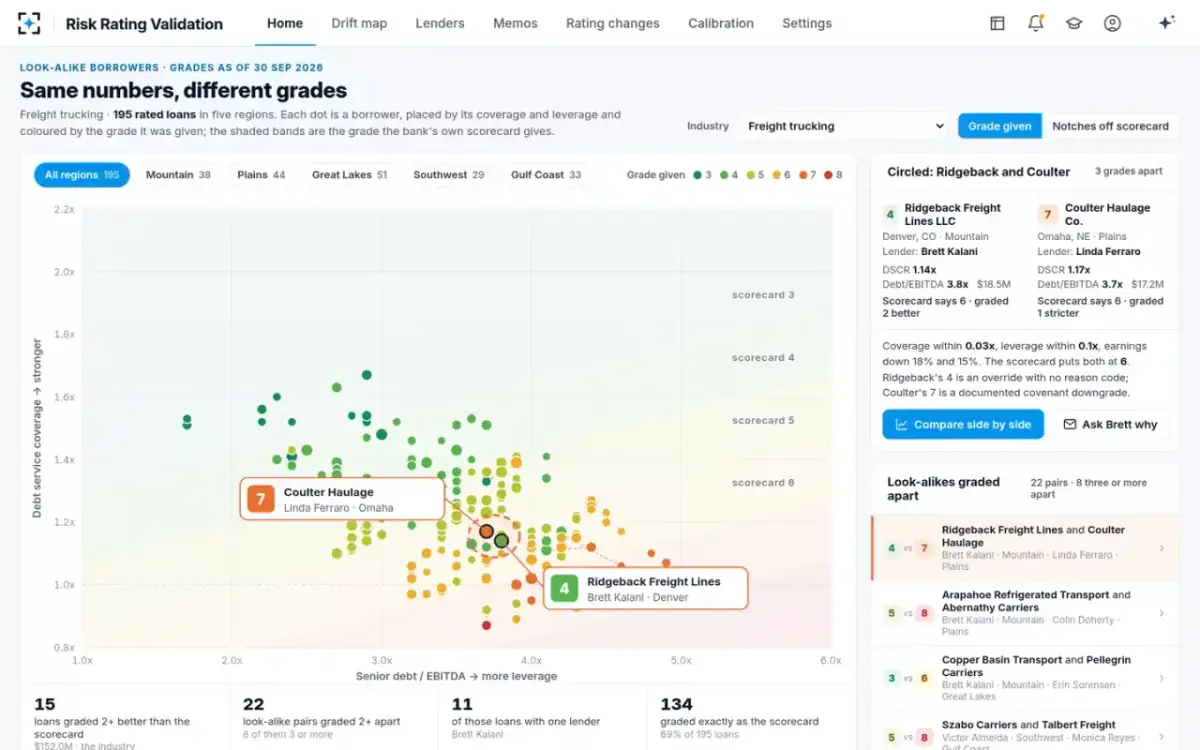
Splitting the scale changes the questions a review asks. On the borrower dimension, the test is comparability: do obligors with the same measured condition carry the same grade in two regions, with two lenders? That is a population test, and it is the one the sample bank runs nightly — each borrower paired with three to five look-alikes in the same three-digit industry, within 25% on revenue, 0.10x on coverage and 0.5x on leverage, graded by a different lender.
On the facility dimension the test is evidence: is the loss protection the grade assumes still there, still worth what the file says, and still documented? That is a collateral and documentation review, not a comparison. A bank that runs the first test on both dimensions will conclude that its facility grades are beautifully consistent — because they were all copied from the borrower grade.
The solution grades the first dimension only: it re-scores the borrower view on the bank's own scorecard and compares obligors, and it produces no facility grade. That is the right division of labour, and it is worth saying out loud, because a system that claimed to validate both from the same data would be checking the collateral by looking at the income statement. How the obligor dimension is worked out, factor by factor, is in how the grade is worked out; who has to agree before either grade moves is in who stands behind a grade.
One obligor, its matched peers, and the two facilities underneath
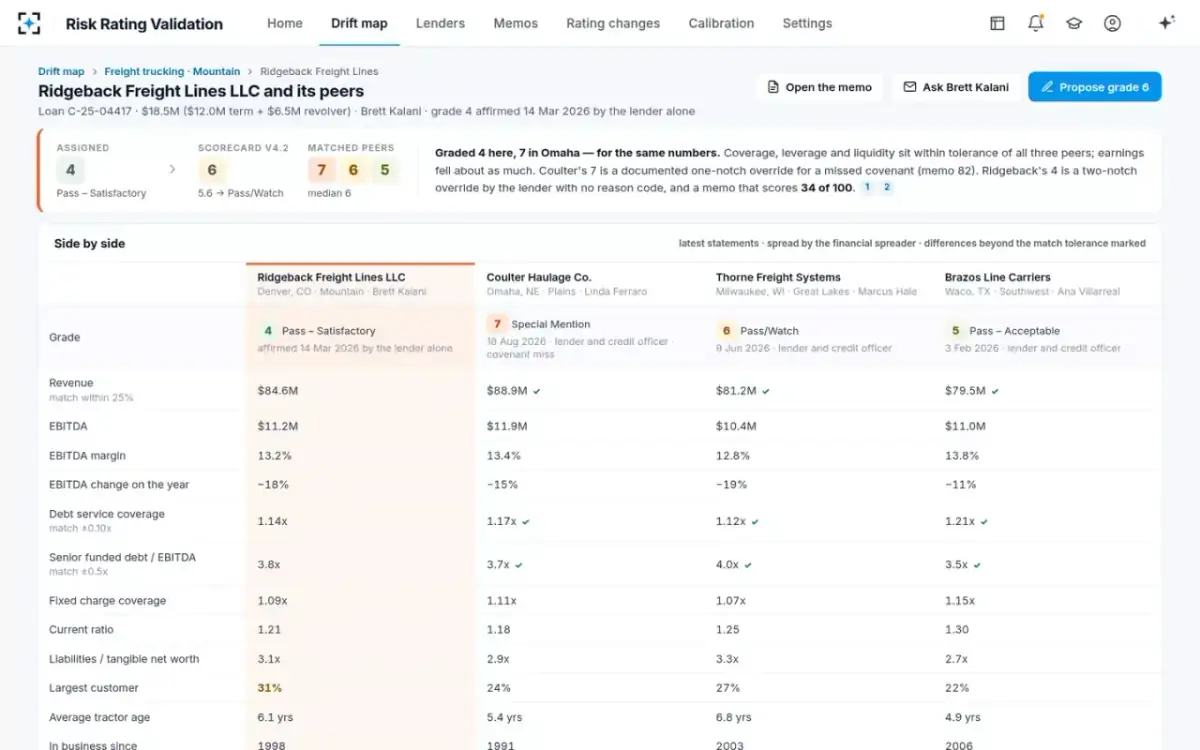
Where the obligor dimension goes wrong across a whole book
Questions people ask
What is a dual risk rating system?
A rating system with two scales: one grade for the obligor's general creditworthiness and a separate grade for each facility outstanding, reflecting the loss protection its collateral and structure provide. The OCC's booklet describes it that way, and notes that such systems emerged "because a single rating may not support all of the functions that require credit risk ratings".
What is the difference between a borrower rating and a facility rating?
The borrower rating is about the chance of default and belongs to the company, so every exposure to that company carries it. The facility rating is about what would be lost if default happened, and belongs to the loan — its collateral, guarantees, covenants and position relative to other creditors. Two loans to one borrower share a borrower grade and can carry different facility grades.
What is a facility risk rating?
A grade on the loan rather than the company. In most US dual systems it reflects "the loss protection afforded by assigned collateral and other elements of the loan structure in addition to the obligor's creditworthiness", which makes it close to an expected-loss grade. Under the Basel advanced approach it is narrower: facility ratings there "must reflect exclusively LGD".
How do PD and LGD relate to a risk rating?
They are what the two dimensions are trying to measure. The borrower grade stands in for the probability of default; the facility grade stands in for loss given default, or for the two combined as expected loss. The OCC notes that although these terms "are not used in the regulatory rating definitions, the concepts are inherent to the regulatory ratings" — so a bank can run a verbal scale and still be describing the same quantities.
How is expected loss calculated from a risk rating?
Expected loss is the probability of default multiplied by loss given default multiplied by the exposure at default. In a dual system the first term comes from the borrower grade, the second from the facility grade, and the third from the commitment rather than today's balance — which matters for revolvers, because a borrower in trouble draws its line.
Do small banks need dual risk ratings?
Not necessarily. The OCC endorses no particular rating system and says such systems "can assign a single rating or dual ratings", provided the scale addresses both the obligor's ability and willingness to repay and the support from structure and collateral. The test is practical: if facilities to the same obligor rarely differ in protection, and the grades are not feeding capital allocation or risk-based pricing, a well-written single scale will carry the work.