AI in credit risk is usually sold as a better grader. The more defensible use is narrower and more valuable: let software do the parts of grading where coverage beats judgement — reading every rating history, putting borrowers on one basis, applying the bank's own approved scorecard, finding look-alike borrowers, scoring the write-up behind each grade — and leave the grade itself to the people who are accountable for it. Botminds' Risk Rating Validation is built on that division. Six specialist agents re-score every rated commercial loan each night and propose; a regional credit officer confirms each regrade, a Chief Credit Officer signs, and nothing reaches the loan system until a committee approves. This guide is about where that line sits, why it sits there, and what to ask any vendor who draws it somewhere else.
Examples come from a working demonstration on sample data: Kestrel Valley Bank, a fictional commercial lender with 2,305 rated loans. Regulatory material is quoted and linked where it appears.
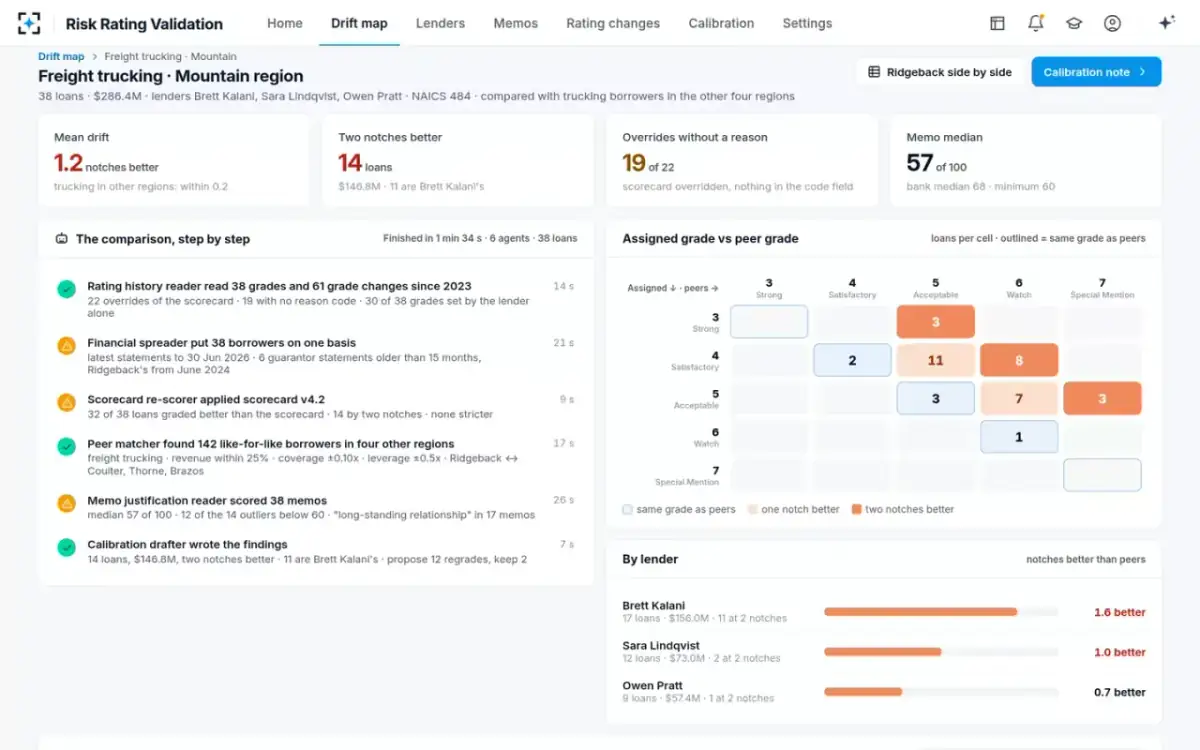
One comparison run in Risk Rating Validation, end to end
38loans
every rated loan in the flagged industry and region, not a sample of them
61
grade changes read back to 2023, with who set each one and whether it carried a reason
142peers
like-for-like borrowers matched in the other four regions, graded by other lenders
94s
for all six agents to finish, including scoring 38 write-ups against five tests
What AI in credit risk is being asked to do
Three different jobs travel under one name, and conflating them is how buying decisions go wrong. The first is underwriting — deciding whether to lend and on what terms. The second is monitoring — watching a book for deterioration between reviews. The third, the subject of this page, is grading quality: checking that the grades already on the book are right, consistent and supported.
None of this is new territory for the sector. The US Treasury's survey of the field notes that "AI has long been deployed in the financial services sector in a variety of ways, including credit underwriting, insurance underwriting, trading, investment advice, customer service, compliance, forecasting, and process automation" (Treasury, December 2024). What is new is the shape: tools that read unstructured material — a credit memo, an annual review, a covenant waiver — and relate it to structured data, which is precisely the join a grading-quality review needs and precisely the join a spreadsheet cannot make.
The reason to point that capability at grading quality rather than at grading is arithmetical. Grading one loan well is a judgement a competent credit officer already makes. Checking two thousand grades against each other is a volume problem no credit risk team of two or three can solve, which is why almost every bank checks a sample instead — 401 of 2,305 rated loans in a quarter at the sample bank, about one loan in six.
Six jobs, six agents: what each one reads
Specialisation is not decoration here. An agent with one job, one input set and one output can be given a limit that can actually be tested; a single general assistant asked to do all six has no boundary anyone can audit. The run below is the order the work has to happen in — you cannot compare a borrower with its peers until both are on one basis.
The six agents in Risk Rating Validation, and the two people they end at
Agent
Rating history readerReads every grade and grade change from the loan system — who set it, when, the scorecard grade at the time, the override and its reason — and flags overrides with no reason and grades set by the lender alone.
Never: Writes to the loan system, or changes a grade
Agent
Financial spreaderPuts each borrower's latest statements on one basis: coverage, senior funded debt to EBITDA, fixed charge coverage, current ratio, liabilities to tangible net worth, earnings trend — and dates the guarantor statement.
Never: Estimates a missing number — it marks it and says what is missing
Agent
Scorecard re-scorerApplies the bank's approved scorecard factor by factor with its own weights and grade guides, and reports the weighted score, the scorecard grade and the gap to the grade given.
Never: Changes a weight or a grade guide, or uses an unapproved version
Agent
Peer matcherFinds three to five like-for-like borrowers for each loan — same three-digit industry, revenue within 25%, coverage within 0.10x, leverage within 0.5x — graded by a different lender, and reports their grades and the median.
Never: Matches across industries or size bands, or uses the same lender's loans as peers
Agent
Write-up readerReads the approval memo or annual review that set the grade and scores it on five tests: ratios cited, each weakness addressed, override explained with a reason, current statements used, and what would move the grade.
Never: Judges the credit — only whether the write-up supports the grade
Agent
Calibration drafterWrites the finding and its cause with every line cited, a proposed grade for each flagged loan, the policy changes implied and the estimated effect.
Never: Regrades a loan, or sends a note unsigned
A person decides
Regional credit officerConfirms or changes each proposed regrade, loan by loan, with the borrower beside its peers and the scorecard open. Never the lender who owns the loan.
A person decides
Chief Credit OfficerSigns the quarterly note for Senior Credit Committee. Nothing moves in the loan system until the committee approves.
The write-up reader is the one buyers underestimate. Across the sample bank's book it scores 1,146 memos on the same five tests, and the scores separate sharply: the annual review affirming a grade 4 on "a long-standing relationship since 2014" and a sponsor with "substantial outside liquidity" scores 34 of 100, while the covenant review that explains a documented downgrade on another borrower scores 82. Neither score is a judgement about the credit. Both are judgements about whether the paper supports the grade — which is the question an examiner asks first and the one a bank can answer without waiting for a default.
The comparison, step by step, with what each agent found
What none of the agents may do
Six limits, written as rules rather than as intentions, because an intention cannot be tested at an examination. They are the part of the arrangement a model risk manager will read first.
The limits matrix: what each agent may do, may never do, and what it has to cite
| Agent | May do | May never do | Cites |
|---|---|---|---|
| Rating history reader | Read grades, changes, overrides and reasons; flag the gaps. | Write to the loan system. Change a grade. | The rating history entry behind every grade it reports. |
| Financial spreader | Normalise statements onto the bank's own ratio definitions; date each statement. | Estimate a missing figure, or fill a gap by inference. | The statement and the line it took each figure from. |
| Scorecard re-scorer | Apply the approved scorecard version factor by factor. | Change a weight or a grade guide; use a draft version. | The scorecard line and weight behind each factor score. |
| Peer matcher | Match within industry and size band on the configured tolerances. | Match across industries or size bands; use the same lender's loans as peers. | Each peer loan, its grade, its lender and the tolerance it met. |
| Write-up reader | Score the write-up against five tests of whether it supports the grade. | Judge the credit itself, or infer a weakness the paper does not contain. | The passage, quoted, for every finding. |
| Calibration drafter | Draft the finding, the cause, a proposed grade per loan and the policy changes. | Regrade a loan. Send a note that nobody has signed. | Every line, to the history, the spread, the scorecard or the write-up. |
The limit that does the most work is the dullest. Read-only access to the loan system means the worst outcome of a wrong answer is a wrong recommendation that a person declines — not a wrong grade propagating into the allowance, the pricing sheet and the quarterly return before anyone notices. It also makes the arrangement far easier to place within an existing control framework, because nothing about the bank's system of record has changed.
Why reading every loan beats sampling, and where it does not
A sample is designed to estimate a rate. It is a poor instrument for finding a pattern that lives in one corner of a book, because the corner is exactly where a representative sample puts the fewest observations. The sample bank's quarterly review covers 401 of 2,305 rated loans; inside one industry and one region that is a handful of files, and a cell that is a notch optimistic looks like noise until several quarters have gone by.
Full coverage changes what can be asked. Every borrower can be compared with every plausible look-alike rather than with the two that happened to be sampled; every override can be counted rather than estimated; the distribution of a single lender's grades against peers becomes a measurement instead of an impression. In the demonstration, that is the difference between knowing that one region's trucking grades disagree with the scorecard and knowing that eleven of the fourteen two-notch gaps belong to one lender, and that none of the region's 38 trucking loans is graded stricter than the scorecard.
Coverage also matches what the rules already ask for. The Basel framework requires that ratings be refreshed at least annually and that "banks must initiate a new rating if material information on the borrower or facility comes to light", and that a bank have "an effective process to obtain and update relevant and material information on the borrower's financial condition", with a procedure to "update the borrower's rating in a timely fashion" on receipt (Basel Framework, CRE36). A nightly re-score is one way to make "timely" mean something.
Where coverage does not help: anything that needs context the bank has not written down. If the reason a borrower is graded 4 lives in a conversation rather than in a file, no amount of reading will find it — the finding will be that the grade is unsupported, which is a true and useful finding, but not the same as the grade being wrong. The sample bank's own demonstration keeps two of fourteen flagged loans at their existing grades for exactly that reason: the write-ups show a verified guarantee and a contract, so the grades stand.
Can an agent change a grade?
It can, technically, and it should not. The reason is accountability rather than capability. Independence requirements in the rating process are written in terms of who approves a rating, not in terms of what tool produced the analysis: the Basel framework requires rating assignments and periodic reviews to be completed or approved by a party that does not stand to benefit from the credit, and adds that "independence of the rating assignment process can be achieved through a range of practices that will be carefully reviewed by supervisors", documented in the bank's procedures and policies.
An agent that proposes, cites and stops leaves that chain exactly as it was. The bank's documented procedure still says that a credit officer who does not own the relationship approves the grade; the agent is the analysis the credit officer reads, in the same sense as a spread or a peer comparison prepared by an analyst. An agent that writes grades replaces a documented human approval with an undocumented automated one, and the bank then has to explain its rating process in terms nobody has a template for.
The practical test for a vendor is a question with only two acceptable answers. Ask what happens when the model is confident and the credit officer disagrees. "The officer's grade stands and the disagreement is kept" is one. "The officer can override with a reason, and overrides are tracked and their performance measured" is the other, and it is what the framework already requires of human overrides of a model. "The system is usually right" is not an answer about controls.
A chat assistant is the wrong tool for this work
Not because it is less capable, but because the work is structured and repetitive and a conversation is neither. Grading quality is the same six operations run over two thousand loans on a schedule, with the same tolerances, producing a comparable answer each time. That is a job for something that can be configured once, run unattended and audited afterwards.
The same question about one borrower, asked two ways
A general chat assistant: Whatever is pasted into the conversation — usually one memo and a spread, because that is what fits.
Six specialist agents on a nightly run: The whole rating history, every statement on file, the approved scorecard, 142 matched peers in other regions and 38 write-ups.
A general chat assistant: Whatever the model infers from the text. Not reproducible between two sessions.
Six specialist agents on a nightly run: Same three-digit industry, revenue within 25%, coverage within 0.10x, leverage within 0.5x, different lender — settings, versioned, on the audit trail.
A general chat assistant: The loans someone thought to ask about.
Six specialist agents on a nightly run: Every rated loan, every night, including the ones nobody suspected.
A general chat assistant: Ask twice, get two answers worded differently; nothing to diff.
Six specialist agents on a nightly run: The same inputs and the same scorecard version give the same factor scores and the same gap.
A general chat assistant: A transcript, if anyone kept it.
Six specialist agents on a nightly run: Each finding against the rating history entry, the statement line, the scorecard factor or the quoted passage it rests on.
A general chat assistant: One-off questions, drafting, and explaining a finding someone else produced.
Six specialist agents on a nightly run: Nothing conversational. It is a scheduled measurement, not an interlocutor.
That last row matters for a buying decision. A bank that already has a general assistant in the hands of its credit officers has something useful and should keep it. What it does not have is a measurement — a number for each cell of its book that means the same thing this quarter as last, which is the only kind of evidence a validation or an examination can use.
Is agentic AI inside model risk guidance, or outside it?
Outside, and the agencies said so in a footnote that is worth reading whole rather than in summary, because the sentence after the exclusion is the one that creates the obligation.
Generative AI and agentic AI models are novel and rapidly evolving. As such, they are not within the scope of this guidance. Nonetheless, a banking organization's risk management and governance practices should guide the determination of appropriate governance and controls for any tools, processes, or systems not covered in this document. However, the principles described in this guidance apply to traditional statistical and quantitative models and non-generative, non-agentic AI models.
Supervisory Guidance on Model Risk Management (SR 26-2), footnote 3, 17 April 2026
Read carefully, that is not a licence. It says the model risk framework does not automatically apply, and that the bank's own risk management and governance practices must therefore decide what governance and controls apply instead — a harder question than following a checklist, because the bank has to answer it rather than inherit it. Any vendor who quotes the first two sentences and stops is quoting selectively.
Two consequences follow for a rating-quality tool. First, the output the agents produce is a recommendation into a human process, so the controls that matter are the ones around that process: who may act on the recommendation, what is kept, and how disagreements are handled. Second, the deterministic parts of the arrangement — re-applying the bank's own approved scorecard, the peer tolerances — are not agentic at all. Whether the scorecard itself is a model is a question the bank has already answered for its own use of it, and re-applying it adds no new estimate; the matching rules are the kind of simple, rule-based processing the guidance's definition leaves out. Where the line falls for a rating scorecard is the subject of its own guide, and it is worth settling before a vendor conversation rather than during one.
What an examiner has to be able to follow, step by step
The requirement is not new and was never about AI. The Comptroller's Handbook expects loan ratings to be verified by an independent third party, and says these verifications "help to ensure accuracy and consistency, and augment oversight of the entire credit risk management process", with their "formality and scope … correspond[ing] to the portfolio's complexity and inherent risk" (Rating Credit Risk). An agent-prepared analysis is evidence inside that verification, and it has to be followable.
What to ask a vendor to show you, in the order an examination would
- A finding, traced to its source, without the vendor's help
Click one line of a conclusion and land on the rating history entry, the statement line, the scorecard factor or the quoted passage behind it.
- The version of the scorecard each run used
If a run cannot name its own scorecard version, nothing produced before the last change can be reproduced.
- Two runs of the same inputs, diffed
Deterministic steps must match exactly. Where a step is not deterministic, the vendor should say which and why.
- The disagreements, kept
Every proposal a person declined, with the reason. A system that keeps only its wins cannot be measured.
- The write path, in writing
What the tool can change in the loan system, stated as a permission rather than as a policy. The best answer is nothing.
- Who confirmed what, and when
An audit trail with the person, the decision and the time against every grade that moved.
NIST's framework for AI risk management makes the ongoing half of this explicit: "validity and reliability for deployed AI systems are often assessed by ongoing testing or monitoring that confirms a system is performing as intended" (NIST AI RMF 1.0). For a rating-quality tool, that monitoring already exists in the credit function's own numbers — the share of proposals a credit officer declines, the share of regrades a committee approves, the disagreement rate of independent reviewers in the regions the tool flagged. A bank does not need a separate testing programme to know whether this kind of system is working. It needs to keep the proposals it rejected.
The framework also supplies a useful definition to hold a vendor to, borrowed from the international standard: accuracy is the "closeness of results of observations, computations, or estimates to the true values or the values accepted as being true", and accuracy measurements "should always be paired with clearly defined and realistic test sets … that are representative of conditions of expected use". For grading quality the realistic test set is sitting in the bank already — last year's independently reviewed loans, where the true value is a grade a human reviewer defended.
Write-up scores across a book: Risk Rating Validation on 1,146 memos
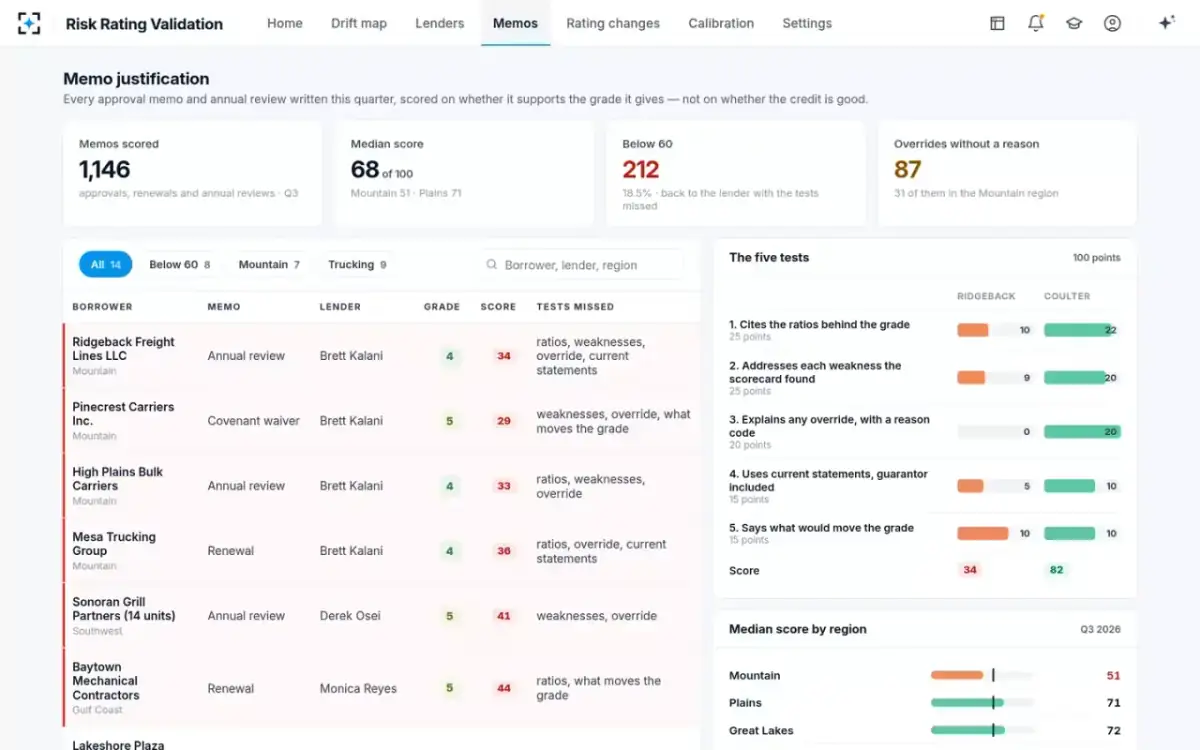
The minimum is a setting — 50, 60 or 70 of 100 — not a figure the solution imposes.
What a person still decides, in order
Four decisions, in a fixed sequence, and none of them is delegated. The lender sets the original grade and owns the write-up behind it. The credit risk officer decides which findings are worth a proposal and what the cause is. The regional credit officer confirms or changes each proposed regrade, loan by loan, and is never the lender who owns the loan. The Chief Credit Officer signs the quarterly note, and the committee approves before anything reaches the loan system.
What has changed is not who decides but what they decide with. The regional credit officer used to be asked to confirm a regrade with a ratio and a write-up and no twin borrower to compare it against; now the borrower sits beside three matched peers with the scorecard open factor by factor. That is the whole value proposition, and it is a smaller claim than "AI grades your loans" — which is the point. To see the chain on one book, start from Risk Rating Validation; to compare it against the three other ways a bank can keep its grades right, read the four approaches side by side, and for the measurement that eventually confirms any of them, the default back-test.
Questions people ask
Can AI set a loan's risk rating?
It can produce a grade, and in a well-governed arrangement it does not set one. The independence requirements in the rating process are about who approves a rating, not about what produced the analysis, so a tool that proposes a grade with its evidence and leaves the approval to a credit officer who does not benefit from the credit keeps the existing accountability chain intact. A tool that writes grades into the loan system replaces a documented human approval with an automated one, and the bank then has to explain a rating process for which no template exists.
How does AI compare borrowers with similar borrowers?
By matching on stated tolerances rather than on resemblance. In this solution a peer must share the borrower's three-digit industry, sit within 25% on revenue, within 0.10x on debt service coverage and within 0.5x on leverage, and be graded by a different lender — all of them settings, versioned and on the audit trail. The tolerances matter more than the model: loosen them and every borrower has peers, tighten them and none does.
Is agentic AI covered by model risk guidance?
No, and the exclusion comes with an obligation. The April 2026 interagency guidance states in a footnote that generative and agentic AI models "are not within the scope of this guidance", then adds that a banking organisation's own risk management and governance practices should determine the appropriate governance and controls for tools the document does not cover. In practice that means the bank decides what applies rather than inheriting a framework, and the deterministic parts of the tool — re-applying the bank's approved scorecard, the matching tolerances — add no new estimate of their own.
What can go wrong with AI in credit risk?
Three failures are worth planning for. A tool that writes to the system of record can propagate a wrong answer into the allowance and the pricing sheet before anyone reads it. A tool whose peer definition is inferred rather than configured produces findings that cannot be reproduced next quarter. And a tool that reports only its accepted proposals cannot be measured at all, because the denominator has been thrown away. Read-only access, stated tolerances and keeping the declined proposals answer all three.
Who is accountable when an AI gets a grade wrong?
The same people as before: the lender who set the grade, the credit officer who approved it and the Chief Credit Officer who signs for the rating process. That is precisely why a proposal-only arrangement is easier to govern — no accountability has moved, so none has to be reassigned. If a tool's recommendation was wrong and a person accepted it, the finding is about the person's review as well as the tool, which is the ordinary position for any analysis prepared by anyone.
What is the difference between a chatbot and an agent in credit risk?
Scheduling, scope and evidence. A chat assistant answers the question someone thought to ask, about the material they pasted in, differently each time. An agent in this sense is a configured job with one task, fixed inputs, stated limits and a citation behind each finding, run over the whole book on a schedule so that this quarter's answer is comparable with last quarter's. The second produces a measurement; the first produces an explanation, which is useful for different reasons.