A chief credit officer owns the quality of a bank's credit decisions, and when a grade is wrong the job is not to re-grade the loan personally — it is to work out whether one loan was misjudged or the process that produced it is leaning, and then to sign for whichever answer is true. That makes the chief credit officer the last of four seats a commercial grade passes through: the lender who knows the borrower and has the worst incentives, the credit officer who concurs, the independent reviewer who checks a sample, and the signature at the end. The chain only works while the same person never occupies two links. Botminds' Risk Rating Validation prepares what each of those seats needs — the borrower beside its look-alikes, the scorecard factor by factor, the write-up scored against the grade — and never moves a grade itself.
The people, the bank and the borrowers in the examples are fictional: characters and sample data from the solution, at Kestrel Valley Bank. The rules come from the OCC's booklet on rating credit risk, the 2020 interagency guidance on credit risk review systems and the Basel framework; the pay and headcount figures are national medians from the US Department of Labor and belong to the occupation, not to any character.
The four seats behind every commercial grade
Most banks describe grading as something a lender does and a committee approves. In practice four different jobs have to be done, and they are different because they fail in different ways. Somebody has to form a first view with the borrower in front of them. Somebody has to concur who does not depend on the deal closing. Somebody has to check a sample who was not in either conversation. And somebody has to be accountable to the board for the result.
A grade from proposal to signature, and who does each step
A person decides
The lenderProposes the grade with the credit, from the borrower’s statements and everything they know about the business.
Never: Confirms a regrade on their own book.
Agent
Reading and spreadingPulls every grade and grade change with its override and reason code, puts the statements on one basis, applies the approved scorecard and finds look-alike borrowers graded by other lenders.
Never: Writes to the loan system, or changes a grade, a weight or the allowance.
Agent
Scoring the write-upReads the approval or annual review behind the grade and scores it on five tests, quoting the passage behind every finding.
Never: Judges the credit — only whether the write-up supports the grade.
A person decides
The credit risk officerDecides which pattern is real, which loans to propose for a change, and what the cause is. Takes the note to the regional credit officer.
Never: Approves their own proposal.
A person decides
The regional credit officerConfirms each proposed regrade one by one, and can keep any grade where the file justifies it.
Never: Confirms a grade on a loan they originated or approved.
A person decides
The chief credit officerSigns the calibration note for committee, with the regrades, the policy changes and the estimated effect.
Never: Signs before the regional credit officer has confirmed.
A person decides
Credit risk reviewChecks a sample independently of all of the above, and reports to the board.
Never: Reports to the lending function, or is paid on the grades it assigns.
Read the never-lines together and the design becomes obvious: every one of them separates proposing from confirming. That is the whole architecture. A grade that was proposed and confirmed by the same person is a grade with one opinion behind it and three signatures on it.
The lender: closest to the borrower, worst placed to grade
The lender knows things no file contains — how the business handled the last downturn, whether the son running operations is any good, what the borrower says when the quarter goes badly. The OCC's booklet acknowledges that and then states the problem in the same breath.
Loan officers maintain close contact with the borrower and have access to the most timely information about their borrowers. However, their objectivity can be compromised by those same factors and their incentives are frequently geared more toward producing loans than rating them accurately.
OCC, Comptroller's Handbook, ‘Rating Credit Risk’
This is not a complaint about lenders. It is a description of a role with two jobs that pull apart, and the booklet's remedy is structural rather than moral: many banks, it notes, get more accurate grades by making each rating a joint decision of a lender and a credit officer. One person from each function, on every grade.
The 2020 interagency guidance takes the same view of where the work starts: lending staff carry primary responsibility for assigning accurate, timely grades and spotting emerging problems, and that assignment is then reviewed by qualified, independent people. Primary reliance, then review. Not one or the other. Who holds the pen at each step, and what happens on the day the lender and the reviewer disagree, is the subject of Credit Risk Review's guide to who assigns a loan risk rating.
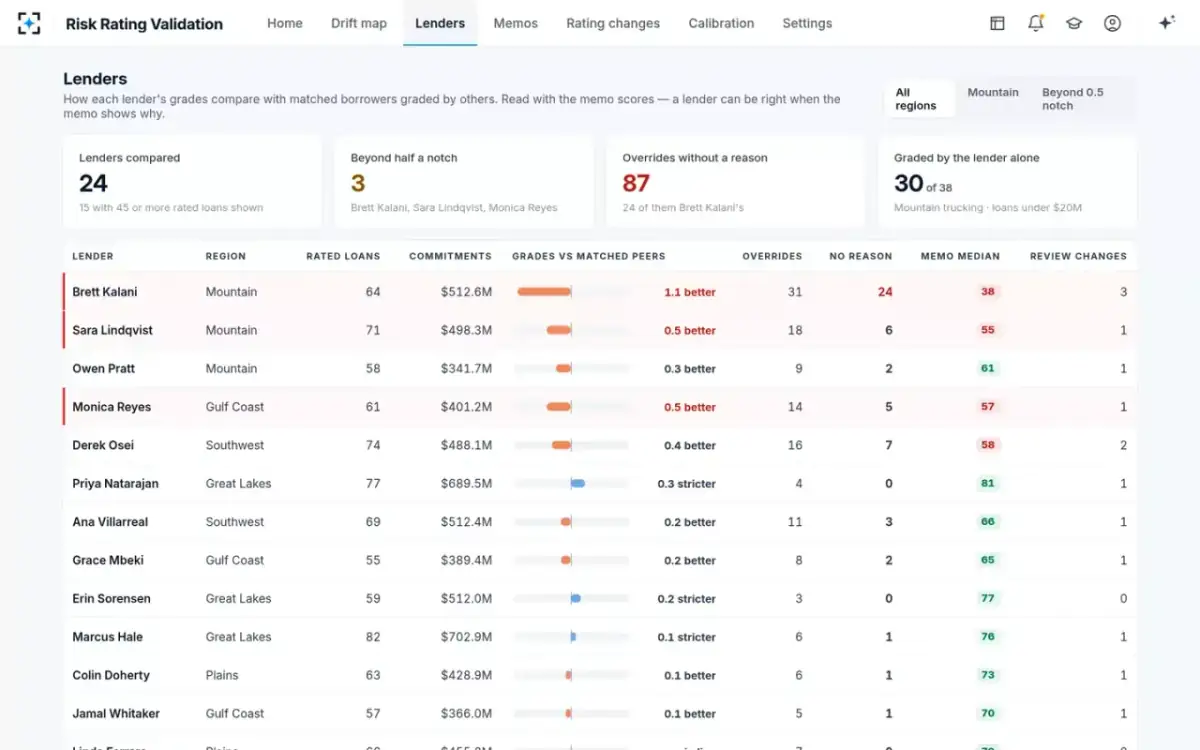
At the fictional sample bank the structural problem is visible as a number: 30 of 38 Mountain-region trucking grades were set by the lender alone, because loans under $20 million in that region are graded without a credit officer. Nothing in that policy is unusual, and nothing about it is wrong on any single loan. Across 38 loans it produced grades that sit 1.2 notches better than matched borrowers elsewhere in the bank.
What does a chief credit officer actually sign?
Four things, in rough order of how often they come round. Credit policy, including the rating scale, the definitions and the override rules. Individual credits above the delegated authorities. The periodic calibration or review findings that say whether the system as a whole is working. And the representations to the board and the examiners about credit quality, which is where the first three meet.
When a grade is wrong, the chief credit officer's signature is on the second and third of those. The practical question is which one a given case is. One borrower graded generously because a guarantee was overvalued is a credit decision. Fourteen loans in one region graded at least two notches better than the bank's own scorecard, eleven of them with one lender, with 19 of 22 overrides carrying no reason code, is not a credit decision at all — it is a policy question that happens to be expressed in fourteen credits.
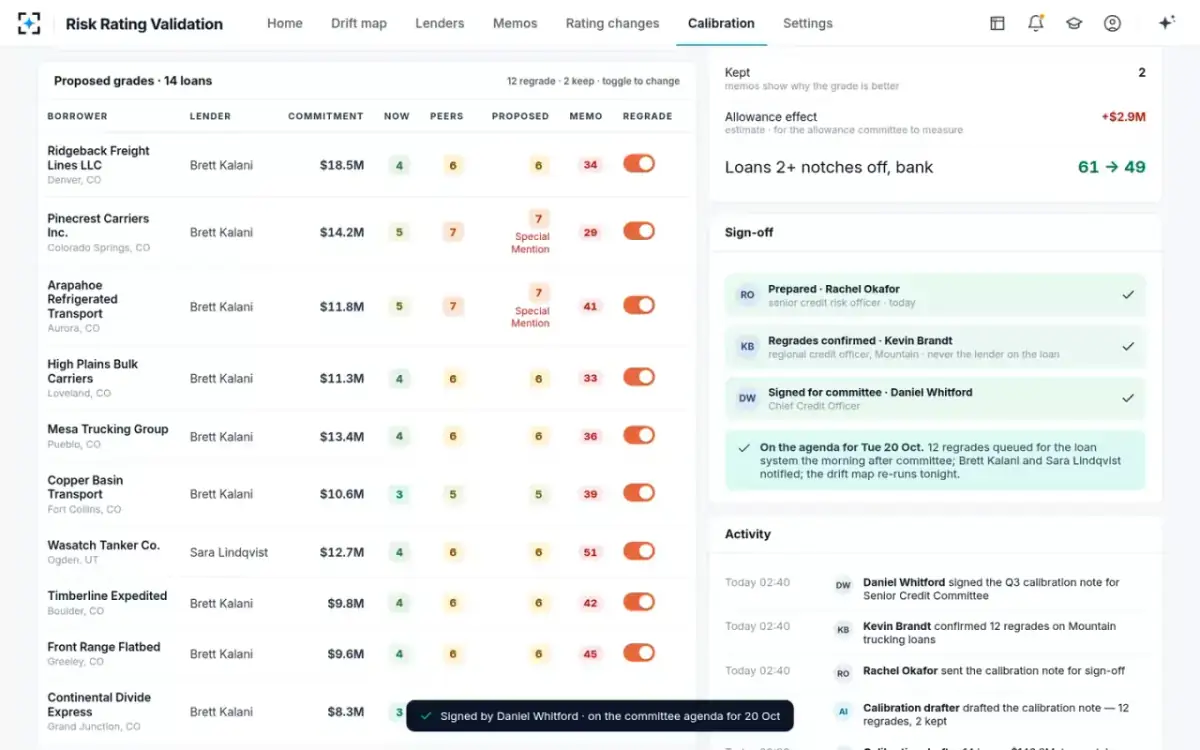
In the sample bank's quarter the second answer is the right one, and the note that reaches the chief credit officer reflects it: twelve proposed regrades, two loans kept because their write-ups justify the grade, four policy changes beginning with a credit officer co-signing every override of the scorecard, and an estimated allowance effect of $2.9 million flagged as an estimate for the allowance committee to measure rather than a number to book. He signs the note; the committee decides; the regrades queue for the loan system the morning after.
Risk Rating Validation: prepared, confirmed, signed — and every step on the trail
The regional credit officer, and why concurrence is not a rubber stamp
Concurrence is the second opinion the OCC's joint-decision practice asks for, and it is the seat where most banks get the least value for the time they spend. The reason is simple: a credit officer asked to confirm a grade is usually handed the same file the lender used. A ratio, a write-up and a recommendation. Agreeing is the path of least resistance, because disagreeing means re-doing the lender's work from scratch.
The same concurrence, with and without a comparable borrower in front of you
Confirming from the file alone: The borrower’s ratios, the write-up and the proposed grade.
Confirming with the look-alikes attached: The same, plus three to five borrowers with matching numbers graded by other lenders, and the grade the bank’s own scorecard gives.
Confirming from the file alone: "Is this grade defensible?" Almost always yes, taken on its own.
Confirming with the look-alikes attached: "Is this grade the same one we give borrowers like this?" A different question, with a checkable answer.
Confirming from the file alone: Re-spreading the borrower and finding comparables by hand — days, for one loan.
Confirming with the look-alikes attached: Reading a comparison that is already there, and saying which of the five grades you believe.
Confirming from the file alone: One officer’s judgement against another’s.
Confirming with the look-alikes attached: A pair of borrowers whose coverage matches within 0.03x and whose leverage matches within 0.1x, graded three notches apart.
Confirming from the file alone: Concurred.
Confirming with the look-alikes attached: Each regrade confirmed or kept individually, with the comparison and the write-up score behind it.
The other half of the seat is the part nobody writes down: the regional credit officer is the person who has to tell a colleague that a grade they have carried for two years is going to change. That conversation goes better with a matched borrower on the screen than with an opinion, which is the practical argument for giving the seat evidence rather than exhortation.
Credit risk review: independent of the lending function, reporting to the board
The third seat is the only one whose entire value is that it was not involved. The OCC's booklet puts it in one sentence — "An independent third party should verify loan ratings." — and allows a range of arrangements: credit review staff at many banks, other divisions or outsourcing where that is appropriate, and at smaller banks "staff who are not directly involved with the approval or management of the rated credits".
The 2020 interagency guidance lists the same range more formally: the lender's grades are typically reviewed by qualified, independent peers, managers or loan committees, by part-time or full-time staff, by a dedicated credit review department, or by outside credit review consultants. The organisational shape is not what matters. The tests are.
Five independence tests the interagency guidance applies to whoever reviews a grade
- No control over the loan
The guidance defines an independent assessment first by what the reviewer does not have: any control over the loan being reviewed.
- Not part of, or influenced by, the approval process
The same definition continues: the reviewer is neither part of the approval process nor influenced by anyone associated with it.
- Not involved in the specific credits assessed
Where a smaller bank uses its own staff, they must have had no hand in originating or approving the particular credits under review — a test about these loans, not about the job title.
- Compensation not influenced by the ratings
The same passage adds that their pay must not move with the grades they assign. Pay is part of independence.
- A route to the board that does not pass through lending
An effective function provides management and the board with "an objective, independent, and timely assessment", and a pre-arranged process resolves rating differences between lenders and reviewers.
Who may never confirm a grade?
Anyone who benefits from it. The Basel framework states the rule as a property of the approver rather than of the role: "Rating assignments and periodic rating reviews must be completed or approved by a party that does not directly stand to benefit from the extension of credit." The lender on the loan is the clearest case and not the only one — a regional head whose targets depend on the region's volumes is in the same position, which is why the guidance names pay when it describes who may review.
The sample bank encodes the rule in two settings. A regional credit officer confirms each regrade and can keep or change any of them; lenders see their own loans read only and cannot confirm a regrade on their own book. Those are policy choices expressed as permissions, which is the only form in which such a rule survives a busy quarter.
There is a matching rule for what happens when the two seats disagree. The interagency guidance expects the difference to be resolved "according to a pre-arranged process", which may include formal appeals and arbitration by an independent party, or may require defaulting to the rating that indicates lower credit quality. Where credit risk review concludes a loan is weaker than portfolio management thinks, the weaker grade normally stands unless new information persuades the independent reviewer or the arbiter — the default Credit Risk Review's guide to who assigns a loan risk rating quotes in full. Deciding that in advance is what stops a disagreement from being settled by seniority.
What each seat is paid, and how many of them there are
The occupational data is thinner than the job titles suggest, because the US Department of Labor's categories do not map onto bank hierarchies. Credit analysts are their own occupation; credit officers and chief credit officers fall inside financial managers, a much larger and better-paid group. The two together bracket the chain.
The occupations behind the chain, by national median pay and headcount
$83,510
median annual wage for credit analysts, 2025 — $40.15 an hour
64,700
credit analysts employed in the United States, 2025, with growth projected to decline through 2035
$166,570
median annual wage for financial managers, 2025, the group that holds credit officers — $80.08 an hour
879,700
financial managers employed, 2025, projected to grow 7 percent or more to 2035
The divergence in those two projections is the interesting part. The occupation that does the mechanical analysis is projected to shrink; the occupation that decides is projected to grow faster than average. That is roughly the shape of what happens when the reading, spreading and comparing become cheap: fewer hours spent assembling a view, no fewer decisions to make about it. The credit analyst's own task list is a good description of what becomes cheap — the Labor Department lists "Compare liquidity, profitability, and credit histories of establishments being evaluated with those of similar establishments in the same industries and geographic locations" as a core task, which is, word for word, what a peer comparison does.
What the chain looks like when agents prepare the file
None of the four seats disappears when the preparation is automated; each of them arrives with different material. The lender still proposes with the borrower in front of them, but their override now carries a reason code or it is visible as one that does not. The credit risk officer starts the quarter with every rated loan already re-scored and paired instead of comparing a handful by hand. The regional credit officer sees the borrower beside its peers and the write-up score, rather than a recommendation. The chief credit officer signs a note whose every line cites the grade history, the spread, the scorecard line or the passage it rests on.
The same drifting region, seen from the four seats that carry it
Today
Can say which grades moved last quarter, not which grades are wrong; compares look-alike borrowers by hand for a handful of loans.
With agents
Starts the week with every rated loan already re-scored and paired, and takes a cited calibration note to committee.
Still theirs: Deciding which pattern is real, and what its cause is.
Today
Is asked to confirm a regrade with a ratio and a write-up, but no twin borrower to compare it with.
With agents
Sees the borrower beside its peers, the scorecard factor by factor and the write-up score, and confirms or keeps each grade.
Still theirs: The confirmation itself, and the conversation with the lender.
Today
Reports grade disagreements from a sample of 401 loans a quarter, 17 percent of the book.
With agents
Sees his disagreements by region against the 5 percent and 3 percent lines, beside upgrades, double downgrades and the default back-test.
Still theirs: Independence, and the route to the board.
Today
Learns a region has drifted when loan review or the examination report says so.
With agents
Signs a calibration note in October with the regrades, the policy changes and the estimated effect.
Still theirs: The signature, and the accountability that comes with it.
The limits matter as much as the preparation. The agents read the loan system and never write to it; they do not change a grade, a scorecard weight or the allowance; a grade is kept where the write-up justifies it, which is why two of the fourteen flagged loans were proposed for no change at all. How those limits sit inside the override policy is in how the grade is worked out, and what the examiners do with the result is in what the Comptroller's Handbook asks.
Each lender's grades against borrowers graded by everyone else
What changes in the seat, and what does not
What changes is the preparation and the reach. A quarterly calibration of one drifting region, done by hand on a handful of loans, spends most of its days on work that has one right answer: pulling grades, overrides and reason codes, re-spreading look-alike borrowers in other regions, re-scoring them on the bank's own scorecard, reading the write-ups. Six agents covering 38 loans, 61 grade changes since 2023, 142 matched peers and 38 write-ups in about a minute and a half changes the economics of that, and with it the sample size: not 17 percent of the book, all of it.
What does not change is who is accountable. A grade is a statement the bank makes to its board, its auditors and its examiners, and a statement needs somebody to have made it. The proposal is prepared; the decision is a person's. That is why the comparison proposes and never regrades, why the regional credit officer can keep any grade the file justifies, why the chief credit officer's signature comes before committee and not after, and why the lender on the loan never confirms their own regrade. Automate the chain's preparation entirely and you still need four seats, because the reason they exist was never the workload.
Questions people ask
What does a chief credit officer do?
Owns credit quality for the bank: the credit policy and the rating framework, approval of credits above delegated authority, the periodic findings on whether the rating system is working, and the representations about credit quality that go to the board and the examiners. When a grade is wrong, the chief credit officer decides whether it was one misjudged credit or a process leaning one way, and signs for the answer.
What does a regional credit officer do?
Concurs with, or challenges, the grades lenders in the region propose, and carries delegated approval authority for the region's credits. In the fictional sample bank the regional credit officer confirms each proposed regrade loan by loan, can keep any grade the file justifies, and never confirms a grade on a loan they originated or approved — the second opinion the OCC's joint-decision practice asks for.
Can a lender grade their own loan?
Propose it, yes, at most banks — and that is where the information is. Confirm it alone is the problem. The OCC warns that a loan officer's objectivity "can be compromised" by the same closeness that makes them well informed, and that their incentives lean toward producing loans rather than rating them accurately. The Basel framework requires ratings to be completed or approved by a party that does not directly stand to benefit from the extension of credit.
Who signs off on a loan downgrade?
It depends on the size of the move and the bank's delegations, but a downgrade across the criticized line usually needs a credit officer rather than the lender alone, and a change of policy or a portfolio-wide recalibration needs the chief credit officer and usually a credit committee. In the fictional sample bank the sequence is fixed: the regional credit officer confirms each regrade, the chief credit officer signs the note, and the committee approves before anything reaches the loan system.
What is the difference between a credit officer and a credit analyst?
Authority. An analyst produces the view — spreads the statements, computes the ratios, drafts the recommendation; the US Department of Labor lists comparing an establishment's liquidity, profitability and credit history against similar establishments as a core task of the occupation. A credit officer decides, concurs or declines, and carries delegated approval authority. The two sit in different occupational groups and the pay reflects it: a 2025 median of $83,510 for credit analysts against $166,570 for financial managers.
Will AI replace credit officers?
The published projections point the other way for the deciding seats and toward contraction for the analytical ones: credit analyst employment is projected to decline through 2035 while financial managers are projected to grow 7 percent or more. That matches what automation actually does here — it prepares the comparison, scores the write-up and finds the pattern, and it proposes rather than decides. Supervisory expectations hold the line in the same place: a rating has to be approved by someone who does not benefit from the credit, and that is a person.