A loan review officer job description, written honestly, has two halves that rarely appear in the same posting. The first is the one the regulators describe: an independent assessment of whether the grades a bank's lenders have given their own commercial loans are right, done by someone with no part in approving them, reported to the board rather than to the lending line. The second is the week, and the week is mostly assembly — pulling documents out of imaging, spreading statements, recomputing covenants — with a surprisingly small slice left for the judgment the first half describes. Botminds' Credit Risk Review is built to change the second half and leave the first alone, because the grade has to stay a person's decision. This guide covers both, plus what the published pay and employment figures do and do not say about the seat.
The people in the worked examples are characters from the solution's fictional sample bank, Northmere Bank & Trust. The wage and employment figures are published by the U.S. Department of Labor and are for related occupations, not for loan review officers; that distinction is kept explicit below, because no federal series measures this job on its own.
The five seats a loan review officer works between
Today
Reads about 60 files a year end to end, and spends four hours building a file for twenty minutes of judging it.
With agents
Opens a loan with the file built, the statements spread, the covenants recomputed and every factor cited — and spends her time on the grade.
Still theirs: Sets the review grade. Nothing changes a grade of record without her.
Today
Plans which loans to sample and hopes the examiner does not find a grade outside the plan.
With agents
Takes the whole commercial book to the board risk committee every quarter, with the newly criticized loans and every open challenge listed.
Still theirs: Owns the plan, the scope and the report to the board.
Today
Hears about a grade dispute in an email thread, without the pages either side relies on.
With agents
Receives the review write-up, the lender’s answer and every cited page together.
Still theirs: Settles a disagreement the reviewer and the lender cannot.
Today
Gets told a grade is wrong without being told what changed.
With agents
Gets the reasons, the pages behind them and the conditions, with ten business days to agree or answer.
Still theirs: Owns the relationship and the first grade on it.
Today
Tests loan review once a year by reconstructing who looked at what, and when.
With agents
Reads every grade, challenge and decision on the activity trail, with who made it and when.
Still theirs: Changes nothing, and audits the review function itself.
What does a loan review officer do all quarter?
Four things, in a repeating cycle: select, read, grade, and argue. Selection is deciding which loans this period's work will cover, which under a sampled programme is most of the intellectual work and under a continuous one is almost none. Reading is assembling the relationship's documents and understanding what has changed since the credit was approved. Grading is scoring the bank's rating factors and reaching a number. Arguing is putting that number to the lender who gave the original grade, and carrying the disagreement to whoever settles it.
The supervisory guidance is specific about what the reading covers. Loans selected for review are typically evaluated for credit quality and the adequacy of the sources of repayment, the reasonableness of assumptions, the creditworthiness of guarantors, the sufficiency of credit and collateral documentation, proper lien perfection, proper approvals, adherence to loan agreement covenants, compliance with internal policies and with law — and, last on the list and first in importance, the accuracy of risk ratings and the timeliness with which loan officers identify problem loans.
That final item is the one the job exists for. Everything above it can be tested by someone checking a folder. Deciding whether a grade is right requires an opinion about a business, and it is the only part of the work that cannot be delegated to a checklist. A loan file review checklist that tests the grade rather than the folder sets out the difference in detail.
The job as the guidance describes it
Three documents between them are the real job description, and a candidate who reads them will interview better than one who reads twenty postings. The FDIC's examination manual sets out the elements of a loan review system — qualifications, independence, frequency, scope, depth, findings and follow-up, and report distribution — and those seven headings are the headings of the job. The interagency guidance on credit risk review systems covers the same ground across all four federal agencies. The OCC's handbook on rating credit risk covers what a grade has to be able to withstand.
The guidance also decides who the officer answers to. The FDIC's manual states that loan review personnel should report their findings directly to the board of directors or a board committee, whatever the bank's size and whichever structure it uses. A loan review officer who reports to the chief lending officer, in substance rather than only on the chart, is in a seat the guidance does not describe.
What the guidance requires of the person in the seat
- Qualified by education, experience and formal credit training
The FDIC manual: personnel are "qualified based on level of education, experience, and extent of formal training". The interagency guidance adds that the level of expertise is expected to match the complexity of the portfolios being reviewed.
- Knowledgeable about this bank’s own lending guidelines
Not just sound lending practice in general, but the institution’s specific guidelines — which is why a reviewer is rarely productive in the first quarter, wherever they came from.
- Knowledgeable about the laws and regulations that affect lending
Appraisal rules, lending limits, nonaccrual policy and the classification definitions, because a grade that ignores any of them will be re-graded by an examiner.
- Independent of the approval of the credits being assessed
The reviewer does not control the loan and is not part of, or influenced by, anyone associated with the loan approval process.
- Not paid on the ratings assigned
Where small institutions use their own staff for review, the guidance describes reviewers whose compensation is not influenced by the assigned risk ratings — a sentence worth reading before accepting a bonus plan.
- Able to escalate an unresolved finding
Deficiencies not corrected within their time frames are reported to senior management and to the board or a board committee, which means the officer needs a route that does not pass through the lender.
What qualifications does a loan reviewer need?
No licence and no mandatory certification. The guidance sets a standard, not a credential: "Personnel to involve in the loan review function are qualified based on level of education, experience, and extent of formal training. They are knowledgeable of both sound lending practices and their own institution's specific lending guidelines." In practice that is read as a bachelor's degree in accounting, finance or economics, formal credit training, and several years of commercial underwriting or lending behind you.
The most common route into the seat is from credit analysis or from commercial lending, and the second of those carries a cost the first does not. A former lender knows the market, the borrowers and the way deals get structured, which makes them a better reader of a file. They also bring a cooling-off problem: their own past approvals and their old relationships are loans they cannot review for a period. Banks that hire this way set a cooling-off period — in the sample bank's settings it is twelve months from a reviewer's former region — and enforce it in the assignment rather than on trust.
Smaller banks reach the standard differently. The interagency guidance allows that smaller institutions may use "an independent committee of outside directors or qualified members of the staff, including loan officers, other officers, or directors, who are not involved with originating or approving the specific credits being assessed and whose compensation is not influenced by the assigned risk ratings". That is a real job description too, and it is the one most community bank directors are actually doing.
How much does a loan review officer earn?
There is no federal wage series for loan review officers, so anyone quoting one is interpolating. The honest answer is to look at the three measured occupations the seat sits between and read the band. Financial examiners — the people who do a version of this work from the regulator's side — had a median annual wage of $94,160 in 2025. Credit analysts, the occupation closest to the analytical half of the seat, had median wages of $40.15 hourly, $83,510 annual in 2025. Loan officers, the people whose grades the reviewer checks, had a median of $76,690 in 2025.
Published median annual pay in the three occupations the seat sits between
Two warnings about the loan officer figure. It is a median across all loan officers — consumer and mortgage as well as commercial — and a large part of commercial lending pay is incentive rather than salary, which a median annual wage captures unevenly. Use it as a floor for the conversation, not as a comparison.
What the occupational data says about the next ten years
It says two opposite things, and the gap between them is the interesting part. The regulator's side of this work is growing: employment of financial examiners is projected to grow much faster than the average for all occupations — 7 percent or more from 2025 to 2035 — with about 4,500 openings a year over the decade, from a base of roughly 70,000 jobs. The bank's side is not. Credit analyst employment is projected to decline over the same decade, with about 3,100 openings a year from a base of 64,700. Loan officers are projected to grow slower than average, by 1 to 2 percent.
The two sides of the same work, projected to 2035
7%+
projected growth in financial examiner employment, 2025–2035, much faster than average
4,500
financial examiner openings projected each year over the decade
64,700
credit analysts employed in 2025, with employment projected to decline to 2035
3,100
credit analyst openings projected each year — mostly replacements, not new seats
For someone deciding whether to take the seat, that pattern has a plain reading. The work is not going away — supervisors are hiring to do more of it from outside — but the number of people banks employ to do the analytical half is flat to falling. The competitive question for a reviewer over the next decade is therefore not whether a bank needs the function. It is how much of the book one person can credibly cover, and that is a question about how the hours are spent.
What is the difference between a credit analyst and a loan review officer?
A credit analyst works before the decision; a loan review officer works after it. O*NET's description of the analyst's job is "Analyze credit data and financial statements of individuals or firms to determine the degree of risk involved in extending credit or lending money" — the risk of a credit the bank is considering. The reviewer asks whether the risk the bank already took is being reported correctly today.
The consequence is organisational rather than technical. Both read the same statements and run the same ratios. Only one of them reports to the board, is barred from the credits they approved, and produces a finding that changes a number in the bank's regulatory reports.
Three seats that read the same credit file
| Credit analyst | Loan review officer | Financial examiner | |
|---|---|---|---|
| Who they work for | The lending line, usually through credit administration | The board or a board committee, however the administrative reporting runs | A federal or state banking agency |
| When they look | Before the approval, and at each renewal | After the approval, on the review cycle, and when something changes | At examinations, every 12 to 18 months for most banks |
| What they decide | What the credit looks like, and what structure it needs | Whether the grade of record is still right, and what the lender must answer | Whether the bank’s grading and administration are adequate |
| What they are measured on | Throughput, turnaround and the quality of the write-up | Grade accuracy found and defended, coverage, and whether examiners find grades they missed | Examination quality and the accuracy of the agency’s own classifications |
| Independence requirement | None beyond ordinary separation of duties | Cannot review credits they approved, managed or were influenced by; pay not tied to the ratings assigned | Statutory, and from the bank entirely |
| Nearest published pay figure | $83,510 median annual, 2025 | None published; postings sit between the other two | $94,160 median annual, 2025 |
Can a loan review officer review loans they approved?
No. This is the one rule in the job with no judgment in it. The FDIC's manual puts it as a conflict of interest to be removed by design: management typically ensures that, when feasible, all significant loans are reviewed by individuals who are not part of, or influenced by anyone associated with, the loan approval process. The interagency guidance says an independent assessment of risk is achieved when the people performing the review do not have control over the loan and are not part of or influenced by the approval.
In a large bank this is easy, and in a small one it is the hardest sentence in the guidance to satisfy. The answer the agencies accept is a modified procedure — outside directors, or staff who were not involved with the specific credits — rather than a pretence that a reviewer can be impartial about their own deal. What makes it fail in practice is not bad faith but memory: assignments are made by someone who does not remember that the reviewer ran that region four years ago.
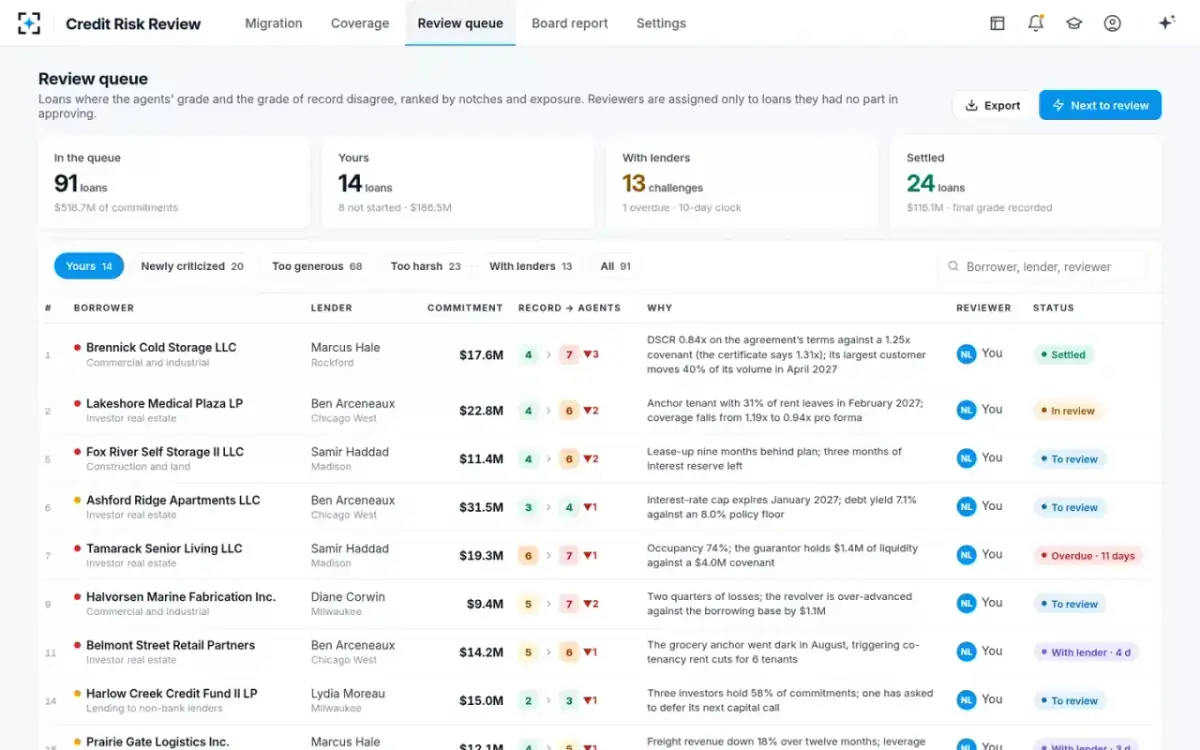
That is why the check belongs in the assignment and not in the person. In the sample bank, the review prioritiser assigns every disagreement to a reviewer by ranking it on notches times commitment, and will not give a loan to anyone who approved or managed it, checked against the approval history of each loan, with a twelve-month cooling-off from a former region. Who assigns a loan risk rating, and who can change it, follows the rest of that chain.
A week in the seat, hour by hour
Here is the part no posting mentions. Take one mid-size commercial relationship through a full file review by hand, and the time divides roughly as follows: an hour and a half pulling the approval memo, the credit agreement, the statements and the certificates together; an hour and a quarter spreading the statements and tax returns; half an hour recomputing the covenants; twenty-five minutes writing up the grade and the challenge; and about twenty minutes judging the credit.
Where four hours of a full file review go, and where half an hour goes
By hand · about 4 hours for one mid-size relationship
- Pulling the file together · 37%
- Spreading statements and tax returns · 31%
- Recomputing covenants · 13%
- Writing up the grade and the challenge · 10%
- Judging the credit · 9%
With the file already built · about half an hour
- Checking the assembled file · 10%
- Checking the spread · 10%
- Checking the covenants · 10%
- Editing the write-up · 10%
- Judging the credit · 60%
Nine percent. That is the share of a full file review that goes on the only activity the job exists for, and it is why a reviewer who reads sixty relationships a year is not lazy or slow — they are spending about ninety hours a year just pulling files together, and nearly two hundred on assembly of every kind, against roughly twenty on judgment. The twenty minutes of judgment at the end are also the worst-rested twenty minutes of the four hours.
The second row is what the same relationship looks like when the assembly is already done: the file gathered, the statements spread on the credit agreement's own definitions, the covenants recomputed against the borrower's certificate, and a suggested grade with each factor cited to a page. The reviewer's job becomes checking four pieces of work and making one decision.
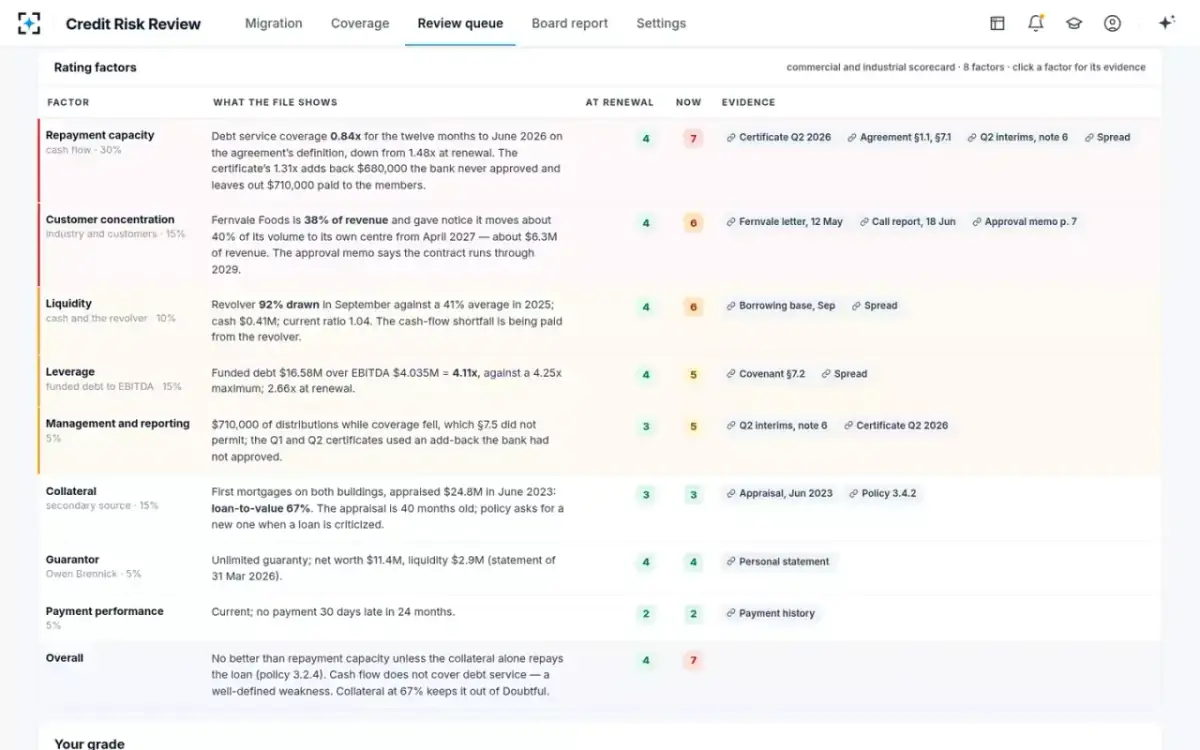
What the reviewer actually reads: eight factors, each with its evidence
Is loan review being automated?
The assembly is. The judgment is not, and the guidance would not accept it if it were. The honest description of what software can do today is that it reads the documents in a credit file, spreads the statements on the agreement's own definitions rather than the borrower's, recomputes the covenants, and proposes a grade with a reason for each factor and a citation for each reason. What it cannot do is own the grade: a suggestion is not an assessment, and the guidance expects an assessment by a qualified, independent person.
That division is what the sample bank runs. Six agents do the reading and the arithmetic. The rating assessor suggests a grade and says why it is not one notch better and not one notch worse. It never changes a grade of record. A reviewer sets the review grade, the lender has ten business days to agree or answer, and a disagreement goes to the chief credit officer. A reviewer who keeps a lender's grade against the agents' suggestion may do so, but has to write the reason, and it goes to internal audit and into the board report.
The effect on the seat is not fewer reviewers. It is a different question arriving on the desk: instead of "which loans shall I read this quarter", it is "here are the loans where the file and the grade disagree, ranked, with the evidence". Whether that is a better job is a matter of taste; it is unambiguously a harder one, because every hour is now spent on contested credits rather than on compliant ones.
The queue a reviewer opens on a Monday
What a good posting for this job should say
Most postings for this seat are interchangeable, and the reason is that they describe the activity rather than the authority. A candidate who is any good will choose between two banks on four questions, and a posting that answers them will out-recruit one that does not.
Who does the officer report to, in substance — the board, a board committee, or the chief lending officer? What happens when the reviewer and the lender disagree, who settles it and in how many days? What coverage is the function responsible for, as a share of the commercial book per year, and who sets it? And what does the reviewer not have to do themselves: is the file assembled and the spread prepared, or is that the job?
The fourth question is the one that decides what the week feels like, and it is almost never answered. A posting that says "statements are spread for you and every rating factor arrives with its citation" is describing a materially different job from one that does not, at the same title and the same pay. For the buyer's side of the same question — what to ask before committing to a system that makes that claim — see what loan review software must do before you buy it.
Questions people ask
Is loan review a good career?
It is a good career for someone who wants to understand a whole commercial book rather than a pipeline, and who is comfortable being unpopular with producers. The published data supports a cautious view of volume: the analytical occupation nearest to it is projected to decline to 2035, while the examiner side is projected to grow much faster than average. Routes onward include chief credit officer, credit risk management and the regulator — where the published median is higher than in the bank-side occupations.
How many loans does a loan reviewer read in a year?
There is no published figure, and it varies enormously with the depth of the review. A full file review of a mid-size commercial relationship, done by hand, takes around four hours, so a reviewer with other duties reaching sixty relationships a year is spending a substantial part of their time on it. The number only becomes comparable between banks when both state what a review includes.
Do you need a certification to work in loan review?
No. The guidance sets a standard of education, experience and formal credit training rather than naming a credential, and it adds that the expertise expected should match the complexity of the portfolios being reviewed. Professional credit training programmes and accounting qualifications help in hiring; none of them is required by any rule.
Who does a loan review officer report to?
Findings go directly to the board of directors or a board committee. Senior management may handle administrative matters — budgets, scheduling, performance reviews — provided that arrangement does not compromise the independence of the function. A reporting line whose practical effect is that the head of lending sees findings first is the arrangement the guidance is written to prevent.
What is the difference between loan review and internal audit?
The interagency guidance states that credit risk review is not intended to be performed by the internal audit function, and that an effective internal audit function keeps the ability to independently audit credit risk review. Loan review forms a view on credit; audit forms a view on whether the processes, including loan review, are working. Some institutions coordinate the two for reporting to the audit committee, which the agencies accept, but the two opinions stay separate.
What does a loan review officer do with software like this?
The same job, from a different starting point. The agents assemble each loan's credit file, spread the statements on the agreement's own definitions, recompute every covenant and score the bank's rating factors with a citation for each; the officer checks that work, sets the review grade, sends the challenge and defends it. The grade of record never moves without a person. To see the factors, the evidence and the challenge together, start from Credit Risk Review.