Loan review software is the tooling a bank's independent credit risk review function uses to do its work: select what to review, read the credit files, test the covenants, score the rating factors, record the findings, run the challenge with the lender, and report the quarter to the board. Almost every claim in the category is a claim about reading — that the tool can get from a credit agreement, a statement and a compliance certificate to something a reviewer can act on — and reading is exactly the thing a scripted demonstration makes easy to fake. The useful protection is to judge the tool against what the guidance already expects of your review function, and to insist the trial runs on your own files. Credit Risk Review is Botminds' entry in this category, and this guide is written so it can lose: the questions below are the ones we would want asked of us.
Figures from the solution are sample data on a fictional bank. The supervisory material is real and linked where it appears.
What a buyer in this category is actually trying to change
39%
of dollars read once a year under a sampled plan, on the fictional sample book
100%target
of commercial loans re-graded every quarter — the design target the solution is built to
64of 91
questioned grades a yearly sample would not have reached by the board committee, $329.1M
3:42h
1,418 loans and 38,612 documents read in one Sunday morning, on the sample book
What is loan review software?
Three different things are sold under the name, and the first job of an evaluation is to work out which one is in front of you. The first is workflow: a place to record which loans were reviewed, by whom, with what findings, and to route a challenge. The second is analytics: dashboards over grades, migration and concentrations, built from data your core system already holds. The third is reading: software that opens the credit file itself — the agreement, the statements, the certificates, the call reports — and produces the findings a reviewer would have produced.
The three are priced similarly and are not comparable. Workflow and analytics change how review output is handled; only the third changes how much of the book can be reviewed at all. A buyer who wants coverage and buys workflow will get a tidier record of the same sample.
Start from what the guidance already asks of you
The interagency guidance describes an effective credit risk review policy in four elements: the qualifications and independence of review personnel; the frequency, scope and depth of reviews; the review of findings and follow-up; and the communication and distribution of results. That is a ready-made evaluation frame, and it has the advantage that every requirement in it is one your examiner is already working from.
The four elements as a must-have and nice-to-have grid
Qualifications and independence of review personnel
Must haveAssignment that respects the approval history of every loan, and a written cooling-off rule it actually applies. Reviewer identity on every decision.
Nice to haveWorkload balancing across the review team.
Frequency, scope and depth of reviews
Must haveA scope you can state and change — size thresholds, segments, risk indicators, policy exceptions — and evidence of what was read and when.
Nice to haveCalendar reminders and review scheduling.
Review of findings and follow-up
Must haveFindings carried to a named owner with a date, and an unresolved item that stays visible rather than ageing out.
Nice to haveTemplated wording for common findings.
Communication and distribution of results
Must haveThe list of loans reviewed with their dates and the analysis behind each rating, plus comparative trends for the board committee.
Nice to haveExport formats and branded report layouts.
Nothing in the right-hand column is worthless; it is simply not what decides the purchase. A tool that produces beautiful board packs from grades nobody tested has improved the presentation of the problem.
What should loan review software do?
At minimum, it should let the review function do the eleven things the agencies' depth-of-review lists ask for, on more of the book than the team could reach by hand, without weakening any of them. Those tests — documentation, lien perfection, approvals, covenants, the sources of repayment, the loss estimate, the accuracy of the grade — are set out in full in the file review checklist, and the question for a vendor is simply which of them the tool performs, which it assists, and which it does not touch.
Two things it should not do, and a good vendor will say so first. It should not move a grade of record, and it should not make the independence decision. Both are judgements the guidance assigns to people, and a tool that quietly takes either has not saved the bank work — it has moved a control.
Question one: what is its unit of work, a file or a field
Ask what the tool produces when you point it at one relationship. A field-level answer — "we extract four hundred data points per document" — describes a capture engine, and the reviewer still has to assemble the case. A file-level answer describes something that can carry a review: the whole relationship read, the statements spread on the agreement's own definitions, every covenant recomputed, each rating factor scored, and the gaps named.
The follow-up is more revealing than the first answer. Ask what it does when the agreement defines a term unusually — a capped add-back, a lease treated as debt, a coverage test with an unusual deduction. A tool whose unit of work is the field will tell you it captures what the certificate says. A tool whose unit of work is the file will tell you which section of which document it reads to find the definition, and what it does when the definition and the certificate disagree.
A whole commercial book on one screen in Credit Risk Review
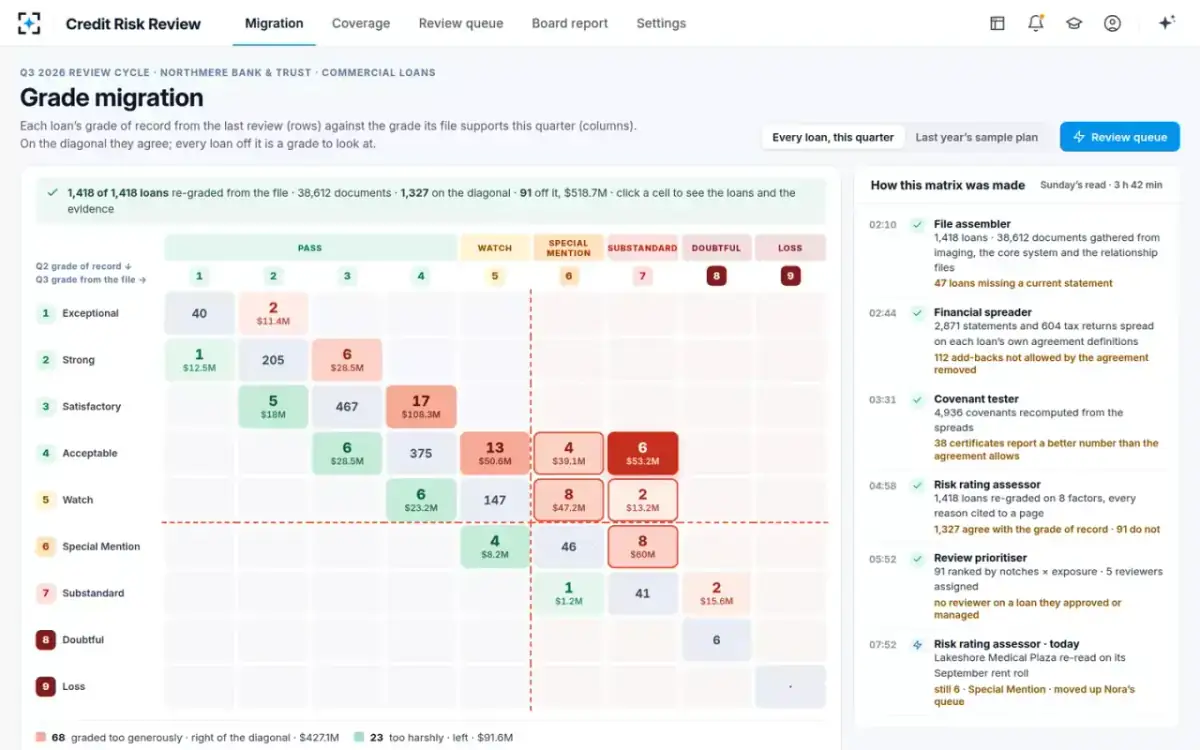
Question two: can it widen the scope without widening the team
This is the only question whose answer is arithmetic, so make the vendor do the arithmetic on your numbers. Give them your loan count, your segment mix, your average documents per relationship and your reviewer headcount, and ask what share of the book gets read, how often, and what the reviewers then spend their time on.
Three ways to widen coverage, and what each one costs
What it changes: Linear: twice the team reads roughly twice the files, with the same depth and the same judgement.
What it still misses: Cost scales with coverage, and recruiting experienced reviewers is the binding constraint at most banks.
What it changes: Cheap and immediate. More loans in the plan, usually by lowering the size threshold.
What it still misses: Depth per file falls as the sample grows unless hours rise. A bigger shallow sample can catch fewer mis-grades than a smaller deep one.
What it changes: The population changes: every loan is read, and reviewer hours go to the loans where the file and the grade differ.
What it still misses: It relies entirely on the reading being right, which is why the citations and the trial matter more here than in either of the other two.
The third row carries its own warning, and a buyer should hold a vendor to it. If the whole case rests on the reading being right, then the evidence that the reading is right is the product. Anything a tool asserts without showing where it read it is a number the reviewer has to redo.
What percentage of the loan portfolio should loan review cover?
There is no required figure, and a vendor who quotes one as a standard is inventing it. The FDIC's examination manual is unusually direct about this.
There are no established or expected levels of minimum or maximum coverage, or penetration, ratios for loan review samples.
FDIC, RMS Manual of Examination Policies, Section 3.2 — Loans
The same passage says what matters instead: "ensuring that the appropriate types of loans are in the sample is more meaningful than how much of the overall portfolio is reviewed." Composition over percentage. The interagency guidance then describes the composition it expects — a risk-based scope "typically includes: Loans over a predetermined size; A sufficient sample of smaller loans, new loans, and new loan products; Loans with higher risk indicators, such as low credit scores, high credit lines, or those credits approved as exceptions to policy", along with segments with similar risk characteristics, fast-growing segments, past due and restructured loans, previously classified loans, insiders and affiliates, and concentrations.
Read that list next to any coverage claim. A tool that lifts coverage from forty per cent to a hundred has, by definition, satisfied the composition requirement — every category is in it. But the claim has to be demonstrated on the bank's own loans, because the categories the guidance names are precisely the ones with the awkward files: policy exceptions, new products, restructured credits.
The same quarter as a yearly sample plan would have seen it
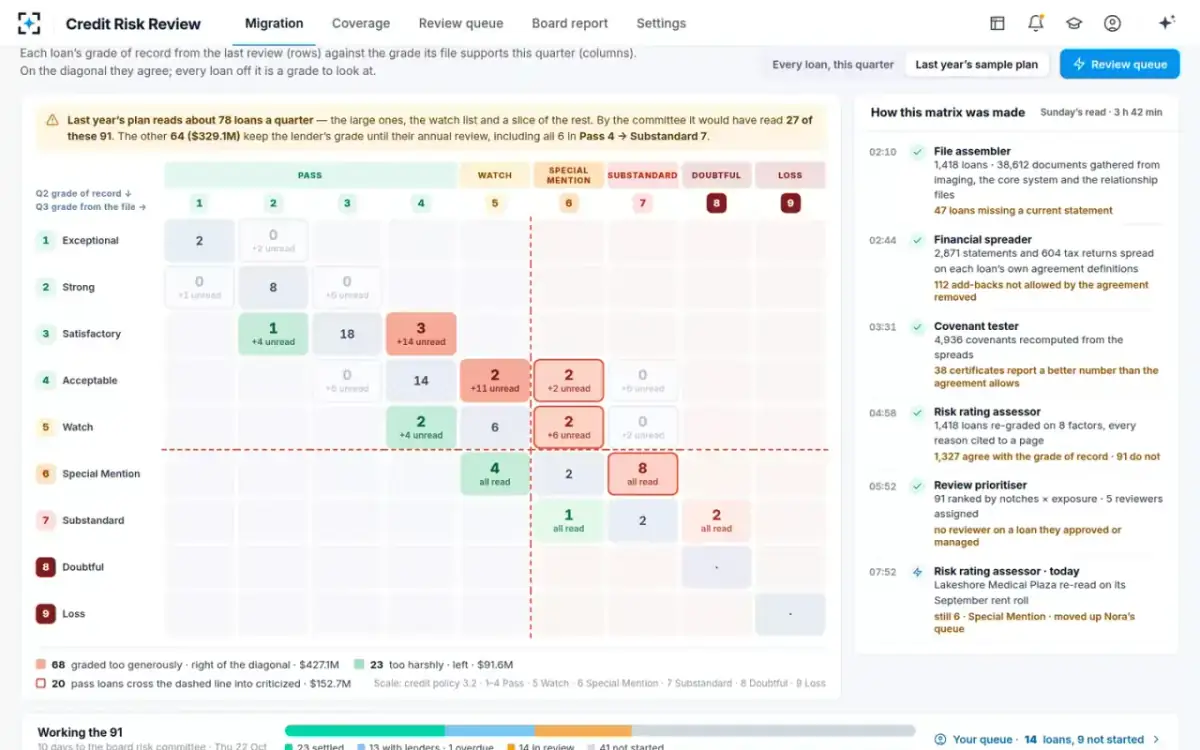
Question three: does every number come back with the page behind it
The requirement here is older than the software category and it is short: the OCC's handbook expects every grade to be well supported, with the support documented in the credit file. A finding with no page behind it fails that test whether it was produced by a person or by a tool, and a reviewer who has to go and find the support has not been saved any work.
So ask to see a citation, and then open it. The useful form is a link to the passage, not to the document: note 9 of the interim statements, not the interim statements. In the sample relationship, sixteen citations sit behind eight rating factors, and the two that decide the grade are a sentence in a note to the statements and a section of the credit agreement — the sort of thing that is unfindable by keyword and obvious once pointed at.
The second half of this question is what the tool does when it cannot find support. The right behaviour is to say so: a missing current statement, an appraisal past the policy window, a covenant whose definition the agreement does not settle. The wrong behaviour is to fill the gap from the previous period and carry on, which produces a complete-looking review of a file that is not complete.
Can software assign a loan risk rating?
It can produce a rating and an argument for it. It should not be the thing that sets the grade of record, and at most banks it cannot be: the grade of record is a decision the credit risk review policy assigns to a named person, and the guidance's whole treatment of independence is written about people, not systems.
That distinction is worth making precisely in an evaluation, because it is easy to blur in a demonstration. A tool that suggests a grade with cited reasons, and leaves a reviewer to set the review grade, fits the guidance's structure exactly — it does what a well-prepared analyst would do. A tool that writes grades back into the core system without a person in the loop has replaced a control rather than supported one, and the first examiner to notice will ask who reviewed what.
Ask the question in its operational form: who, in this product, can change a grade of record, and can it be configured so that the software cannot? The answer tells you more about the vendor's understanding of the work than any accuracy claim. Who is entitled to move a grade, and what happens when the lender disagrees, is set out in who assigns a loan risk rating.
The twelve questions, and the three that decide it
Twelve questions, each with the answer that should worry you
- What is the unit of work — a file or a field?
Worrying: “we extract four hundred data points per document.” That is capture, and the reviewer still assembles the case.
- Does it read the credit agreement, or only structured data?
Worrying: “we connect to your core system.” The definitions that decide a covenant live in the agreement, not in the core.
- Does it recompute covenants, or record what was certified?
Worrying: “we capture the certificate values.” Recording the borrower’s arithmetic is not testing the covenant.
- Does every number come back with the passage behind it?
Worrying: an accuracy percentage offered instead of a citation. Ask to click one, on your own file.
- Whose rating scale does it score?
Worrying: “we use a standard nine-point scale.” Your grades have to be argued against your board-approved definitions.
- Does it say why not one rung better and one rung worse?
Worrying: a grade with a confidence score. A confidence score is not an argument a lender can answer.
- What happens when a document is missing or stale?
Worrying: silence, or a value carried forward from last period. The gap is the finding.
- Who can change a grade of record, and can the software be stopped from doing it?
Worrying: automatic write-back. Ask to see the setting that turns it off, not the promise that it will be off.
- Does it enforce reviewer independence per loan?
Worrying: “you can assign reviewers however you like.” Independence tested against the approval history of each loan is the control; a free-text assignment field is not.
- What does it put in front of the board, and in front of an examiner?
Worrying: dashboards with no list of loans reviewed, dates and the analysis behind each rating.
- What does it need from us, and who maintains that?
Worrying: an integration list with no owner. Imaging, core data, statements, certificates, relationship files and your credit policy all have to come from somewhere.
- What will it not do?
Worrying: no answer. A vendor with no list of things their product does not do has not thought about where it fails.
Three of the twelve do most of the work. Question one separates a capture tool from something that can carry a review. Question four decides whether the output saves reviewer hours or merely relocates them. Question eight decides whether you are buying support for a control or quietly replacing it. A product that answers those three well can be forgiven a weak answer on reporting; a product that answers them badly cannot be rescued by anything else on the list.
How to run the trial so it can fail
The purpose of a trial is to find out whether the claims hold on your files, which means it has to be designed so that it can come back negative. Three rules make that possible. Use your own loans, including the awkward ones. Decide the measurements before the trial starts. And have somebody independent of the purchase read the output.
What a trial should produce, and what each number tells you
| Evidence | How to measure it | What it tells you |
|---|---|---|
| Loans read, and documents read | Count both, against the file inventory you supplied. | Whether “reads the whole file” survives contact with your imaging system. Missing document types are the usual finding. |
| Findings a reviewer agrees with | Have a reviewer who did not run the trial mark each finding agree, disagree or not material. | The only honest accuracy measure in this category. A disagreement rate you can live with is a judgement, not a benchmark. |
| Findings a reviewer would not have made | Flag each finding the reviewer concedes they would have missed. | The value side of the trade. Expect most of these to come from documents nobody re-reads: notes, call reports, letters. |
| Citations per finding, and whether they open | Click a sample. Count the ones that point at a passage rather than a document. | Whether the output can be defended to a lender without redoing the work. |
| Grades suggested, and how many a reviewer settled on | Compare the suggested grade with the grade the reviewer set after reading. | Whether the tool’s argument survives a reviewer. Both agreement and disagreement are useful; silence is not. |
| Reviewer hours per relationship | Time a handful of files end to end, before and during. | The business case. Measure the hours spent judging, not just the hours saved. |
| What it refused to do | Keep a list of the files it could not read and the covenants it could not settle. | The shape of the gap you are buying. A short list of honest refusals beats a long list of confident errors. |
Pick the files deliberately. A dozen relationships should include two with amendments, one with a policy exception, one restructured, one with a guarantor who matters, one whose last statement is late, and at least one the team already knows is mis-graded. If the tool only works on tidy files, a trial of tidy files will not say so.
What no tool in this category should promise
Three promises should end a conversation. The first is a coverage standard: there is no required percentage, and anyone citing one as a regulatory expectation is either mistaken or selling.
The second is that examiners will accept its grades. There is a real passage behind this claim and it says something different: "if the institution's internal grading system (watch list) is determined to be accurate and reliable, examiners can use the institution's data for preparing the applicable examination report pages and schedules, for determining the overall level of classifications, and for providing supporting comments regarding the quality of the loan portfolio." That is a finding an examiner makes about a bank's grading system, after testing it. It is an outcome a bank can earn and no vendor can sell.
The third is the elimination of the reviewer. The last test on both federal lists — the accuracy of the grade — is a judgement, and the guidance builds its entire independence framework around who exercises it. A product that offers to remove that person is offering to remove the control, and the time it saves will be charged back at the next examination.
What the reviewer is left holding in Credit Risk Review
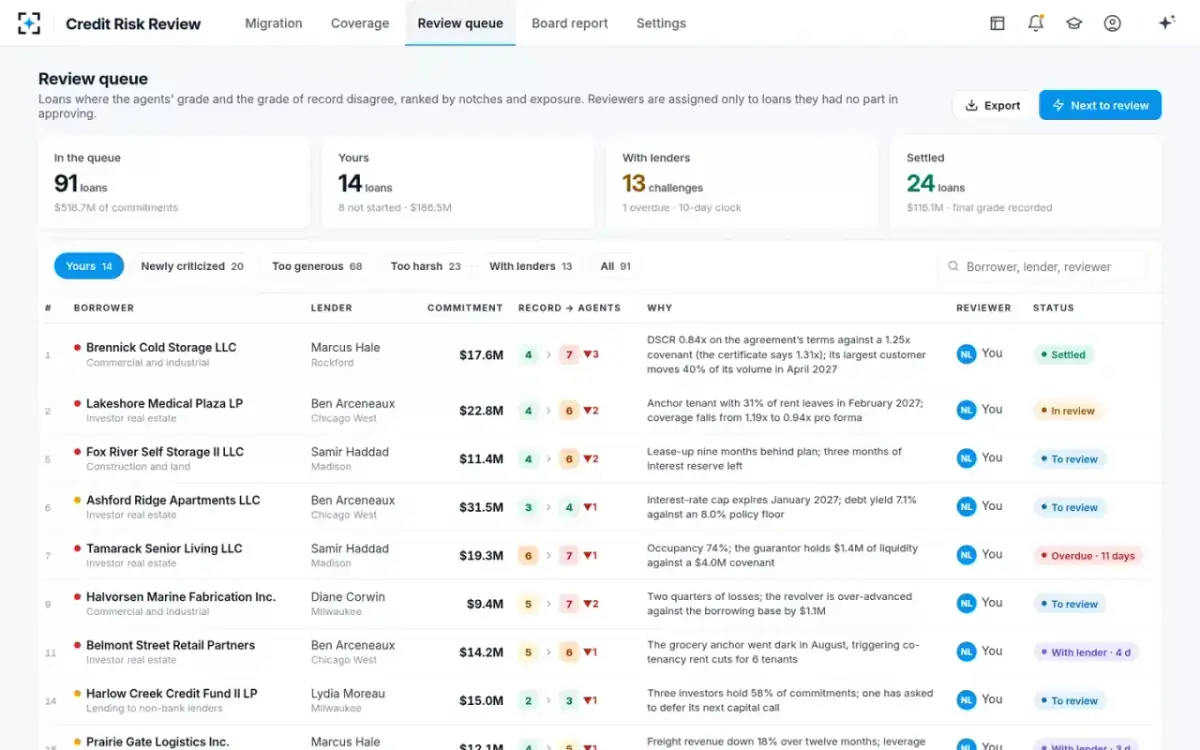
What Credit Risk Review covers, and what it leaves alone
Credit Risk Review reads whole commercial credit files and re-grades them each quarter, scoring the factors of the bank's own scale and citing every reason to a page. It brings the loan to a reviewer with the case built, drafts the challenge to the lender in the bank's format, holds the response clock, and assembles the quarter's report for the board committee.
It does not price loans, originate them, or set the allowance. It does not decide a grade of record, and it is not an independence policy — it enforces the one the bank writes. It needs the bank's imaging system, core loan and payment data, statements and tax returns, compliance and borrowing base certificates, relationship files, and the credit policy and rating scale the grades are argued against. A bank that cannot get the files out of imaging has a problem no product in this category solves. For the arithmetic the output eventually feeds, see classified assets to capital.
Questions people ask
How do you evaluate loan review software?
Against the four elements the interagency guidance asks of a credit risk review policy — independence and qualifications, the frequency and scope and depth of reviews, findings and follow-up, and communication of results — and then on three specifics: whether its unit of work is a whole file, whether every number comes back with the passage behind it, and who can change a grade of record in it. Then run a trial on your own loans with the measurements fixed in advance.
Does loan review software replace a loan reviewer?
No, and a product that says otherwise is proposing to remove a control. The accuracy of the risk rating is the last test on both federal depth-of-review lists and it is a judgement; the guidance's independence framework exists to govern who makes it. What the software can take is the assembly, the spreading and the recomputation — the hours that stand between a reviewer and the judgement.
What data does loan review software need from the core system?
Loan, payment and rating history: balances, structure, past due status, the grade of record and when it was last set. That is necessary and nowhere near sufficient, because the definitions a covenant is tested on, the add-backs allowed and the approvals required all live in the credit agreement, and the facts that move a grade often live in a note to the statements or a letter in the relationship file.
What questions should you ask a loan review software vendor?
Start with what it will not do, which is the fastest way to find out whether the vendor understands the work. Then: what it produces from one relationship, what it does when a document is missing, whose rating scale it scores against, whether it says why a grade is not one rung better or worse, and whether reviewer independence is tested per loan against the approval history.
How do you test loan review software before you buy it?
On your own files, including deliberately awkward ones — amendments, a policy exception, a restructured credit, a late statement, and at least one loan you already believe is mis-graded. Fix the measurements before you start: documents read, findings a reviewer agrees with, findings they would have missed, citations that open on a passage, and hours per relationship. Have somebody independent of the purchase mark the output.
Will an examiner accept grades produced this way?
Examiners assess a bank's internal grading system, not the tools behind it. Where that system is determined to be accurate and reliable, the manual says examiners can use the institution's own data for the examination report pages and schedules and for determining the overall level of classifications. That is a conclusion reached by testing; no product can deliver it, and any claim to do so should be treated as a reason to look harder at everything else the vendor says.