A material loss review is the report an inspector general has to write when a bank fails and the cost to the deposit insurance fund crosses a threshold set in law. It is not journalism and not litigation: it is a federal auditor, with access to every examination report, answering two questions — why did this bank fail, and did its supervisor do its job. Four of those reports are read here, chosen because each one has something precise to say about risk ratings and loan review. Three of them say the same thing outright, and the fourth describes the conditions that produce it. Loans were graded better than they were, the correction came from an examiner rather than from the bank, and by then the losses were in the portfolio. Botminds' Credit Risk Review exists for that gap, and the last part of this guide shows what it looks like on a fictional sample book; the four banks here are real and the words quoted are the inspectors general's own.
Those two halves are kept apart on purpose. No figure from the sample bank describes any real failure, and nothing on this page suggests any software would have saved one. What the reports support is narrower and more useful: a description of how grading failures actually unfold, in enough detail that a chief credit officer can test their own function against it.
How long the weakness sat in the examination record before the bank failed
- From the 2000 examination: loan review "essentially nonexistent", 75% of classifications downgrades11 years
- From the 2004 examination: the concentration named5 years
- From 2005: appraisal and credit administration weaknesses cited at examination after examination10 years
- From March 2020: improve credit administration3 years 8 months
What a material loss review is, and why it exists
Section 38(k) of the Federal Deposit Insurance Act requires the inspector general of the failed bank's federal supervisor to review the failure whenever the loss to the insurance fund is material. The threshold has moved. For 1st Centennial in 2009 a loss was material if it exceeded the greater of $25 million or 2 percent of the institution's total assets when the receiver was appointed. For losses in 2010 and 2011 — the peak of the failure wave — Congress raised it to $200 million. Since 1 January 2014 the figure has been $50 million.
The statute tells the inspector general what to produce: review the agency's supervision of the failed institution, including its use of prompt corrective action; establish why the institution's problems caused a material loss; and recommend how to prevent one in future. That is a narrow brief, and it is why these reports are worth more to a credit officer than most commentary on bank failure. They are not arguing a thesis. They are reconstructing, examination by examination, what was known and when.
Below the threshold the work does not stop. When the fund's loss is under $50 million the inspector general still determines the grounds the state or federal agency gave for appointing a receiver, and decides whether unusual circumstances warrant a fuller in-depth review. That shorter product is a failed bank review, and the Citizens Bank memorandum read here is one.
Who writes one, and what it is allowed to say
An office of inspector general writes it — the Federal Reserve Board's own OIG for a state member bank, the FDIC's for a state nonmember bank, the Treasury's for a national bank. The offices are independent of the supervisory divisions whose work they are assessing, and they say uncomfortable things about them: the 1st Centennial report, for one, concludes that the FDIC's supervision of the concentration and the timing of its formal enforcement action could have been improved.
What a report does not do is adjudicate. It assigns no liability and settles no dispute between the bank and its supervisor. It describes examination findings, the bank's responses, and the sequence. That restraint is what makes the recurring sentences significant. When four auditors with no shared agenda, writing across fifteen years about banks in Virginia, California, Georgia and Iowa, keep recording that problem loans were recognised late and that nobody independent of the lenders caught them in time, the finding is structural rather than anecdotal.
Four failures, and what each report records about grades and loan review
| Bank, and the report | What the inspector general found about grading or review | Estimated loss to the insurance fund |
|---|---|---|
| Bank of the Commonwealth, Norfolk, Virginia — Federal Reserve OIG, April 2012 | At the 2000 examination, 75 percent of loan classifications were downgrades of the bank’s own internal risk ratings; loan review was "essentially nonexistent"; delays in downgrading ratings recurred at examinations from 2001 to 2008. | $268.3 million, 27.5 percent of $974.9 million of total assets at closing |
| 1st Centennial Bank, Redlands, California — FDIC OIG, AUD-09-019, August 2009 | The internal loan grading system "was considered inadequate and was not effectively classifying loans", which the report ties directly to late problem-asset recognition, an inaccurate allowance and misstated capital and earnings. | $226.6 million at the first estimate, cut to $215.4 million by July 2009, against $784 million of assets at closing |
| Capitol City Bank & Trust, Atlanta, Georgia — FDIC OIG, AUD-15-006, September 2015 | External loan review ran at inconsistent intervals and "lacked depth", testing documentation and policy exceptions rather than the credit quality of each relationship; management did not risk rate loans appropriately or identify nonaccrual loans in time. | $88.9 million, against $272.3 million of total assets at the end of 2014 |
| Citizens Bank, Sac City, Iowa — FDIC OIG, AEC Memorandum 24-02, March 2024 | Failure attributed primarily to "insufficient Board and management oversight of its credit administration practices", with repeated examination findings on underwriting and administration from 2020 onward unaddressed. | $14.8 million, 23 percent of $65 million of total assets |
Bank of the Commonwealth: three quarters of the classifications were downgrades
The Norfolk bank gives the cleanest measurement of a grading problem anywhere in this material, and it is eleven years before the failure. The Federal Reserve OIG records that "During its 2000 examination, the bank's difficulties with problem loan recognition became apparent when 75 percent of the loan classifications represented downgrades from internal risk ratings assigned by the bank."
Read that slowly. Of every four loans the examiners classified, three were loans the bank itself had graded more favourably. The bank's grading was not merely imprecise; on the loans that mattered it was wrong three times out of four, and the only mechanism that produced the right answer was a visiting examiner. The report says why there was no other mechanism:
Examiners noted that loan review was "essentially nonexistent," which prevented Commonwealth from accurately identifying loan risk.
Federal Reserve OIG, Material Loss Review of Bank of the Commonwealth (April 2012)
What happened next is the part worth studying. The bank improved. Ratings went up, and at one later examination the Reserve Bank recorded that it now considered the bank's risk rating system reliable, identified no rating downgrades at all, and noted classified assets at their lowest level in three years. Yet the same report still asked the bank to obtain current borrower financial information to verify ability to repay. A rating system judged reliable while the information behind the ratings was known to be missing is a system being judged on its outputs. Classified assets later rose to 65 percent of tier 1 capital, then 178 percent, then 222 percent.
There is also an unglamorous detail about outsourcing in this file. Examiners found that only one written loan review report had been provided to the bank in 2003, although quarterly reviews had been conducted under an outsourcing arrangement — and the one report that existed, found in the examiners' own work papers, was about the lack of current financial information in the loan files. The work was bought. The findings did not reach anyone who could act on them. What a board can and cannot hand to a third party is set out separately.
Did inaccurate risk ratings cause bank failures?
Not on their own, and no report here says so. Every one of the four puts a concentration at or near the centre of the failure — commercial real estate and construction in Virginia and California, higher-risk commercial real estate including loans to churches and religious organizations in Georgia, commercial trucking in Iowa. What inaccurate ratings did was remove the warning that the concentration was going bad, and remove it from everybody at once: the board report, the allowance, the capital plan and the examiner's own scoping all run on the bank's grades.
The 1st Centennial report draws that chain explicitly. The grading system was "considered inadequate and was not effectively classifying loans, leading to the untimely recognition of problem assets, an inaccurate ALLL, and a misrepresentation of the bank's capital and earnings". One weak control, and three reported numbers are wrong — asset quality, allowance, capital. The April 2008 examination that finally classified the portfolio produced $110 million of adverse classifications in a single pass and cut the composite rating from 2 to 4. Nine months later the bank was closed.
What the bank's grades said, and what the examiners found
The bank's own view: The loans carried the internal risk ratings the bank itself had assigned.
What the examination recorded: 75 percent of the loans examiners classified were downgrades of those internal ratings; loan review was "essentially nonexistent".
The bank's own view: Classified assets at their lowest level in three years, below peer averages, and the rating system judged reliable with no downgrades identified at the examination.
What the examination recorded: The same report still asked the bank to obtain current borrower financial information to verify ability to repay.
The bank's own view: A grading system in place and applied by lenders, with some loans 100 to 160 days past due still accruing.
What the examination recorded: $110 million of adverse classifications in one pass, and a composite rating cut from 2 to 4.
The bank's own view: An external loan review bought and performed, reporting documentation, policy and financial statement exceptions.
What the examination recorded: Reviews that "lacked depth", and management that did not appropriately risk rate loans or identify nonaccrual loans in time.
The bank's own view: Trucking relationships carried while the bank advanced further funds through overdrafts.
What the examination recorded: Exposure of 310 percent of tier 1 capital and the allowance, 43 percent of the portfolio, advanced without current financial information or collateral analysis.
What the insurance fund lost, as a share of each bank's assets
A loss of a quarter to a third of a bank's assets is not the arithmetic of a few bad loans. It is what happens when a portfolio is marked at book while it deteriorates, and is then marked to reality all at once by a receiver. The grades are the mark.
1st Centennial: a grading system that did not classify
The Redlands bank is the clearest case of a rating scale that existed on paper and did not sort. Examiners had flagged the construction and development concentration from 2004; by the April 2006 examination construction loans represented 611 percent of tier 1 capital, and the examination concluded that management was effectively monitoring and managing the risk. No action was taken to limit the concentration. A state examination the following year put the commercial real estate concentration above 581 percent of tier 1 capital and made no recommendation.
Through all of this, the bank's own grading system was not sorting the problem loans out of the book. The report lists what 2008 examiners found alongside the ineffective grading system: inappropriate use of interest reserves, a weak loan approval process, and a lack of current borrower financial statements to assess ability to repay against falling collateral values. It records loans the bank had not placed on nonaccrual, or had delayed placing on nonaccrual, when payments were 100 to 160 days past due.
That last detail is the one to take away, because it is checkable in any bank today. A loan 160 days past due and still accruing is not a judgment call that a reasonable reviewer could go either way on. It is a fact in the core system that contradicts a grade in the same core system, and nothing was comparing the two.
Capitol City Bank & Trust: an outsourced review that tested the folder
The Atlanta bank had a loan review function. It bought it, and the FDIC OIG's report describes exactly what it bought: "The frequency of external loan review was inconsistent and the reviews lacked depth. For example, examiners noted that the reviews focused on documentation, credit policy exceptions and financial statement exceptions, rather than the credit quality of each relationship."
Every one of those three things is worth testing. A missing statement, a policy exception and an unreconciled covenant are real findings. But a review that only produces them answers the question "is the file tidy?" and leaves the question "is the grade right?" to the person who assigned it. The report puts the consequence in the next bullet: "Management was not able to identify loan problems in a timely fashion and failed to identify nonaccrual loans in a timely manner and appropriately risk rate loans."
There were other things an exceptions-based review would not catch. Examiners found the bank originating, extending and renewing commercial real estate credits on annual interest-only terms, a structure the report says can mask deterioration, since a loan that only owes interest once a year rarely looks past due. Appraisal practices drew citations at 11 of the 15 examinations and visitations between 2005 and 2014. A file could pass a documentation test while every economic fact behind the grade was stale. The distinction between testing a folder and testing a grade is the subject of a loan file review checklist that tests the grade.
Citizens Bank, Sac City: more money, no current financials
The Iowa bank is the recent one, and the smallest. It had been in business since 1929, mostly lending to farms. From 2014 it began lending to trucking companies, and by 30 June 2023 the FDIC OIG records that "the bank had a significant exposure to commercial trucking loans (310 percent of Tier 1 Capital and Allowance for Credit Losses), with these loans accounting for 43 percent of the bank's portfolio."
Supply-chain problems and rising fuel, insurance and repair costs hit those borrowers between 2020 and 2022. The bank responded by advancing more money, often through overdrafts, often above the state's legal lending limit, and the report says it did so without first obtaining current financial information or conducting proper collateral analysis. A supervisor's view of the same facts is in the memorandum's conclusion: the failure "occurred primarily due to insufficient Board and management oversight of its credit administration practices."
The warning path is fully documented. A March 2020 examination told the board to improve credit administration. Examinations in 2021 and 2022 repeated findings on underwriting and administration and added lending-limit violations. A memorandum of understanding followed in January 2023, a visitation in May cut the composite rating from 3 to 4, a consent order came in August, and the bank was closed in November. Nothing was hidden. The memorandum does not discuss loan review at all; what it describes is a bank that had changed its own business in nine years and kept advancing money to its largest exposures without current financial information — the condition an independent re-read of the files exists to surface.
Do strong earnings hide weak loan grades?
They do, and the mechanism is arithmetic rather than conspiracy. Classifying a loan costs money: it drives a higher allowance, which is a provision, which reduces earnings. A bank that classifies less earns more, until the loans that were not classified default. The Federal Reserve OIG's sentence about Bank of the Commonwealth is the whole argument in one line: "Despite these weaknesses, Commonwealth's earnings exceeded peer group averages from 2003 to 2007, in part because of its minimal classified assets."
Minimal classified assets were, in that period, a reason the bank looked good — to its board, to its peer comparisons, and to anyone reading its ratios. That is why asset-quality strength is the one metric a board should never accept without asking who measured it and against what. A falling classified total produced by a bank that has stopped classifying looks identical, in a quarterly pack, to a falling classified total produced by a portfolio that is getting better. The classified assets to capital ratio and the independence of the function that feeds it are the same question asked twice.
What the four reports have in common, and what they do not
What they do not have in common is almost everything on the surface. Different decades, different regulators, different states, assets from $65 million to $975 million, concentrations in construction, commercial real estate, churches and trucks. One bought its loan review from outside and got reviews that lacked depth; another started the record with loan review examiners called essentially nonexistent. The common ground is narrower and more awkward.
Five findings that recur across the four reports
- The bank’s own grades were better than the loans
Stated as downgrade shares at Bank of the Commonwealth, as a grading system that was not classifying at 1st Centennial, and as a failure to appropriately risk rate at Capitol City.
- The correction arrived from outside
Where the reports describe a re-rating, it came from an examiner on the examination cycle — every twelve to eighteen months at best — not from a reviewer on a cycle measured in quarters.
- The underlying facts were already in the file
Missing current financial statements, 160-day past-due loans still accruing, appraisals cited at 11 of 15 examinations, overdrafts above the lending limit. None of it needed new information.
- The weakness was named years before the failure
Eleven years at Bank of the Commonwealth, five at 1st Centennial, ten at Capitol City, more than three at Citizens Bank — repeated at examination after examination.
- A concentration was the cause; the grades were the blindfold
No report says bad grading caused a failure. Each shows that accurate grading was the thing that would have made the concentration visible while it could still be managed.
One more thing they share: none of them recommends a better rating scale. The recommendations are about who does the rating, how often, and whether anyone independent reads the file. That is a process answer, not a definitions answer, and it is why the grade definitions themselves are the easy half of the problem.
What a review function would have had to do differently
Everything above is the public record of four real banks. What follows is a fictional sample book — Northmere Bank & Trust, 1,418 commercial loans, invented borrowers and lenders — shown to make one mechanism visible, not to claim any software would have changed any real outcome.
The mechanism the four reports describe is coverage over time. A risk-based sample reads the large relationships, the watch list, insider loans and a slice of the rest. Every loan outside this quarter's slice keeps the grade its lender gave it until its turn comes round. That is defensible when the portfolio is stable and indefensible when a concentration is turning, which is precisely when nobody knows the portfolio is turning.
The same quarter, seen through a yearly sample plan
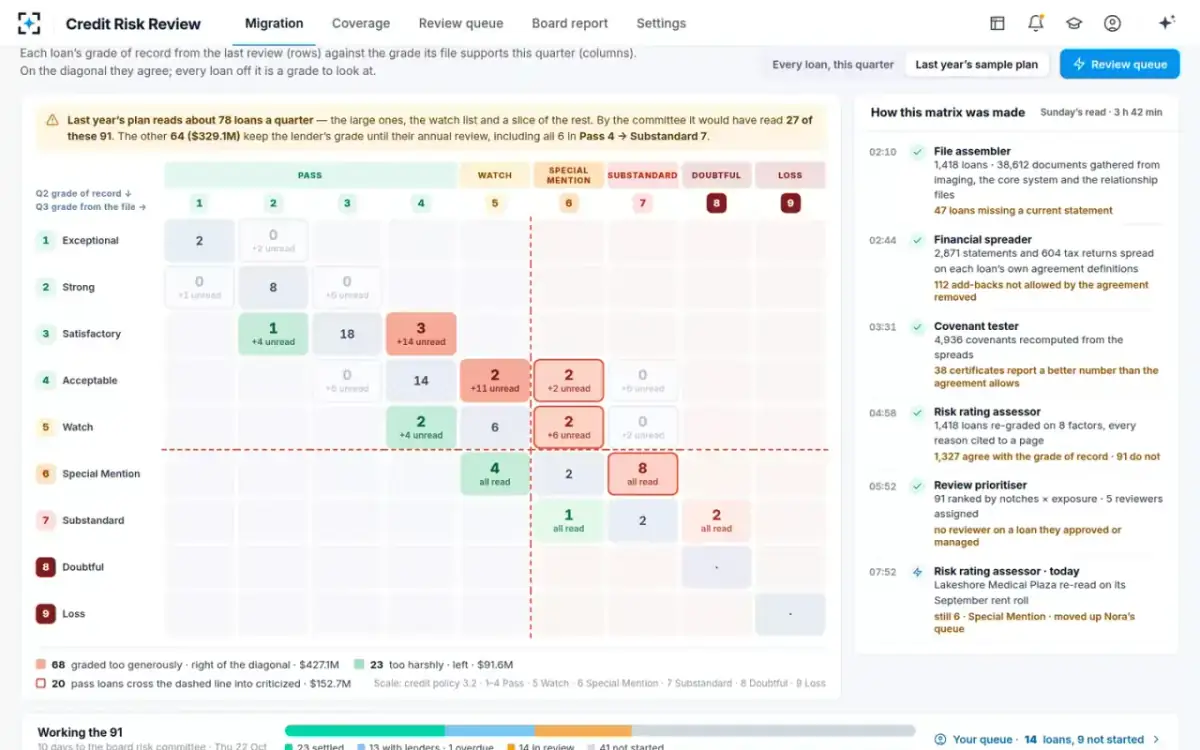
On that sample book the agents read every commercial loan and disagreed with 91 grades of record, $518.7 million of commitments, 68 of them graded more generously than the file supports. Last year's plan would have reached 27 of the 91 by the board committee date. The other 64, $329.1 million, would have kept the lender's grade until their annual review — including all six of the loans the file puts three notches lower, at substandard.
What each report would have needed is the same three things, and none of them is a scale: every loan read against current documents rather than a sample; the disagreements ranked and given to someone with no part in approving them; and a clock on the answer, so a grade in dispute is settled rather than left open. That last one matters because the natural state of a grade challenge is to sit.
One loan, re-read from its file, with the reason for every factor
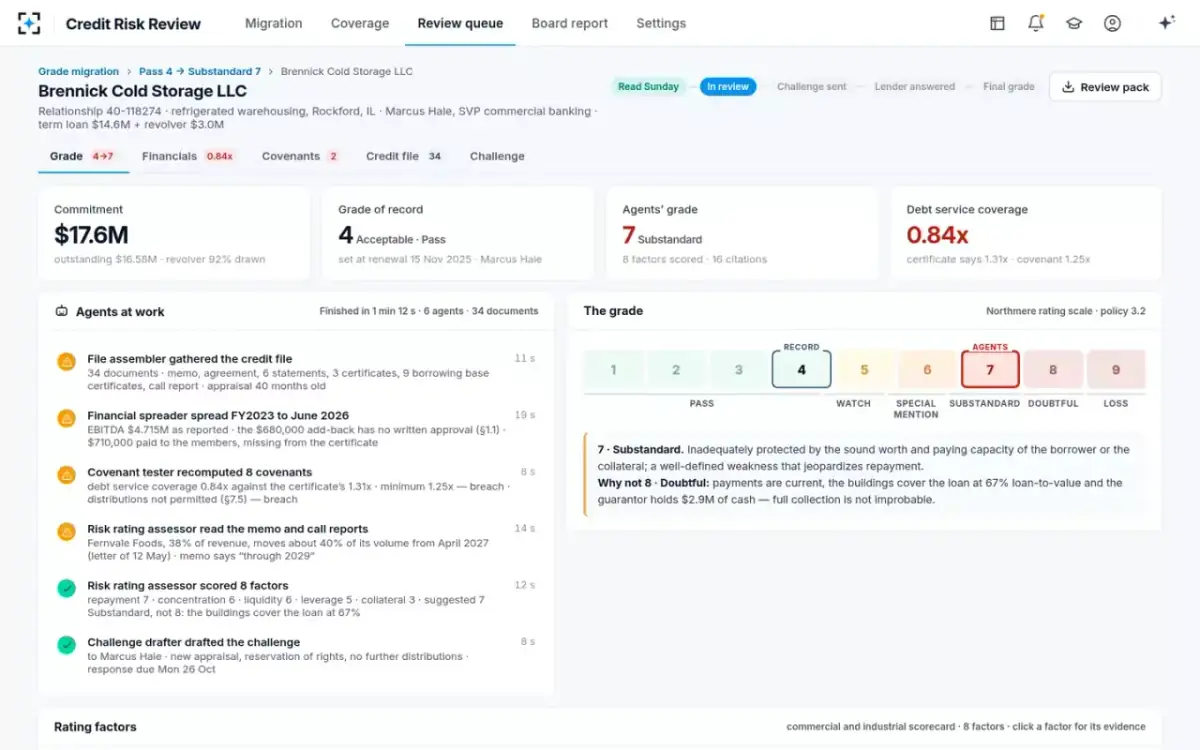
Credit Risk Review is built around those three things. Six agents assemble each loan's file, spread the statements on the credit agreement's own definitions, recompute every covenant and score the bank's rating factors, suggesting a grade with each reason cited to a page. They never change a grade of record. A reviewer who had no part in approving the loan sets the review grade, the lender has ten business days to agree or answer, and a disagreement goes to the chief credit officer with both write-ups. Whether a function like that would have changed any of the four outcomes is unknowable, and we do not claim it. What is knowable is that each report describes a bank whose grades went uninspected for years, and that is the condition it removes.
Questions people ask
What is the difference between a material loss review and a failed bank review?
The threshold. A material loss review is required when the loss to the deposit insurance fund crosses the figure in section 38(k) of the Federal Deposit Insurance Act, currently $50 million for losses on or after 1 January 2014. Below it, the inspector general writes a shorter failed bank review that establishes the grounds for the receivership and decides whether unusual circumstances warrant a full in-depth review. The Citizens Bank memorandum discussed here is a failed bank review; the other three are material loss reviews.
Where can I read material loss reviews?
On the inspector general's own site for the failed bank's federal supervisor: the Federal Reserve Board OIG for state member banks, the FDIC OIG for state nonmember banks, and the Treasury OIG for national banks. They are free to read, and every report quoted on this page is linked beside its quotation.
How much of a failed bank's portfolio was rated pass?
The reports rarely give a clean percentage, which is itself telling. The closest figure in this set is Bank of the Commonwealth's 2000 examination, where 75 percent of the loans examiners classified had been rated better by the bank. The more common formulation is qualitative — a grading system that was "not effectively classifying loans", or management that "failed to identify nonaccrual loans in a timely manner and appropriately risk rate loans".
What warning signs appeared before these banks failed?
Four recur. A concentration growing faster than the staff who understood it; current borrower financial statements missing from files; past-due and nonaccrual status applied late or not at all; and repeat examination findings that the board acknowledged and did not fix. None of these needs a model to detect. Each is visible from the loan files and the core system in the quarter it happens.
Do material loss reviews criticise the regulator as well as the bank?
Yes, and that is half the statutory brief. The 1st Centennial report concludes the FDIC could have done more about the concentration it had identified as early as 2004 and could have moved to a formal enforcement action sooner. That matters for a credit officer's reading of them: a report that is willing to criticise the supervisor is not writing a defence of the examination process, so its findings about the bank's own grading are not there to shift blame.
Does loan review software stop a bank from failing?
No, and no inspector general report supports that claim. Concentrations, underwriting and board oversight cause failures; grading accuracy determines how early anyone can see it. What an independent review function changes is the interval between a loan going wrong and someone saying so in writing. Credit Risk Review shortens that interval by re-grading every commercial loan from its file each quarter and ranking the disagreements for a reviewer — the grade still belongs to a person. To see how that works on a book, start from Credit Risk Review.