The difference between special mention and substandard is the difference between a potential weakness and a well-defined one, and it is the boundary where commercial risk grades most often split. Risk rating consistency is the chance that two qualified people, given the same loan and the same file, assign it the same grade. It is never perfect, because a grade combines objective measures such as coverage and leverage with subjective ones such as management quality and the outlook for the borrower's market. Examiners measure it from the outside: the OCC compares a sample of the bank's grades with its own and digs for root causes when inaccuracies pass about 5% of loans reviewed or 3% of the dollars. Loan review measures it from the inside, and typically changes no more than a tenth of the grades it sees. A bank that measures agreement itself, between two reviewers and between a proposed grade and the final one, knows where its grading is soft. Botminds' Annual Credit Review makes the second comparison routine: every review carries the agents' proposed grade with its factor scores beside the grade the analyst decided.
Where reviewers most often split: special mention or substandard
Special mention (grade 6 on a sample scale): “Potential weaknesses that deserve management's close attention. If left uncorrected, these potential weaknesses may result in deterioration of the repayment prospects”. Not adversely classified.
Substandard (grade 7): “Inadequately protected by the current sound worth and paying capacity of the obligor or of the collateral pledged”, with “a well-defined weakness, or weaknesses, that jeopardize the liquidation of the debt”.
Special mention (grade 6 on a sample scale): “Adverse operating trends (declining revenues or margins) or an ill-proportioned balance sheet (e.g., increasing inventory without an increase in sales, high leverage, tight liquidity)”.
Substandard (grade 7): “Current or expected unprofitable operations, inadequate debt service coverage, inadequate liquidity, or marginal capitalization. Repayment may depend on collateral”.
Special mention (grade 6 on a sample scale): Revenue down 12%, EBITDA down 37%, leverage covenant breached at 3.03x, but fixed charges still covered at 1.04x and all 36 payments on time.
Substandard (grade 7): Would apply if coverage fell below 1.00x for two quarters, a payment went past due, the borrowing base fell short of the line, or the default were declared without a waiver.
Special mention (grade 6 on a sample scale): Is the weakness still potential?
Substandard (grade 7): Is it now well defined, with repayment in jeopardy?
What is the difference between special mention and substandard?
Special mention is criticized but not classified: the borrower shows weaknesses that could hurt repayment if nothing changes. Substandard is the first classified grade: the weakness is well defined, repayment is in jeopardy, and the bank faces "the distinct possibility" of some loss if the problem is not corrected. The OCC's booklet adds two sentences that settle many arguments. For special mention, "Although an SM asset has a higher probability of default than a pass asset, its default is not imminent." For substandard, "an individual asset's loss potential does not have to be distinct for the asset to be rated substandard" (OCC, Rating Credit Risk).
Two features of special mention are often missed. It is not only financial: "Nonfinancial reasons for rating a credit exposure special mention include management problems, pending litigation, an ineffective loan agreement or other material structural weakness, and any other significant deviation from prudent lending practices." And it is not a parking place: "Special mention is not a compromise between pass and substandard and should not be used to avoid exercising such judgment." A reviewer torn between pass and substandard who settles on special mention is doing what the definition forbids.
The consequences differ in kind. "Classified assets are exposures rated substandard, doubtful, or loss. Classified assets do not include pass and special mention exposures." Classified totals are what boards and examiners track most closely, and the booklet notes that for some substandard assets "the likelihood of full collection of interest and principal may be in doubt; such assets should be placed on nonaccrual." A one-grade disagreement at this boundary moves a loan into a different set of reports, reserves and conversations with the board.
Why do two reviewers give the same loan different risk ratings?
Because the grade definitions describe degrees of weakness, and degrees are judged; the special mention and substandard boundary is the sharpest case. The OCC asks that rating criteria be "clear and precisely defined using objective (e.g., cash flow coverage, debt-to-worth, etc.) and subjective (e.g., the quality of management, willingness to repay, etc.) factors" (OCC, Rating Credit Risk). The objective factors narrow the range; the subjective ones decide within it. Two reviewers who agree on every ratio can still disagree on whether a customer concentration of 34% is a potential weakness or a well-defined one.
Scales make it harder. Federal Reserve staff found that among the fifty largest banks "the number of Pass grades varies from two to the low twenties. The median is five Pass grades, including a watch grade if any" (Treacy and Carey, 1998). More pass grades mean finer distinctions and more boundaries to disagree across. The same study found that 36% of large banks put half or more of their rated loans in a single grade, a sign of a scale that is not separating risk at all.
And incentives tilt the disagreement one way. The OCC warns that "it can be relatively easy for loan officers and line managers to rate credits a step, or more, above what they deserve", which is why examiners treat understated risk as the more serious error. Disagreement is expected; disagreement that always runs in the same direction is a finding.
How much disagreement the regulators and research treat as normal
0–10%
of ratings changed by loan review at large banks, outside mergers or new rating systems
Treacy and Carey
5%
of credits reviewed, or 3% of the dollar amount, inaccurately rated: the point at which OCC examiners look for root causes
OCC
5
pass grades at the median large bank, watch included
Treacy and Carey
36%
of large banks put half or more of their rated loans in one grade
Treacy and Carey
How do examiners test risk rating accuracy?
They sample and compare. "To determine whether a bank's risk ratings are accurate, examiners will review a sample of loans and compare internal bank ratings with those assigned by OCC staff. Examiners should be most concerned when rating inaccuracies understate risk; however, any significant inaccuracy should be criticized" (OCC, Rating Credit Risk). When inaccuracies are significant, "generally, greater than 5 percent of the number of credits reviewed, or 3 percent of the dollar amount", examiners "must investigate to determine the root causes and decide whether to expand their loan review sample."
The booklet also says what they look at when they investigate: "The nature and pattern of rating inaccuracies, for example, inaccuracies within pass categories, problem credits that are passed, missed ratings with a few large credits or several smaller credits", and "The severity of inaccuracy, i.e., how many grades away the rating is from what it should be". Those are agreement measures, and a bank can compute them on itself before the examiner does. The OCC's 2026 booklet adds that comparing the agency's own testing with the bank's credit risk review findings "is a common way that examiners test the reliability of credit risk review's work" (OCC, Lending and Loan Portfolio Risk Management).
Disagreement between reviewers is expected. Disagreement that always runs in the same direction is a finding.
Special mention or substandard? One loan argued both ways
The fictional Calder Precision Components shows how two careful reviewers can land on different sides of the line. In one year its revenue fell 12%, EBITDA fell 37%, its leverage covenant was breached at 3.03x against a 3.00x maximum, global debt service coverage fell to 1.08x against a 1.15x policy minimum, and the main guarantor's liquid assets more than halved. The bank has not declared the default, and its fixed charge coverage, at 1.04x, still covers its fixed charges, if barely. Every one of its 36 payments was on time.
The case for substandard reads the definition literally. An event of default exists under the agreement, global coverage is below policy, and the substandard description lists "inadequate debt service coverage" and "inadequate liquidity" among its marks; with the borrowing base availability down 73%, a reviewer can argue the weakness is already well defined. The case for special mention reads it in time. Coverage is still above one, the borrower is current, tangible net worth rose, and a waiver with a covenant reset is on the table: the weaknesses are serious but still "potential weaknesses that may, if not checked or corrected, weaken the asset".
Annual Credit Review's draft proposes 6, special mention, and writes down what would make it 7: coverage below 1.00x for two quarters, a payment past due, the borrowing base short of the line, or the default declared without a waiver. That list is what makes the disagreement useful. A second reviewer who would grade it 7 today can say which trigger they think has already happened, and the next quarterly review tests it. A disagreement framed as a trigger can be settled by evidence; one framed as a feeling cannot.
How do you measure risk rating consistency? Five ways
A single "percent agreed" hides most of what matters. Agreement on a nine-grade scale should be read at several levels, and with the direction of each miss.
Agreement measures for risk grades, and what each one tells you
| Measure | How to compute it | What it catches |
|---|---|---|
| Exact agreement | Share of loans where both reviewers chose the same grade | Overall consistency; harsh on scales with many pass grades |
| Within one grade | Share where the grades differ by no more than one step | Whether disagreement is ordinary judgment or something larger |
| Agreement at the boundaries | Exact agreement on pass vs special mention vs classified only | The disagreements that change reserves, reporting and the watch list |
| Direction of misses | Of the loans where reviewers differ, the share where the line's grade is the better one | Systematic understatement, the error examiners weight most |
| Chance-corrected agreement | Cohen's kappa, weighted by distance between grades | Agreement that is not just everyone choosing the most common grade |
The boundary measure deserves its own line in any report. A disagreement between grade 2 and grade 3 rarely changes anything outside the credit file. A disagreement between grade 5 and grade 6 changes whether a loan is criticized, whether it moves to quarterly review and how it is reserved. The interagency guidance tells banks how to settle such disputes, "the lower classification or risk rating typically prevails unless internal parties identify additional information sufficient to obtain the concurrence of the independent reviewer" (85 FR 32991), but settling a dispute is not the same as measuring how often they happen.
Agreement between Annual Credit Review's proposed grade and the analyst's decision
Every review in the solution carries two grades: the one the agents propose and the one the analyst decides. The review writer scores the bank's grading model factor by factor, last year beside this year, proposes a grade, quotes the definition it rests on and says what would move it up or down. The analyst then decides. The gap between the two, review by review, is an agreement measure the bank gets without running a separate study.
The proposed grade with its seven factor scores and the definition it rests on
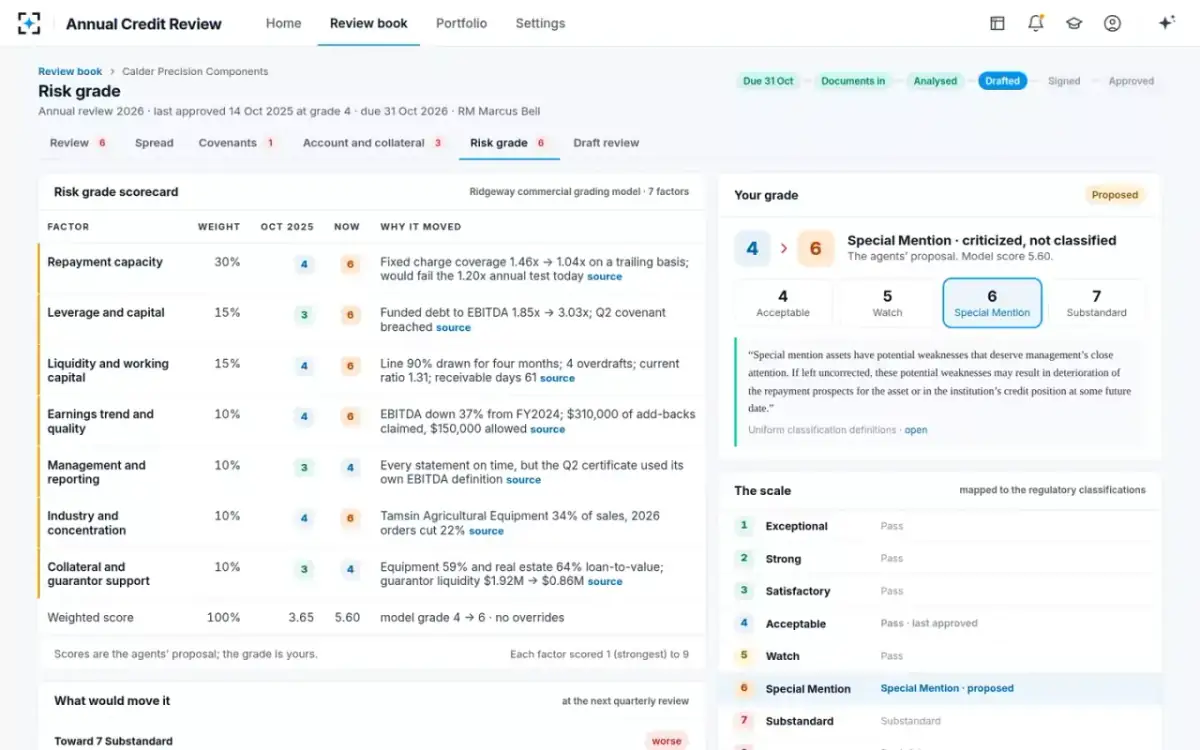
“No overrides” on the weighted score line is the agreement measure: the analyst's grade matches the proposal on this loan.
Read that measure carefully. High agreement between proposal and decision can mean the model is good, or that analysts have stopped thinking; low agreement can mean the model is poor, or that analysts are softening grades. The direction of the overrides tells you which. Overrides that mostly lift the grade above the proposal are the pattern the OCC warns about; overrides that mostly lower it suggest the scorecard's weights understate a risk the bank cares about. Either way, the reason for each override sits in the review, so loan review can test a sample of them.
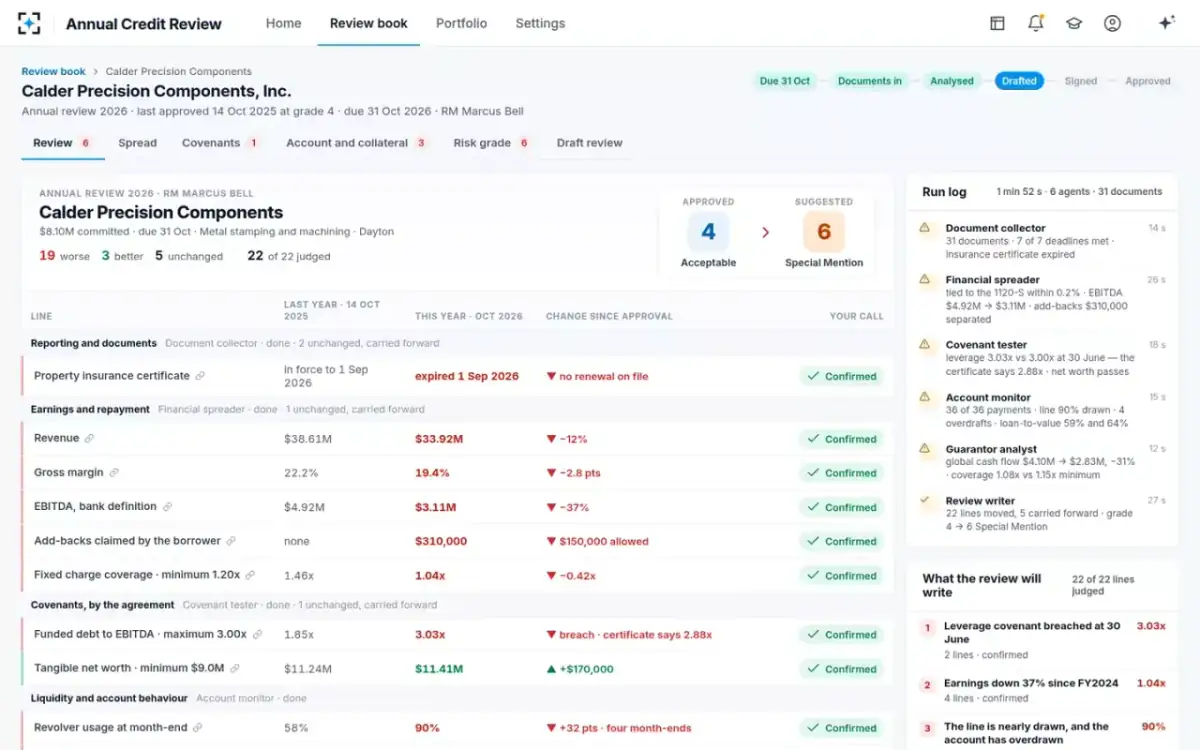
The line-level challenge adds a second layer. Before the grade, the analyst confirms or challenges each line that moved, and a challenge goes back to the agent that produced it. Challenges by line type, and how often the recheck changed the line, show where the agents' reading of the documents disagrees with the analyst's reading of the borrower.
Every moved line confirmed by the analyst before the grade is decided
Running a two-reviewer test on your own book
A bank does not need an examiner to find out how consistent its grades are. It needs a fair sample, a second reviewer who has not seen the first grade, and the patience to count. Re-running last year's reviews applies the same method to a pilot of the solution.
A two-reviewer test of risk rating consistency
- Draw the sample by risk, not convenience
Over-weight the boundaries: watch, special mention and the lowest pass grade, plus recently upgraded loans, which the OCC also samples.
- Blind the second reviewer
Give the full file and the policy, but not the current grade or the line's write-up.
- Count at three levels
Exact, within one grade, and at the pass / special mention / classified boundaries, by count and by dollars.
- Score the direction of every miss
Who was more conservative, and was there information one reviewer lacked?
- Compare with the OCC's yardstick
If more than about 5% of loans, or 3% of dollars, would be regraded, look for the root cause before the examiner does.
- Repeat each year, and after any change to the scale
The 0–10% loan-review range excludes the aftermath of mergers and new rating systems for a reason.
Questions people ask
Is special mention a classified asset?
No. Special mention is criticized but not classified; classified assets are those rated substandard, doubtful or loss. Many banks report "criticized" as special mention plus the classified grades, which is why a move from 5 to 6 on a sample scale changes the criticized total but not the classified one.
Can a loan that is current be rated substandard?
Yes. Grades measure the likelihood of future repayment, and the OCC expects examiners to focus "primarily on the borrower's ability to meet its future debt service obligations". A borrower paying on time from a shrinking cash cushion, with coverage below one and repayment resting on collateral, can be substandard while current.
What comes after substandard?
Doubtful, then loss. A doubtful asset has substandard's weaknesses plus the feature that collection in full is "highly questionable and improbable", with loss deferred only because of a specific pending event such as a sale or capital injection; doubtful assets go on nonaccrual. Loss means "uncollectible and of such little value that their continuance as bankable assets is not warranted".
Who wins when loan review and the analyst disagree?
Under the 2020 interagency guidance, the lower grade typically prevails unless the line brings information that persuades the independent reviewer. Annual credit review vs loan review sets out the two roles.
How long before a substandard loan can be upgraded?
Until the weakness is corrected and the borrower has performed for a while. Examiners "normally will await correction of the weaknesses and a period of sustained performance under reasonable repayment terms", generally six months for a restructured loan, and "The mere existence of a plan for improvement, by itself, does not warrant an upgrade."
Does a matching AI grade prove the grade is right?
No. It shows the analyst and the scorecard agree. Accuracy is tested the way examiners test it, against an independent reviewer on a sample. The Annual Credit Review page shows how a proposed grade reaches a signed one.