Risk rating migration analysis tracks how commercial loans move between grades from one review to the next: how many held, how many slipped one notch, how many fell two or more, and how many recovered. Laid out as a transition matrix, it is the earliest credit signal a bank owns, because a grade can move a year before a payment is missed. The OCC's 2026 lending booklet lists "risk-rating migration" beside delinquency and renewal activity as the material for "an informative picture of current asset quality". The catch is that migration measures the grades, so a bank whose annual reviews run late is measuring last year. Botminds' Annual Credit Review addresses that end of the problem: it re-tests each relationship against fresh numbers in time for the review, and shows the migration the quarter's reviews propose before they are approved.
A sample quarter's grade migration: 62 reviews, 9 down, 4 up
What is risk rating migration, and why do examiners ask for it?
Risk rating migration is the movement of loans between risk grades over a period, and the analysis is the count of those changes between two dates, arranged so that direction and distance are visible. Each row is where a loan started, each column where it ended; the diagonal holds the loans whose grade did not change. Everything below the diagonal improved, everything above it deteriorated, and the further from the diagonal, the bigger the move.
The regulators treat it as standard management information. The OCC's rating booklet says a bank's rating reports should let management calculate "The volume of credits whose ratings changed more than one grade (i.e., 'double downgrades')", the "Seasoning of ratings (the length of time credits stay in one grade)", "The velocity of rating changes", and "The ratio of rating upgrades to rating downgrades" (OCC, Rating Credit Risk). Its 2026 booklet puts "rating migration" in the list of risk-rating reports the board should receive, and grades a bank's risk as high where "Downgrades dominate rating changes within the pass category" (OCC, Lending and Loan Portfolio Risk Management). When the agencies issued the 2020 credit risk review guidance, they called "risk rating migrations" a forward-looking indicator "consistent with proactive risk management" (85 FR 32991).
Reading a transition matrix: one sample bank's quarter
Take a sample bank's book as it runs through Annual Credit Review. Ridgeway Commerce Bank, a fictional lender with 612 commercial relationships and $1.84 billion committed, reviewed or drafted 64 annual reviews in the quarter that began on 1 October. The matrix above shows the 62 that started in grades 2 to 6. Forty-nine of them, read off the diagonal, held their grade. Nine fell and four rose.
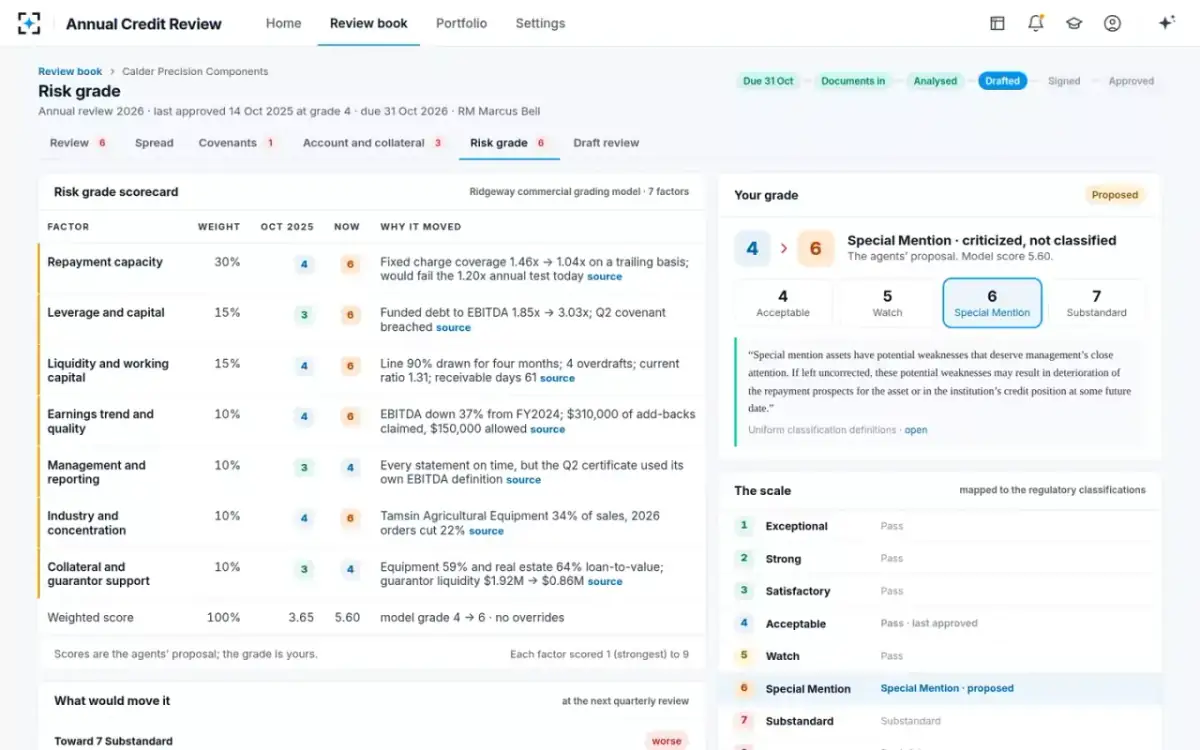
Three readings matter more than the totals. First, the downgrades are spread across every starting grade, from 2 to 6, which says the pressure is broad rather than confined to the weakest names. Second, five of the nine downgrades stay inside the pass grades (2 to 3, 3 to 4, 4 to 5), against three upgrades inside pass: by the OCC's matrix, that is the beginning of "starting to favor the lower or riskier pass ratings". Third, one move skips a grade. Calder Precision Components, a Dayton machining shop, goes from 4 Acceptable to 6 Special Mention in a single review, after a leverage covenant breach, a 37% fall in EBITDA and a revolver held at 90% for four month-ends.
Share of each starting grade the quarter's reviews propose to lower
How do you build a risk rating migration matrix?
Pick two dates, take every loan rated on the first, and record where each one stands on the second: in a grade, paid off, charged off or moved to nonaccrual. Count the cells by number of loans and again by dollars committed, then divide each row by its total to get the share of a starting grade that held, rose or fell. Those row shares are what the rating agencies publish for bonds as a credit transition matrix; a bank's own version uses its internal grades and its own borrowers.
Worked on the sample quarter, the grade 4 row reads: 19 loans, 1 rose to 3 (5%), 15 held (79%), 2 fell to 5 (11%) and 1 fell to 6 (5%). Repeated over several quarters, those shares become the bank's own estimate of how quickly a grade 4 credit tends to become a criticized one, which is the "velocity" the OCC asks banks to track. Adding exit columns for payoffs and charge-offs turns the same table into the "Default and loss history by rating category" on the OCC's list.
Five decisions that make a migration matrix honest
| Decision | The shortcut | The choice that holds up |
|---|---|---|
| Which loans | Whatever is on the books at the end date | Loans rated at the start date, followed to the end date; new loans reported separately |
| Exits | Loans that paid off or were charged off simply disappear | Separate columns for paid off, charged off and nonaccrual, so the worst outcomes stay in the count |
| Weighting | Count only, or dollars only | Both, as the OCC asks: one large account can swing a dollar view |
| Stale grades | A loan not reviewed in the window counts as held | Flag loans whose review is overdue; their place on the diagonal is unproven |
| Window | One quarter, read alone | Quarterly matrices plus a rolling twelve months, so a slow drift shows |
The scale has to be fine enough to show movement. Federal Reserve staff found that among large banks, "sixteen institutions, or 36 percent, assign half or more of their rated loans to a single risk grade" (Treacy and Carey, 1998). When half the book sits in one pass grade, most deterioration happens inside that grade and the matrix shows a calm diagonal until loans fall straight into special mention.
Five numbers from the matrix a board should see each quarter
A matrix is too detailed for a board pack; five numbers drawn from it are not. Each comes from the OCC's list, and each should be shown by count and by dollars, because the booklet warns that "some reports can be skewed by changes in one large account."
Migration measures worth reporting, and what each one catches
- Upgrades to downgrades
The sample quarter runs 4 to 9. A ratio that turns against you for two quarters is a trend, not noise.
- Double downgrades
Loans that fell two or more grades in one review. Each is a question about why the earlier review missed it.
- Pass-to-criticized moves
Loans crossing from pass into special mention or worse; three in the sample quarter, including the double downgrade.
- Seasoning
How long loans sit in one grade. A watch grade nobody leaves is a parking place, not a rating.
- Changes by officer and line of business
Downgrades concentrated in one lender's book, or found only by loan review, point to the grading, not the borrowers.
A grade can move a year before a payment is missed. Migration is the only credit signal a bank produces entirely by itself.
Why portfolio ratios hide what migration shows
Ratios have a denominator, and a growing book can hold a ratio down while the underlying credits get worse. The 2025 Shared National Credit review is the cleanest public example. The share of commitments rated special mention or classified fell to 8.6% from 9.1%, and the agencies said why: "The decline is primarily due to growth in new commitments rather than an underlying improvement in credit quality" (Federal Reserve, FDIC and OCC, January 2026). A migration count would not have been flattered by the new loans; it follows the same loans from one grade to the next.
The national backdrop: calm ratios, a slow drift
8.6%
of Shared National Credit commitments non-pass in 2025, down from 9.1% mainly because of new commitments
SNC review
1.81%
community-bank C&I past-due and nonaccrual rate, fourth quarter 2025, above the 1.62% pre-pandemic average
FDIC
0.96%
of C&I loans at all insured institutions noncurrent at June 30, 2026
FDIC QBP
Delinquency comes last for the same reason. A borrower can breach a leverage covenant, draw its line to the limit and lose a third of its EBITDA while paying every instalment on time; Calder made all 36 of its payments. The FDIC's community-bank C&I past-due rate rising above its pre-pandemic average (FDIC Risk Review 2026) is the late, aggregate version of a story that each bank's own migration tells earlier and loan by loan.
What are rating velocity and seasoning?
Velocity is how fast grades are changing, and seasoning is how long loans stay in one grade; the OCC lists both as measures a rating system's reports should produce. Velocity can be read as grade changes per loan over twelve months, or as the time a loan takes from its first downgrade to a criticized grade. Seasoning is the average time loans have sat in their current grade, measured from the date the grade was last changed or confirmed with fresh numbers.
The two catch different failures. Rising velocity with a steady upgrade-to-downgrade ratio says the book is becoming more volatile, and is worth explaining before it shows up in the downgrade count. Long seasoning in the watch grade says the grade has become a holding pen: the OCC's own definition of special mention describes a weakness that "may, if not checked or corrected, weaken the asset", which is a condition that should resolve one way or the other, not last for years. Seasoning measured from the last confirmation also exposes stale grades, because a loan whose grade has not been confirmed for eighteen months is not stable, it is unreviewed.
Migration analysis is only as early as the annual reviews behind it
A grade that should have moved in April and moved in October puts the move in the wrong quarter, and the matrix faithfully reports the wrong quarter. The OCC is explicit that ratings should "measure risk rather than record history", and that "the risk rating should be changed now when the borrower's risk of default increases rather than later when cash flow coverage becomes negative or when default occurs" (OCC, Rating Credit Risk). The 2026 booklet's postmortem list includes "Assessing the timeliness of risk-rating changes and problem loan identification".
Late annual reviews damage migration in two ways. Overdue reviews simply leave grades where they were, which shows up as false stability on the diagonal. And reviews done in a rush tend to roll last year's analysis forward, which does the same thing with a signature on it. Double downgrades are the visible symptom: a loan that falls two grades in one review was usually a one-grade move that nobody made at the time. That is why migration and review frequency belong in the same conversation, and why loan review's job of testing whether two reviewers would give the same grade matters to the matrix as well.
Seeing proposed migration in Annual Credit Review before grades are approved
The solution shows two versions of the book: grades as approved, and grades as this quarter's reviews propose them. The gap between them is migration in progress. On the sample bank, criticized commitments in grades 6 to 9 stand at $96.2 million as approved and $113.6 million with the proposals, 6.2% of commitments. The chief credit officer sees the $17.4 million of exposure heading into special mention or worse while the reviews are still being signed, not a quarter later.
Grades approved and proposed, overdue reviews and this quarter's migration
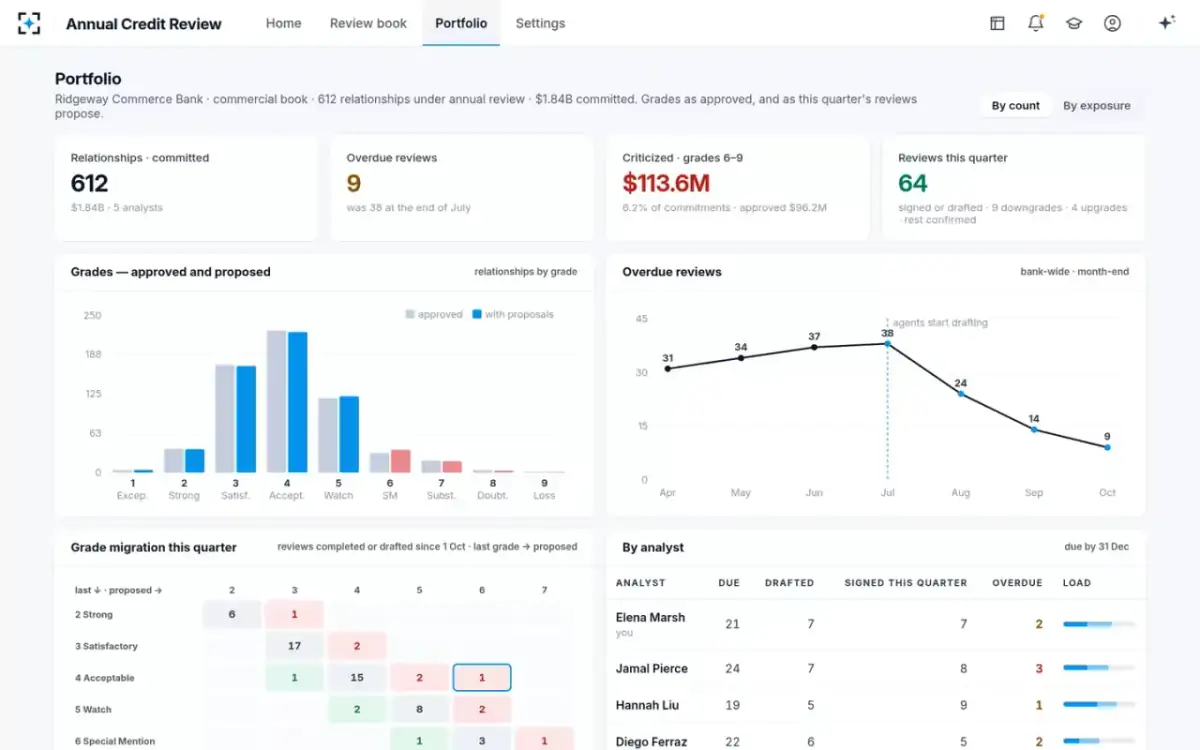
The highlighted cell is the double downgrade from 4 to 6: Calder Precision Components.
Each proposed move carries its reasons. The scorecard behind Calder's 4 to 6 sets the grading model's seven factors side by side for last October and now, from repayment capacity at 30% weight to collateral and guarantor support at 10%, quotes the special mention definition, and states what would move the loan to 7. The analyst decides the grade and a senior credit officer approves the change; the agents' scores are a proposal. For a migration report, that means every cell in the matrix can be opened to the review that put a loan there.
Why one loan moved two grades: the scorecard behind a double downgrade
Questions people ask
What is a double downgrade?
A loan whose grade falls by two or more steps in a single review. The OCC lists the volume of them as a standard risk rating report; at most banks each one deserves a short note on why the earlier review did not move it.
What is a credit transition matrix?
It is a migration matrix expressed as probabilities: each cell shows the share of loans starting in one grade that ended the period in another. Rating agencies publish them for corporate bonds; a bank builds its own from internal grades, and over several years the rows become its estimate of how likely each grade is to deteriorate or default.
Does grade migration affect the allowance for credit losses?
Yes, wherever the allowance uses risk grades as an input. The 2020 interagency guidance says periodic review "is particularly important to the estimation of ACLs or the ALLL because loss expectations may change as the credit quality of a loan changes". A migration that is late reaches the allowance late too.
How often should migration be reported to the board?
Quarterly is the natural rhythm: the 2020 guidance describes quarterly reporting of credit risk review results to the board, and the OCC's 2026 booklet lists rating migration among the risk-rating reports management should receive. Monthly views inside credit administration catch the drift sooner.
How many grades does a migration matrix need?
As many as the rating scale. Migration inside the pass grades only shows if the scale has several of them; Federal Reserve staff found the median large bank used five pass grades, including watch (Treacy and Carey, 1998).
Should migration use approved or proposed grades?
Report approved grades to the board, and watch proposed grades inside credit. The proposed view is earlier; the approved view is the one that has been checked. The Annual Credit Review page shows both on the same book.