Independent loan review does not require a loan review department. A small bank can meet the 2020 Interagency Guidance on Credit Risk Review Systems with the people it has, because the guidance lets it use "qualified members of the staff, including loan officers, other officers, or directors, who are not involved with originating or approving the specific credits being assessed and whose compensation is not influenced by the assigned risk ratings." In many community banks that means the chief credit officer, perhaps one analyst, a committee of outside directors and an outside firm once a year. The same people also carry the annual credit reviews of every commercial relationship, which is where their time goes. Botminds' Annual Credit Review is built for that second job: its agents assemble and draft each annual review so the few people the bank has can spend their hours on judgment, and on the independent testing the guidance asks of them.
The same loan review duty, carried by four roles at a small bank
Today
Approves the larger loans, signs grade changes, writes the loan review plan and reviews the credits nobody else may touch. Annual reviews pile onto the same calendar.
With agents
Receives annual reviews already assembled, with each change since approval cited. Approves grade changes from one screen and spends the saved days on the review plan.
Still theirs: Every grade change and covenant exception, and any review of a loan the CCO did not approve.
Today
Spreads statements, re-tests covenants, chases missing certificates and writes the annual reviews, about two days each by our estimate.
With agents
Opens each review with this year's column filled and judges only the lines that moved; a stable credit clears in minutes.
Still theirs: The confirm-or-challenge call on each line, and the signature.
Today
Grades the loans they made and feeds the analyst whatever the borrower sends.
With agents
Gets the covenant breach, line usage and lapsed insurance on the review before the borrower calls.
Still theirs: The relationship and the conversation; never a review of their own loans.
Today
Sample the portfolio once a year and test grades against thin files.
With agents
Sample reviews where every number links to its source page and every challenge is kept.
Still theirs: The independent opinion on grades, reported to the board.
What the interagency guidance lets a small bank do
It lets a small bank build independence out of the people it has, as long as those people are independent of the specific loans they test. The guidance says the nature of a review system "varies based on an institution's size, complexity, loan types, risk profile, and risk management practices", and that "in smaller or less complex institutions, a credit risk review system may include qualified members of the staff, including loan officers, other officers, or directors, who are independent of the credits being assessed" (Interagency Guidance on Credit Risk Review Systems).
Footnote 6 adds the condition that keeps the arrangement honest: "It is appropriate to employ such modified procedures when more robust procedures and methods are impractical", and management and the board "should have reasonable confidence that the personnel chosen will be able to conduct reviews with the needed independence despite their position within the loan function." The guidance also says where the function should answer: "it is prudent for the credit risk review function to report directly to the institution's board of directors or a committee thereof", with senior management handling administration only so long as that "does not compromise the independence of the credit risk review function".
Most U.S. banks are small, and lean on very few credit people
3,818
community banks at June 30, 2026, out of 4,238 FDIC-insured institutions
12.1%
of community banks' loan books are commercial and industrial loans
76%
of small banks involve an executive in decisions on small business loans
1.81%
community-bank C&I past-due and nonaccrual rate at year-end 2025, above the 1.62% pre-pandemic average
The approval structure explains the strain. The FDIC's survey found that "76 percent of small banks involve an executive in decision-making for small business loans", and that at 73% of banks the highest approval route has three or more levels, 41% exactly three (FDIC Small Business Lending Survey, section 3). At a small bank those levels are often the same few senior people, so the person most qualified to review a commercial credit has often approved it. That is the case the independence rule is written for.
What does independent loan review mean? Nobody grades their own loans
Independence is defined loan by loan, not person by person. The guidance says it "is achieved when personnel who perform the loan review do not have control over the loan and are not part of or influenced by individuals associated with the loan approval process." A chief credit officer can review a lender's loans; the same officer cannot review a loan they approved. A lender may sit on the review committee for every loan except their own.
The reason is incentive, and the regulators say so directly. The OCC's rating booklet notes that loan officers' "incentives are frequently geared more toward producing loans than rating them accurately", and warns that "it can be relatively easy for loan officers and line managers to rate credits a step, or more, above what they deserve" (OCC, Rating Credit Risk). Federal Reserve staff found the same structure at large banks: "All institutions evaluate the performance of RMs—and thus set their compensation—on the basis of the profitability of the relationships in question" (Treacy and Carey, 1998). Compensation is the second half of the small-bank test: a reviewer's pay may not be "influenced by the assigned risk ratings."
A chief credit officer can review a lender's loans. The same officer cannot review a loan they approved.
The practical consequence is a conflicts map. Before the review plan is written, list each commercial relationship with its originating lender and its approver, and assign every loan in the sample to someone who is neither. Loans approved by the chief credit officer, which at a small bank are often the largest, go to the outside directors or the outside firm. That single list is what an examiner will ask to see when testing independence.
How much of the loan portfolio should loan review cover?
Enough to cover every segment that carries significant risk, chosen by rule; the guidance sets no percentage. The scope is risk-based, so a small function covers it by choosing well, not by reading everything. The guidance's list is short: "Loans over a predetermined size; A sufficient sample of smaller loans, new loans, and new loan products; Loans with higher risk indicators … or those credits approved as exceptions to policy; … Segments of the loan portfolio experiencing rapid growth", together with renewed and restructured loans, criticized loans, insider loans and concentrations. Each line can be met with a rule a two-person function can run.
The guidance's scope, and how a one- or two-person function can cover it
| Scope item (2020 guidance) | A workable rule for a small bank | Who reviews |
|---|---|---|
| Loans over a predetermined size | Every relationship above a threshold set by the board, each year | CCO, or outside firm where the CCO approved |
| A sample of smaller and new loans | A fixed number drawn each quarter, new loans first | Credit analyst, never on loans they spread for approval |
| Higher risk indicators and policy exceptions | Every loan approved as an exception, and every loan with a covenant breach since approval | CCO or outside directors |
| Rapid-growth segments | An extra sample from any segment that grew faster than the book | Outside firm |
| Past due, nonaccrual, renewed and restructured loans | Every renewal without principal reduction and every modification | CCO, or outside directors where the CCO approved |
| Criticized and previously classified loans | Every grade 6 and worse, on its quarterly cycle | CCO with the committee |
| Insiders, affiliates, concentrations | All of them, each year | Outside directors or outside firm |
Reporting is the other fixed cost. The guidance expects the function to prepare "a list of all loans (and portfolio segments) reviewed, the date of review, and a summary analysis that substantiates the risk ratings assigned", and describes giving results to the board or a committee "quarterly" as typical. For a one-person function that list is worth keeping as it goes, not assembling in the week before the board meeting.
Can a small bank outsource loan review?
Yes, in whole or in part. One workable arrangement is a hybrid: an outside firm samples the portfolio once or twice a year and an internal reviewer or committee covers the quarters between. The guidance allows the board to "outsource the credit risk review function to an independent third party", but "the responsibility for maintaining a sound credit risk review system remains with the institution's board of directors", and even then "institution personnel who are independent from the lending function typically assess risks, develop the credit risk review plan, and verify appropriate follow-up of findings". Hiring the bank's own external auditor for the work "may raise additional independence considerations".
The engagement is a third-party relationship like any other. The agencies' 2023 guidance, still in force, says that using a third party "does not diminish or remove" the bank's responsibility for doing the activity safely (Interagency Guidance on Third-Party Relationships). The agencies proposed in September 2026 to rescind and replace that guidance, with comments due by 16 November; until a final version appears, the 2023 text applies. In practice the engagement letter should fix four things: the scope the board approved, the reviewers' qualifications, the format of the findings, and who inside the bank tracks each finding to closure.
Examiners look at the arrangement itself. The OCC's 2026 booklet notes that "High levels of credit risk review staff turnover or changes in third-party credit review firms may warrant a deeper review by examiners." A bank that changes firms every year to get a softer opinion should expect that question.
Where a small team's hours really go: the annual credit reviews
The independent sample is rarely what overwhelms a small credit department. The annual reviews are. The OCC expects all credits to get "a formal review at least annually", with "Large credits, new credits, higher risk pass and problem credits, and complex credits" reviewed more often (OCC, Rating Credit Risk). Each of those reviews means chasing statements, spreading them, re-testing covenants and writing up the grade.
Our estimate for an ordinary relationship done by hand is sixteen hours, about two working days. At that rate a bank with 150 commercial relationships spends some 2,400 hours a year on annual reviews alone, more than one full-time analyst before a single loan has been independently tested (our arithmetic, at 2,080 working hours a year). When the same two people also run loan review, the annual reviews win the calendar and the review plan slips. Examiners notice: the OCC's 2026 procedures tell them to "Determine the cause of reviews that are behind schedule, have been postponed, or were canceled" (OCC, Lending and Loan Portfolio Risk Management). How long a commercial loan annual review takes breaks the sixteen hours down.
What Annual Credit Review changes for a small credit department
It moves the assembly out of the small team's week and leaves every decision with the people who own it. The agents collect the year's documents against the agreement's reporting clause, spread them and tie revenue to the tax return, recompute covenants by the agreement, check account behaviour, collateral and guarantors, and draft the review with a proposed grade. The analyst confirms or challenges each line that moved and signs. A grade change or covenant exception goes to a second approver, and classified grades can be routed on to the chief credit officer.
Who approves what is a setting, so the conflicts map can live in the tool
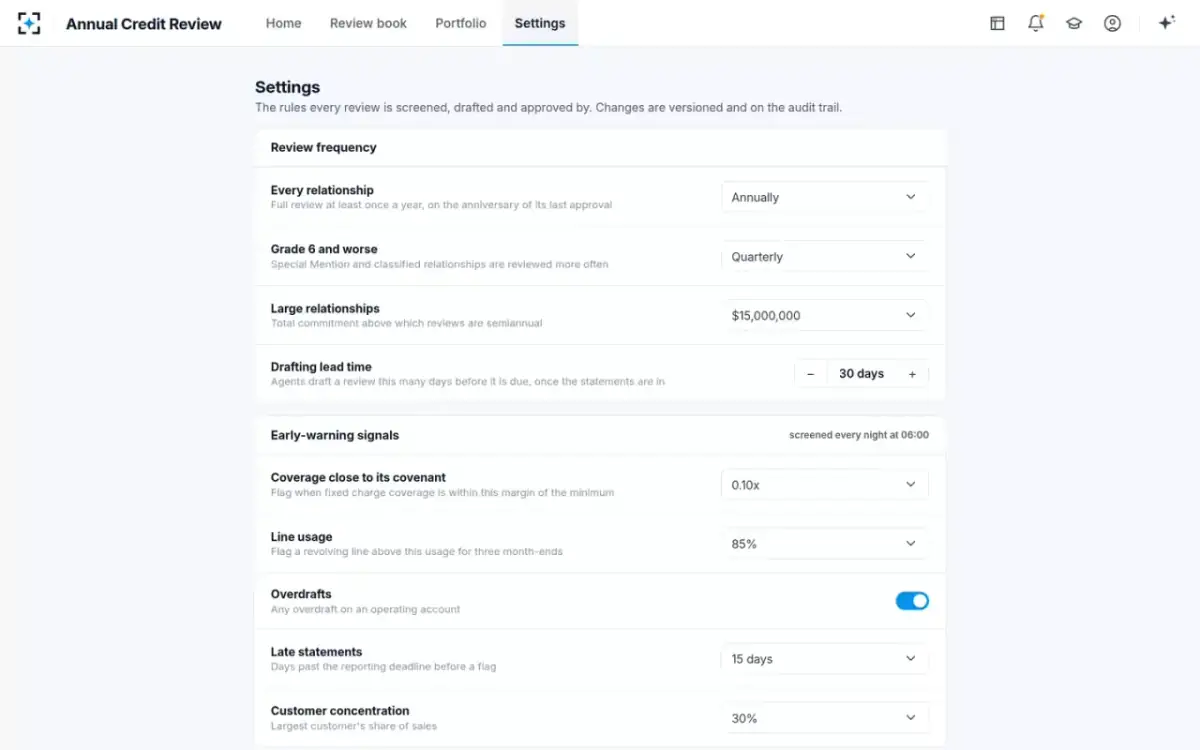
A small bank can set the approver for grade changes so that a loan's own approver never signs off its regrade.
For the independent side, the gain is evidence. An outside director or a review firm sampling a loan sees last year's approved numbers beside this year's, the page each figure came from, any line the analyst challenged and the answer, and the time each signature was made. That is the material needed to test the guidance's last depth item, "the accuracy of risk ratings and the appropriateness and timeliness of the identification of problem loans". It does not make the agents a loan review function; they work for the line, and the guidance's independence test applies to people. Annual credit review vs loan review sets out where one ends and the other begins.
A grade change signed by the analyst and approved by someone else
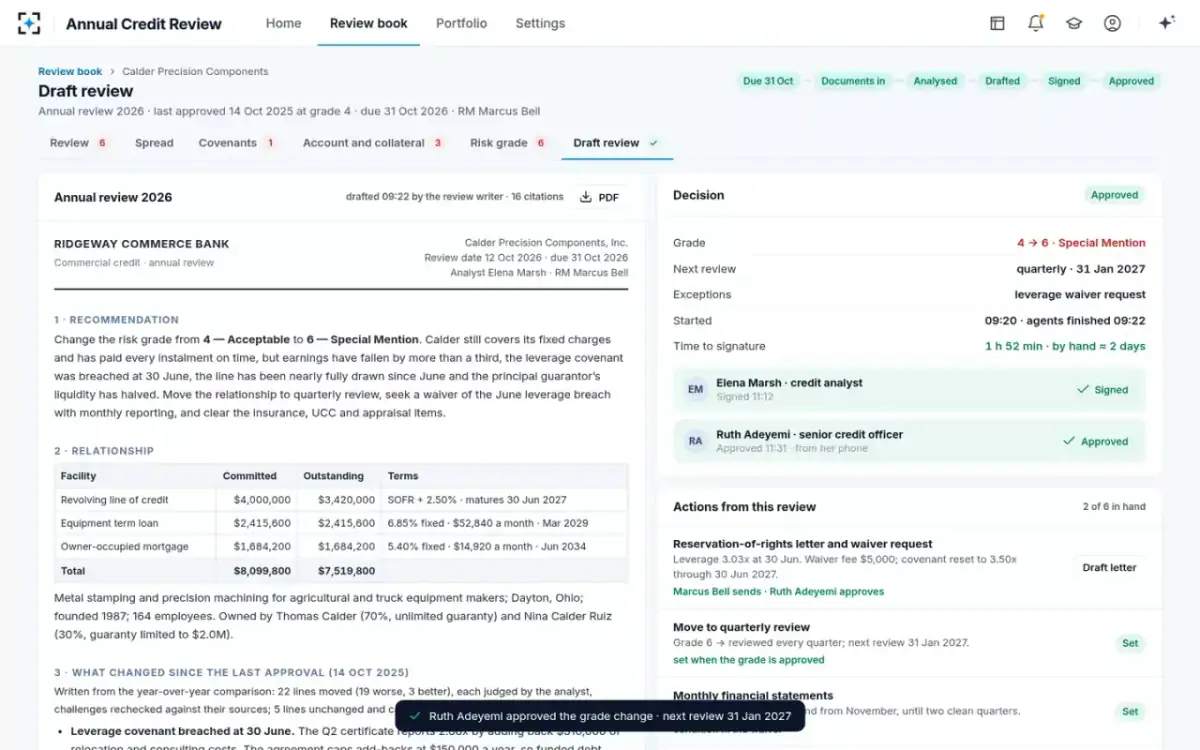
How examiners test a small bank's independent loan review
They re-grade some of the same loans and compare. The OCC's 2026 booklet calls "Comparing results of the OCC's transaction testing with independent credit risk review findings" a "common way that examiners test the reliability of credit risk review's work", and when examiners find "risk-rating or credit administration concerns that credit risk review did not identify", they look for the root cause in the review function itself (OCC, Lending and Loan Portfolio Risk Management). A review function that examiners trust earns a lighter touch: they "may use conclusions from independent credit risk reviews the OCC has determined are satisfactory when determining the scope" of their own work.
The booklet's procedures apply "regardless of whether reviews are performed in-house or outsourced to a third party", and they are a usable self-test for a one-person function. Step one is the independence question in the guidance's words. Step three weighs staffing against "the size, complexity, and risk profile of the loan portfolio", including turnover and "formal credit training". Step four's scope list goes further than the 2020 guidance in two places a small bank tends to skip: "low-grade pass loans" and "recently upgraded loans". Both are where a grade that is a step too generous hides, and both are cheap to add to the sample.
What a one-person function can drop, and what it cannot
The guidance is flexible on structure and fixed on a few outcomes. Those outcomes are the checklist a small bank's chief credit officer can hold the function to.
Loan review at a small bank: the parts that cannot be scaled down
- A written policy the board approves
The guidance describes it as reviewed and typically approved at least annually, with the scope approved each year.
- No reviewer on their own loans
Keep the originator-and-approver list current, and send the CCO's own approvals to outside directors or a firm.
- Pay not tied to grades
Anyone reviewing may not have compensation influenced by the ratings assigned.
- A risk-based sample, not a convenient one
Exceptions, renewals without paydown and criticized loans every time; smaller loans by rule.
- Disputes settled by a set process
The lower grade typically stands unless the line brings information the reviewer accepts.
- Quarterly reporting to the board
A list of loans reviewed, dates and a summary that supports each grade, plus trends.
- Annual reviews that are current
The independent function tests the line's grades; if the annual reviews are a year stale, there is nothing sound to test.
Questions people ask
Can a loan officer review their own loans?
Not as loan review. A loan officer can and should update the grade on their own loans whenever new information arrives, and the OCC expects that. The independent review of the same loan must be done by someone who did not originate or approve it.
Can a small bank use its directors for loan review?
Yes. The guidance names "an independent committee of outside directors" as one option for smaller institutions, provided they are qualified and independent of the loans they review.
What is the Interagency Guidance on Credit Risk Review Systems?
It is the June 2020 guidance from the OCC, Federal Reserve, FDIC and NCUA that sets out what a sound loan review system looks like: a board-approved policy, qualified and independent reviewers, risk-based frequency, scope and depth, a set process for rating disputes, and reporting to the board. It replaced Attachment 1 of the 2006 policy statement on the allowance for loan and lease losses, and the OCC's 2026 lending booklet still cites it as current.
Should loan review sample pass-rated loans?
Yes. The guidance asks for "a sufficient sample of smaller loans, new loans, and new loan products", and the OCC's 2026 procedures add "low-grade pass loans" and "recently upgraded loans" to the scope. A sample made only of criticized credits tests the workout team, not the grades the line set on everything else.
How often should a small bank's loan review report to the board?
The guidance describes quarterly reporting as typical, and more often when material adverse trends appear. How the line's own review cycle can be set by risk is covered in how often to review commercial loans; the solution itself is on the Annual Credit Review page.