An ordinary commercial loan annual review takes about sixteen hours of a credit analyst's time when it is done by hand, by our estimate, and a complex relationship takes much longer. Twelve of the sixteen go on collecting statements, spreading them, re-testing covenants and checking accounts, collateral and guarantors; four go on writing the review and deciding the grade. At the national mean wage for credit analysts, loaded for benefits, that is roughly $1,100 per review, and across a book of 612 relationships about $678,000 a year before a single quarterly review of a criticized credit. No regulator or academic study publishes hours per annual review, so this page shows the method and our estimate side by side; the inputs are the bank's to replace. Botminds' Annual Credit Review is designed to take the assembly hours, which leaves about two hours of judgment on an ordinary review and minutes on a stable one.
Where sixteen hours go in one ordinary annual review, by hand (our estimate)
How long does a commercial loan review take, and why is there no benchmark?
About two working days for an ordinary relationship by our estimate, and it depends on the relationship more than on the bank, which is one reason no public benchmark exists. A single borrower with reviewed statements, one line and one guarantor is a small job beside a group with several entities, pass-through returns, a borrowing base and three guarantors, which can take several times as long. We found no regulator, academic or non-profit source that measures it, and vendor figures are not evidence. The sixteen hours here are the solution's estimate for an ordinary relationship, and the first thing a bank should do is replace them with its own.
The fastest way to get a baseline is to time ten reviews by section. Ask analysts to log start and stop times for five blocks: chasing documents, spreading and tie-out, covenants, accounts, collateral and guarantors, and writing with the grade. Ten reviews across simple and complex relationships give a usable average and, more usefully, show which section varies most. In most books that is chasing documents, because it depends on the borrower.
Three jobs inside one review: collect, re-test, judge
The sections group into three jobs, and they have different economics. Collecting is waiting and asking. Re-spreading and re-testing is careful arithmetic on documents, with a right answer the documents settle. Judging is reading the result, deciding the grade and writing down why. The regulators' description of what credit analysis is for points at the third: "Financial statement analysis is central to appraising the likely adequacy of future cash flow and thus the ability of the borrower to service its debt" (Treacy and Carey, 1998). The first two jobs exist to make that possible.
Assembly is three-quarters of an annual review done by hand (our estimate)
By hand · 16 h
- Collect · 3 h · 18.75%
- Re-spread and re-test · 9 h · 56.25%
- Judge and write · 4 h · 25%
With agents · 2 h
- Collect · 15 min · 13%
- Check the re-test · 1 h · 50%
- Judge and write · 45 min · 37%
A sixteen-hour review spends four hours on the part only a person can do. The other twelve are the price of getting there.
What does a commercial credit analyst earn, fully loaded?
About $69 an hour once benefits are added to the national mean wage, by our arithmetic on BLS data. The BLS publishes the inputs. Credit analysts, occupation 13-2041, earned a national mean wage of $100,850 in May 2025, with a median of $83,510, across 64,390 jobs (BLS, OEWS). That category includes consumer and other credit analysts as well as commercial ones, so a bank should use its own payroll if it can. Wages are not the whole cost: in June 2026, wages and salaries "accounted for 70.0 percent of employer costs" in private industry, the rest being benefits and other compensation (BLS, Employer Costs for Employee Compensation).
An analyst hour, priced from BLS data (our arithmetic)
$100,850
mean annual wage, credit analysts, May 2025
BLS OEWS
$48.49
per hour at 2,080 paid hours a year
our arithmetic
70.0%
share of private-industry employer costs paid as wages and salaries, June 2026
BLS ECEC
$69.27
loaded cost of an analyst hour: $48.49 ÷ 0.70
our arithmetic
At $69.27 an hour, sixteen hours is $1,108 per review and two hours is $139. The loaded rate leaves out overhead such as space and systems, and it uses the mean, which is above the median; both choices are easy to change, and a bank's own figures will be better than either.
How many credit analysts does a bank need for its annual reviews?
Divide the book's review hours by the hours an analyst actually has for reviews. Multiply first by the book. Take the sample bank in Annual Credit Review, fictional Ridgeway Commerce Bank, with 612 commercial relationships under annual review and five analysts. One review per relationship per year at sixteen hours is 9,792 hours, or 4.7 full-time analysts at 2,080 hours each: nearly the whole team, before the quarterly reviews its policy requires for every relationship graded 6 or worse, and before any new lending.
Annual analyst cost of one review per relationship, 612 relationships (our arithmetic)
| Hours per review | Analyst hours a year | Full-time analysts | Loaded cost a year |
|---|---|---|---|
| 12 h by hand | 7,344 | 3.5 | $508,700 |
| 16 h by hand (our estimate) | 9,792 | 4.7 | $678,200 |
| 24 h by hand | 14,688 | 7.1 | $1,017,400 |
| 2 h with agents drafting | 1,224 | 0.6 | $84,800 |
The point of the table is not the dollar figure, which depends on inputs a bank can measure better than we can. It is the ratio. At sixteen hours a review, the annual reviews alone absorb most of the analysts a bank of this size employs. That is why reviews pile up, why teams roll last year's analysis forward, and why the OCC's 2026 procedures ask whether annual reviews are completed "in a timely manner" (OCC, Lending and Loan Portfolio Risk Management). The sample bank's backlog shows what that looks like month by month.
How many annual reviews can one credit analyst do in a year?
At sixteen hours a review, about 65 if half the analyst's year goes to annual reviews, and about 130 if all of it does, which no analyst's year allows (our arithmetic on 2,080 hours). The sample bank shows how tight that is. Its 612 relationships across five analysts come to about 122 annual reviews each, or some 1,960 hours, 94% of a full year, before quarterly reviews of criticized credits, new deals and renewals.
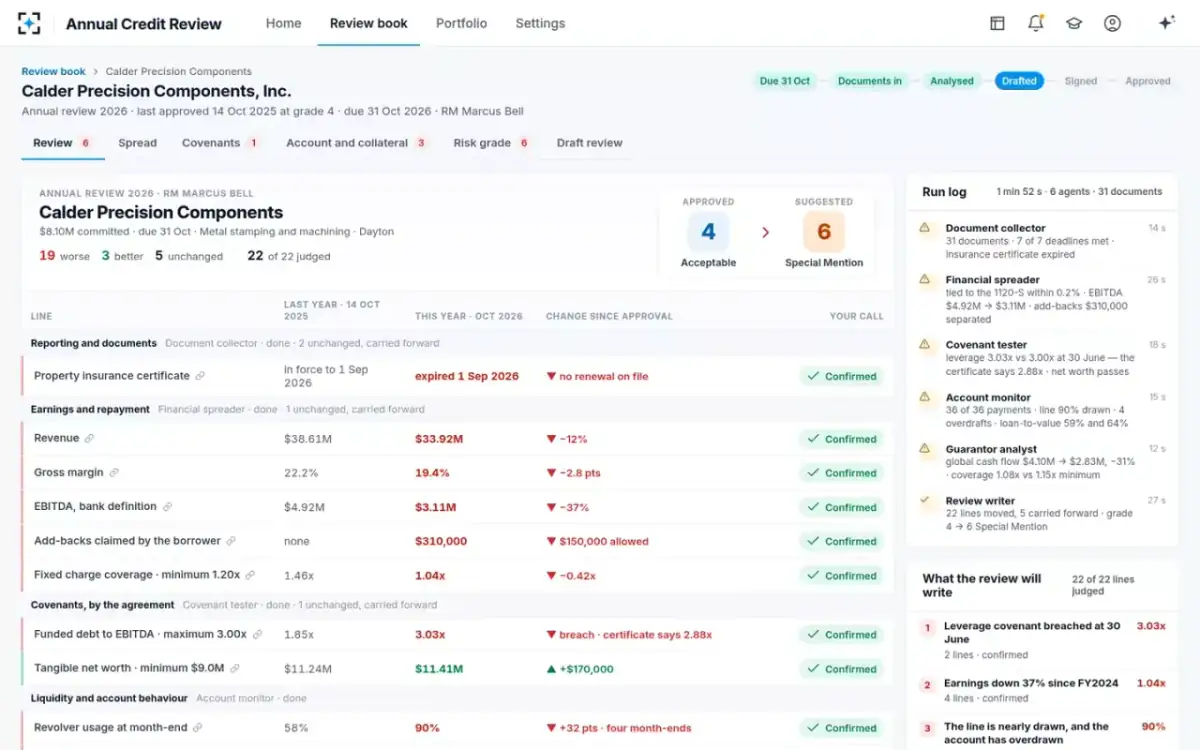
Capacity is the wrong unit once the assembly moves, because the time per review stops being roughly constant. On the sample bank, Elena Marsh's six reviews that moved need 3 hours 50 minutes of her time in all and her two stable ones 11 minutes. Calder Precision Components, with three facilities, two guarantors, a borrowing base and 22 lines that moved, took 1 hour 52 minutes from opening to signature. Oakmere Dental Partners, where one line moved, took six. The hours follow what changed in the borrower, not the size of the relationship, so a book's capacity depends on how many of its credits moved that year.
That changes the staffing question a chief credit officer asks. By hand, the answer is a headcount, sized for the year's review count. With the assembly done for them, it is a judgment budget, sized for the number of relationships likely to move in a bad year, which is exactly when a bank needs its senior analysts free. How often to review commercial loans covers the policy side of the same trade-off.
Where the saved hours come from: stable credits and the ones that moved
Most of the saving comes from credits where little changed, because by hand they cost nearly as much as the hard ones. Take the eight reviews ready in Elena Marsh's queue on the sample bank. By hand, at the solution's estimate, they come to about sixteen working days, some 128 hours. With the agents drafting, the six that moved need 3 hours 50 minutes of her time and the two stable ones 11 minutes, about four hours in all (our arithmetic on the sample figures).
The two kinds of saving are worth different things. On a stable credit, nearly all of a day or two of assembly turns into minutes of confirmation, which is pure capacity. On a credit that moved, the saving is calendar time: Calder's downgrade was drafted, judged, signed and approved on the morning it was opened, instead of waiting its turn in a due-date queue. The first kind is easy to price with the formula below. The second is the one a chief credit officer will care about more, because it decides how early the bank acts.
A return on Annual Credit Review you can fill in with your own numbers
The return has two gains a bank can price and two costs it must count. The gains are the hours released and the reviews completed on time; the costs are the subscription and the time people spend checking the agents' work. A third gain, grades that move when they should, is real and hard to price, so it is listed rather than added in.
The annual return on moving review assembly to agents
Hours released
(hours by hand − hours with agents) × reviews a year × loaded hourly cost
Measure both hour figures on your own reviews; count quarterly and interim reviews too.
Credit administration
Reviews on time
overdue reviews avoided × cost of clearing each by overtime or contract help
Use what the bank last paid to clear a backlog, if it did.
Chief credit officer
Subscription and set-up
annual price + one-time set-up spread over the contract
Finance
Oversight
hours spent sampling and checking agent output × loaded hourly cost
Include loan review's time on the new evidence trail.
Loan review
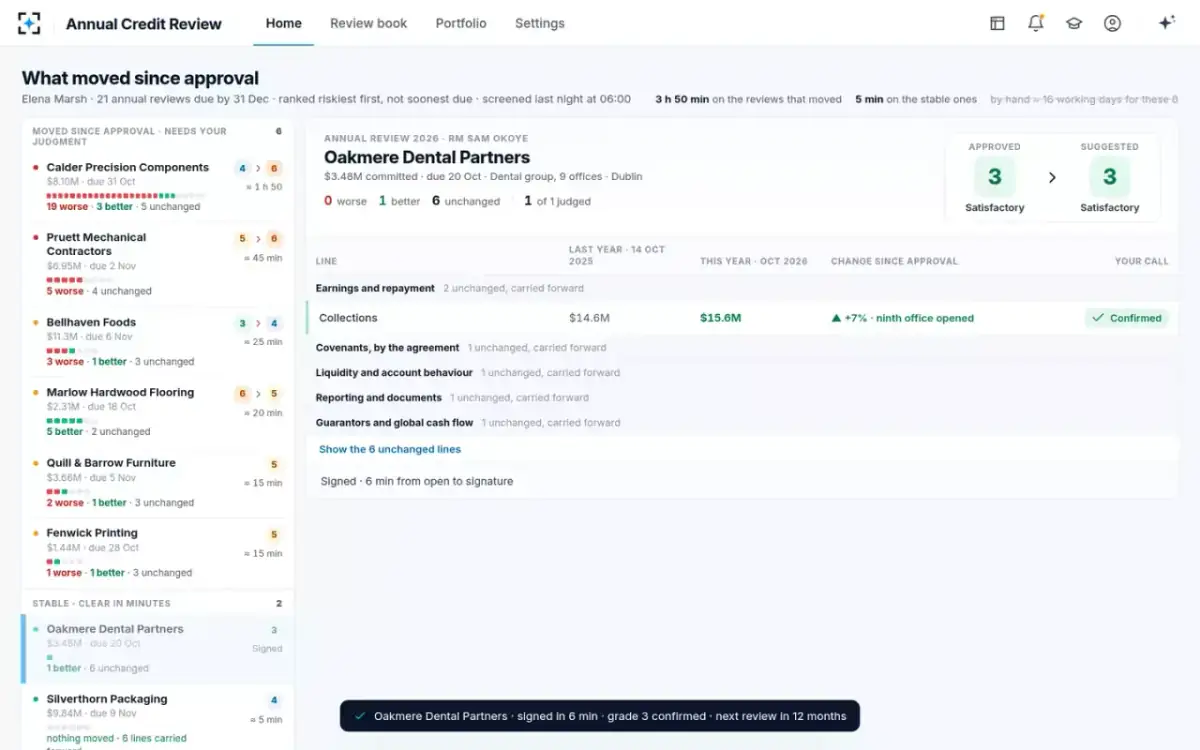
Two cautions keep the result honest. The hours-with-agents figure must include the analyst's time confirming and challenging the agents' lines, not just the time to sign; the solution's estimate of about two hours already does. And the released hours only count if they go somewhere: to the review plan, to new lending, or to the loans that moved. Stable credits are where the difference is largest. In the sample bank, Oakmere Dental Partners, which moved on one line, was signed in six minutes; the solution's design target for a stable credit is about six minutes.
A stable credit cleared in six minutes, its unchanged lines carried forward
What the hours do not show: the grade, and when it moves
An hours model treats every review as a cost. The reason banks do annual reviews is the grade, and the value of a review is that the grade moves when the borrower does. The OCC wants risk ratings to "measure risk rather than record history" (OCC, Rating Credit Risk); the Federal Reserve wants the annual review to include "a reassessment of the appropriateness of credit lines" (Commercial Bank Examination Manual). Neither shows up in a cost per review, and both are what a backlog sacrifices first.
So the return worth presenting to a board is two numbers and a sentence: the hours released, the cost, and what the bank will do with the time. The run log below is where the hours go instead.
Six agents' work on one review in under two minutes
Questions people ask
Can an annual review take less time without automation?
Yes, within limits. Carrying forward unchanged sections with their sources, a template that follows the order of the grading model, and using the OCC's allowance that "smaller, performing credits may be excluded from periodic reviews and reviewed as exceptions" all cut hours. None of them removes the spreading and covenant re-test on a credit that moved.
Should the cost include the approver's and relationship manager's time?
Yes, if the bank wants the full cost of a review rather than the analyst's share. Time the senior credit officer's approval and the relationship manager's document chasing separately; on the sample bank the approval of Calder's downgrade came 19 minutes after the analyst signed, but elapsed time is not effort, so measure both.
Are quarterly reviews of criticized loans included in these figures?
No. Each relationship on a quarterly cycle adds three interim reviews a year on top of the annual one. Time a few of them separately; they may be narrower, but they fall on exactly the credits that need the most judgment.
Which part of the review costs the most?
Spreading with the tax-return tie-out, and chasing documents, in our estimate. Chasing varies most from borrower to borrower. AI credit review, task by task, shows who does each part with the solution.
How should a bank test the estimate?
On its own completed reviews, before committing. Re-running last year's reviews describes a pilot that measures hours and grades together; the Annual Credit Review page shows a full review.