In the meaning banks and examiners give it, an annual credit review is the yearly re-underwriting of a commercial borrower by the people who manage the loan: new financial statements and tax returns are spread, every covenant is re-tested, account behaviour, collateral and guarantors are looked at again, and the analyst either confirms the risk grade or changes it. Loan review, which the regulators call credit risk review, is a separate function that samples those loans and tests whether the grades are right. The confusion matters because the two are held to different standards. The OCC's 2026 lending booklet draws the line explicitly, and Botminds' Annual Credit Review is built for the first job, the line's own review, so that the second has something sound to test.
The work is hard for an ordinary reason: every relationship comes due once a year, and the assembly of statements, certificates, spreads and covenant arithmetic crowds out the judgment. When it slips, grades go stale, and a stale grade is exactly what loan review and examiners are looking for.
Two reviews of the same loan, with different owners and purposes
Annual credit review: The credit analyst and the relationship manager, with the approver who signs a grade change.
Credit risk review (loan review): People with no control over the loan and no part in approving it: a review department, qualified staff, outside directors or an outside firm.
Annual credit review: Every commercial relationship, at least once a year or at renewal.
Credit risk review (loan review): A risk-based selection: large loans, a sample of smaller and new ones, exceptions, fast-growing segments, criticized and renewed loans.
Annual credit review: What changed since the last approval, and is the grade still right?
Credit risk review (loan review): Are the line's grades accurate and timely, and is the process that sets them working?
Annual credit review: A signed review: refreshed spread, covenant results, the grade confirmed or changed, actions on the line.
Credit risk review (loan review): A list of loans reviewed with dates and a summary that substantiates each grade, findings, and a report to the board.
Annual credit review: Credit administration and the lending chain of approval.
Credit risk review (loan review): Typically the board or a board committee, directly.
The annual credit review is the lending side's job; loan review checks it
The annual review belongs to the line. The Federal Reserve's examination manual asks that a bank's lending policy include "the requirement for an annual review of borrowers, including a reassessment of the appropriateness of credit lines" (Commercial Bank Examination Manual §2010.1). The OCC's rating booklet puts it as a duty of whoever rates the loan: "All credits should receive a formal review at least annually to ensure that risk ratings are accurate and up-to-date" (Rating Credit Risk).
The interagency guidance of June 2020 says the same thing from the other side. An effective rating framework "generally places primary reliance on the lending staff to assign accurate and timely risk ratings and identify emerging loan problems", and then subjects their grades to review by people who are independent of them (Interagency Guidance on Credit Risk Review Systems). The order is the point: the line grades first, and loan review tests what the line produced.
The 2026 OCC booklet that replaced "Loan Portfolio Management" is the clearest text on the split. Its credit risk review section "focuses on independent credit risk review (i.e., credit risk reviews independent of loan officers and loan production staff)", and sends readers looking for "risk-rating reviews performed by loan officers (e.g., annual commercial credit reviews)" to a different section of the booklet (OCC, Lending and Loan Portfolio Risk Management). Examiners ask about each separately. For the annual review the procedure is blunt: "Does the bank complete annual reviews of commercial loans in a timely manner?"
What is included in an annual credit review?
A complete annual review re-asks every question underwriting asked, with a year of evidence. The safety and soundness guidelines frame the underwriting questions as the borrower's "overall financial condition and resources, the financial responsibility of any guarantor, the nature and value of any underlying collateral, and the borrower's character and willingness to repay" (12 CFR part 30, appendix A). The annual review answers them again, and adds what only a year of history can show: how the loan actually behaved.
What an annual credit review re-tests, line by line
- Reporting
Every statement, tax return, compliance certificate and borrowing base the agreement requires, received and on time. Stale statements are an administrative exception in the OCC's scheme.
- Earnings and repayment
The new year spread beside last year's, revenue tied to the tax return, the bank's own EBITDA definition, fixed charge or debt service coverage.
- Covenants
Each financial covenant recomputed by the agreement's definitions and amendments, not by the borrower's certificate. A breach is a financial exception even if waived.
- Account behaviour
Payments, overdrafts, line usage and borrowing base availability over twelve months.
- Collateral
Loan-to-value, appraisal or evaluation age, insurance in force, UCC financing statements and their lapse dates.
- Guarantors
Personal statements and returns for liquidity and contingent liabilities, and global debt service coverage across borrower and guarantors.
- The grade and the line
The risk grade confirmed or changed with reasons, the line reassessed, and the actions that follow: waivers, more frequent reporting, a shorter review cycle.
In practice the review is written as a comparison: last year's approval on one side, this year's evidence on the other, and the analyst's judgment on what moved. That framing matters for the next section, because it is also what loan review will read.
An annual credit review laid out as what moved since approval
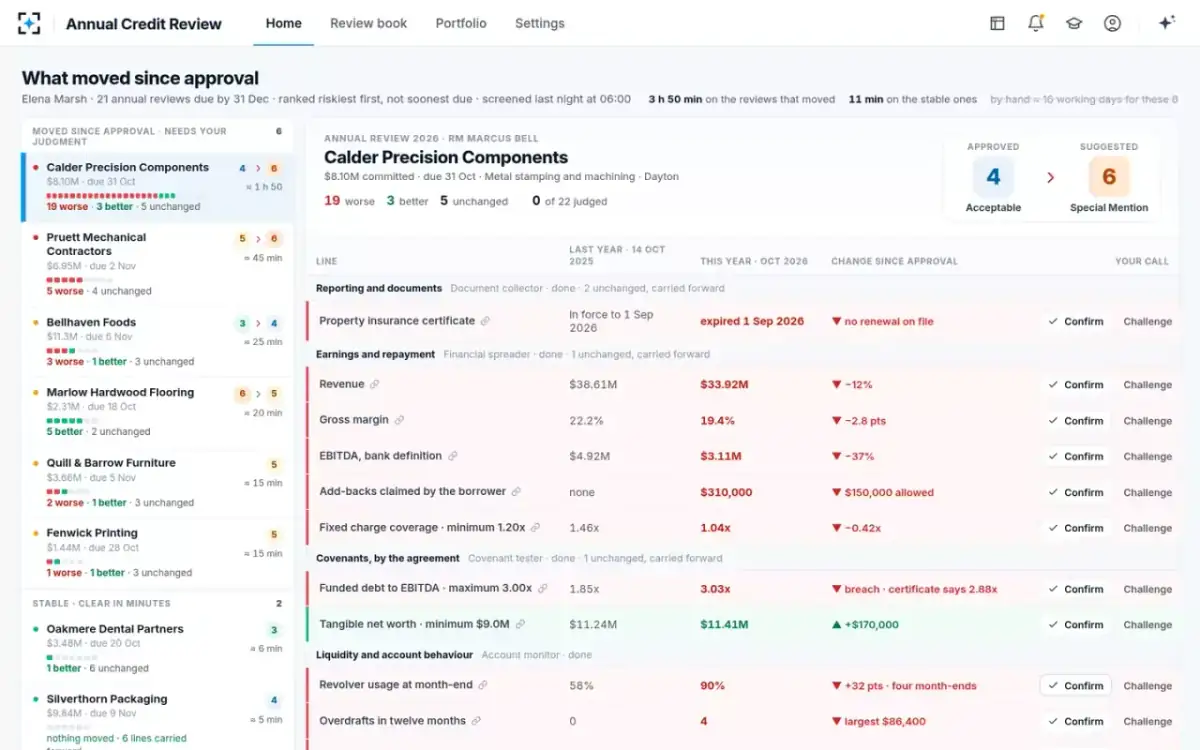
The left column is what loan review will test against: the grade the bank last approved and the numbers it rested on.
The annual credit review process runs on a tickler
The process starts before any statement arrives, with a system that knows what each borrower owes the bank and when. The Federal Reserve's manual says the bank "should also implement a file documentation tickler system to help bank personnel obtain updated information on borrowers, thereby facilitating continuous assessment and monitoring of credit risk" (§2010.1). The OCC's 2026 examination questions put the same duty first in line: "Does the bank have a system to monitor the timely submission of commercial borrower and guarantor financial statements and other items required in the bank's loan agreements?"
What the tickler asks for is set by two documents. The lending policy defines "the financial-statement requirements for businesses and individuals at various borrowing levels", from audited statements to interim balance sheets, and the loan agreement's reporting clause turns that into dates the borrower signed up to. A review cannot be better than the file behind it, and the manual names what that file must show: the borrower's business, its "past and current financial condition", the purpose and repayment source of every loan, and the collateral with "its value and the source of the valuation".
From there the sequence is the same at most banks, whatever the template looks like. Statements and returns come in and are spread; covenants are recomputed; the twelve months of account history, collateral and guarantors are read; the analyst writes the comparison and proposes a grade; an approver signs any change; and the line is reassessed, which is why the Fed's wording ties the annual review to "the appropriateness of credit lines". The step that slips is nearly always the first one. A missing statement stops everything after it, and a review finished on last year's numbers is the "stale financial statements" exception the OCC lists by name.
What is credit risk review, and what does it test?
Credit risk review is the independent function that tests the line's work, not the borrower's. The 2020 guidance lists what a review of a selected loan typically evaluates, and almost every item is a question about whether the annual review got something right. Reading the two lists side by side is the quickest way to see where each function's responsibility starts.
What loan review checks, and the part of the annual review it lands on
| Loan review evaluates | Where the annual review answers it |
|---|---|
| Credit quality, borrower performance and adequacy of the sources of repayment | The spread, coverage and account behaviour |
| Reasonableness of assumptions | Projections and the add-backs allowed into EBITDA |
| Creditworthiness of guarantors or sponsors | Guarantor statements and global cash flow |
| Sufficiency of credit and collateral documentation; proper lien perfection | Statements received, insurance, UCC filings and appraisal age |
| Adherence to loan agreement covenants | The covenant re-test by the agreement's definitions |
| Proper approvals consistent with internal policies | Who signed the review and who approved a grade change or exception |
| Accuracy of risk ratings and timeliness of problem loan identification | The grade itself, and when it moved |
The guidance's scope list says which loans get that scrutiny: "Loans over a predetermined size; A sufficient sample of smaller loans, new loans, and new loan products; Loans with higher risk indicators … or those credits approved as exceptions to policy", plus fast-growing segments, criticized loans, and "Past due, nonaccrual, renewed, and restructured loans". The annual review covers every relationship; loan review covers a deliberate selection of them. Its frequency is set by the board's policy, and the guidance describes reviews "typically annually, on renewal, or more frequently when internal or external factors indicate a potential for deteriorating credit quality".
What does a loan review officer do?
A loan review officer tests a risk-based sample of the line's grades against the evidence and reports what they find to the board, not to the lenders. The 2020 guidance gives the function seven objectives; the first two are to identify "loans with actual and potential credit weaknesses so that timely action can be taken", and to validate "and, if necessary, adjust" risk ratings, "especially for those loans with potential or well-defined credit weaknesses that may jeopardize repayment". The rest widen the lens: portfolio trends, adherence to policy, the quality of lending personnel's work, and input to the allowance for credit losses.
The output is specified. Reviewers "typically prepare a list of all loans (and portfolio segments) reviewed, the date of review, and a summary analysis that substantiates the risk ratings assigned", and results go to the board or a board committee quarterly, or sooner "when material adverse trends are noted". The reporting is meant to carry "management's response to substantive criticisms or recommendations", which is where an annual review that left a grade too high becomes a board-level item.
The guidance also sets the bar for the people. Credit risk review staff should be "qualified based on their level of education, experience, and extent of formal credit training", with knowledge of "sound lending practices and the institution's lending guidelines". The function may be outsourced, but "the responsibility for maintaining a sound credit risk review system remains with the institution's board of directors", and handing it to the bank's external auditor "may raise additional independence considerations".
Where the two meet: the risk grade and the disagreement
They meet at the grade, and the guidance settles in advance who wins a dispute. Differences between loan officers and loan review should be resolved "according to a pre-arranged process", and "the lower classification or risk rating typically prevails unless internal parties identify additional information sufficient to obtain the concurrence of the independent reviewer". In other words, an annual review that leaves a grade too high does not survive contact with loan review, and the burden of proof sits with the line.
How often that happens is a useful measure of the line's annual reviews. Federal Reserve staff who studied the fifty largest bank holding companies found that loan review changes "essentially none to roughly 10 percent" of the ratings it looks at, outside mergers or a new rating system (Treacy and Carey, 1998). A rate drifting above that range says the annual reviews are not doing their job. Special mention vs substandard takes the measurement further.
The line grades first and loan review tests the grade. When the two disagree, the lower grade usually stands until the line proves otherwise.
Why merging annual review and loan review fails examiners
A bank that lets the same people do both has no independent check, and the guidance's definition of independence is specific. It is achieved "when personnel who perform the loan review do not have control over the loan and are not part of or influenced by individuals associated with the loan approval process." The OCC's rating booklet explains why: loan officers "have access to the most timely information about their borrowers. However, their objectivity can be compromised by those same factors and their incentives are frequently geared more toward producing loans than rating them accurately."
The failure case is on the public file. At First NBC Bank in New Orleans, whose 2017 failure cost the Deposit Insurance Fund an estimated $996.9 million, "loan reviews were overseen by the CEO", examiners reported loan review weaknesses in four of six examination reports from 2010 to 2016, and "Risk management deficiencies related to loan extensions and loan reviews were the most prevalent" (FDIC OIG, AUD-18-002). The same report shows annual reviews and loan review failing together: extensions that hid weak borrowers went unchallenged, because the person who could challenge them was the person granting them. Extend and pretend follows that pattern.
The opposite mistake is quieter. Some banks lean on loan review to find problems the annual review should have caught, which leaves the grade owned by nobody between visits. The guidance warns against "over-reliance on loan officers and line staff for identification of problem loans", but it equally places the first responsibility on them. Small banks have a sanctioned way to keep the two apart with very few people, set out in independent loan review at a small bank.
What Annual Credit Review automates, and what it leaves to loan review
Botminds' Annual Credit Review does the line's job, not loan review's. Its six agents collect the year's documents, spread them, recompute covenants by the agreement, check account behaviour, collateral and guarantors, and draft the review with a proposed grade. The analyst confirms or challenges each line that moved and signs; a grade change goes to a second approver. Nothing in that chain makes the review independent in the guidance's sense, and it is not meant to.
Annual Credit Review: who does each step of the line's review
Agent
CollectGathers statements, returns, certificates and guarantor statements against the agreement's reporting clause.
Never: Marks a requirement met without the document.
Agent
Spread and testSpreads the year, ties revenue to the return, recomputes each covenant by the agreement.
Never: Uses the borrower's definition or alters a reported figure.
Agent
Compare and proposeSets this year beside last year's approval, scores the grading model's factors and proposes a grade.
Never: Sets the grade.
A person decides
Judge and signThe analyst confirms or challenges each moved line and signs the review.
A person decides
ApproveA senior credit officer approves any grade change or covenant exception.
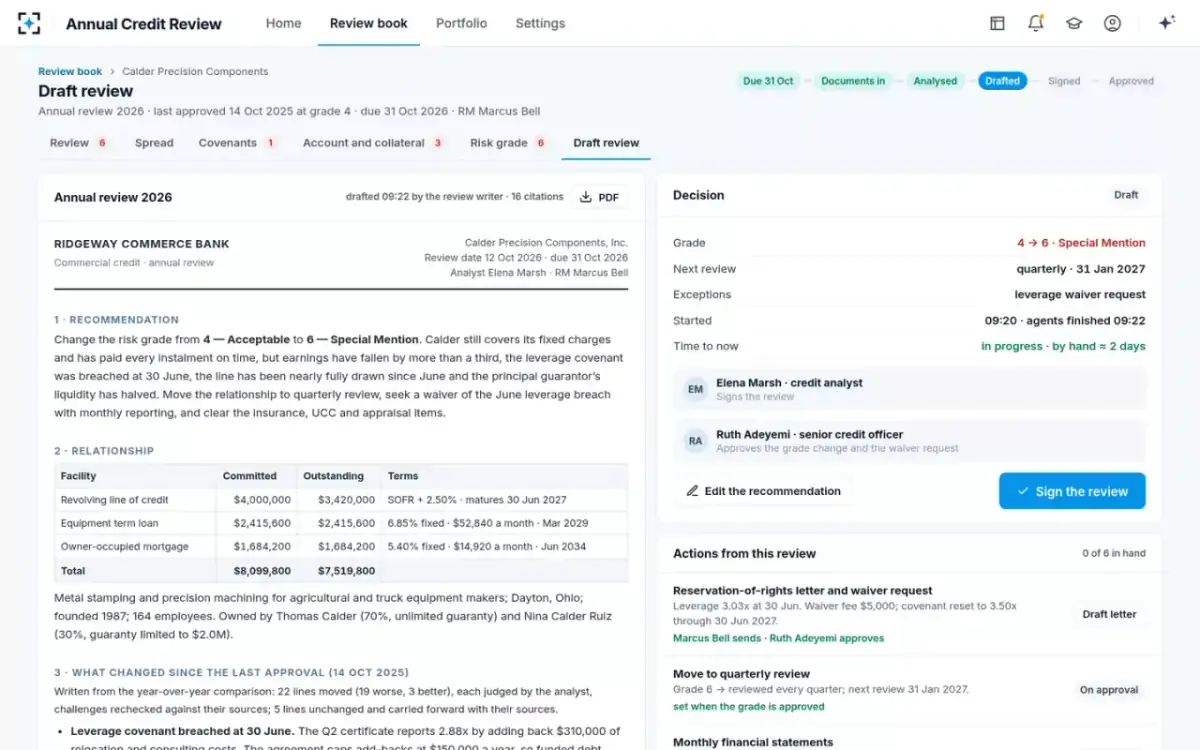
What changes for loan review is the material it receives. Every number in the review links to the page it came from, each challenge and its answer stay in the review, and the grade proposal shows the factor scores and the definition it rests on. A reviewer sampling a loan can see what the analyst saw, what the analyst disagreed with, and when the grade moved. That makes the “accuracy and timeliness” test faster to run, and harder to argue with.
The drafted annual review that loan review will later sample
Questions people ask
Is loan review the same as credit review?
Usually, yes. The interagency guidance notes that credit risk review "may be referred to as loan review, credit review, asset quality review, or another name". The term to be careful with is "credit review" used for the annual review itself, which is the line's work and not independent.
Does every commercial loan need an annual review?
The OCC expects all credits to get a formal review at least annually, with large, new, higher-risk and complex credits reviewed more often. It also allows that "smaller, performing credits may be excluded from periodic reviews and reviewed as exceptions". How a bank sets those rules is covered in how often to review commercial loans.
Is an annual credit review the same as a loan renewal?
No, though they often fall in the same month. A renewal is a new credit decision on a maturing facility; the annual review re-grades the whole relationship, including term loans years from maturity. Among firms with less than $50 million in assets, "three-quarters of credit lines have maturity of 1 year or less at origination", Federal Reserve and academic economists found, which is why many banks fold the line's renewal into its review (Chodorow-Reich and others, NBER).
What happens if an annual review is late?
The grade goes stale and examiners notice. The OCC treats stale financial statements, tax returns and borrowing base certificates as administrative exceptions, its examination procedures ask whether the bank completes annual reviews "in a timely manner", and its first-day request letter asks for a report on where every annual review stands. A late review is also a review written on old numbers, which is the condition in which a deteriorating borrower stays at its old grade.
Can the external auditor perform loan review?
It can, with care. The 2020 guidance allows the board to outsource credit risk review to an independent third party, but warns that using the bank's own external auditor "may raise additional independence considerations". Either way the board keeps the responsibility, and bank staff independent of lending still "develop the credit risk review plan, and verify appropriate follow-up of findings".
Who should approve a changed grade?
The bank's policy decides. Many banks have the analyst sign and a senior credit officer approve any change, with the chief credit officer added for classified grades. The Annual Credit Review page shows that chain on one relationship.