Extend and pretend is what bankers call it when a lender moves a maturity date, renews a line or advances fresh money to a borrower who could not otherwise repay, so the loan stays current while the credit underneath it deteriorates. Examiners have a precise phrase for the pattern: "renewals with little or no repayment of principal". It was the most prevalent risk management failure at First NBC Bank, whose 2017 collapse cost the Deposit Insurance Fund an estimated $996.9 million. The defence is not to refuse extensions, which are often the right call, but to decide each one as a credit decision with a year of evidence in hand. That is the work of the annual credit review, and it is where Botminds' Annual Credit Review is aimed: each relationship is re-underwritten against fresh statements and twelve months of account behaviour before its renewal comes round.
The same renewal, processed as paperwork or judged as a credit decision
Renewed as paperwork: The maturity date, and a request from the relationship manager to roll it.
Judged as a credit decision: The annual review, scheduled before maturity, or a trigger such as a line that has not paid down.
Renewed as paperwork: Whatever is on file, sometimes last year's.
Judged as a credit decision: Fresh statements and returns, spread and tied to the return, covenants recomputed by the agreement.
Renewed as paperwork: Interest current, so the loan is current.
Judged as a credit decision: Can the borrower repay principal on reasonable terms, from which source, and did the line clean up?
Renewed as paperwork: Carried forward.
Judged as a credit decision: Confirmed or changed with reasons; a renewal of a weak credit is a reason to look harder, not a reason to wait.
Renewed as paperwork: Unchanged; appraisal age not checked.
Judged as a credit decision: Value, appraisal or evaluation age, insurance and lien filings checked; reappraisal considered.
Renewed as paperwork: None.
Judged as a credit decision: Modification reporting considered where the borrower is in financial difficulty; renewals and restructurings flagged for loan review.
What does extend and pretend mean?
It means extending a loan the borrower cannot repay and pretending it is still performing, so that a loss is never recognised. The extension changes the date a payment is due, not the borrower's ability to make it. A term loan whose balloon cannot be paid is extended; a working-capital line that should have come down after the season is renewed at the same limit; a new advance pays the interest on the old one. In every case the loan's past-due status is unchanged and the credit risk is higher. The FDIC inspector general's review of First NBC put it plainly: "a borrower needing multiple loan renewals is likely having cash flow problems" (FDIC OIG, AUD-18-002).
Revolving lines are where it hides best. The Federal Reserve's manual describes the classic working-capital facility as "renewable at maturity", for "a one-year term", with "a clean-up requirement for a period sometime during the low point or contraction phase of the business cycle". The clean-up "provides the bank with proof that the borrower is not dependent on the lender for permanent financing" (Commercial Bank Examination Manual §2080.1). A line that never comes down, renewed every year, has quietly become term debt with no amortization. Short lines are the norm for smaller firms: among firms with less than $50 million in assets, "three-quarters of credit lines have maturity of 1 year or less at origination" (Chodorow-Reich and others, NBER). Every one of those renewals is a decision point, whether or not anyone treats it as one.
Examiners know where to look. The Federal Reserve's loan procedures tell them to obtain loans "on which interest is not being collected in accordance with the terms" and add: "Particular attention should be paid to loans that have been renewed without payment of interest." The OCC's 2026 sampling list includes "Loans with high numbers of modifications, renewals, or extensions" and "Loans to borrowers with significant overdrafts" (OCC, Lending and Loan Portfolio Risk Management).
First NBC: six examinations, one pattern of renewals
First NBC is the public case study in what extensions cost when nobody independent judges them. From 2008 through 2016, the inspector general found, "examiners criticized the bank's liberal lending practices to financially distressed borrowers, such as numerous renewals with little or no repayment of principal, new loans or renewals with additional advances, and questionable collateral protection." The bank's loan policy "did not include maximum maturity dates, capital limits, or other common controls for these relationships. These extensions masked potential delinquencies".
What liberal renewals cost one bank
$996.9M
estimated loss to the Deposit Insurance Fund when First NBC failed
6th
examination to find that renewal and extension practices “may be masking delinquencies”, in 2016
$90M+
of new loan extensions since the prior examination, found at the 2016 exam
$506M
of adversely classified items at the 2016 exam, more than triple
The relationships grew as they were extended. The inspector general's Table 2 follows three of them from their original balance to their balance after the extensions. One, an oil and gas credit, had been "not properly underwritten originally in 2011" and its "advances were used to finance operating expenses".
Three First NBC relationships, before and after their extensions
Loan review failed alongside. First NBC's "loan reviews were overseen by the CEO", examiners reported weaknesses in the loan review function in four of six examination reports between 2010 and 2016, and the report lists "Untimely reviews" and "Failure to identify impairments" among them. The extensions and the weak reviews were the same failure seen from two sides: the decision to extend was never re-underwritten by anyone with the standing to say no. Annual credit review vs loan review explains why those two checks need different people.
A renewal moves the date a payment is due, not the borrower's ability to make it.
Can a renewed or extended loan still be rated pass?
Yes, if the borrower can repay on reasonable terms and the renewal was underwritten as a credit decision. Extensions are not the problem; unexamined ones are. The 2023 interagency policy statement on commercial real estate workouts says that workouts "can take many forms, including a renewal or extension of loan terms, extension of additional credit, or a restructuring", and that institutions that make them "after performing a comprehensive review of a borrower's financial condition will not be subject to criticism for engaging in these efforts, even if these arrangements result in modified loans that have weaknesses that result in adverse classification" (88 FR 43115). Loans to sound borrowers modified on prudent terms "should not be adversely classified by examiners unless well-defined weaknesses exist that jeopardize repayment."
The grade is where honesty shows. The OCC says a harsher rating may be appropriate "when the poor performance of a portfolio or individual transactions is masked by liberal cure programs (re-aging, extensions, deferrals, or renewals)", and that restructured loans need "a period of sustained performance, generally six months, under the restructured terms before being upgraded to a pass rating" (OCC, Rating Credit Risk). An extension that never reaches the review that decides the grade never reaches that test either.
The independent check is required too. The 2020 credit risk review guidance puts "Past due, nonaccrual, renewed, and restructured loans" in the scope of review, and the OCC grades a bank's risk as high where "Re-aging, extension, renewal, and refinancing practices raise substantial concern about the accuracy/transparency of reported problem loan, past due" and nonaccrual figures.
Is extend and pretend real? Two Federal Reserve studies disagree usefully
It is real at some banks and some times, and the research says the terms of the extension tell the two apart. A Federal Reserve Bank of New York staff report found that after the pandemic, "weakly capitalized banks provided maturity extensions and granted payment relief to distressed commercial real estate (CRE) borrowers to preserve capital", and that distressed loans at those banks were "assigned a lower probability of default by lenders" than similar loans at better-capitalized banks (Crosignani and Prazad, Staff Report 1130). By the end of 2024, CRE loans maturing within three years "accounted for 37% of marked-to-market capital for less-capitalized banks, compared with 27% for better-capitalized banks": the maturity wall that extensions build.
A Federal Reserve Board working paper, using the same kind of supervisory data, reached a more reassuring reading of the same period. It found that "extensions predominantly address temporary payment frictions", and that "banks increased income and principal paydown requirements for extensions, contributing to strong ex-post performance for extended loans" (Glancy, FEDS 2026-025). In the weakest quarter of loans by income, about 20% of extensions came with a material principal paydown during the stress period, "compared to under 10% of extensions before the pandemic". The author notes the limit himself: the data cover only larger banks.
Two Federal Reserve readings of the same extensions
| FRBNY Staff Report 1130 | FEDS 2026-025 | |
|---|---|---|
| Data | Loan-level supervisory data on CRE mortgages at stress-tested banks, plus loans to REITs | Loan-level supervisory data on CRE loans at larger banks, before and after the 2023 stress |
| Question | Do weakly capitalized banks extend distressed loans to avoid recognising losses? | Do extension terms look like loss-delay or like help through a temporary squeeze? |
| Finding | Yes: more extensions, more payment relief and lower assigned default odds at weaker banks | Mostly help: paydown and income requirements rose, and extended loans performed well |
| The test it implies | Compare how the same distressed loan is treated by banks with different capital | Look at the terms: subsidised terms on a low-income loan point to pretending; a paydown or strong income points to amending |
For an annual reviewer the practical rule falls out of the second paper's model: "risky extensions to avoid default costs entail subsidized terms and low debt yields, while safer extensions to remedy temporary strains entail either stringent terms or high debt yields." An extension with a paydown, an equity injection or a higher spread is a lender amending a loan. An extension with lower payments for a borrower whose income no longer covers them is a lender pretending.
Renewal, extension, modification: what each term means for the grade
A renewal replaces a maturing note with a new approval; an extension moves the maturity date of the existing note; a modification is any change to the terms, from rate to amortization. All three are credit decisions, and the 2020 credit risk review guidance puts "renewed, and restructured loans" in loan review's scope for that reason. The Federal Reserve's manual expects a lending policy to set out, "in the case of renewals or extensions, procedures for possible reappraisals or re-evaluations" of the collateral.
The reporting line runs through the borrower's condition, not the label. Banks report modifications to borrowers experiencing financial difficulty when they include "principal forgiveness, an interest rate reduction, an other-than-insignificant payment delay, a term extension, or a combination thereof" (FDIC Risk Review 2026). A twelve-month extension of a line to a borrower whose coverage has fallen below one is a term extension to a borrower in difficulty, whatever the file calls it. The annual review is where that judgment gets made with the evidence on the table.
Six questions to answer at the annual review before any renewal
Before renewing or extending: the credit decision in six questions
- Has principal actually come down?
For a term loan, against the original schedule. For a line, did it clean up, and how low did usage go at its best month-end?
- What repays it now?
The primary source of repayment on this year's numbers, and coverage on the bank's own definition, not the borrower's.
- Is the interest being paid from cash flow?
Or from a new advance, the line itself, or an overdraft cured days later.
- Is the collateral still what it was?
Value, appraisal or evaluation age, insurance in force, and UCC financing statements before they lapse.
- What does the grade say, and when did it last move?
A renewal of a borrower whose grade has not moved in years, while the numbers have, is the case loan review will pick.
- What changes with the renewal?
Amortization, a clean-up period, tighter reporting, a shorter review cycle, or a waiver fee with a covenant reset, each written into the approval.
A line that has stopped paying down: one sample relationship eight months before maturity
Take a sample bank's relationship as it runs through Annual Credit Review. Calder Precision Components, a fictional Dayton machining shop, has a $4 million revolving line that matures on 30 June 2027. At its annual review in October 2026 the line is 90% drawn at the last four month-ends, against 58% a year earlier. There were four overdrafts in August and September, the largest $86,400, each cured within a day or two. Borrowing base availability has fallen 73% to $329,000, and receivables more than 90 days old have risen from 4% to 11%. All 36 loan payments were on time.
A revolving line that has not cleaned up all year
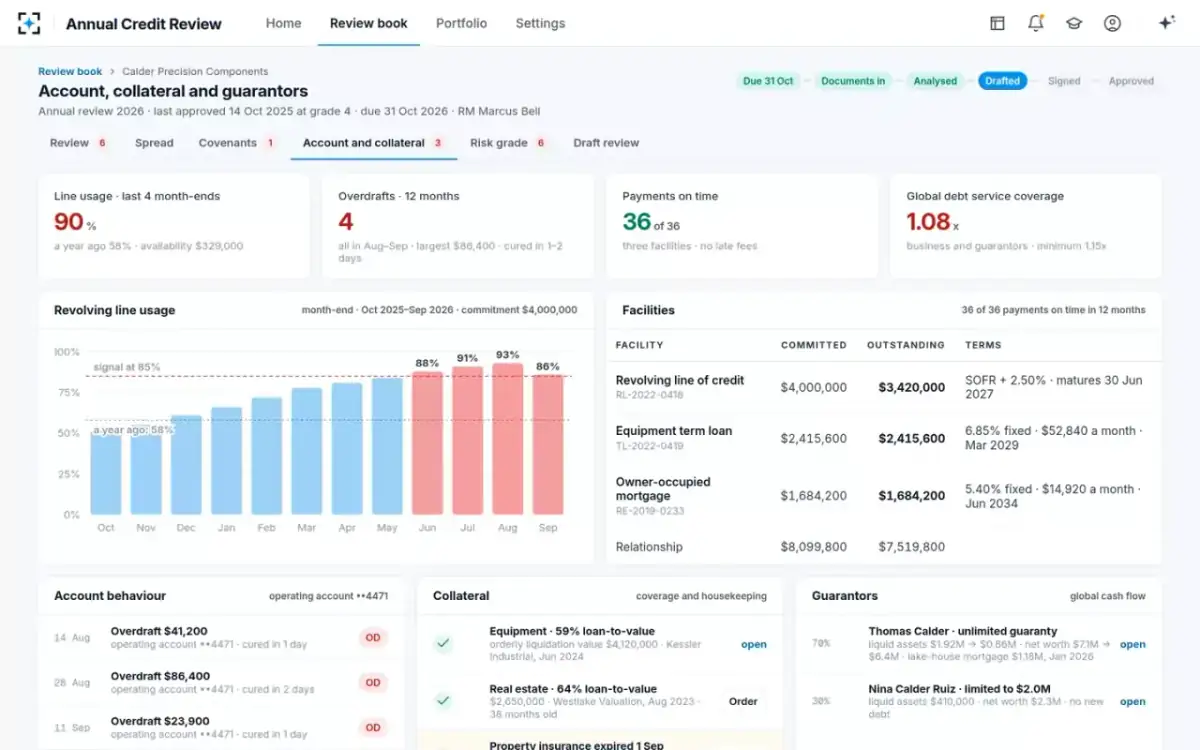
Every payment was on time. Nothing on a past-due report would show this relationship.
Nothing here is delinquent, which is the point. Processed as paperwork next June, the line would roll at the same limit. Reviewed now, the evidence goes into a credit decision eight months early: the proposed grade moves from 4 to 6, the relationship goes to quarterly review, the bank asks for monthly financial statements, and the scorecard writes down what would push it to substandard, including "the borrowing base short of the line". When June comes, whoever decides the renewal decides it against three quarterly reviews, not one stale annual.
The drafted review lists the actions with the decision. On the sample loan they include a reservation-of-rights letter and a waiver request for a leverage covenant breach, with a $5,000 fee and the covenant reset to 3.50x through 30 June 2027, the same date the line matures. A waiver is itself an exception the OCC counts even when granted, so it belongs in the same review as the line, not in a separate letter file. Risk rating migration shows how moves like this one appear in the portfolio view.
How Annual Credit Review keeps renewals and extensions in view
It ties the review cycle to the renewal date and screens the signals that an extension would hide. A sample bank can set review frequency to "Annually, or at renewal if sooner", so no line renews without a current review behind it. The nightly screen flags a revolving line above a usage threshold for three month-ends, any overdraft, statements past their deadline and coverage close to its covenant, and the flagged relationships go to the top of the analyst's queue. The account and collateral monitor checks payments, line usage, borrowing base, appraisal age, insurance and UCC lapse dates; it never releases or revalues collateral, and the agents never set a grade or waive a covenant.
The renewal decision written with the review, not after it
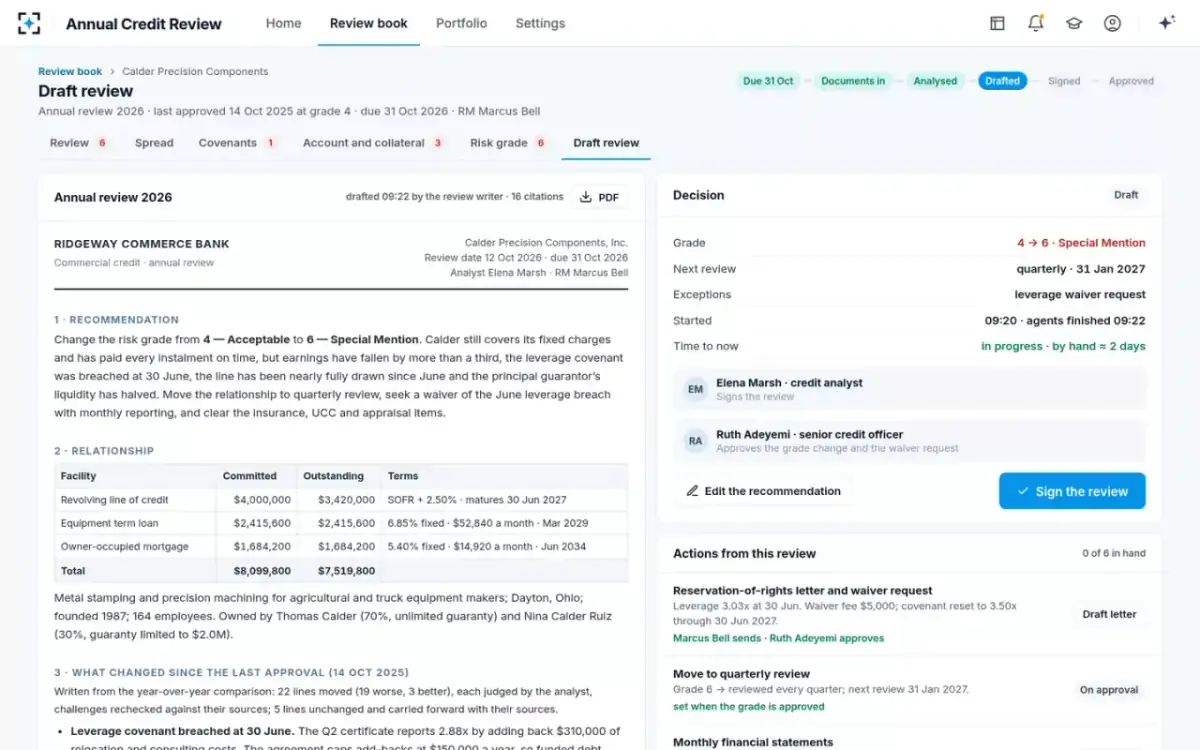
Loan review gets a cleaner population to sample. Every relationship renewed without principal reduction has a review behind it, with the line usage, the overdrafts and the grade decision in one place, and the analyst's confirmations and challenges kept. That is the list examiners will draw from in any case. The Annual Credit Review page walks the same relationship from the queue to an approved downgrade.
Questions people ask
Is extending a loan to finish a refinance a red flag?
Not by itself. A short extension to close a committed refinance, with a current review behind it, is ordinary. The red flag is the second and third extension with no principal paid and no new analysis, which is what the inspector general described at First NBC.
Is a loan extension the same as a refinance?
No. A refinance pays the old loan off with a new one, often on new terms and sometimes from another lender; an extension keeps the same loan alive past its maturity. A borrower that can refinance elsewhere has passed a market test of its credit, which an extension by the existing lender never provides.
What is evergreening of loans?
Evergreening is another name for the same practice: rolling a loan over, or lending new money to pay the old, so that it never shows as past due. A Federal Reserve Board paper on commercial real estate uses the word in its title ("Pretend or Amend? On Evergreening in CRE") and frames the question every annual review should ask of a renewal: is the bank amending a viable loan or pretending about a failed one?
What is a clean-up period on a line of credit?
It is a stretch, usually 30 days in the Federal Reserve's description, during which a working-capital line must be paid to zero, normally at the low point of the borrower's business cycle. It proves the line is financing the season and not the business itself. The Fed notes the requirement "is becoming less common", which makes month-end usage the next-best evidence.
How often should a line that does not clean up be reviewed?
More often than once a year. Most policies move a criticized relationship to quarterly review, and a usage signal can pull the review forward before the grade changes. How often to review commercial loans sets out the triggers.