A loan tickler system tells a bank when each borrower's statements, certificates and annual review fall due, and most banks have one. It does not do the reviews. An annual review backlog builds when the reviews falling due each month take more analyst hours than the team has, and it clears only when either the hours per review fall or the order of work changes. Ridgeway Commerce Bank, a fictional lender in Botminds' Annual Credit Review, shows both. Its commercial book holds 612 relationships and $1.84 billion of commitments, reviewed by five analysts. At the end of April 31 annual reviews were overdue; by the end of July, 38. The credit administration manager, Joanne Whitley, owned that number, and the OCC's examination procedures ask the question she dreaded: "Does the bank complete annual reviews of commercial loans in a timely manner?" This is how the backlog came down, told from her desk, with the sample data the solution runs on.
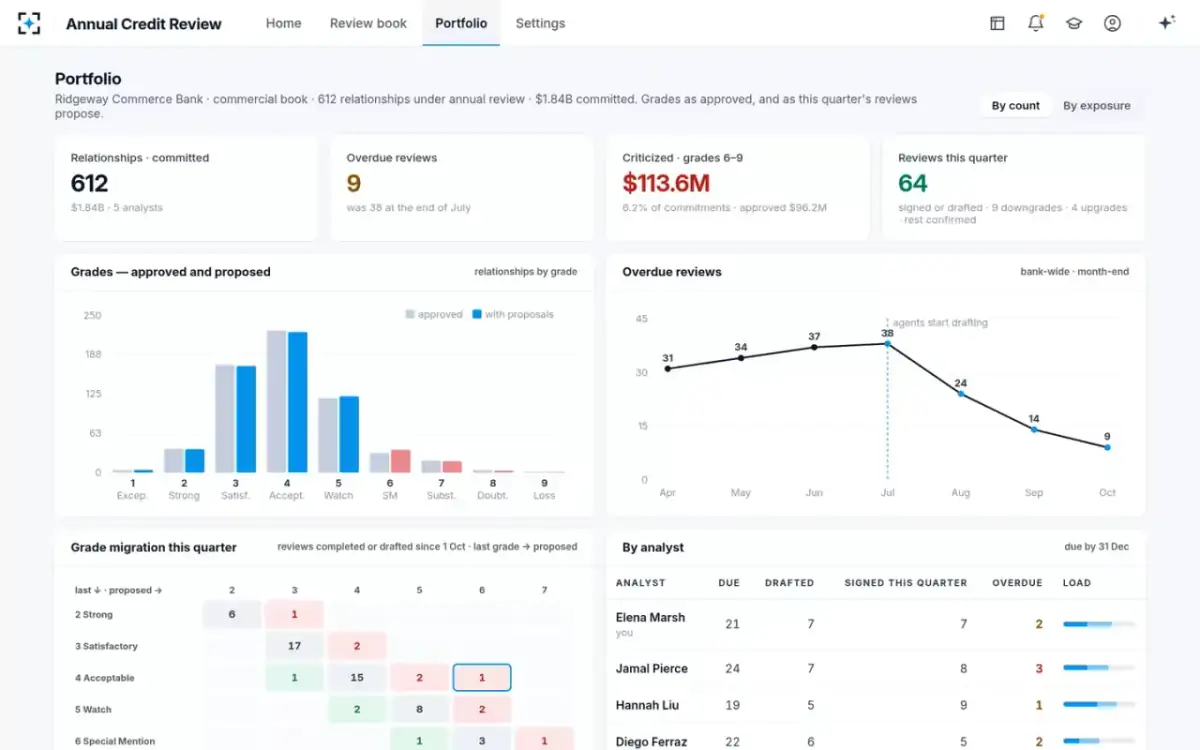
The backlog month by month: overdue annual reviews at each month-end
- April31
- May34
- June37
- July38
- August24
- September14
- October9
What is a loan tickler system, and what does it track?
A loan tickler system is the list of dated follow-ups a bank owes on each loan after closing: statements, tax returns, compliance certificates, borrowing bases, insurance renewals, collateral inspections, lien filings and the annual review itself. The Federal Reserve's examination manual describes it plainly: "Most banks also have either an automated or manual 'tickler' system to identify when updated documents are needed, such as current financial statements, tax returns, UCC-1 filings, collateral inspections, and evidence of insurance." It adds the reason it matters: "many of which need to be updated at least annually" (Commercial Bank Examination Manual).
The manual's examination questions show what a good tickler does beyond listing dates. For construction loans they ask whether the bank keeps "tickler files that provide advance notice (such as 30 days' prior notice) to staff" of expiring insurance and commitments; for consumer collateral, that "The bank should maintain a tickler system to monitor the expiration of insurance policies." The OCC's 2026 booklet places the same work in credit administration: "monitoring the status of required periodic borrower financial statements and loan covenant testing" and "monitoring the status of periodic commercial loan reviews (e.g., annual analysis and risk-rating reviews)" (OCC, Lending and Loan Portfolio Risk Management).
What a loan tickler system does, and what an annual review still needs
Loan tickler system: Knows what each borrower owes and when, and warns before it is due.
The annual review behind it: Re-underwrites the relationship and confirms or changes the grade.
Loan tickler system: A due list, reminders and an exceptions report.
The annual review behind it: A spread, covenant results, account, collateral and guarantor checks, and a signed grade.
Loan tickler system: Marks the item received.
The annual review behind it: Has to read it, tie it to the return and test every covenant on it.
Loan tickler system: A borrower who has not sent the document.
The annual review behind it: Analyst hours, the order of work and approvals, as well as the borrower.
Loan tickler system: Whether the borrower got worse.
The annual review behind it: Nothing, once it is done; that is its purpose.
July: 38 annual reviews overdue, and why the number kept rising
The backlog was arithmetic before it was a management problem. By the solution's estimate an ordinary relationship review takes about sixteen hours by hand, and a complex one much longer. Every one of Ridgeway's 612 relationships needs at least one review a year, and the criticized ones a review every quarter. At sixteen hours each, the annual reviews alone come to roughly 9,800 hours, or 4.7 full-time analysts at 2,080 hours a year (our arithmetic). Ridgeway has five analysts, and they also spread new deals, answer relationship managers and support renewals.
The calendar made it worse. Most of the book is lines and short loans, and short lines are the norm for smaller firms: "three-quarters of credit lines have maturity of 1 year or less at origination" among firms with less than $50 million in assets (Chodorow-Reich and others, NBER). Reviews fall due on the anniversary of approval, but they cannot start until the year-end statements arrive, so they bunch behind the reporting deadlines. When the team fell behind, each analyst worked the queue by due date, and the overdue count rose by three a month from April to June and by one more in July.
Why the sample bank fell behind: the book against the team
612
commercial relationships under annual review, $1.84 billion committed
5
credit analysts, who also spread new deals and support renewals
≈ 9,800
analyst hours a year for one review per relationship at sixteen hours each (our arithmetic)
4.7
full-time analysts' worth of hours, at 2,080 hours a year
Where annual reviews stall: three places, three different fixes
Whitley's first step was to stop treating "overdue" as one number. A review is late for one of three reasons, and each needs a different response. The OCC asks examiners to "Determine the cause of reviews that are behind schedule, have been postponed, or were canceled" (OCC, Lending and Loan Portfolio Risk Management), so the split is also what an examiner will want to see.
Waiting on the borrower. Two of Elena Marsh's reviews in October sit here. Wexford Logistics Group's FY2025 statements are 42 days late; Granger Street Brewing's 2025 tax return has not arrived. No analyst effort fixes these. They need a request that cites the reporting clause, a relationship manager who makes the call, and, past a point, a decision on whether a missed reporting covenant is itself a reason to downgrade. Stale statements are an administrative exception in the OCC's scheme.
Assembly. Most of the backlog was here: statements received and nobody yet free to spread them, tie them to the return and re-test the covenants. This is where the hours were, and the only stall the analysts could not clear by working harder.
Judgment and approval. A review drafted but not signed, or signed but waiting for a grade change to be approved. These are the reviews that matter most and were most often pushed to the next week, because they require a conversation with the relationship manager and a decision the analyst has to defend.
“Overdue” is three different problems. Only one of them yields to more effort from the analysts.
August: drafting 30 days before due, riskiest first
At the end of July the agents in Annual Credit Review began drafting each review 30 days before it is due, once the statements are in, so assembly no longer waits for an analyst. Each analyst's queue is ranked by the overnight screen on what changed since approval rather than by due date, so judgment goes first to the loans that moved. The calendar remained the deadline.
How an annual review moves through the sample bank after July
Agent
Collect as statements fall dueChecks what the relationship owes under its reporting clause and asks the relationship manager for anything missing, citing the clause.
Never: Marks a requirement met without the document.
Agent
Draft, 30 days outSpreads the year, recomputes covenants, checks accounts, collateral and guarantors, and drafts what moved with a proposed grade.
Never: Sets the grade or waives a covenant.
Agent
Rank, every nightScreens the whole book at 06:00 and orders each analyst's queue riskiest first.
A person decides
Judge and signThe analyst confirms or challenges each moved line, decides the grade and signs.
A person decides
ApproveThe senior credit officer approves a grade change or exception; classified grades go on to the chief credit officer.
The effect on the three stalls was uneven, as it should be. Assembly nearly vanished as a cause. Judgment and approval became the main work, done in risk order. Borrower delays did not change at all, but they became visible as a separate list with a named relationship manager on each, instead of a reason buried in the overdue count. The count fell by 14 in August and by 10 in September.
October: one analyst's week inside the quarter
By October the queue looks different. Elena Marsh has 21 reviews due by 31 December. The overnight screen sorts them into six that moved, two stable, two waiting on the borrower and eleven later in the quarter, and estimates her time: 3 hours 50 minutes on the six that moved and 11 minutes on the stable ones. The solution's own estimate for the same eight reviews by hand is about sixteen working days.
The first review of the week is Calder Precision Components, approved at grade 4 a year earlier and due 31 October. The agents' run takes 1 minute 52 seconds over 31 documents. Nineteen lines got worse: EBITDA down 37%, a leverage covenant breached at 3.03x against a 3.00x maximum that the borrower's certificate reported as 2.88x, the revolver 90% drawn for four month-ends, an expired insurance certificate. Marsh challenges one line, confirms the rest, and signs a downgrade to 6 with a waiver request 1 hour 52 minutes after opening the review; the senior credit officer approves it 19 minutes later. Oakmere Dental Partners, where only collections moved, is signed in six minutes with its grade confirmed.
The review book: every review due by week, coloured by risk
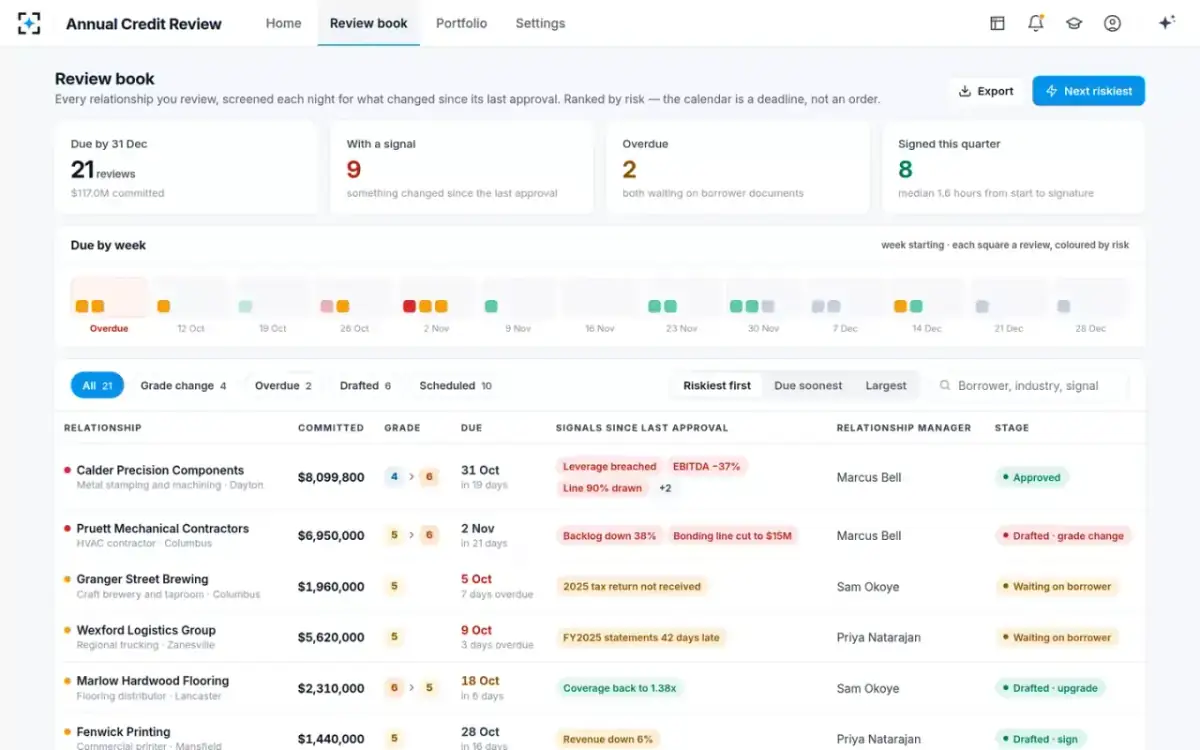
Both overdue reviews in this book are waiting on the borrower. None is overdue for lack of analyst time.
What the quarter's annual reviews found
Clearing a backlog is only worth doing if the reviews find something. In the quarter that began on 1 October, Ridgeway's analysts signed or drafted 64 reviews: nine proposed downgrades, four upgrades and the rest confirmed. Among Marsh's own, Pruett Mechanical Contractors moves from 5 to 6 after its backlog fell 38% and its bonding line was cut, Bellhaven Foods from 3 to 4 on a 3.1-point fall in gross margin, and Marlow Hardwood Flooring up from 6 to 5 with coverage back to 1.38x.
The portfolio view sets the approved grades beside the proposed ones. Criticized commitments in grades 6 to 9 stand at $96.2 million as approved and $113.6 million with the quarter's proposals, 6.2% of the book. Those are the moves a stale review would have postponed. The OCC's position is that a rating "should be changed now when the borrower's risk of default increases rather than later" (OCC, Rating Credit Risk), and a backlog is the most common reason it is changed later. Risk rating migration reads the same quarter as a transition matrix.
The backlog line, the proposed grades and each analyst's load
Is a spreadsheet good enough for loan ticklers?
It can be, for a small book with one careful owner, but it fails in predictable ways as the book grows. The regulators do not require software. The Federal Reserve's manual says that "Whether the bank uses a computerized or manual system to manage its loan portfolio", key information "should be readily available and routinely reviewed by management", including "new extensions of credit, credit renewals, and restructured credits" and credits "not in compliance with bank policies". The test is whether the information is current and reviewed, not where it lives.
A spreadsheet tickler breaks at the handoffs. It depends on someone entering every received document on the day it arrives, rolling each due date forward correctly after a renewal or amendment, and noticing when a guarantor's statement is missing because the borrower's arrived. It keeps no record of who changed a date or why, which matters when an examiner asks why a review was postponed. And it knows nothing about the content of what arrived: a certificate that reports a breach is "received" exactly like one that reports compliance.
What should loan tickler software do for annual reviews?
It should track each obligation from the clause that creates it, warn before it is due, and hand the review to someone, or something, that does the work. A tickler that stops at the reminder solves the smaller half of the annual review problem, because the reminder was never the constraint on the sample bank: the analysts knew which 38 reviews were overdue. They did not have the hours to do them in the order the risk required.
A buyer comparing tools should ask five things. Does it read the loan agreement's reporting clause, including amendments, so due dates come from the contract rather than a template? Does it track guarantor statements and borrowing base certificates as separately as the borrower's statements? Does it read what arrives, so a certificate reporting a breach triggers something different from one reporting compliance? Does it rank the queue by risk, not only by date? And does it keep a trail of every postponement and its reason? Annual Credit Review answers the last four by doing the assembly itself: it checks each item against the reporting clause, drafts the review 30 days out once statements are in, and screens the whole book nightly to order the queue.
The nine still overdue, and what a credit administration manager tracks each week
Nine overdue reviews in October is not zero, and the remaining ones are the hard kind: mostly borrowers who have not sent what they owe. They do not yield to more analyst capacity. They yield to relationship managers making calls, to a policy on when a missed reporting deadline becomes a covenant default, and to a grade decision made on the information the bank has. The 2020 interagency guidance allows reviews "on renewal, or more frequently when internal or external factors indicate a potential for deteriorating credit quality" (85 FR 32991); a borrower who stops reporting is one of those factors. How often to review commercial loans covers the other triggers.
A credit administration manager's weekly annual review report
- Overdue, split by cause
Waiting on the borrower, not yet drafted, drafted and unsigned, awaiting approval. Each cause has a different owner.
- Coming due in 30 and 60 days
The OCC lists “status of annual and interim reviews of commercial borrowers (e.g., coming due and late)” among the reports management should see.
- Reviews with signals, ranked
What moved since approval, so that judgment goes to risk, not to the calendar.
- Late statements by relationship manager
Borrower delays concentrated in one book are a management issue, not a borrower issue.
- Postponements and their reasons
Who postponed each review, why and until when; examiners ask for the cause.
- Grade changes pending approval
A downgrade that waits for a signature is a downgrade the board has not seen.
Questions people ask
Is an overdue annual review an exam finding?
It can be. The OCC asks whether annual reviews are completed in a timely manner and tells examiners to find the cause of reviews that are behind schedule. A short list of reviews late for documented borrower reasons reads very differently from a long list nobody can explain.
Should a bank hire to clear a backlog?
Only after splitting it by cause. Hiring helps with assembly; it does nothing for borrower delays or approvals. The cost of the assembly hours is set out in how long a commercial loan annual review takes.
Who owns the loan tickler in a bank?
Usually credit administration, with the relationship manager responsible for getting documents from the borrower. The OCC's 2026 booklet places "monitoring the status of periodic commercial loan reviews" within credit administration; what matters to an examiner is that every overdue item has a named owner and a recorded reason.
How far ahead should a tickler warn?
Far enough ahead to act. The Federal Reserve's examination questions use 30 days' advance notice as an example for expiring items, and the sample bank drafts each annual review 30 days before it is due once statements are in. For statements, the warning should come before the agreement's reporting deadline, not after it.
How long does it take for a backlog to fall once drafting starts?
On the sample bank, from 38 at the end of July to 9 in October. A bank's own pace depends on how much of its backlog is assembly. The Annual Credit Review page follows one of those reviews from the queue to an approved downgrade.