Commercial loans should be formally reviewed at least once a year, and more often when they are large, new, complex, criticized or showing early signs of strain. That is the OCC's wording almost exactly: "All credits should receive a formal review at least annually", while "Large credits, new credits, higher risk pass and problem credits, and complex credits should be reviewed more frequently." Most banks turn that into a calendar: each relationship comes due on the anniversary of its last approval. The calendar is a fine deadline and a poor order of work, because it treats a stable credit due on Monday as more urgent than a slipping one due in six weeks. Botminds' Annual Credit Review keeps the deadline and changes the order: it screens every relationship nightly for what changed since approval and ranks the analyst's queue riskiest first.
One analyst's 21 annual reviews, sorted by what they need rather than when they are due
Reviews due by 31 December · 21
- Ready to judge now (8) · 38%
- Waiting on the borrower (2) · 10%
- Later in the quarter (11) · 52%
The 8 ready now
- Moved, need judgment (6) · 3 h 50 in all · 75%
- Stable (2) · 11 min in all · 25%
Do all commercial loans need an annual review? What the regulators say
Nearly all of them do: the regulators set a floor of once a year, allow the smallest performing loans to be reviewed by exception, and leave the rest to a risk-based policy. The guidance is consistent across the three federal banking agencies, and it is short enough to quote in full where it matters.
Review frequency in the guidance, and the policy a bank writes from it
| Source | What it says | What a bank's policy usually sets |
|---|---|---|
| OCC, Rating Credit Risk | “All credits should receive a formal review at least annually to ensure that risk ratings are accurate and up-to-date.” | Every relationship annually, on the anniversary of its last approval |
| OCC, Rating Credit Risk | “Large credits, new credits, higher risk pass and problem credits, and complex credits should be reviewed more frequently.” | Criticized grades quarterly; large relationships semiannually |
| OCC, Rating Credit Risk | “smaller, performing credits may be excluded from periodic reviews and reviewed as exceptions.” | A size floor below which loans are reviewed only on a trigger |
| Interagency guidance, 2020 | Reviews “typically annually, on renewal, or more frequently when internal or external factors indicate a potential for deteriorating credit quality”. | Annually, or at renewal if sooner; an interim review on any trigger |
| Interagency guidance, 2020 | “Use of key risk indicators or performance metrics … can support adjustments to the frequency and scope of reviews.” | A list of early-warning signals screened between reviews |
| Federal Reserve, Examination Manual | Policy should require “an annual review of borrowers, including a reassessment of the appropriateness of credit lines”. | The line itself reassessed at every annual review |
Two lines in that table are easy to miss. The interagency text puts renewal on the same footing as the anniversary, so a line renewed in June should not wait for an October review date. And the OCC's instruction that ratings be updated "whenever relevant new information is received" means the annual review is a minimum, not a schedule: a grade that should have moved in April and moved in October was wrong for six months (OCC, Rating Credit Risk).
Why an anniversary calendar produces a review backlog
Because the inputs arrive in bunches and the calendar does not know which reviews are easy. Most small and middle-market lines are short. Among firms with less than $50 million in assets, "three-quarters of credit lines have maturity of 1 year or less at origination" (Chodorow-Reich and others, NBER), so renewal and review fall due every year. Year-end statements then arrive on the reporting deadlines in the credit agreements, which sit months after the fiscal year closes; the sample agreement used later on this page allows 120 days for reviewed annual statements. Reviews that cannot start until the statements are in pile up behind them.
The calendar also hides the difference in effort. A relationship where nothing moved needs a few confirmations; one that breached a covenant and drew its line to the limit needs a day of judgment and a conversation with the borrower. Working in due-date order spends the analyst's best hours on whatever is due first. When the queue falls behind, stretched teams do the predictable thing and roll last year's analysis forward, which is how a grade goes stale.
Examiners look for exactly that. The OCC's 2026 procedures ask, "Does the bank complete annual reviews of commercial loans in a timely manner?", list "Status of annual and interim reviews of commercial borrowers (e.g., coming due and late)" among the reports management should see, and tell examiners to find "the cause of reviews that are behind schedule, have been postponed, or were canceled" (OCC, Lending and Loan Portfolio Risk Management).
The anniversary is a deadline, not an order. Work in due-date order and the best hours go to whatever is due first, not to what moved.
What are the early warning signs of a problem commercial loan?
The reliable ones are coverage drifting toward a covenant, a revolving line that stops paying down, overdrafts, late statements, customer concentration and renewals without principal reduction. A risk-first order needs exactly that kind of cheap, repeatable signal of what changed since the last approval, read across the whole book every night. The useful signals are the ones a bank already holds in its core system, its borrower portal and its credit files: coverage drifting toward a covenant, a revolving line held near its limit, overdrafts, statements past their deadline, and a borrower's dependence on one customer.
Signals that should pull a review forward, and the settings a sample bank uses
- Coverage close to its covenant
Fixed charge or debt service coverage within a set margin of the minimum; 0.10x in the sample bank.
- A revolving line held high
Usage above a threshold at three straight month-ends; 85% in the sample bank. A working-capital line that never comes down is no longer seasonal.
- Any overdraft on an operating account
The OCC's examiners sample “loans to borrowers with significant overdrafts” for a reason.
- Late statements
Statements, returns or certificates past the agreement's deadline by more than a set number of days; 15 in the sample bank. Stale statements are an exception in their own right.
- Customer concentration
The largest customer above a share of sales; 30% in the sample bank.
- A renewal or extension without principal reduction
The guidance lists renewed and restructured loans in the scope of review; a renewal is a credit decision.
- A covenant breach or waiver
The OCC counts a breach as a financial exception even if waived.
None of these signals sets a grade. Each one changes the order of work and, past a threshold, the date of the next review. That distinction keeps the screen out of model territory and keeps the judgment with the analyst. It also gives management the forward-looking measures the agencies mention approvingly in the 2020 guidance's preamble: "portfolio concentration trends, shifting underwriting standards, and risk rating migrations". Risk rating migration takes the last of those further.
When should a risk rating be changed between annual reviews?
As soon as the evidence says the borrower's risk of default has risen, not at the next review date. The OCC's rating booklet makes the horizon explicit: "Expected performance should be evaluated over the foreseeable future — not less than one year", because "Credit risk ratings are meant to measure risk rather than record history" (OCC, Rating Credit Risk). A grade that waits for a missed payment is a grade that recorded history.
The booklet's worked example is worth reading as a review-frequency rule. A borrower "in the third year of a seven-year amortizing term loan" has "made payments as scheduled, and is current", but its prospects are weakening and its "projected cash flow will be insufficient to cover the required debt service". The instruction: "the risk rating should be changed now when the borrower's risk of default increases rather than later when cash flow coverage becomes negative or when default occurs." Nothing in that borrower's payment history would trigger a review. Only a signal read from its statements, its line or its customers would.
The same booklet tilts the other way on upgrades. Examiners "normally will await correction of the weaknesses and a period of sustained performance under reasonable repayment terms before upgrading", and a harsher rating may be appropriate when poor performance "is masked by liberal cure programs (re-aging, extensions, deferrals, or renewals)". Downgrades between reviews are expected; upgrades between reviews need a track record. Extend and pretend covers the cure programs in detail.
What is a stale financial statement exception?
It is a credit administration exception recorded when the borrower's statements, tax returns or borrowing base certificates on file are older than the bank's policy or the loan agreement allows. The OCC's 2026 booklet lists stale financial statements, tax returns and borrowing base certificates among its administrative exceptions, beside missing lien recordation and lapsed insurance (OCC, Lending and Loan Portfolio Risk Management). The regulators do not set a number of months; the bank's policy and each agreement's reporting clause do.
Stale statements matter for frequency because they quietly cancel it. A review dated on time but written on eighteen-month-old numbers satisfies the calendar and tells the bank nothing. The OCC names the failure in its discussion of operational risk: banks "have incurred increased credit risk when information systems failed to provide adequate information to identify concentrations, problem loans, loans past maturity, or stale commercial borrower financial statements". Its examination questions start from the same place, asking whether the bank has "a system to monitor the timely submission of commercial borrower and guarantor financial statements".
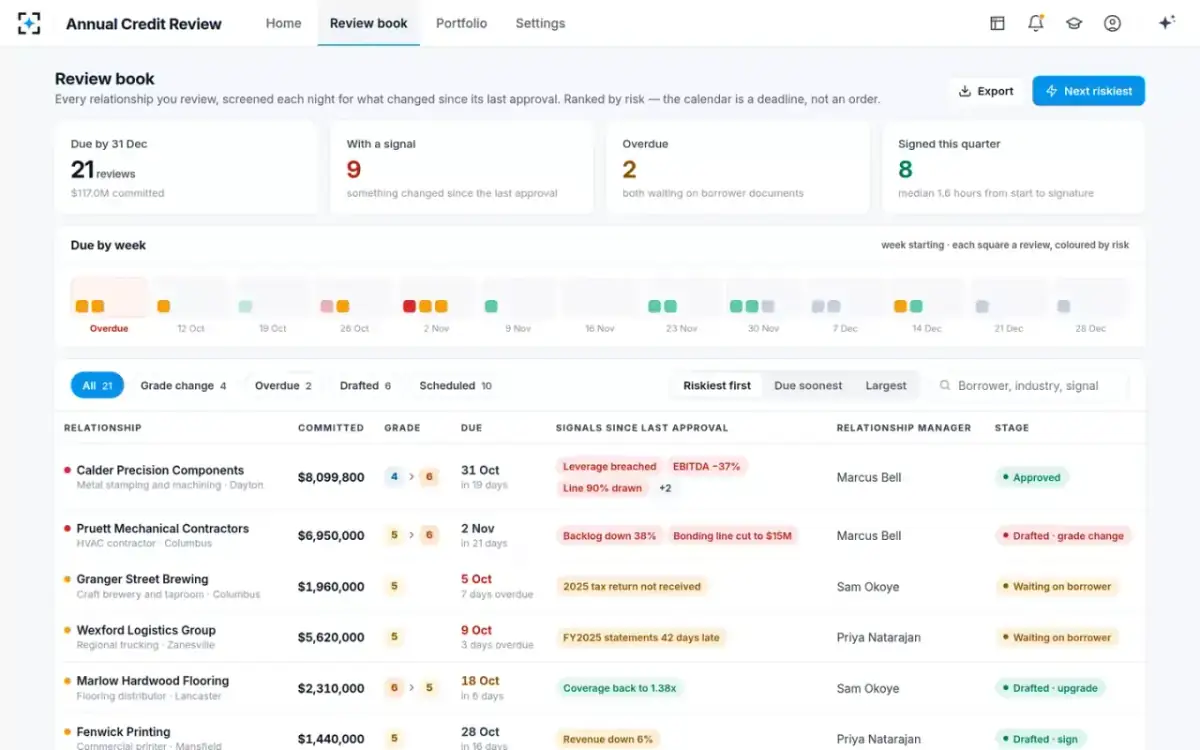
A workable policy treats lateness as a signal in its own right. Ridgeway's sample settings flag statements more than 15 days past the agreement's deadline, and two of Elena Marsh's 21 reviews sit in that state: Wexford Logistics, whose statements are 42 days late, and Granger Street Brewing, still missing its 2025 tax return. Both are overdue because the borrower has not reported, which is itself information about the borrower.
What a risk-first queue looks like in Annual Credit Review
Take a sample bank's book as it runs through the solution. Elena Marsh, a senior credit analyst at fictional Ridgeway Commerce Bank, has 21 annual reviews due by 31 December. The overnight screen at 06:00 sorts them into six that moved and need her judgment, two stable ones she can clear in minutes, two waiting on the borrower and eleven due later in the quarter. Each row shows how many lines got worse or better since approval and how long the review should take.
The queue ranked riskiest first, with the time each review will take
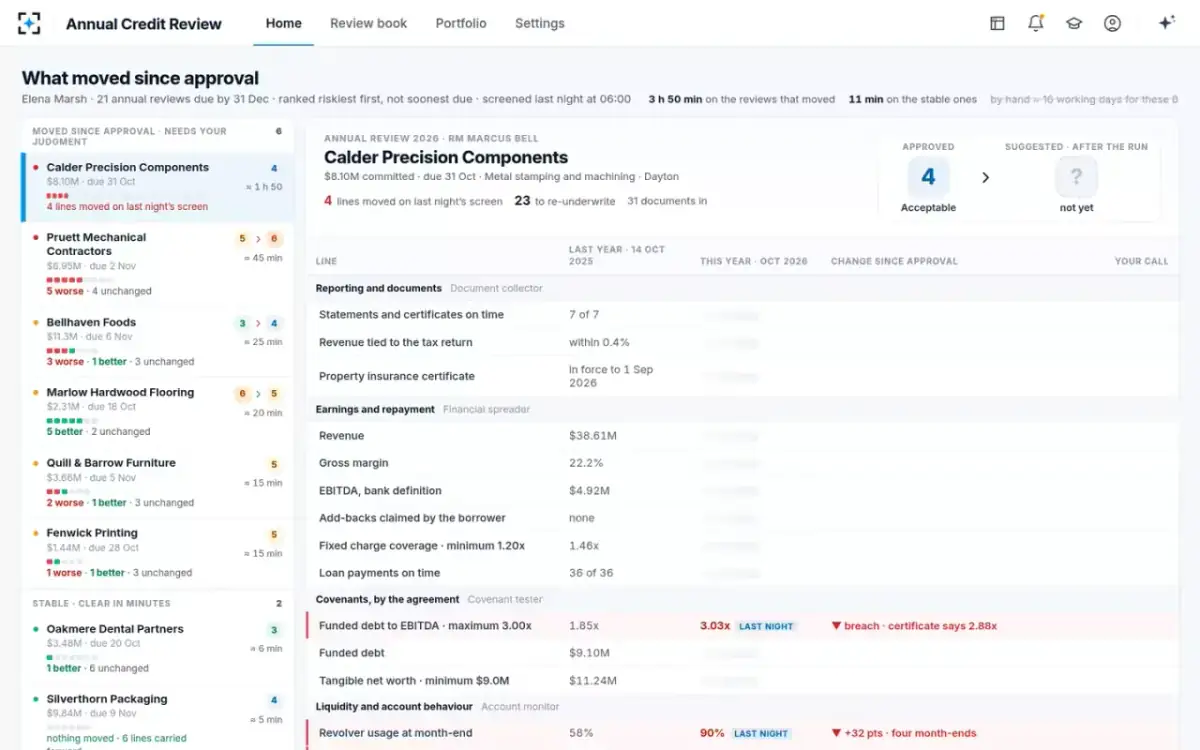
The header shows 3 h 50 min on the reviews that moved and 11 min on the stable ones.
The order changes what happens to the deteriorating credits. Calder Precision Components, approved at grade 4 a year earlier, opens with a leverage covenant at 3.03x against a 3.00x maximum, a revolver at 90% for four month-ends and an expired insurance certificate. It is reviewed first and leaves the day as a proposed grade 6 with a waiver request and a move to quarterly review. Oakmere Dental Partners, where only collections moved, is signed in six minutes with its grade confirmed. Both meet their deadlines; only one needed to be early.
Across the bank the order shows up in the overdue count. Ridgeway's overdue annual reviews climbed from 31 in April to 38 at the end of July, before the agents began drafting reviews 30 days ahead of their due dates once the statements were in. By the end of October nine were overdue. The quarter that cleared the backlog follows those months review by review.
Overdue annual reviews at a sample bank, month-end
Setting a review frequency policy you can defend to an examiner
A frequency policy that will hold up has three parts: the floor, the exceptions above it, and the triggers between reviews. The floor is annual for every relationship above a size threshold, with renewal counting as a review date if it comes sooner. Above the floor, criticized grades go quarterly and the largest relationships semiannually; Ridgeway's sample policy uses quarterly for grade 6 and worse and semiannual above $15 million committed. Between reviews, a written list of signals pulls a review forward and is screened on a set schedule.
Two further rules keep it honest. A loan upgraded after a problem should earn the upgrade: the OCC expects restructured loans to show "a period of sustained performance, generally six months" before a pass rating, and notes that "The mere existence of a plan for improvement, by itself, does not warrant an upgrade" (OCC, Rating Credit Risk). And the policy should name who may postpone a review and require the reason in writing, because a postponed review is the first thing an examiner will ask about.
Review frequency and early-warning signals, set as policy
Questions people ask
Can small performing loans be reviewed less than annually?
The OCC allows that "smaller, performing credits may be excluded from periodic reviews and reviewed as exceptions". The bank needs a written size floor and a reliable trigger, so that an excluded loan that starts to slip is caught. A small bank weighing that trade-off can start with independent loan review at a small bank.
Does a renewal count as the annual review?
It can, if the renewal includes the full re-underwriting: refreshed financials, covenant tests, collateral and guarantors, and a grade decision. A renewal processed as paperwork does not, and a renewal without principal reduction deserves more scrutiny, not less.
What is an interim credit review?
It is a review between annual reviews, started by an event rather than a date: a covenant breach, a request to extend or advance, an overdraft, late statements or news about a key customer. The 2020 interagency guidance expects reviews "more frequently when internal or external factors indicate a potential for deteriorating credit quality", and an interim review usually ends with the grade confirmed or changed and the next review date reset.
How often should guarantor financial statements be updated?
As often as the loan agreement and the bank's policy require, and at least at each annual review, because global cash flow cannot be tested without them. The Federal Reserve's manual expects the lending policy to set financial-statement requirements "for businesses and individuals at various borrowing levels", and the OCC asks whether the bank monitors the timely submission of "borrower and guarantor financial statements". In the fictional Calder review, the main guarantor's liquid assets fell from $1.92 million to $0.86 million in the same year the business breached its leverage covenant.
How often should criticized loans be reviewed?
Quarterly is the common policy for special mention and classified credits, and the OCC names problem credits among those to review more often than annually. The Annual Credit Review page shows one relationship moving to quarterly review when its grade falls to 6.