AI credit review works when the AI takes the assembly and leaves the judgment, and that is also the honest test of any annual credit review automation a bank is offered. Of the fourteen tasks in a commercial annual review, nine are collecting, spreading, recomputing and drafting, and agents can do them; two are shared; three stay with people: confirming or challenging each change, deciding and signing the grade, and approving a grade change or exception. The regulators describe bank AI in 2026 in the same terms, as "human-in-the-loop accountability", and the division is also where the time sits: by our estimate, about three-quarters of a review's hours go on assembly. Botminds' Annual Credit Review is built on this split, with six agents that fill this year's column beside last year's approval and an analyst who judges only what moved.
The fourteen tasks of an annual credit review, and who does each
| Task | Who | The limit, or who decides |
|---|---|---|
| 1. Track what each relationship owes: statements, returns, certificates, borrowing bases | Agent | A requirement is never marked met without the document |
| 2. Chase what is missing or late | Shared | The relationship manager asks the borrower; the agent cites the clause |
| 3. Spread the year and the interims into the bank's template | Agent | Reported figures are never altered |
| 4. Tie revenue to the tax return; keep add-backs on their own lines | Agent | Only add-backs the agreement allows are applied |
| 5. Recompute every covenant by the agreement and compare with the certificate | Agent | Any waiver |
| 6. Check twelve months of payments, overdrafts, line usage and borrowing base | Agent | Flags what crosses the bank's thresholds; decides nothing |
| 7. Check collateral: value, appraisal age, insurance, UCC lapse dates | Agent | Release or revaluation of collateral |
| 8. Read guarantors' statements; work out global cash flow | Agent | Assets not shown on a statement are not counted |
| 9. Draft what moved since the last approval, each line cited | Agent | The wording of the final review |
| 10. Score the grading model's factors and propose a grade | Agent | The grade itself |
| 11. Confirm or challenge each line that moved | Person | Analyst |
| 12. Decide the grade and sign the review | Person | Analyst |
| 13. Approve a grade change or covenant exception | Person | Senior credit officer; chief credit officer for classified grades |
| 14. Decide the line and the waiver, and talk to the borrower | Shared | Relationship manager and approver; the agent drafts the letter |
Which credit review tasks can AI automate? Nine, each with a limit
The tasks that move to agents are the ones with a right answer that a source document settles. Tracking reporting requirements is a comparison of the credit agreement's reporting clause with what arrived. Spreading is reading statements into a template. A covenant test is arithmetic on definitions the agreement fixes. Each has a check: the document exists or it does not, the number is on the page or it is not, the ratio passes or fails.
The covenant re-test shows why those tasks still need care. In the solution's sample bank, Calder Precision Components' second-quarter compliance certificate reports leverage of 2.88x. It adds back $310,000 of relocation and consulting costs; the credit agreement's §6.12 caps add-backs at $150,000 a year. On the agreement's definition, funded debt of $9,420,000 over EBITDA of $3,110,000 is 3.03x against a 3.00x maximum, an event of default not yet declared. The covenant tester never uses the borrower's definition, and it never waives a covenant. The Federal Reserve's manual is the reason the test matters: "With proper use of loan covenants, a bank can protect its right to receive additional or more frequent information if a borrower's financial condition deteriorates" (Commercial Bank Examination Manual §2010.1).
One assembly task done by an agent: the covenant test, two ways
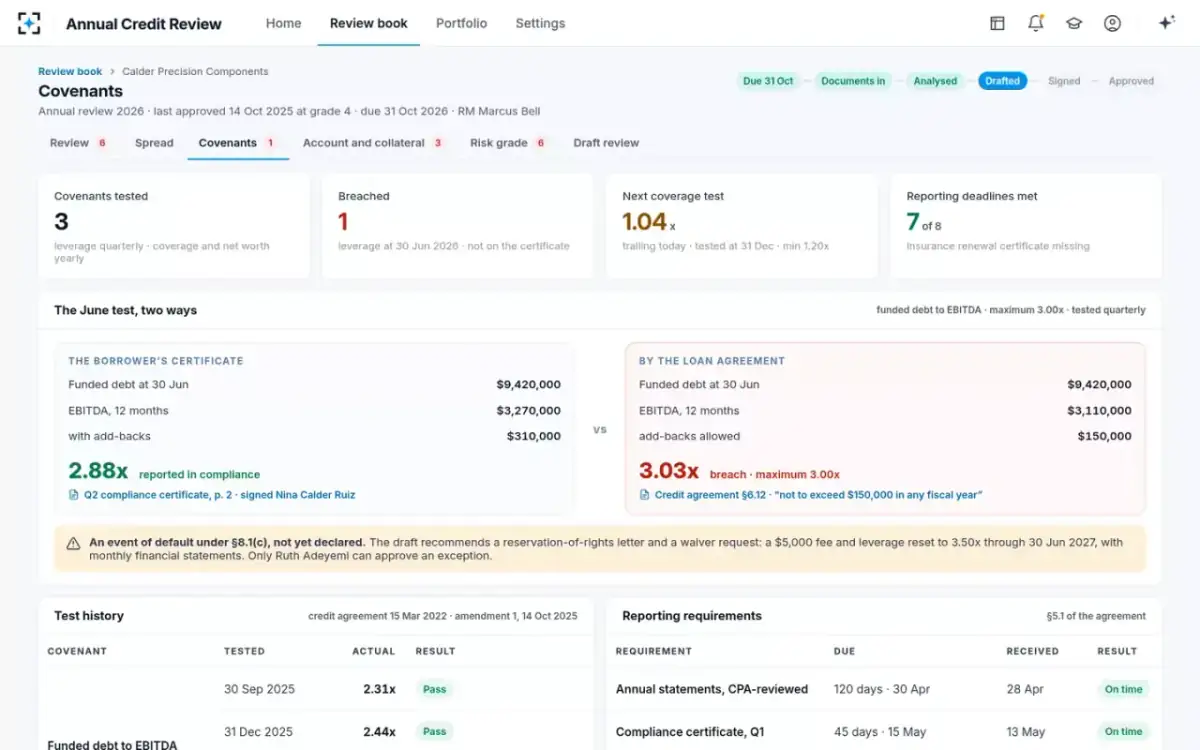
The agent's output is the comparison and the clause. Whether to waive is not its call.
Each agent's limits are written as rules, not habits. The spreader never alters a reported figure and keeps adjustments on their own lines. The account and collateral monitor never releases or revalues collateral. The guarantor analyst never counts an asset it cannot see on a statement. The review writer never sets a grade. These limits are what make the agents' output checkable by a person in minutes rather than redone in hours.
Annual Credit Review: six agents, an analyst and an approver
Agent
Statement and document collectorFinds what the relationship owes and checks each item against the agreement's reporting clause.
Never: Marks a requirement met without the document.
Agent
Financial spreaderSpreads statements and interims, ties revenue to the return, keeps add-backs separate.
Never: Alters a reported figure.
Agent
Covenant testerRecomputes each covenant by the agreement and explains every difference from the certificate.
Never: Waives a covenant or uses the borrower's definition.
Agent
Account, collateral and guarantor checksPayments, overdrafts, line usage, appraisals, insurance, UCC filings, guarantor liquidity and global cash flow.
Never: Releases or revalues collateral.
Agent
Review writer and grade recommenderWrites what moved since approval with each source cited, scores the factors and proposes the grade.
Never: Sets the grade.
A person decides
Credit analystConfirms or challenges each moved line, decides the grade and signs.
A person decides
Senior credit officerApproves any grade change or covenant exception; classified grades also go to the chief credit officer.
What should stay human in a credit review
The grade, the signature and the approval stay with named people because they are credit decisions, and accountability for credit decisions is not something a bank can hand to software or to a vendor. The OCC's spring 2026 risk report describes banks' use of generative and agentic AI as "generally limited to specific use cases with guardrails and human-in-the-loop accountability to manage risk" (OCC, Semiannual Risk Perspective). The interagency third-party guidance adds that using an outside provider "does not diminish or remove banking organizations' responsibilities" (88 FR 37920).
The approval is also where independence starts. The OCC notes that an approval authority "whose primary goal is credit quality can introduce more objectivity" (OCC, Lending and Loan Portfolio Risk Management), which is why a grade change on the sample bank goes from the analyst to a senior credit officer, never back to the person who proposed it.
Agents take the tasks a source document can settle. People keep the ones a source document cannot.
Do regulators allow AI in credit review?
Nothing in federal guidance forbids it, and automated analysis in credit administration is old news to examiners: the Federal Reserve's manual already lists "automated financial statement spreads of borrowers" among the management information a bank should have to hand (Commercial Bank Examination Manual §2010.1). What the agencies have done is name the risks. Their 2021 request for information listed "Credit decisions" as a use of AI "to inform credit decisions in order to enhance or supplement existing techniques", and said AI "may present particular risk management challenges" in "explainability, data usage, and dynamic updating" (86 FR 16837).
Each of those three maps onto a design choice a buyer can check. Explainability, which the request defines as "how an AI approach uses inputs to produce outputs", is met when every figure in the review links to its page and every proposed grade shows its factor scores. Data usage is met when the agents read only the bank's own file and the borrower's documents. Dynamic updating, an approach that can "update on their own, sometimes without human interaction", is avoided when the bank's policy, thresholds and grading model are versioned settings that change only when the bank changes them.
Model risk guidance leaves the question open rather than closed. The April 2026 revision that replaced SR 11-7 says "Generative AI and agentic AI models are novel and rapidly evolving. As such, they are not within the scope of this guidance" (OCC Bulletin 2026-13), while the OCC's lending booklet says models "used for credit underwriting and decisioning should be subject to sound model risk management". Keeping the grade with a person who sees each factor and its source, and can overrule it, holds up under either reading.
Where the hours move when the assembly goes to agents
By our estimate an ordinary relationship review takes about sixteen hours by hand and about two with the agents doing the assembly. The split below shows why the total falls so far: the work that shrinks is the work that was most of the day. What is left is mostly the analyst reading the comparison and writing up the grade.
Where an analyst's hours go on one annual credit review, by hand and with agents
By hand · about 16 hours
- Assembly: documents, spread, covenants, accounts, collateral, guarantors · 12 h · 75%
- Writing and the grade · 4 h · 25%
With agents · about 2 hours
- Checking the agents' assembly · 1 h 15 min · 62.5%
- Judging and the grade · 45 min · 37.5%
Stable credits change the arithmetic again. A relationship where nothing that needs judgment moved is mostly confirmations: on the sample bank, Oakmere Dental Partners moved on one line, collections up 7% with a ninth office, and was signed in six minutes with its grade confirmed. The solution's design target for a stable credit is about six minutes. How long a commercial loan annual review takes prices those hours.
The challenge: how a person overrules an agent, line by line
Every line that moved carries two choices, Confirm and Challenge. A challenge goes back to the agent that produced the line, which rechecks it against the source and answers in place, and the challenge and the answer stay in the review. It is the analyst's tool for bringing in what no document shows yet.
A challenged line, rechecked and answered by the agent that produced it
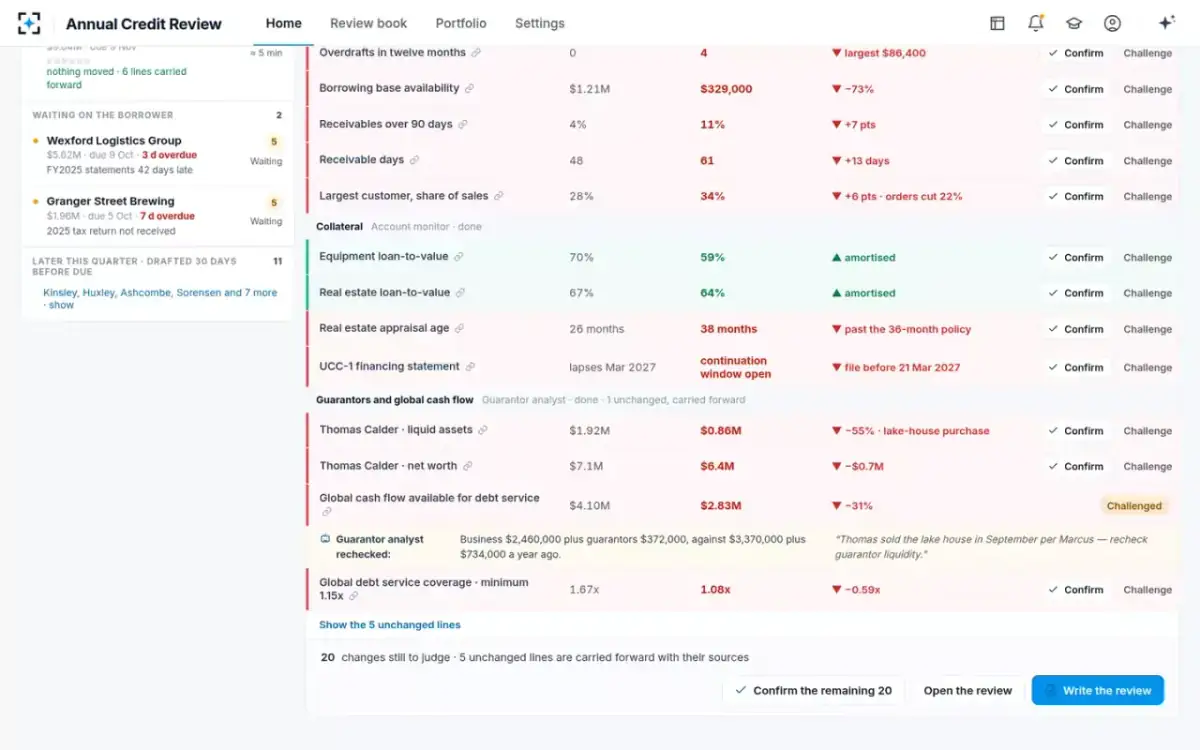
The challenge does not change the number. It makes the analyst's question, and the evidence behind the answer, part of the review.
That is the right behaviour for a credit file. The guarantor analyst never counts an asset it cannot see on a statement, so a sale the relationship manager mentions is a reason to ask for an updated personal financial statement, not a reason to change the figure. The analyst keeps the judgment, and the review shows anyone who reads it later what was asked and what the documents said. Special mention vs substandard looks at how those disagreements can be measured.
How accurate is AI credit review?
No public study measures it for commercial annual reviews, so the only accuracy figure worth having is one measured on the bank's own loans. The best-known academic claim in this area shows why. A 2024 working paper reported that a large language model "outperforms financial analysts in its ability to predict earnings changes directionally"; it has since been withdrawn, after "A co-author identified inconsistencies in the data and analyses while attempting to replicate past analyses" (Kim, Muhn and Nikolaev, arXiv). Headline accuracy claims about AI and financial statements deserve the same scepticism a credit officer gives a borrower's projections.
Accuracy also means different things at different steps, and a single percentage hides that. A spread is right or wrong field by field against the statement. A covenant result is right or wrong against the agreement's definition, which is where the borrower's certificate and the bank's arithmetic part company. A proposed grade is a judgment, and its fair test is agreement with what an experienced analyst signed, within a stated tolerance. Credit review software pilots sets out how to score all three on last year's completed reviews.
What to look for in an AI credit review tool
Look for a tool that shows its work, follows the bank's policy, and leaves every decision with a named person. The market mixes several kinds of product under the same label: spreading tools, origination systems with a renewal module, portfolio monitors and general-purpose assistants. An annual review needs all of the assembly in one place and the judgment kept apart from it.
Eight things to check before buying AI for annual credit reviews
- Every number traced
Each figure in the review opens the page of the statement, return or agreement it came from.
- Covenants by the agreement
Ratios recomputed by the credit agreement's definitions and amendments, with the gap to the borrower's certificate explained.
- A proposal, never a decision
The tool proposes a grade with factor scores; the analyst decides, and overrides are recorded.
- A challenge that stays in the file
The analyst can dispute any line, and the question and the answer remain in the review.
- Your policy as settings
Review frequency, warning thresholds, the grading model and approvers set by the bank, versioned, and on the audit trail.
- Fixed behaviour
No silent self-updating: the tool changes when the bank changes its settings, not on its own.
- Proof on your loans
A replay of completed reviews scored against criteria agreed before the test, not a vendor demonstration.
- Third-party diligence that fits
Data handling, access and exit terms reviewed as for any critical provider; the bank keeps the responsibility.
Annual Credit Review is built for the line's annual review of commercial relationships: it collects, spreads, tests, checks and drafts, and proposes a grade an analyst signs. It is not a loan origination system, it does not replace the bank's spreading template or core, and it is not loan review, which must stay independent of the line it tests. A bank that wants AI to decide grades on its own should not buy it; a bank that wants its analysts to spend their hours on the lines that moved is who it is for.
What changes for each person who carries an annual credit review
Five roles in the annual review, before and after the assembly moves to agents
Today
“I spend two days assembling a review and an hour thinking about it.”
With agents
Opens each loan with this year's column filled beside last year's approval and judges only the lines that moved.
Still theirs: Confirm or challenge on every moved line; the grade; the signature.
Today
“Show me why it moved, and what would move it again.”
With agents
Gets the downgrade with every changed line, the factor scores and what would move it a grade further, and approves from her phone.
Still theirs: Every grade change and covenant exception.
Today
Owned a 38-review backlog in July on the sample bank.
With agents
Sees every review by week and by risk, drafted 30 days before due once the statements are in.
Still theirs: The calendar, the exceptions and who reviews what.
Today
“A stale grade is worse than a bad one — I can't manage what I can't see.”
With agents
Sees grades as approved and as this quarter's reviews propose them, with the migration matrix.
Still theirs: Classified grades and the credit policy the agents follow.
Today
“Tell me before the borrower does.”
With agents
Gets the covenant breach, line usage and lapsed insurance on the review, with the waiver letter drafted.
Still theirs: The conversation with the borrower and the decision to send.
Questions people ask
Can AI set a commercial loan's risk grade?
It can propose one, with each factor scored and sourced, and that is where it should stop. In Annual Credit Review the analyst decides and signs, and any change needs a second approver.
Is AI credit review the same as automated underwriting?
No. Automated underwriting decides new credit, often by scoring; an AI credit review re-underwrites credit the bank already holds and proposes a grade for a person to decide. The questions differ too: underwriting asks whether to lend, the annual review asks what changed since the bank did and whether the grade still holds.
Can AI read tax returns and financial statements reliably?
It can read them quickly, and the safeguard is to check what it read rather than trust it. Tying revenue on the statements to the tax return, keeping every adjustment on its own line and linking each figure to its page turn an extraction error into a visible discrepancy instead of a silent one.
Does annual review automation replace the credit analyst?
It replaces most of the analyst's assembly time. The confirm-or-challenge calls, the grade and the conversations with the relationship manager remain, and they are the parts of the job a bank most needs done well.
What does a bank need to start?
Its credit policy, grading model, review template and a sample of relationships due for review. Re-running last year's reviews describes a pilot built on those; the Annual Credit Review page shows the full review on one relationship.