An actuarial memo template for a reserve selection should have seven elements: the pick and where it lives, the data it was made on, the indications computed, the alternatives considered, the reason for the selection, its sensitivity, and how it changed from last year with who accepted it. That structure answers the questions a peer reviewer, an auditor's actuary and a state examiner ask, in the order they ask them, and it meets the reserving standard, ASOP No. 43, on assumptions, sensitivity and changes. The template below is written out for one tail factor. It is the document a team writes once and reads for years; Botminds' Actuarial Assumption Management keeps each memo paragraph linked to the workbook cell it explains, so the memo can still be followed after its author has gone.
The actuarial memo template, written out for one tail factor: seven elements and why each is there
1The pick
Commercial general liability, occurrence. Selected tail factor, 120 months to ultimate: 1.12. Workbook CGL_Occ_LDF_Selections_YE2023, version saved 14 February 2024, Tail tab, cell F42. Selected by the reserving actuary for the line.
Value, location and version, so a reader opens the cell the memo describes. ASOP 41 asks every actuarial document to carry a date and subject, with a modifier such as a version, that makes it unique.
2The data
Paid and incurred triangles from the third-quarter 2023 extract, valued 30 September 2023, rolled forward to 31 December 2023. Reconciled to Schedule P Part 1 in exhibit 2.
ASOP 43 asks for the accounting, valuation and review dates; regulators expect roll-forwards and reconciliations to be traceable.
3The indications
Inverse power curve fitted to paid and incurred factors at ages 48 to 120: 1.094. Industry benchmark tail, 2023 edition: 1.138.
Every method computed, with its result, so another actuary can re-perform it.
4The alternatives
Company fit alone (1.094) and benchmark alone (1.138) were both considered reasonable bounds. An exponential decay fit was computed and set aside because it fell well below both.
ASOP 43 asks the actuary to consider multiple methods and to explain relying on one.
5The reason
The last three diagonals show case reserve strengthening on 2014–2016 construction defect claims that the fit does not yet reflect. We therefore weight the benchmark two-thirds and the company fit one-third: 1.123, rounded to 1.12.
What the actuary saw and why it moved the pick. This is the sentence no one else can write.
6The sensitivity
On losses of $198.6 million beyond 120 months, the company fit alone would lower the estimate by about $5.2 million and the benchmark alone would raise it by about $3.6 million.
ASOP 43 asks the actuary to consider reasonable alternatives and tell the principal when they are material.
7Change and sign-off
Prior selection 1.10, with the benchmark weighted one-third. Raised because of the strengthening above. For acceptance by the reserve committee and peer review. Revisit when the 2014–2016 claims close, or sooner if the company indication moves materially.
The change from last year and its reason, who accepted it, and the condition that should reopen it.
What should an actuarial memo include? Seven elements
The seven elements follow the questions a qualified reader asks of any selection. What did you pick, and where is it? On what data? What did the methods say? What else could you have picked? Why this? How much does it matter? What changed since last time, and who agreed? A memo that answers all seven lets another qualified reserving actuary make an objective appraisal, the test in ASOP No. 41 (section 3.2).
Writing is part of the job description. The Bureau of Labor Statistics notes that actuaries "must describe their work and recommendations clearly in written reports and memos" (BLS, Occupational Outlook Handbook, Actuaries). In reserving, the memo is where that description becomes evidence: it is part of the support behind the Actuarial Report and workpapers that NAIC Model #745 requires "to support each Actuarial Opinion" (NAIC Model #745).
How do you write an actuarial memo for a reserve selection?
Write it while the workbook is open, one memo section per material selection, in the seven-element order. Three habits make the difference between a memo that survives an audit and one that does not.
Name the cell and the version. Selection workbooks are saved many times. ASOP No. 41 asks that every actuarial document "include the date and subject of the document with any additional modifier (such as “version 2” or time of day) to make this entire description unique" (section 4.1.2). A memo that cites "the selection workbook" without a version invites the reviewer to open the wrong one.
Write the reason in terms of what you saw. "Consistent with industry" or "judgmentally selected" is a label. "The last three diagonals show case reserve strengthening on 2014–2016 construction defect claims" is a reason another actuary can test against the triangle and the claims department. The guide on what regulators say actuarial judgment is not explains why the label fails.
Say what would reopen it. A selection made for a reason should name the condition that would undo the reason: here, the construction defect claims closing, or the company's own indication moving. That sentence turns a hold at the next year-end from a habit into a check.
What does ASOP 43 say about assumptions and sensitivity?
ASOP No. 43, the property and casualty unpaid claim estimate standard, asks for three things a memo should show. First, balance: assumptions free of any known significant bias in either direction, and consistent with each other (ASOP No. 43, section 3.6.2). Second, sensitivity, quoted below. Third, in an update, disclosure of material changes with their reasons (section 4.2).
"When the actuary determines that the use of reasonable alternative assumptions would have a material effect on the unpaid claim estimates, the actuary should notify the principal and attempt to discuss the anticipated effect of this sensitivity on the analysis with the principal."
ASOP No. 43, section 3.6.2
The sensitivity element is where most memos are thin. The arithmetic is short. A tail factor applies to losses at the last development age, so a change of one point in the tail moves the estimate by one percent of those losses. In the sample, $198.6 million of losses sat beyond 120 months when the tail was selected, so each 0.01 in the tail is worth about $2 million.
The sensitivity element: reasonable alternative tails and what each would do to the estimate
ASOP 43 also asks the actuary to "consider the use of multiple methods or models" and, if a single method is used for a material component, to say why in the communication (section 3.6.1, quoted inactuarial reserving software vs a monitor). The alternatives element is where that shows. For a tail factor the CAS study note lists the usual approaches: industry benchmarks, a curve fitted to the development factors, and, for paid development, reported-to-paid ratios at the latest age (Friedland, CAS). Naming which were computed and why one was set aside is most of the element.
How do you document a tail factor selection? A real paragraph, scored
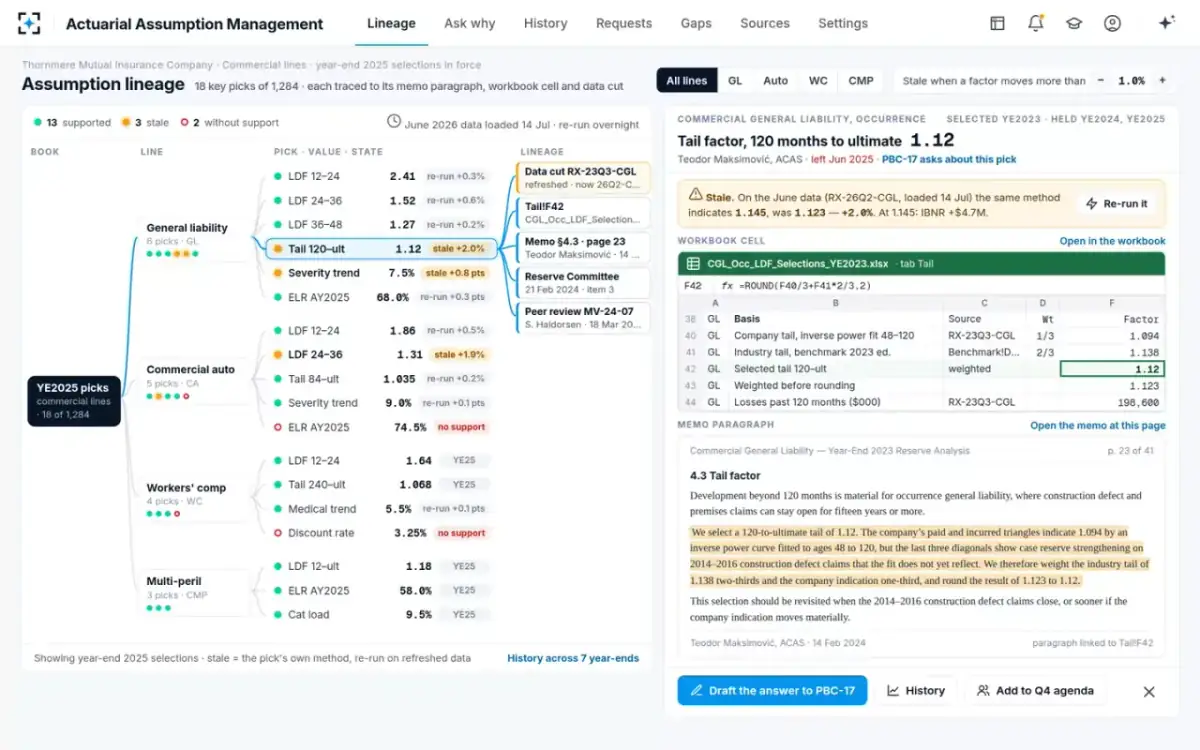
Here is the paragraph a fictional reserving actuary actually wrote for the sample tail, as it sits in the year-end 2023 memo in Actuarial Assumption Management: "We select a 120-to-ultimate tail of 1.12. The company's paid and incurred triangles indicate 1.094 by an inverse power curve fitted to ages 48 to 120, but the last three diagonals show case reserve strengthening on 2014–2016 construction defect claims that the fit does not yet reflect. We therefore weight the industry tail of 1.138 two-thirds and the company indication one-third, and round the result of 1.123 to 1.12." The memo adds: "This selection should be revisited when the 2014–2016 construction defect claims close, or sooner if the company indication moves materially."
Scored against the template, it is a good paragraph. It has the pick, the indications, a genuine reason and a reopening condition: elements 1, 3, 5 and part of 7. It lacks the version of the workbook, the data date, the alternatives considered, the sensitivity and the prior selection. Those five gaps are typical, and they are the ones an auditor asks about first, because they are the ones that let the reviewer re-perform the work.
The memo paragraph beside the cell it explains
What is the difference between an actuarial memo and an actuarial report?
A memo is one document; an actuarial report, in ASOP 41's sense, is "The set of actuarial documents that the actuary determines to be relevant to specific actuarial findings that is available to an intended user". A reserve memo is usually one piece of the report or of the workpapers behind it. The Statement of Actuarial Opinion is a third thing, with different readers and different confidentiality.
Selection memo, Actuarial Report and Statement of Actuarial Opinion
Selection memo: The actuary’s written support for specific selections, often one section per line
Actuarial Report and the opinion: The report and workpapers supporting the appointed actuary’s opinion; the opinion itself is a short filed statement
Selection memo: Company practice; the ASOPs set its standard
Actuarial Report and the opinion: NAIC Model #745 and the annual statement instructions
Selection memo: Peer reviewers, the auditor’s actuary, successors
Actuarial Report and the opinion: Regulators and examiners; the opinion is read by anyone
Selection memo: Internal; produced to auditors and examiners on request
Actuarial Report and the opinion: Report, workpapers and opinion summary confidential by law; the opinion is a public document
Selection memo: Each selection, its data, indications, reason and sensitivity
Actuarial Report and the opinion: Enough for an objective appraisal of the opinion, with the memo as support
Model #745 sets the confidentiality: the Statement of Actuarial Opinion is public, while the Actuarial Report, workpapers and Actuarial Opinion Summary held by the department are confidential and privileged (the section is quoted in are statements of actuarial opinion public). The word memo is also used for rate filings, where an actuarial memorandum explains the rates to a regulator; the guide to the actuarial memorandum for a rate filing covers that document.
How long should an actuarial memo be?
As long as the seven elements need for the material selections, and no longer. Material is the operative word: a development factor at an age where little remains to develop does not need the sensitivity paragraph a tail does. ASOP 41 allows a report to be limited by circumstances but adds that "the actuary must be prepared to identify such circumstances and justify limiting the content". A short memo that names the workbook version, the data and the minutes where the rest lives can pass the test; a long one that restates the triangle without a reason cannot.
The sample's year-end 2023 general liability memo runs to 41 pages, with the tail on page 23. Length did not make it complete: the five gaps above were in a long memo. What makes a memo short and complete is linking, not prose.
Before the memo is signed: seven checks, one per element
- Every material pick names its cell and workbook version
Open the cell from the reference alone.
- The data has a valuation date and a reconciliation reference
Accounting, valuation and review dates are stated.
- Each indication is reproducible
Method, ages, averages or fit, and weights are written down.
- Alternatives are named
Including any method computed and set aside, with why.
- The reason names what was seen
No sentence rests on “judgment” or “consistent with” alone.
- Sensitivity is stated where material
In dollars, on the losses the pick applies to.
- The change from last year and the acceptance are written down
Prior value, reason for change, committee date, peer review, and what would reopen it.
Who signs an actuarial memo?
The actuary responsible for the selections in it. ASOP 41 says a communication "should clearly identify the actuary responsible for it", and where several actuaries issue it jointly, all of them (section 3.1.4). In practice the line's reserving actuary writes and signs the selection memo, a peer reviewer signs off on the review, and the appointed actuary relies on the memo in forming the opinion. When the appointed actuary relies on another person's analysis for a material portion of the reserves, NAIC's 2026 instructions now require disclosures in the Actuarial Report, including whether and to what extent the appointed actuary reviewed it (NAIC AOWG 2026 guidance).
The signature is also what makes a memo useful years later. A selection whose author left can still be explained if the memo is signed, dated and linked to its cell; the guide on actuarial knowledge management software covers what a team brings to make that true across a whole book.
Keeping the memo tied to its workbook with Actuarial Assumption Management
The template above is a writing discipline. What breaks it over time is not the writing but the links: workbooks are re-saved, folders move, picks are revised in committee after the memo is issued, and later memos say "no change; see YE2023 memo §4.3". Actuarial Assumption Management keeps those links for the whole book. Its agents read every memo by paragraph and every workbook by cell and version, link each pick to its paragraph, data cut, minutes and peer review, and match the pick across year-ends. When data refreshes, the pick's original method is re-run and a move past the company's threshold is flagged. In the sample, the tail's indication reached 1.145 on June 2026 data, 2.0% above the 1.123 the memo was written on.
A support note drafted from the memo, with the original pages and cells attached
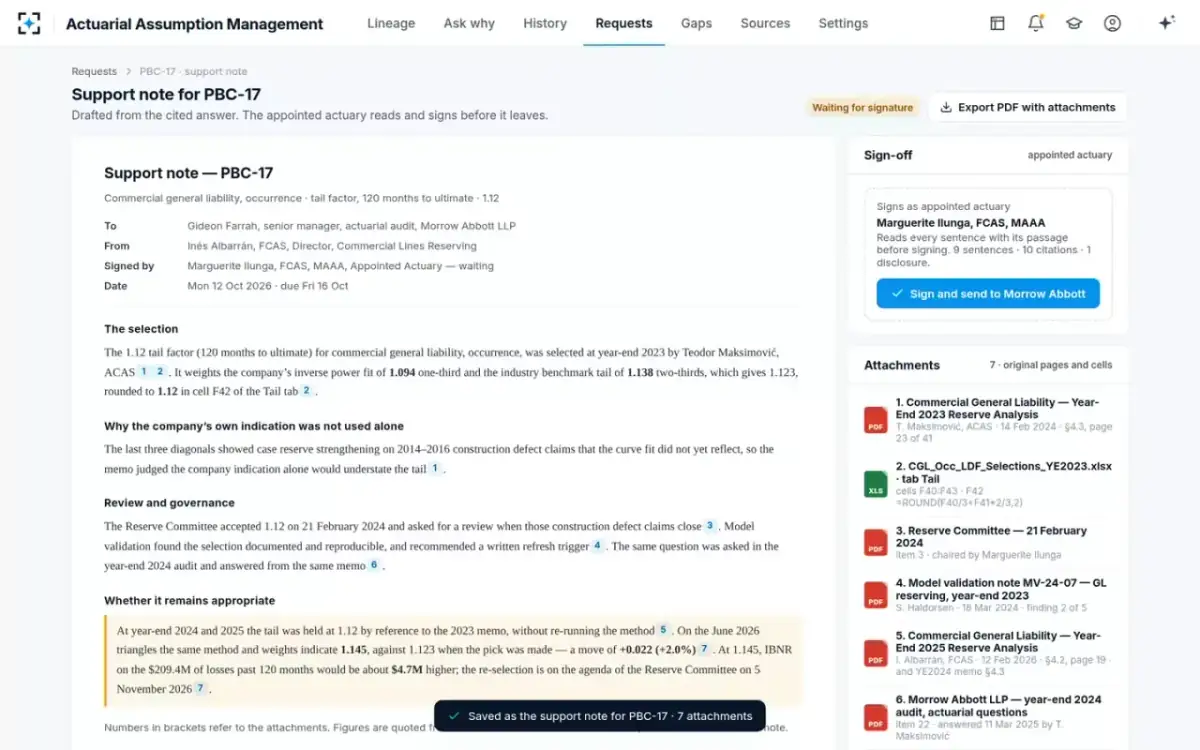
The solution does not write the memo. Agents never select or change a pick and never supply a reason a person did not write; a pick with no paragraph is reported as a gap for its owner. The seven elements remain the actuary's to write. How the most leveraged of them, the tail, should be kept beside its factor is the subject of the tail factor selection tool guide.
Questions people ask
Is there a required format for an actuarial memo?
No standard prescribes a format for an internal selection memo. ASOP 41 sets the test it must meet and the identification it must carry, and ASOP 43 adds reserving disclosures such as the accounting, valuation and review dates. The seven-element structure here is one way to meet them.
Should the memo include the triangles?
It should identify them precisely, by extract and valuation date, and point to where they are kept; exhibits often carry the triangles themselves. What a reader cannot do without is the link from each selected factor to the triangle and cell it came from.
How should a memo describe a selection held from last year?
With the reason for holding, not just the hold itself. ASOP 43 asks the actuary to consider whether chosen methods remain appropriate even when they are not changed. A held pick should say where its original support is, whether the original method was re-run on new data, and what it showed.
What dates belong in a reserve memo?
Three, under ASOP 43: the accounting date that separates paid from unpaid, the valuation date of the data, and the review date through which other information was considered. The standard's own example puts all three in one sentence: an estimate as of a year-end, based on data evaluated a month earlier and information received through mid-January.
Can a memo template be automated?
The structure and the retrieval can; the reason cannot. A tool can fill the pick, version, data, indications and sensitivity from the workbook, and link minutes and reviews, but the sentence saying what the actuary saw and why it moved the pick has to come from the actuary.