Yes, statements of actuarial opinion are public. Under the NAIC's Property and Casualty Actuarial Opinion Model Law (#745), on which state laws are based, the Statement of Actuarial Opinion "shall be provided with the Annual Statement" and "shall be treated as a public document." The documents behind it are not: the Actuarial Opinion Summary, the Actuarial Report and the actuary's workpapers, once in the insurance department's hands, are "confidential by law and privileged." That split decides what an analyst, broker, journalist or competitor's actuary can learn about an insurer's reserves. The public opinion shows the appointed actuary's conclusion, materiality standard, risk view and named risk factors; the confidential documents show the numbers behind them, such as the actuary's point estimate and range. Keeping the two apart is part of the appointed actuary's job, and Botminds' Actuarial Opinion & Report Automation, which drafts the public opinion and the confidential report from the same reserve analysis, is built so that a figure meant for one is never pasted into the other unnoticed.
Public or confidential, document by document
Who can read it: Anyone. Filed with the annual statement, attached to page 1.
The rule that decides it: Model #745 section 3A: "shall be treated as a public document."
Who can read it: Anyone, as part of the opinion; the data also feeds an NAIC database.
The rule that decides it: Filed in print and data-capture format (instructions ¶10; AOWG 2026 II.K.1).
Who can read it: The domiciliary regulator; another state on request if it can keep it confidential.
The rule that decides it: Model #745 section 3B; summary instructions ¶¶1 and 4: "not intended for public inspection."
Who can read it: The board; regulators on request or at examination.
The rule that decides it: Instructions ¶7: to be "held confidential and not be intended for public inspection"; Model #745 section 3B.
Who can read it: Regulators, for seven years.
The rule that decides it: Instructions ¶7; Model #745 section 3B.
Who can read it: The board; regulators on request or at examination.
The rule that decides it: Instructions ¶1: considered workpapers.
Who can read it: The public, through the CAS and SOA.
The rule that decides it: Instructions ¶1: the CAS and SOA "make available the attestations to the public."
Are statements of actuarial opinion public?
Yes, in every state that follows the model law, and by design. The NAIC model is explicit about the opinion and equally explicit about the rest. Section 3B makes the report, workpapers and summary, "and any other material provided by the company to the commissioner in connection with" them, confidential and privileged, exempt from open-records requests, not subject to subpoena, and not subject to discovery or admissible in evidence in any private civil action (NAIC Model #745, section 3). Section 3C adds that the commissioner and staff cannot be made to testify about them in a private civil action, and section 3E says sharing them with another regulator waives no privilege.
"The Statement of Actuarial Opinion shall be provided with the Annual Statement in accordance with the appropriate NAIC Property and Casualty Annual Statement Instructions and shall be treated as a public document."
NAIC Property and Casualty Actuarial Opinion Model Law (#745), section 3A
The reason for the split is practical. The opinion is meant to be read by policyholders, the market and other regulators, so it says what the actuary concluded and why the conclusion might prove wrong. The supporting documents contain what the instructions call "significant proprietary information": reserve estimates by line, the gap between management's number and the actuary's, the reasoning behind each assumption. Making those public would discourage candour in exactly the documents regulators rely on most.
Where can I find an insurer's statement of actuarial opinion?
With the insurer's annual statement. The instructions require the opinion to be "included with or attached to Page 1 of the Annual Statement," so it travels with the statutory filing, which state law sets for 1 March. Three routes reach it. The NAIC sells filed statements: its InsData service lets users purchase individual financial statements "of more than 4,800 insurance companies in a PDF format," with "up to 10 years of annual and quarterly filings" (NAIC, financial data products). The insurer's domiciliary insurance department holds the filing and may provide it under the state's public records law.
The public trail of one opinion
4,800+
insurers whose filed statements the NAIC sells as PDFs through InsData
NAIC
10years
of annual and quarterly filings InsData offers
NAIC
1Mar
when the opinion is filed with the annual statement
State law, e.g. Minnesota § 60A.13
7years
the report and workpapers stay available to regulators, never to the public
NAIC instructions ¶7
Two cautions. Check that the PDF you obtain is the full filing with the opinion attached, and that it is the latest version: an opinion found in error after filing is amended, and the working group asks that a revised opinion say it is amended, explain why and carry the date of revision. And read the opinion beside Schedule P, which is in the same statement and shows ten years of loss development by line, the record against which any opinion's risk comments can be checked.
Is the opinion filed with the NAIC?
Yes, as part of the annual statement, and its two exhibits are also captured as data. The instructions require Exhibits A and B "to be filed in both print and data capture format," and the working group explains that data capture "allows for the population of an NAIC database that contains qualitative information, and financial data" (AOWG 2026, section II.K.1). That is why Exhibit B repeats items that are already in the text, such as the actuary's name, designation code and opinion type: so they can be queried across companies.
The summary is treated the opposite way. The summary instructions say it "should not be filed with the NAIC and should be kept separate from any copy of the Statement of Actuarial Opinion," and the working group advises actuaries to give it to company staff separately and "avoid attaching the related SAO to the AOS." The Academy's practice note reports that appointed actuaries commonly repeat these instructions in the email or cover letter that transmits it.
Is the Actuarial Opinion Summary confidential?
Yes, in states that follow the model law and the NAIC instructions, which describe it as "a confidential document" to be "clearly labeled and identified prominently as such." It goes to the domiciliary state by 15 March, or the state's later date, and to another state within 15 days of a request, no earlier than 15 March, only if that state can show it is able to preserve the document's confidentiality.
What the confidential summary holds that the public opinion does not
| In the summary | In the public opinion instead |
|---|---|
| Range of reasonable estimates, net and gross | Only that carried reserves are inside it (a reasonable opinion), or the minimum or maximum if deficient or redundant |
| Point estimate, net and gross | Nothing |
| Carried reserves and the gap to the actuary's estimates | Carried amounts in Exhibit A; no difference shown |
| Causes of persistent adverse development: over 5% of prior year-end surplus in three or more of the last five years | Comments on unusual IRIS reserve ratios, which are public |
Not every state works the same way. The working group notes that "Not all states have enacted" Model #745 and recommends preparing the summary regardless, so it is ready if a state with confidentiality safeguards asks for it. New York is an example of a different mechanism: in a 2015 circular letter, the Department of Financial Services told domestic property and casualty insurers to file the summary with it by 15 March, and said an insurer that believes its records contain trade secrets "may request" that the Department except them from disclosure under the state's Public Officers Law, in which case the insurer is notified and may respond if someone asks for them (NY DFS, Supplement No. 7 to Circular Letter No. 22 (2005)).
Who can see the actuarial report, and can a regulator share it?
The board must have it; the domiciliary regulator can require it; other regulators can receive it under confidentiality agreements. The instructions say the report and the opinion "must be made available to the Board of Directors," and that the report must be available by 1 May or within two weeks of a commissioner's request: "It is expected that the Actuarial Report be held confidential and not be intended for public inspection." Model #745 lets the commissioner share confidential material with other state, federal and international regulators, with the NAIC and with law enforcement, provided the recipient agrees to keep it confidential and has the legal authority to do so (section 3D).
One further route matters to actuaries. The commissioner may release the documents to the Actuarial Board for Counseling and Discipline "so long as the material is required for the purpose of professional disciplinary proceedings" and the board's procedures preserve confidentiality (section 3B(2)). A weak report, in other words, is not only seen by the regulator. What the report must contain, and what it costs to write properly, is covered in actuarial report template: what one year-end report costs to write.
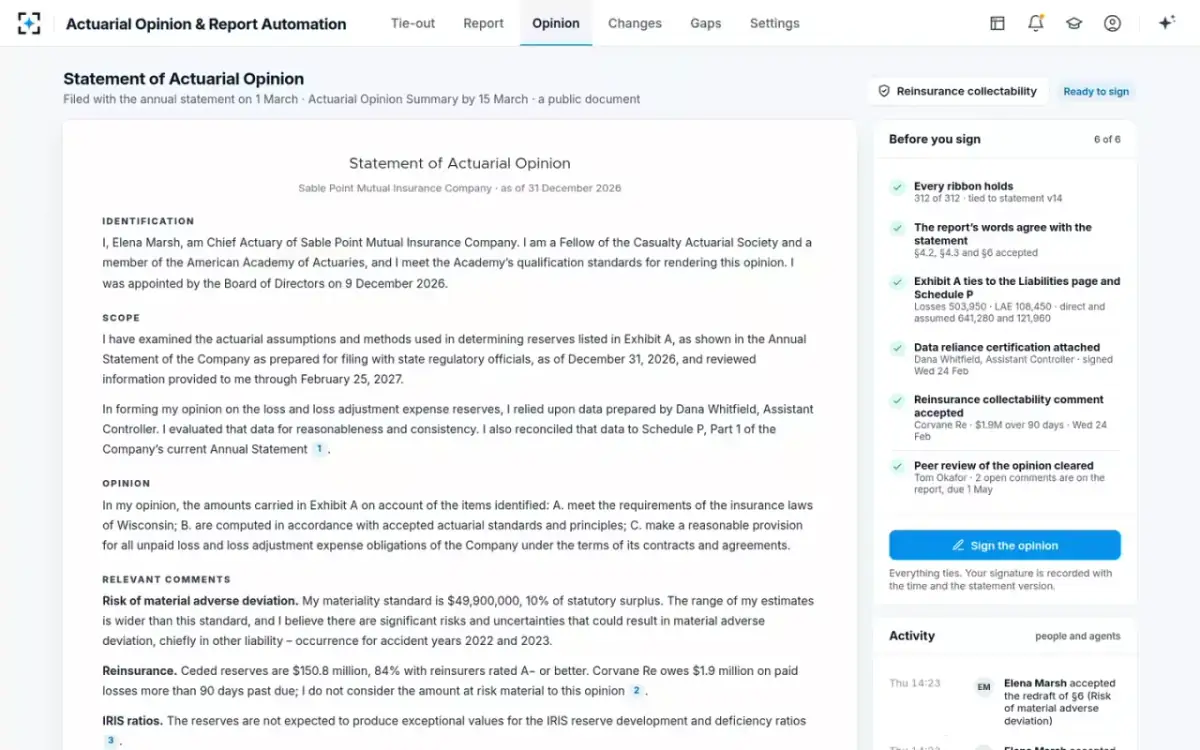
The opinion screen labels its document as public; the report is kept apart
What can you learn from a public actuarial opinion?
More than most readers expect. Read Exhibit B and the relevant comments, and the opinion tells you who the actuary is and how independent: employee (E) or consultant (C), and designation. It tells you the type of opinion, reasonable, deficient, redundant, qualified or none. It gives the materiality standard in dollars and its basis, and whether the actuary sees a significant risk of material adverse deviation; across opinions, the Academy's practice note says approximately one-third answer yes. It names the company-specific risk factors, comments on reinsurance collectability with any balances over 90 days, explains any unusual IRIS reserve ratio, and discloses significant changes in methods and assumptions. Exhibit B adds statutory surplus, anticipated salvage and subrogation, discount, and reserves for asbestos and environmental claims.
Three readings are especially informative. A small materiality standard makes a "yes" more likely under the ASOP No. 36 test, so a "no" beside an unusually small standard is worth a question. An IRIS comment is rare, since the NAIC's 2025 medians for the reserve development and deficiency ratios across 2,647 companies were at or just below zero (NAIC IRIS ratios, 2025), so its presence and its specificity both say something. And a change of appointed actuary is visible from one year's identification paragraph to the next; the procedure behind it, including the confidential disagreements letter, is set out in the NAIC change in appointed actuary.
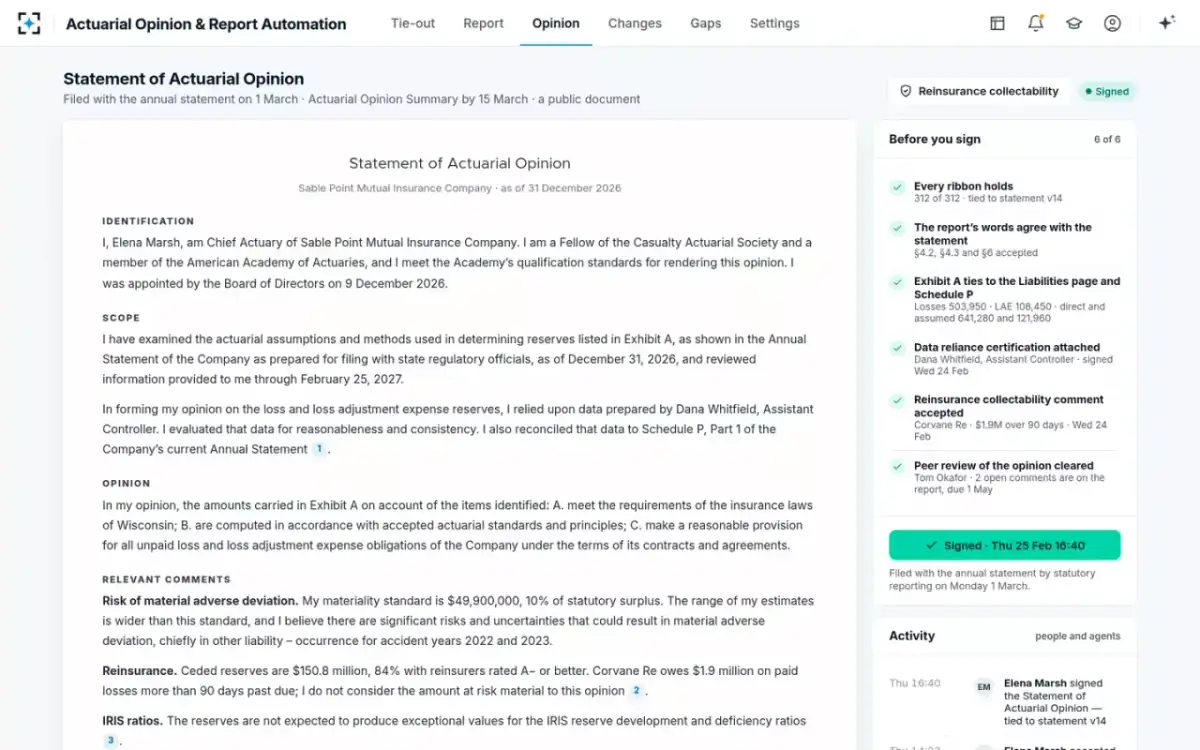
What a reader sees in the risk comment of a signed opinion
How to read a public opinion in ten minutes
Read it beside last year's opinion from the same company and the current Schedule P, in a fixed order, and most of what it can tell you comes out quickly. Start with the identification paragraph and Exhibit B, items 1 to 3: has the actuary changed, moved between employee and consultant, or changed designation? Then the opinion type in the opinion paragraph and item 4, and whether the paragraph opines on anything beyond loss and loss adjustment expense reserves, such as long-duration unearned premium, which from year-end 2026 is shown in Exhibit A whatever its size.
Next, items 5 and 6 with the risk paragraph: the standard in dollars, its basis, the yes or no, and whether the text and the exhibit agree. Compare the standard with last year's; a basis that changes from surplus to reserves, or a standard that falls while surplus rose, deserves a question. Then the named risk factors: a line, a set of accident years, a program, a reinsurance change. Generic factors are a weakness the instructions themselves rule out. Then reinsurance, for balances over 90 days and disputes, and the IRIS comment if there is one. Finish with the methods paragraph: a significant change in assumptions or methods should be described there, and a newly appointed actuary who did not review the predecessor's work should say so. Each of these is a sentence or a number on the page; none needs access to the confidential documents.
What does a qualified actuarial opinion mean?
It means the actuary could not reach a conclusion on certain items, but could on the rest. Under the instructions and ASOP No. 36, a qualified opinion is issued when the reserves for an item "are in question because they cannot be reasonably estimated or the Appointed Actuary is unable to render an opinion on those items." The opinion must name the item, give the reasons and the amount if the company disclosed it, and say whether the remaining reserves make a reasonable provision. An actuary need not qualify an opinion over an item that is not likely to be material. A qualified opinion is coded Q in Exhibit B, item 4, and is different from "no opinion," which is used when data or analysis are too deficient to reach any conclusion and must give the reasons.
For an outside reader, the type is the first thing to check and the last thing to over-read. A reasonable opinion with a "yes" on adverse deviation is a legitimate combination; the risk of material adverse deviation, in plain words explains why.
Questions people ask
Can I get a copy of another insurer's Actuarial Report?
No. Under Model #745 the report, workpapers and summary held by the insurance department are confidential and privileged, exempt from open-records laws, not subject to subpoena and not admissible in private civil actions. Only the opinion is public.
Is the statement of actuarial opinion audited?
No; it is the appointed actuary's professional opinion. The independent CPA audits the statutory financial statements and tests data, and the working group distinguishes that testing, which generally covers current calendar-year activity, from the actuary's reconciliation of cumulative data to Schedule P.
Are actuaries' continuing education records public?
The attestations are. Appointed actuaries subject to the U.S. Qualification Standards attest each year to meeting the continuing education requirement, and under the instructions the CAS and SOA make the attestations available to the public. The detailed log is not; qualification documentation is a workpaper.
Do life insurers file a public actuarial opinion too?
They file their own actuarial opinions under different rules and standards, such as ASOP No. 22 for opinions based on asset adequacy analysis. This guide covers the property and casualty opinion under Model #745.
Can the confidential summary be attached to the opinion by mistake?
It can, which is why the working group advises giving the summary to company staff separately and not attaching the opinion to it, and why the summary should be labelled confidential prominently. A drafting process that keeps the estimates in the report and out of the opinion's text reduces the risk further.