The NAIC annual statement instructions for 2026 change the property and casualty actuarial opinion in seven ways: a revised definition of Accepted Actuarial Designation; disclosure of unearned premium for P&C long-duration contracts in Exhibit A whatever its size, with clarifying comments when it is non-zero but immaterial; a Schedule P reconciliation that must compare the data the appointed actuary used with Schedule P; new Actuarial Report disclosures when someone else's analysis covers a material part of the reserves; and two changes to Exhibit B, one line removed and one clarified. They apply to statements of actuarial opinion on year-end 2026 reserves, filed with the annual statement by 1 March 2027. Each is small; together they touch the qualification wording, both exhibits, the data-capture file and three report sections, in a season when the statement itself is still moving. Botminds' Actuarial Opinion & Report Automation drafts the report and opinion from the 2026 instructions' illustrative wording and checks them against the instructions paragraph by paragraph, so the changes become items on a gap list rather than surprises in review.
Seven changes for 2026, seven tasks before 1 March
- 1 · Accepted Actuarial Designation redefined → appointed actuary
Check the designation wording in the identification paragraph and qualification documentation, and the code in Exhibit B, item 3, against the new conditions for FSAs and the renamed CAS Exam 7.
- 2 · Long-duration unearned premium shown regardless of materiality → statutory reporting and appointed actuary
Populate Exhibit A, items 7 and 8, every year; a blank is no longer an option.
- 3 · Clarifying comments when those amounts are non-zero but immaterial → appointed actuary
Say in scope, opinion or relevant comments that no opinion is expressed on them, and on what basis.
- 4 · Schedule P reconciliation compares the actuary's data → appointed actuary and reserving data owner
Rebuild the reconciliation exhibit from the data used in the analysis; if someone else prepared it, name them in the report and document your review.
- 5 · Report disclosures for another party's analysis → appointed actuary
For each material portion: dollars and share of reserves covered, how far you reviewed it, and what you concluded.
- 6 · Pools line removed from Exhibit B → statutory reporting
Update the data-capture template; the pools disclosure (line 10 in the 2025 form) goes.
- 7 · Extended reporting line clarified → appointed actuary and statutory reporting
Recompute Exhibit B, item 11, across all P&C lines; it should be at least Schedule P Interrogatories item 1.2.
What changed in the 2026 actuarial opinion instructions?
The working group lists the seven at the top of its 2026 guidance, which "supplements the NAIC Annual Statement Instructions—Property/Casualty" and is published free on the NAIC's site (AOWG, 2026 Regulatory Guidance). None changes the opinion's structure: four designated sections, Exhibits A and B, the five types of opinion and the relevant comment topics all stand. What changes is what must be disclosed and documented. The Academy's 2025 practice note had flagged five of them a year early, as changes "expected to be made to the 2026 NAIC SAO Instructions" (Academy practice note 2025, section 1.6), so a team that read it last winter has had time; one that did not has a season.
What is an Accepted Actuarial Designation, and what changed for 2026?
It is item (ii) of the NAIC's three-part definition of a qualified actuary: a designation accepted as meeting the NAIC's minimum P&C educational standards for an appointed actuary, with conditions. The 2025 instructions accepted the FCAS with CAS Exam 6 (United States), the ACAS with Exam 6 and Exam 7, and the FSA through the general insurance track with the U.S. Financial and Regulatory Environment exam and the Advanced Topics in General Insurance exam; the 2025 text already carried a note that an FSA qualified only if earned under the requirements in place through May 2025, because the SOA's pathway was changing.
The 2026 change follows the working group's periodic review of SOA and CAS education against the NAIC knowledge statements, done in 2024–2025 and last done in 2018–2019, with subject matter experts proposed by the SOA, CAS and Academy. It specifies the four courses an FSA must complete under the new pathway, edits the exam substitution table for FSAs who completed courses under the old one, and updates the title of CAS Exam 7. The guidance's sample wording shows both: an FSA whose education includes "GI 101 Ratemaking and Reserving; GI 201 Operational, Financial, Regulatory, and Legal; GI 301 Further Topics in General Insurance; and GI 302 General Insurance in the U.S.," and an ACAS with "Exam 7 – Advanced Estimation of Claims Liabilities." For most FCAS appointed actuaries the task is a wording check; for a new FSA appointee it is the qualification question itself. Appointed actuary responsibilities covers the rest of the definition.
What must the actuarial report say about the Schedule P reconciliation?
From 2026 the instructions say explicitly that the reconciliation documented in the Actuarial Report should compare the data used by the appointed actuary to Schedule P, and they set out the actuary's responsibilities when someone else produced it. The working group's guidance explains the first point: reconciling the data handed to the actuary is not enough, because it does not show that the data used in the analysis ties; the actuary should show that data was not created or lost along the way, commonly by mapping the analysis exhibits to the reconciled data. That guidance is now in paragraph 7C itself.
"In these cases, the 2026 Instructions were amended to require the Appointed Actuary to identify in the Actuarial Report who performed the reconciliation and confirm that the Appointed Actuary reviewed the reconciliation for reasonableness."
NAIC Actuarial Opinion (C) Working Group, 2026 Regulatory Guidance, section II.B
The rest of the regulators' expectations are unchanged and demanding: the finest segmentation that is practical, accident year by accident year, gross and net, with claim counts and earned premium included where they matter and a note for anything left out on purpose. The guidance also distinguishes this work from the CPA's annual data testing, which generally covers current calendar-year activity, while reserving methods use cumulative data. The data-side work is set out in Schedule P reconciliation; the report has to show its result and say who did it.
What disclosures are needed when using another actuary's work?
Two sets now. The opinion already had to name, for an analysis not produced under the appointed actuary's direction and covering a material portion of reserves, the person, their affiliation, their credential if an actuary, and the type of analysis if not. From 2026 the Actuarial Report must add three things: "the dollar amount of the reserves covered by the other's analysis or opinion and the percentage of the total reserves subject to the Appointed Actuary's opinion that these other reserves represent"; whether and how far the appointed actuary reviewed the other's methods, assumptions and arithmetic; and, if reviewed, the conclusions (AOWG 2026, section II.C).
The disclosure matches the judgement ASOP No. 36 already required. Under section 3.4.4 the actuary should use another party's work only when it is reasonable to do so, considering, among other things, "the amount of the reserves covered by another party's analysis or opinion in comparison to the total reserves," the nature of the exposure, how variations in the other estimate could affect the whole opinion, the person's credentials and whether the work complies with applicable standards (ASOP No. 36). The 2026 instructions make the appointed actuary write that judgement down.
What changed in Exhibit B for 2026?
The disclosure of the company's share of voluntary and involuntary underwriting pools' and associations' unpaid losses and loss adjustment expenses is removed, and the extended reporting item is clarified. The renumbering that follows matters for anyone who builds the opinion from last year's file or maps the data-capture output.
Exhibit B items that move between the 2025 form and the 2026 guidance
| Disclosure | 2025 form | 2026, as the guidance refers to it |
|---|---|---|
| Company share of voluntary and involuntary pools and associations | Item 10 | Removed |
| Reserves for extended reporting coverage on claims-made contracts (death, disability or retirement) | Item 12 (12.1 losses and LAE, 12.2 unearned premium) | Item 11 (the guidance refers to Line 11.2); description revised and explained in paragraph 6.C |
| A&H long-duration contracts | Item 13 (13.1 to 13.4) | Item 12; items 12.1 and 12.2 are subsets of Exhibit A items 1 and 2 |
| Scope sentence on disclosure items reflected in the opinion | Items 8 through 13.2 | Items 8 through 12.2 |
The clarified item is easy to understate. The working group says the amount should be "the policy reserve for not-yet-issued extended reporting coverage associated with claims-made contracts that offer coverage at no additional charge in the event of death, disability, or retirement of a natural person insured," that it should be at least the amount in item 1.2 of the Schedule P Interrogatories, and that, unlike the interrogatory, it covers all P&C lines, giving professional liability for architects, engineers and lawyers as examples (section II.K.2). A company that has only ever reported medical professional liability here may need a new calculation.
Long-duration unearned premium: disclosed even when immaterial
Exhibit A, items 7 and 8, carry the direct and assumed and the net unearned premium reserves for P&C long-duration contracts, defined as contracts of 13 months or more that the insurer can neither cancel nor reprice during the term. From 2026, paragraph 4 says these amounts are disclosed "regardless of whether the Appointed Actuary deems the amounts immaterial." If they are non-zero and the actuary does not opine on them, paragraph 5 asks for clarifying comments in the scope, opinion or relevant comments, and the guidance offers wording: a scope sentence limited to loss and loss adjustment expense reserves, and a relevant comment that the amounts "are not material" and that the actuary relied on the company's representation of their reasonableness. When they are material and the opinion includes a point D on them, the report should support the conclusion, for example with the three tests of SSAP No. 65.
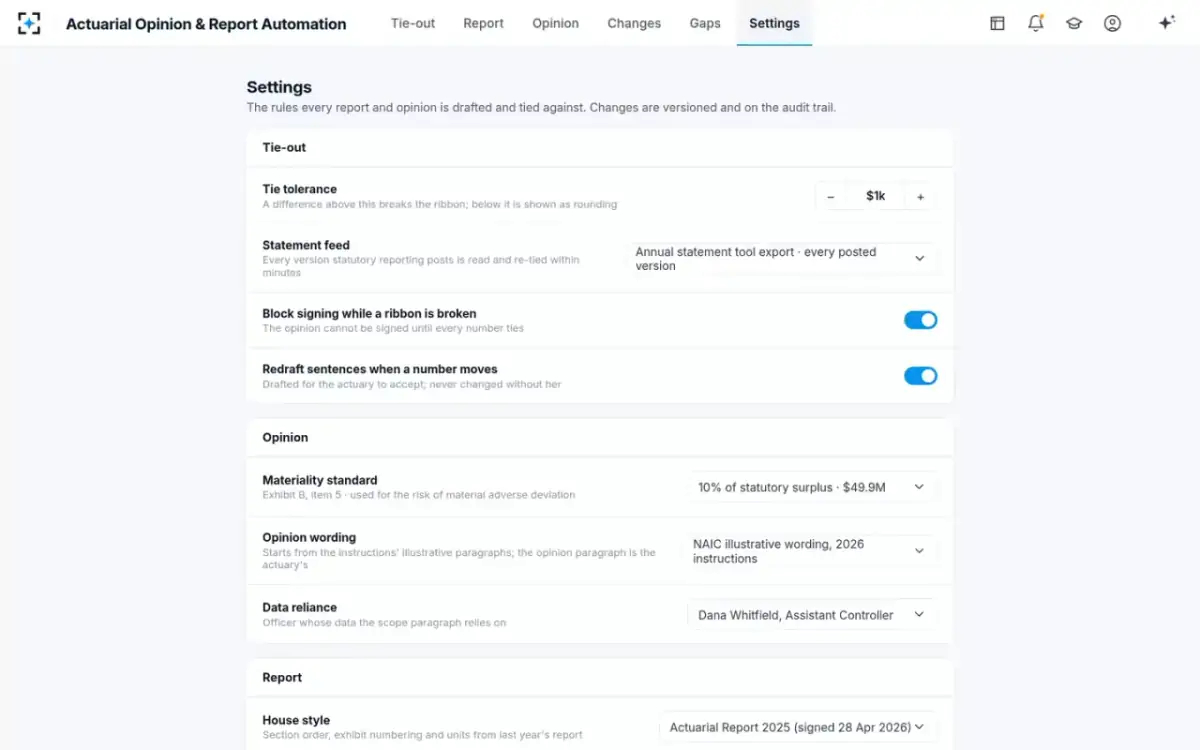
Opinion wording set to the 2026 instructions, before drafting starts
When do the 2026 instructions apply, and where are they?
They apply to opinions on reserves as of 31 December 2026: the opinion filed with the 2026 annual statement by 1 March 2027, the Actuarial Opinion Summary due to the domiciliary state by 15 March 2027, and the Actuarial Report available by 1 May 2027. The instructions are part of the NAIC's Annual Statement Instructions—Property/Casualty, published by the NAIC; the working group's guidance summarising the changes is free on the NAIC site, and the American Academy of Actuaries' 2025 practice note reproduces the 2025 opinion instructions in an appendix; check actuary.org for a 2026 edition.
From early notice to filing: the 2026 changes on one calendar
- Practice note flags expected changesDec 2025
- Guidance publishedOct 2026
- Year-end work
- 1 Mar
- Before
- Exposed10 Feb
- ASOP 43 and 41 revisions in task forcetask forces at work
What is new for year-end 2026, and what is only proposed?
Three things often mentioned alongside the 2026 instructions are not part of them. First, the NAIC Casualty Actuarial and Statistical (C) Task Force exposed a rewrite of the Schedule P instructions, known as Phase 2, on 10 February 2026; it is a proposal. The Academy's casualty committee commented on 26 March 2026, warning among other things that intercompany pooling stops Schedule P from tying to the rest of the statement and that one claim-count instruction could be read as counting reopened claims twice (Academy comment letter, March 2026; both points are read in Schedule P reconciliation). Nothing in it changes this year-end's reconciliation.
Second, ASOP No. 36, revised in March 2024, has applied to opinions issued since 1 October 2024; it is not new for 2026, though a template written before it may lack its expanded disclosure on the risk of material adverse deviation. The risk of material adverse deviation, in plain words covers it. Third, the Actuarial Standards Board approved a proposal in 2025 to revise ASOP No. 43 on unpaid claim estimates, with a task force being formed (ASB annual report, 2025), and it exposed a third draft revision of ASOP No. 41 on actuarial communications in March 2026, with comments due by 1 June 2026 (ASOP No. 41, third exposure draft); neither has an adopted revision.
The regulators' standing expectations also carry over: company-specific comments on unusual IRIS ratios rather than "adverse development," support for every assumption rather than an appeal to judgement, change-in-estimate exhibits at a meaningful level of detail, and a narrative that conveys uncertainty and any gap between the actuary's estimates and the carried reserves.
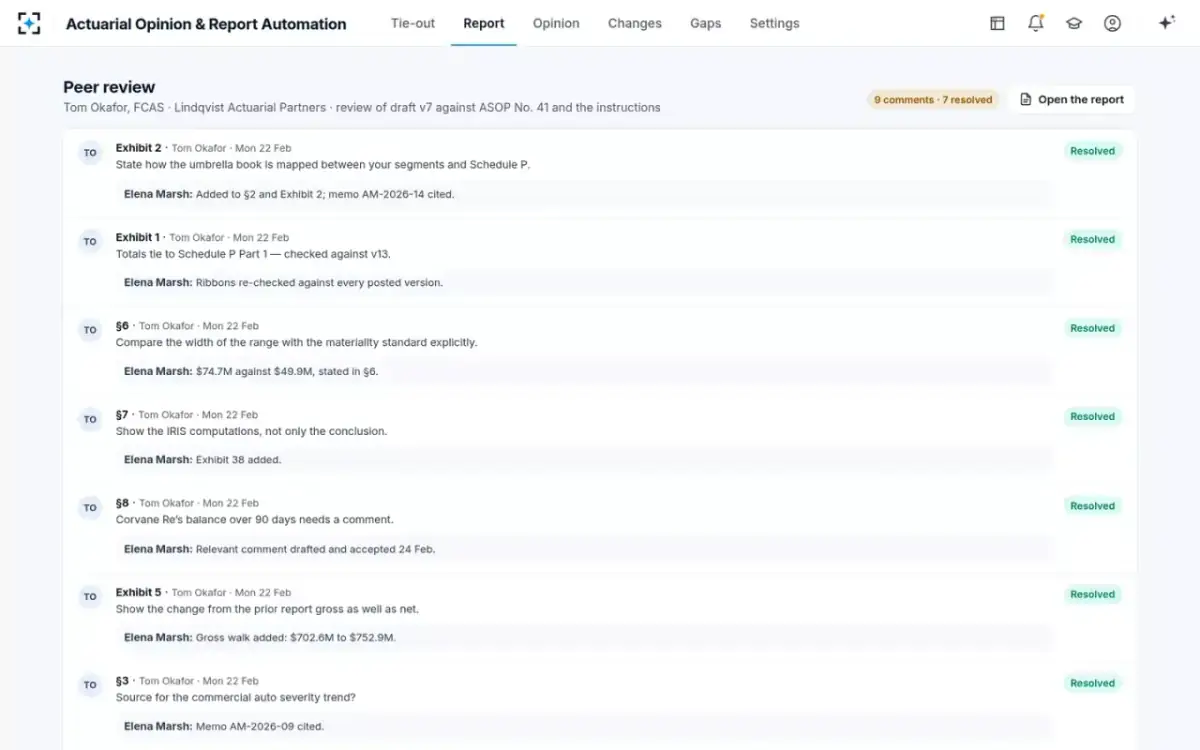
A peer review that checks the year's requirements, comment by comment
Questions people ask
Is the Schedule P Phase 2 rewrite in force for 2026?
No. It was exposed for comment by the NAIC's Casualty Actuarial and Statistical (C) Task Force on 10 February 2026, and the Academy commented on 26 March 2026. Treat it as a proposal until the NAIC adopts it.
Do I need new qualification documentation for 2026?
Only on an initial appointment: since year-end 2024 opinions, qualification documentation goes to the board at initial appointment rather than annually. The 2026 change to Accepted Actuarial Designation may still require a wording change where the identification paragraph describes the designation.
Did the 2026 instructions change the opinion types or the RMAD requirement?
No. The five opinion types are the same, and so is the duty to give a materiality standard and a yes-or-no answer on the risk of material adverse deviation. The 2024 revision of ASOP No. 36 already applies.
Did anything change for the Actuarial Opinion Summary?
The seven listed changes concern the opinion and the report. The summary's guidance carries over: it is confidential, not submitted to the NAIC, due to the domiciliary state by 15 March, and should present the actuary's estimates and ranges consistently with the report.
What happens if the 2026 changes are missed?
A missing disclosure is usually raised in the department's review or examination, and a revised opinion may be appropriate. The working group says a revised opinion should state that it is amended, explain why and give the date of revision, and that it would be prudent to contact the regulator about problems even when they do not meet the instructions' definition of "in error."