A statement of actuarial opinion is the appointed actuary's signed opinion, filed with a property and casualty insurer's annual statement, on whether the reserves the company carries make a reasonable provision for its unpaid losses and loss adjustment expenses. A good example has four clearly marked sections, identification, scope, opinion and relevant comments, followed by Exhibit A, which lists the amounts opined on, and Exhibit B, which carries the disclosures. The example below is short, illustrative and deliberately flawed: we planted ten errors of the kind regulators, peer reviewers and examiners find. Opinions are hard to get right because they are signed in the last days before the 1 March filing, against a statement that is still moving, and most errors are small inconsistencies rather than bad judgement. Botminds' Actuarial Opinion & Report Automation drafts the report and the opinion from the reserve analysis and checks both against the statement and the instructions, so that a reviewer's time goes to the judgement. Planting errors is the quickest way to test any review process, including that one.
An illustrative statement of actuarial opinion, with ten errors planted
Statement of Actuarial Opinion · Harbourline Example Mutual Insurance Company · as of December 31, 2026
Identification1
I, [name], FCAS, MAAA, am the Vice President and Actuary of Harbourline Example Mutual Insurance Company. I meet the definition of a Qualified Actuary in the NAIC Annual Statement Instructions.
Scope23
I have examined the actuarial assumptions and methods used in determining reserves listed in Exhibit A, as shown in the Annual Statement of the Company as prepared for filing with state regulatory officials, as of December 31, 2026. In forming my opinion on the loss and loss adjustment expense reserves, I relied upon data prepared by the Company. I evaluated that data for reasonableness and consistency. I also reconciled that data to Schedule P, Part 1 of the Company's current Annual Statement.
Opinion
In my opinion, the amounts carried in Exhibit A on account of the items identified: A. meet the requirements of the insurance laws of [state]; B. are computed in accordance with accepted actuarial standards; C. make a reasonable provision for all unpaid loss and loss adjustment expense obligations of the Company under the terms of its contracts and agreements.
Relevant comments: risk factors7
The Company's reserves are subject to uncertainty from economic changes, judicial decisions, regulatory actions and social inflation.
Relevant comments: adverse deviation6
My materiality standard is 10% of statutory surplus, or $18.4 million. I believe there are significant risks and uncertainties that could result in material adverse deviation.
Relevant comments: IRIS8
The Company's One-Year Reserve Development to Surplus ratio is 23%, which is outside the usual range, due to adverse development.
Relevant comments: reinsurance9
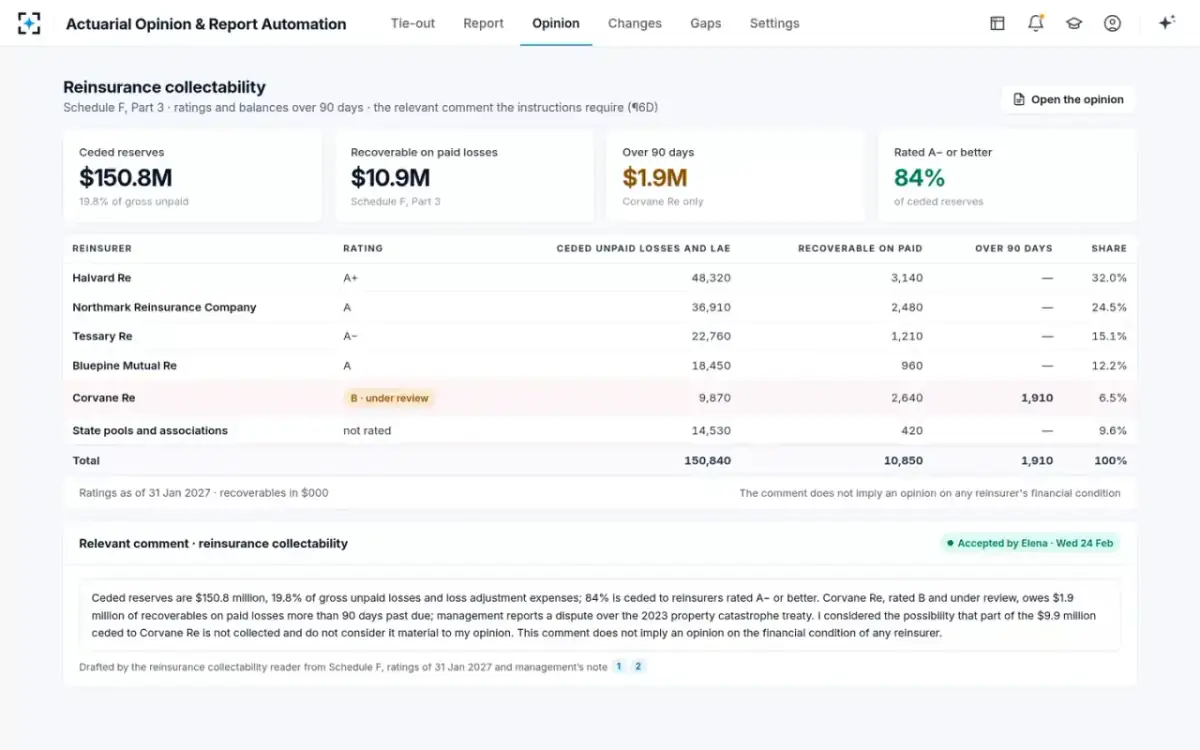
Ceded reserves are $31.2 million. All reinsurers are rated A- or better and I am not aware of any collectability problems.
Relevant comments: methods and assumptions10
There have been no significant changes in actuarial assumptions or methods from those previously employed.
Exhibit A45
Item 3, unpaid losses, direct and assumed: $142,618,000 (the Schedule P, Part 1 Summary shows $142,619 thousand). Items 7 and 8, unearned premium for P&C long-duration contracts: left blank as immaterial.
Exhibit B6
Item 4: R. Item 5: $18,400,000. Item 6: No.
What is a statement of actuarial opinion?
It is the opinion every property and casualty insurer must file each year under state law based on the NAIC's Property and Casualty Actuarial Opinion Model Law (#745), "unless otherwise exempted by the domiciliary commissioner." The instructions put it with page 1 of the annual statement, so it is due with the statement, which state law sets for 1 March. Model #745 makes the opinion a public document, while the supporting Actuarial Opinion Summary and Actuarial Report are confidential; whether statements of actuarial opinion are public, and what an outsider can learn, is its own subject.
The opinion takes one of five types under the instructions and ASOP No. 36: reasonable provision, deficient or inadequate, redundant or excessive, qualified, or no opinion. A deficient opinion must disclose the minimum amount the actuary believes reasonable, a redundant one the maximum. A qualified opinion names the item in question, the reason and the amount, and says whether the rest is reasonable. The type is coded in Exhibit B, item 4, as R, I, E, Q or N.
What are the sections of a statement of actuarial opinion?
Four, and the instructions say they "must be clearly designated." Each has its own job.
Identification says who the actuary is: the relationship to the company, the qualifications for acting as appointed actuary, the date of appointment, and that the board made the appointment (paragraph 3). Scope lists the reserves in Exhibit A, gives the as-of date and the review date, names the officer whose data the actuary relied on, and states that the actuary evaluated that data for reasonableness and consistency and reconciled it to Schedule P, Part 1 (paragraph 4). Opinion states the conclusion; the illustrative sentence covers three points, that the amounts meet the state's insurance laws, are computed in accordance with accepted actuarial standards, and make a reasonable provision for unpaid loss and loss adjustment expense obligations (paragraph 5). Relevant comments cover company-specific risk factors, the risk of material adverse deviation, the remaining Exhibit B items, reinsurance, unusual IRIS ratios, and changes in methods and assumptions (paragraph 6). The opinion ends with the actuary's signature, printed name, employer, address, telephone, email and the date rendered (paragraph 8).
"The Working Group considers the Relevant Comments paragraphs to be the most valuable information in the SAO."
NAIC Actuarial Opinion (C) Working Group, 2026 Regulatory Guidance
What is Exhibit A in an actuarial opinion?
Exhibit A is the list of amounts the actuary is opining on, filed in print and in a data-capture format that feeds an NAIC database. Its lines come straight from the statement, which makes it the most mechanical part of the opinion and the easiest place for a tie error to survive a hurried review.
Exhibit A: where each line must come from
| Item | What it holds | Where it must tie |
|---|---|---|
| 1 | Unpaid losses | Liabilities, Surplus and Other Funds page, column 1, line 1 |
| 2 | Unpaid loss adjustment expenses | Same page, column 1, line 3 |
| 3 | Unpaid losses, direct and assumed | Schedule P, Part 1 Summary, totals of columns 13 and 15, line 12, times 1,000 |
| 4 | Unpaid loss adjustment expenses, direct and assumed | Schedule P, Part 1 Summary, totals of columns 17, 19 and 21, line 12, times 1,000 |
| 5 | Retroactive reinsurance reserve assumed | The page 3 write-in item |
| 6 | Other loss reserve items opined on | Listed separately |
| 7 and 8 | Unearned premium for P&C long-duration contracts, direct and assumed, and net | Disclosed regardless of materiality from the 2026 instructions |
| 9 | Other premium reserve items opined on | Listed separately, with a relevant comment |
What is Exhibit B in an actuarial opinion?
Exhibit B is the disclosure form, completed for net amounts. Items 1 to 4 repeat what the text says, the actuary's name, whether an employee (E) or consultant (C), the accepted designation (F, A, S, M or O) and the opinion type, so a database can read them. Item 5 is the materiality standard in U.S. dollars; item 6 answers whether there are significant risks that could result in material adverse deviation: yes, no, or not applicable, the last meant only for a company with a 0% share of an intercompany pool. Item 7 is statutory surplus, item 8 anticipated net salvage and subrogation, item 9 tabular and non-tabular discount. The items that follow cover asbestos and environmental reserves, claims-made extended reporting reserves, A&H long-duration contracts and other items.
For year-end 2026 the form changes: the line for the company's share of voluntary and involuntary pools (item 10 in the 2025 form) is removed, and the working group's guidance now refers to the extended reporting item as Item 11 and the A&H long-duration item as Item 12, where the 2025 form numbered them 12 and 13. An opinion built from last year's template with the old numbering is the most predictable error of the season; the 2026 NAIC annual statement instructions sets out all seven changes.
Ten planted errors, and the rule each one breaks
Each error in the example is small, plausible and tied to a specific rule. A review process that catches all ten is reading the opinion against the instructions, the statement and the report; one that catches three is reading for tone.
The ten errors in the example, with the rule each breaks
- 1 · Identification omits the date of appointment and that the board made it
Paragraph 3 requires both, as well as the relationship to the company and the qualifications.
- 2 · Scope has no review date
The illustrative sentence ends "and reviewed information provided to me through XXX date"; ASOP No. 36 requires the review date to be disclosed.
- 3 · Scope relies on data "prepared by the Company" with no officer named
The illustrative paragraph names the officer and title whose data was relied on.
- 4 · Exhibit A, item 3, is $1,000 off Schedule P
Item 3 should equal the Part 1 Summary, columns 13 and 15, line 12, times 1,000. A $1k difference is small, but it is a tie that does not hold.
- 5 · Exhibit A, items 7 and 8, left blank as immaterial
From 2026 these amounts are disclosed regardless of materiality; if non-zero but immaterial, the opinion adds clarifying comments.
- 6 · The text says there is a significant risk of material adverse deviation; Exhibit B, item 6, says No
Regulators expect item 6 to be consistent with the relevant comments; the data capture is what their database reads.
- 7 · Risk factors are general
The instructions rule out general statements about economic, judicial, regulatory, political or social risk that apply to every insurer; the paragraph must name this company’s own conditions.
- 8 · An unusual IRIS ratio is explained as "adverse development"
The working group calls that insufficient and expects the company-specific factors that caused the value.
- 9 · The reinsurance comment ignores a balance over 90 days
Before commenting, the actuary should examine Schedule F for recoverables on paid losses over 90 days past due and for regulatory action.
- 10 · "No significant changes" in methods, while the report shows a new tail factor
A significant change belongs in a relevant comment; ASOP No. 36 requires disclosure of changes likely to have a material effect on the estimate.
What are relevant comments in an actuarial opinion, and where do they go wrong?
Relevant comments are the paragraphs that explain the opinion: what could make the reserves wrong, how much would matter, and what the actuary looked at. They go wrong in one of two ways, by being generic or by being inconsistent with the numbers.
Generic is error 7. The instructions want the particular conditions at this company behind the risks the actuary sees, and they exclude broad statements about the economy and the courts (the wording is quoted in the risk of material adverse deviation). The working group adds two points that catch many drafts: the company's own risk factors belong in the comment whichever way the risk conclusion goes, and an actuary who finds none should say so; and the comments should describe significant risk factors as they exist before the company's controls or mitigation, though risk management may affect the conclusion (AOWG 2026, section II.I).
Inconsistent is error 6. In the example, the risk paragraph says there is a significant risk of material adverse deviation and Exhibit B, item 6, says no. Neither is wrong on its own, and a reader who checks each in isolation passes both. The materiality standard has the same exposure: it must appear in the text with its basis and in Exhibit B, item 5, in dollars. How the standard is set, and how the conclusion follows from it, is worked through in the risk of material adverse deviation, in plain words.
The IRIS comment, error 8, is where regulators have been most explicit. The appointed actuary must comment on factors behind unusual values for IRIS ratios 11, 12 or 13, and the working group will not accept strengthening or adverse development as the explanation (its words are quoted in what reserve strengthening is). The ratios are rarely unusual: across 2,647 property and casualty companies in the NAIC's 2025 IRIS results, the median one-year and two-year development ratios and the estimated reserve deficiency ratio were all at or slightly below zero, against usual-range limits of 20, 20 and 25 (NAIC, IRIS ratios, 2025 means and medians). When one is unusual, the comment is read closely.
A drafted reinsurance comment that does not skip the balance over 90 days
How do you review a statement of actuarial opinion?
Read it four times, each time against a different source. First against the statement: every Exhibit A line and every amount in the text, to the Liabilities page and Schedule P. Second against itself: text against Exhibit B, the materiality standard in both places, the opinion type in the paragraph and in item 4. Third against the instructions and ASOP No. 36, paragraph by paragraph, for what must be present. Fourth against the Actuarial Report, for whether the comments are true of the analysis: the method changes, the risk factors, the reinsurance.
The working group expects a review of this kind. It says "the use of a robust peer review process" by the appointed actuary "should reduce reporting errors and nonreconciling items," and ASOP No. 36 applies to a reviewing actuary too, who "should follow the guidance in this standard to the extent practicable within the scope of the actuary's assignment" (ASOP No. 36, section 1.2). The trouble is time: the review happens in the same week the statement is still being revised.
What it takes to catch each of the ten planted errors
What the planted-error test tells you about a drafting process
Run the test by giving the example, or better, last year's signed opinion with the ten errors planted, to the process you rely on: the internal reviewer, the checklist, the peer reviewer or software. Count what comes back. The classification above predicts the pattern. A review that is short of time catches the judgement errors, because that is what reviewers are good at, and misses the mechanical ones, because those require re-reading sources that seem settled.
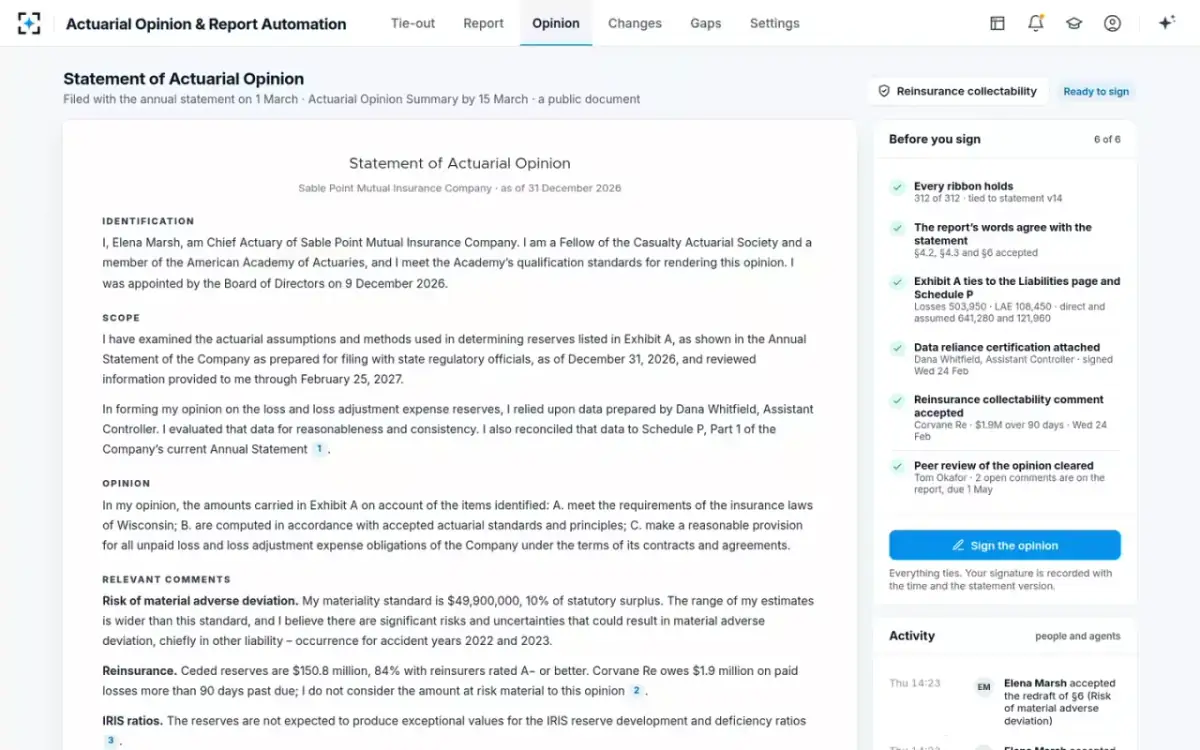
That is where Actuarial Opinion & Report Automation is designed to sit. Its tie-out checker keeps every Exhibit A line and every amount in the text linked to the posted statement version and blocks signing while one does not hold, the class of error 4. Its documentation reviewer reads the report and opinion against paragraphs 2 to 7 of the instructions and ASOP Nos. 36 and 41 and lists gaps by paragraph; in the sample year-end those included the officer's data reliance certification, the reinsurance collectability comment, the IRIS comment and an unexplained change in a workers' compensation tail factor, the classes of errors 3, 8, 9 and 10. The reinsurance reader drafts the comment from Schedule F. None of them decides whether a risk factor is truly company-specific; that stays with the actuary, as does every word of the opinion paragraph.
The opinion beside its six checks, in Actuarial Opinion & Report Automation
One more check belongs after filing. If the actuary later finds the opinion was in error because it relied on data that was factually incorrect at the balance sheet date, the instructions give five business days to tell the board, and the amended opinion goes to the commissioner. The working group adds that a revised opinion should say it is amended, explain why, and carry the date of revision. Errors that are not "in error" in that strict sense still justify a call to the regulator, it says. A planted-error test before signing is cheaper than either.
Questions people ask
What does a statement of actuarial opinion look like?
A short document: four designated sections (identification, scope, opinion, relevant comments), the signature block, and Exhibits A and B in the NAIC's format. Exhibits A and B are filed both in print and in a data-capture format that populates an NAIC database.
Where can I find the illustrative wording?
The NAIC instructions contain illustrative sentences for the scope and opinion paragraphs, and the American Academy of Actuaries' annual practice note, Statements of Actuarial Opinion on Property and Casualty Loss Reserves, gives illustrative language for most situations. The working group encourages actuaries to use whatever language clearly conveys their opinion and its basis.
What is a qualified actuarial opinion?
One where the actuary cannot reach a view on some items, because they cannot be estimated reasonably or for another stated reason (the definition is quoted in are statements of actuarial opinion public). The actuary names the items, the reasons and the amounts if disclosed, and states whether the remaining reserves make a reasonable provision; it is coded Q in Exhibit B, item 4.
Is the opinion on a net or a gross basis?
Both, if both are in scope: ASOP No. 36 calls for an opinion on direct and assumed reserves and on reserves net of recoverables. Exhibit B is completed for net amounts, and the regulators assume the opinion type applies to both unless the actuary says otherwise in the relevant comments.
How many statements of actuarial opinion conclude there is a significant risk of material adverse deviation?
The Academy's 2025 practice note puts it at approximately one-third. The conclusion has to follow from the materiality standard and the range, and the relevant comments must support it either way.
What happens if Exhibit A does not tie to the annual statement?
The working group expects any difference between the opinion, the summary, the report and the statement to be explained in the appropriate document. An unexplained difference is an error a reviewer or the department's actuary will find, and a factual data error discovered after filing can make the opinion "in error" under paragraph 9.