In accounting, a topside adjustment (also written top-side) is an entry made at the top of the reporting process, to a consolidation, a reporting system or the report itself, rather than in the general ledger or the source system where the figure began. It changes what is reported without changing what the books and the source systems hold. In regulatory reporting, a topside is how a Call Report or an FR Y-9C is made to show the right figure when the source cannot be fixed before the filing date. No regulator's text uses the word: the OCC's examination procedures speak of "Manual adjustments, if any", and the Federal Reserve's deposit report instructions of post-closing adjustments. One topside, approved and documented, is a decision. The same topside next quarter is evidence that a feed or a mapping is broken, and Botminds' Regulatory Reporting Reconciliation shows, for every concept, whether it ties at the source or only after an adjustment, and flags an adjustment that comes back.
The examples come from a fictional sample bank, about $92 billion in assets, owned by a holding company and closing its third quarter of 2026 in the solution. The rules come from the OCC, the Federal Reserve and the FFIEC agencies, linked where they appear.
One adjustment, four quarters: the report was right, the source stayed wrong
- Q1$5.9M adjusted
- Q2$6.2M adjusted
- Q3$6.8M adjusted
- Q4, if the fix landsat source
- Q1, three accounts mapped to trading assetswrong
- Q2, unchangedwrong
- Q3, fix scheduledwrong
- Q4, in a scheduled releasefix due
What is a topside adjustment in accounting?
A topside adjustment in accounting is a change to reported figures made above the general ledger, typically during consolidation or report preparation, and recorded outside the systems that produce the underlying balances. In financial reporting it often means an entry posted only in the consolidation, after the subsidiaries' books have closed. In regulatory reporting it also covers overrides in the reporting system and adjustments to a single report's schedule. What they share is that the source is left as it was.
The sample bank's quarter shows the range. Four adjustments were proposed in the third quarter of 2026. One added $2.1 million of accrued interest on purchased loans that was missing from a subledger extract, on Call Report Schedule RC-F, approved because the source fix was scheduled. One reversed a duplicate $1.4 million goodwill impairment posting on the FR Y-9C. One, adding $88.6 million of pledged securities missing from a custody extract on Call Report Schedule RC-B, was returned with the instruction "fix at source instead". And one moved $6.8 million of derivative receivables on the FR Y-9C for the third quarter running.
Four top-side adjustments in one quarter, and what happened to each
| Adjustment | Report and schedule | Why | Decision |
|---|---|---|---|
| Add $2.1M accrued interest on purchased loans | Call Report, Schedule RC-F | Missing from the subledger extract | Approved: source fix scheduled; adjustment until it lands |
| Reverse a $1.4M duplicate goodwill impairment | FR Y-9C, Schedule HC-M | Duplicate posting | Approved |
| Add $88.6M pledged securities | Call Report, Schedule RC-B memoranda | Missing from the custody extract | Returned: fix at source instead |
| Move $6.8M derivative receivables to other assets | FR Y-9C, Schedule HC | Consolidation mapping sends three accounts to trading assets | Waiting; third quarter in a row |
Topside vs journal entry: what is the difference?
A journal entry changes the general ledger, and every report built from the general ledger inherits it; a topside changes one report or one consolidation, and nothing downstream knows. That difference is why a topside creates reconciliation work. The Call Report instructions define posting to the general ledger as recording both the debit and the credit entries as of the same date, and every report drawn from those balances moves together when an entry is posted. A topside on the FR Y-9C moves only the FR Y-9C. Unless someone makes the same adjustment in the FR 2052a run and checks the Call Report, the reports that agreed before the adjustment now disagree.
A journal entry and a top-side adjustment, side by side
Journal entry: In the general ledger, or a subledger that feeds it.
Top-side adjustment: In the consolidation, the reporting system or the report.
Journal entry: Every report built from those balances.
Top-side adjustment: Only the report or consolidation where it is made.
Journal entry: They move together and keep agreeing.
Top-side adjustment: They disagree unless the same change is made in each.
Journal entry: Corrected, if the entry fixes an error.
Top-side adjustment: Unchanged; the next close repeats the error.
Journal entry: The posting itself, with its preparer and approver.
Top-side adjustment: Whatever the bank keeps beside the report: reason, maker, checker.
Journal entry: When the books need to change.
Top-side adjustment: When the books are right and the mapping is not, or the source cannot be fixed before filing.
When is a topside adjustment allowed?
A topside adjustment is allowed when it makes the report right, is supported by evidence, and is approved by someone other than the person who made it. No instruction forbids reporting the correct figure because the source could not be fixed in time; what the instructions require is that the report be correct and supportable. The FR Y-9C instructions, for instance, require that a holding company's financial records "shall be maintained in such a manner and scope so as to ensure that the Consolidated Financial Statements for Holding Companies can be prepared and filed in accordance with these instructions" (FR Y-9C instructions). A recurring adjustment is a sign the records are not yet maintained that way.
The Federal Reserve's deposit report draws the line more sharply than any other instruction. Adjustments made to the general ledger after close to reflect transactions on the report date belong on the FR 2900, but "post-closing adjustments to the accounting records of the reporting institution that reflect transactions that did not occur on the reporting date should not be reported on the FR 2900" (FR 2900 instructions, effective June 2024). And its guide to differences with the Call Report warns against the most common reason for a topside of all, making two reports agree:
The FR 2900 report should be revised to reflect late adjustments that are material. Single-day FR 2900 data for the Call Report date should not automatically be revised merely to match the Call Report.
Federal Reserve, Summary of Legitimate Interseries Differences between the FR 2900 and the Call Report, September 2024
That sentence is the rule for every cross-report topside. An adjustment that corrects a report is justified by the conditions on the report date. An adjustment whose only purpose is to make one report agree with another is not, because the difference may be legitimate, and making it disappear hides the information that it exists.
Are topside adjustments a red flag?
A topside adjustment is not a red flag by itself; a pattern of them is. The flags are an adjustment that recurs quarter after quarter, one approved by the person who made it, one with no linked break and no date for a source fix, one that grows, and one made in a single report when the same balance appears in others. Examiners are told to look for exactly this territory: the OCC's procedures ask whether a bank's procedures address "Manual adjustments, if any", next to data quality, mapping of items and independent reconcilements (OCC Comptroller's Handbook, Regulatory Reporting).
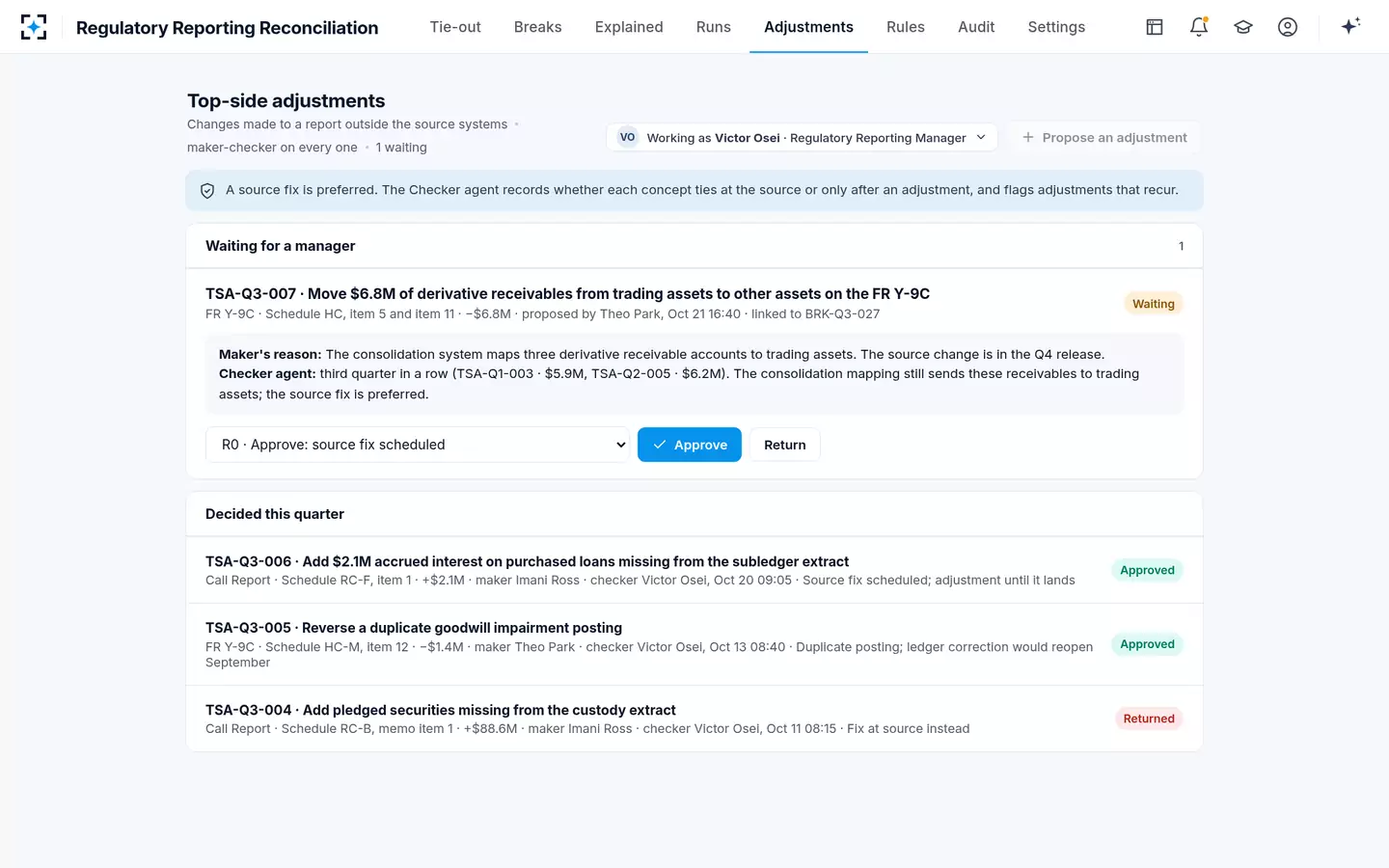
The sample bank's derivative adjustment shows all but one of those flags at once: third in a row, growing from $5.9 million to $6.8 million, confined to the FR Y-9C, with the fix waiting for a release. Only the approval was clean. The checker agent's note on the third quarter says so in plain words, and the manager approving it has to choose a reason code.
The checker agent's note in Regulatory Reporting Reconciliation: third quarter in a row
Why a recurring topside means a broken feed
A topside that recurs means the same wrong number arrives from the same source every quarter, and the only control catching it is a person remembering to correct it. That is the risk the OCC describes in automated reporting: "the failure to periodically test the accuracy of data flows from the bank's reporting or accounting could result in inaccurate reporting" (OCC Comptroller's Handbook, Regulatory Reporting). A recurring adjustment is the data flow test failing, quarter after quarter, and being patched instead of fixed.
It is also a growing exposure. The sample's adjustment rose by about $0.3 million and then $0.6 million a quarter as the receivables grew. In any quarter the adjustment is missed, the report goes out wrong by the full amount, and an examiner assessing the misstatement will look at the bank's history of the same error. The cheapest quarter to fix the source is the first one.
Why do auditors look at topside entries?
Auditors look at topside entries because they are where reported figures and the bank's books deliberately part company, outside the controls built into the systems that produce the books. An auditor testing a regulatory report needs to trace each figure to the bank's financial records, and an adjustment is the place where that trace has to rely on documentation instead of the system. The OCC puts the standard simply: the work papers must let someone follow the trail from the report back to the books (call report preparation, followed for one figure quotes the passage). For an adjustment, that means the reason, the evidence, the maker, the checker and the date, kept with the report.
For larger institutions the stakes are formal. Under the FDIC's Part 363, internal control over financial reporting explicitly covers financial statements prepared for regulatory reporting purposes, and for institutions with $5 billion or more in assets the independent accountant attests to management's assessment of it. A pattern of manual adjustments to regulatory reports is internal control evidence the accountant will want to see.
How should topside adjustments be approved?
Approve topside adjustments under maker and checker, with a reason code, a linked break and a date for the source fix, and count every one that recurs. The Federal Reserve's examination manual asked the same question about reconciling entries long before regulatory reporting systems existed: "Are follow-up and necessary adjusting entries directed to the department originating or responsible for the entry for correction with subsequent review of the resulting entries by the person responsible for reconcilement?" (Federal Reserve, Commercial Bank Examination Manual, section 2320.4). Fix it where it started, then check that the fix held.
Eight conditions for approving a top-side adjustment
- A maker who states the reason
What is wrong, in which source, and why it cannot be fixed before the filing date.
- A checker who is not the maker
The regulatory reporting manager in the sample bank; never the analyst who proposed it.
- A reason code for the decision
Approve with source fix scheduled, approve as a one-off, or return with fix at source instead.
- A linked break with an owner
The adjustment closes nothing; the break stays open with the owner of the source.
- A date for the source fix
A release, a change ticket or a quarter, so recurrence can be judged against a promise.
- The same treatment in every report that carries the balance
Or a documented reason why the other reports should differ.
- A recurrence count
The checker agent in the sample flags an adjustment in its second and third quarter.
- Evidence kept with the report
Reason, maker, checker and dates, exportable for examiners and internal audit.
Three numbers about topside adjustments worth reporting every quarter
Topside adjustments are easy to approve one at a time and hard to see in aggregate, so a head of regulatory reporting should report three numbers to the CFO each quarter. The first is how many concepts tie only after an adjustment, not at the source. The second is how many adjustments recur, and for how many quarters. The third is the total amount the filed reports rely on adjustments for, by report, because the same figure can matter very differently on the Call Report, where capital ratios are computed, and in a supporting schedule.
In the sample bank's third quarter the answers were short: four adjustments proposed, one returned, one recurring for the third quarter, and a checker agent that notes for every concept whether it tied at the source or after an adjustment. The point of the numbers is the trend. A quarter in which more concepts tie at the source than the quarter before is a quarter in which the reports depend less on someone remembering, and the history of the bank's reports will show it.
Turning a recurring topside into a source fix
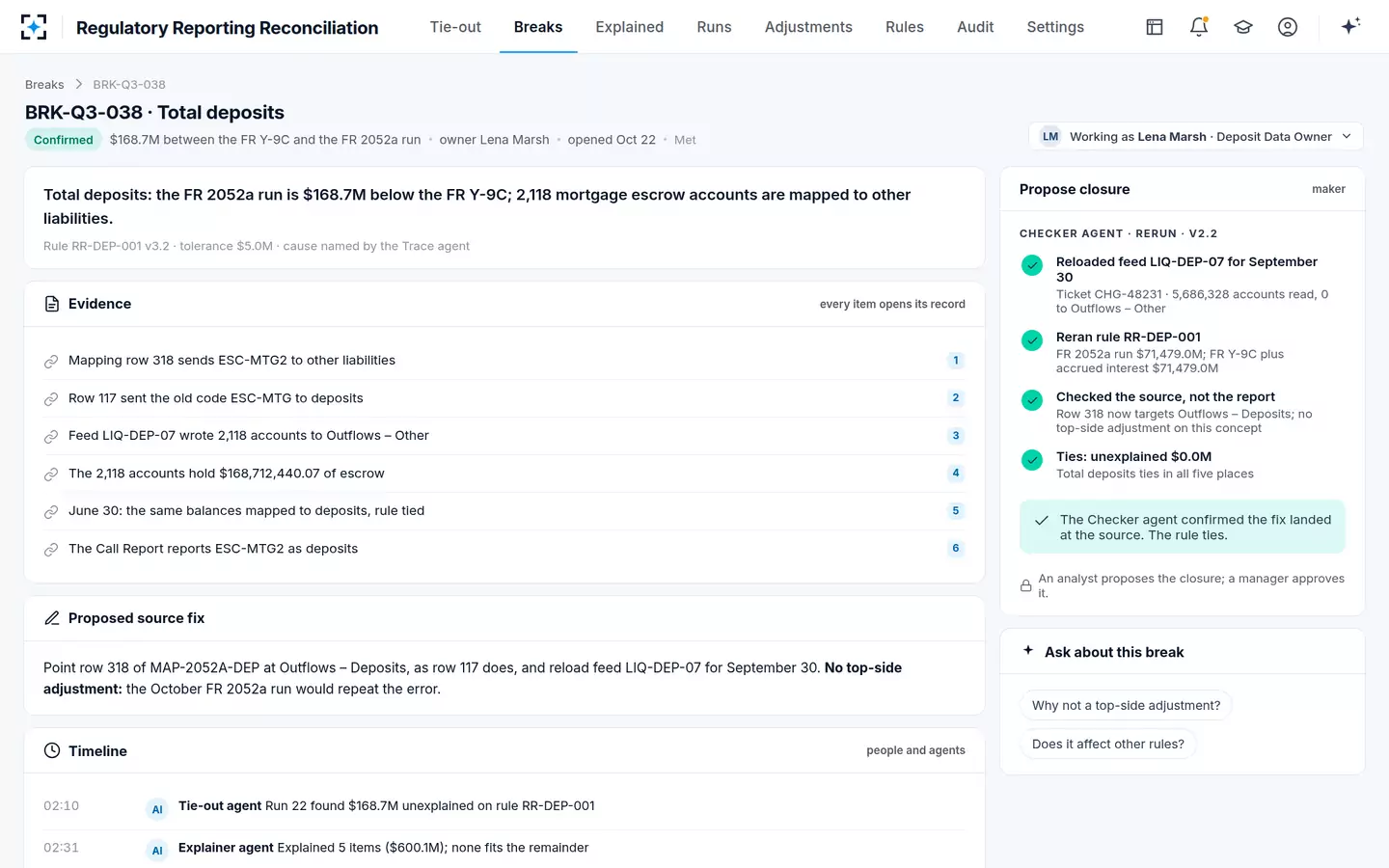
The way out of a recurring topside is to treat it as an open break with an owner and a clock, not as a closed item with a note. The sample bank's mortgage escrow case shows the alternative path. When a new escrow product code began flowing to the wrong line of the FR 2052a run, the break that went to the deposit data owner proposed a source fix and said, in so many words, "No top-side adjustment: the October run would repeat the error." The owner corrected the mapping row the same day; the checker agent reloaded the feed, reran the rule, and checked the source, not the report, before the closure was approved.
Regulatory Reporting Reconciliation confirms a fix at the source, with no adjustment
A recurring topside also deserves a price; the cost of one break works through what an adjustment costs each quarter it is repeated. And because an adjustment sometimes gets mistaken for a legitimate difference, what counts as a reconciling item draws that line. To see adjustments, breaks and source fixes on the sample bank's close, start from Regulatory Reporting Reconciliation.
Questions people ask
What is a top side adjustment in regulatory reporting?
It is a change made to a regulatory report, or to the consolidation or reporting system behind it, that is not made in the general ledger or the source system. It is used when the reported figure must be corrected before a filing date and the source cannot be fixed in time. It should be approved by someone other than its maker and tied to a break that stays open until the source is fixed.
Is a topside adjustment the same as a late adjustment?
No. In the Federal Reserve's usage, late adjustments are entries made to the general ledger after one report was prepared, such as the FR 2900 a day or two after the report date, and correctly included in a report prepared later, such as the Call Report. They change the books. A topside changes a report without changing the books.
What is a topside entry in accounting?
The same thing as a topside adjustment: an entry recorded at the consolidation or reporting level rather than in the ledgers of the entities being consolidated. Some topside entries are a normal part of consolidation, such as recurring eliminations recorded only in the consolidation system; the ones to watch are corrections that should have been made in a source and keep coming back.
How do you track topside adjustments?
Give each one an identifier, a report and line, an amount, a reason, a maker, a checker and a linked break, and keep the history by concept so recurrence is visible. The sample bank's adjustments carry identifiers by quarter, and its checker agent flags any concept that needed one in an earlier quarter, which is how the derivative receivables adjustment was marked as the third in a row.
Can a filed Call Report be corrected with a topside adjustment?
No. Once a report is filed, a correction is an amendment, not an adjustment. The Call Report instructions allow the agencies to require an amended report for significant classification errors and for material recognition or measurement errors, so an error found after filing goes to that decision, not to next quarter's adjustments.