Regulatory reporting software for banks produces, validates and files the reports the banking agencies require, such as the Call Report, the FR Y-9C, the FR 2900 and the FR 2052a, and the better products also prove that those reports agree with the general ledger and with each other. That last part runs on inputs only the bank has: the cross-report rules it already ties, the known reconciling items with the basis for each, a named owner and a clock for every source system, and the breaks it found last quarter. Without them, software can show that two figures differ but not whether the difference is legitimate or whom to send it to. Botminds' Regulatory Reporting Reconciliation sits beside the reporting system a bank already runs, reads its drafts and the source systems, and never changes a figure in a report; this guide sets out what a bank brings to make it, or any similar product, work from the first close.
Four inputs a bank brings, each with the person who owns it
- The cross-report rules you already tie, with tolerances
Owner: the head of regulatory reporting. Which concept, which report lines on each side, and how much difference the bank accepts as noise, by area.
- The known reconciling items, each with its basis
Owner: the analysts who explain them today. The elimination journal, the daily balances, the treatment memo or the instruction that makes each difference legitimate.
- An owner and a clock for every source system
Owner: the controller or chief data officer. Deposit system, loan subledger, consolidation system, liquidity data mart: a named person and a response time for each.
- Last quarter's breaks and how each was closed
Owner: the regulatory reporting manager. What broke, why, who fixed it, and whether by a source fix or an adjustment: the first test set.
The worked examples below come from a fictional sample bank, about $92 billion in assets with one foreign branch, as it runs its third quarter of 2026 in the solution. The reports' rules come from the agencies' own instructions and form pages, current for the September 30, 2026 report date and linked where they appear.
What is regulatory reporting software for banks?
Regulatory reporting software for banks does three jobs, and products differ in how many they cover. It produces the reports by mapping general ledger accounts and source data to schedule lines. It validates them, running the agencies' edits and the bank's own checks before submission. And it reconciles them, proving that each report agrees with the general ledger and with the other reports built from the same data. The first two are about one report at a time. The third is about the whole set, and it is the one this guide is about.
Whatever the product does, the responsibility stays with the bank. The Call Report instructions say plainly that responsibility for accurate data cannot pass to software vendors (FFIEC 031/041 General Instructions, September 2026), and the FR 2900 instructions say the same of a vendor that prepares or transmits a bank's deposits data (FR 2900 instructions). That is why the inputs matter: software can only reconcile against rules and reasons the bank is prepared to defend as its own.
List of regulatory reports for banks that must agree
For a bank with a holding company, the reports that carry the same balances are the Call Report, the FR Y-9C, the FR 2900 and, above $100 billion, the FR 2052a. Each has its own filer test, frequency, deadline, signer and publication rule, and each difference in those rules is a reason the figures will not match on their face.
Four reports that carry the same balances, and the rules that make them differ
| Report | Who files | How often, and when | Published? |
|---|---|---|---|
| Call Report (FFIEC 031, 041 or 051) | Every FDIC-insured bank; the 031 for banks with any foreign office or $100 billion or more, the 051 for eligible domestic banks under $5 billion | Quarterly; 30 days after the report date, 35 with more than one foreign office | Yes, except selected items |
| FR Y-9C | Top-tier bank, savings and loan, intermediate and securities holding companies with $3 billion or more | Quarterly; 40 days after March, June and September, 45 after December | Yes, with certain exceptions |
| FR 2900 | Depository institutions with gross liquid deposits and small time deposits at or above the deposit reporting limit, $1.4 billion in the June 2024 instructions, and Edge and agreement corporations | Weekly: daily figures for a Tuesday-to-Monday week | Aggregates only; microdata confidential |
| FR 2052a | Banking organizations subject to Category I to IV standards, from $100 billion | Daily or monthly; T+2 business days or T+10 calendar days by category | No; microdata confidential |
Publication matters to reconciliation more than it seems. Call Report data, "except for selected data items and text", are not given confidential treatment, according to the agencies' 2025 notice (Federal Register, July 10, 2025), and FR Y-9C microdata are generally public too, while FR 2900 and FR 2052a microdata are confidential. A difference between two public reports can be seen by any analyst with both downloads; the evidence for a difference involving a confidential report has to be handled as supervisory information.
Which bank reports must reconcile to each other?
Five pairs do most of the work: the general ledger to the Call Report, the Call Report to the FR Y-9C, the Call Report to the FR 2900, the FR Y-9C or Call Report to the FR 2052a, and, inside the Call Report, the deposit insurance schedule to the balance sheet. Some of these comparisons the agencies run themselves. The Federal Reserve compares five FR 2900 items with Call Report codes every quarter and publishes the comparisons and their legitimate differences (Summary of Legitimate Interseries Differences, September 2024). The FR 2052a includes balance sheet products that, in the instructions' words, are "necessary, in tandem with other FR 2052a balance sheet products, to construct an accounting balance sheet" (FR 2052a instructions), which is what makes it reconcilable to the books at all.
Five report pairs, the rule each needs, and the legitimate differences it must expect
| Pair | An example rule | Legitimate differences to expect | Basis |
|---|---|---|---|
| General ledger to Call Report | Deposit control accounts to Schedule RC, item 13 | Late adjustments booked after close; accounts mapped to other lines | OCC: reconcile general ledger accounts to figures reported |
| Call Report to FR Y-9C | Total deposits, RC to HC | Eliminations of the parent and affiliates; subsidiaries outside the bank | FR Y-9C rules of consolidation |
| Call Report to FR 2900 | FR 2900 A.1 to RCON2210 − RCON2202 − RCONB551 − RCON2213 | Primary obligations, teller's checks, Edge subsidiaries, definition of the United States, late adjustments | Federal Reserve interseries edits |
| FR Y-9C or Call Report to FR 2052a | Total deposits to Outflows-Deposits products | Accrued interest and other treatment differences; entities and timing | FR 2052a balance sheet products |
| Call Report balance sheet to Schedule RC-O | Deposits on the balance sheet to RC-O deposit totals | Subsidiaries' deposits eliminated on the balance sheet but required in RC-O | FDIC FIL-37-2023 |
The last row is worth singling out because it is inside one report. The FDIC found institutions leaving subsidiaries' intercompany deposits out of Schedule RC-O, although the instructions require deposits that are eliminated from the consolidated balance sheet to be reported there (FDIC FIL-37-2023). The same elimination is right on one page of the Call Report and wrong on another. A reconciliation that knows only the totals cannot tell.
What do we need to implement regulatory reporting software?
Beyond licences and access, a bank needs the four inputs in the opening checklist, written down well enough that a machine can use them and an examiner can read them. The connections are the easy part: the sample bank's agents read the general ledger, the regulatory reporting system's drafts, the consolidation system's eliminations and subsidiary packages, the liquidity data mart's FR 2052a run with its feeds and mapping tables, the deposit and core banking systems, and the issue management system, all read-only. What takes thought is the content.
Input 1: the rules you already tie
Most regulatory reporting teams already tie dozens of concepts across reports in spreadsheets, and those spreadsheets are the first input. Each one becomes a rule: a concept, the report lines on each side, the reconciling items expected between them, and a tolerance. The sample bank runs 214 such rules, every night of the close from the first day after quarter-end to the filing date. Its rule for total deposits, RR-DEP-001, compares five places with a $5.0 million tolerance.
Tolerances should be set by area and written down, not inherited. The sample bank uses $2.0 million for loans, securities, cash and liabilities, $1.0 million for capital and credit quality, $0.5 million for income and expense, and $5.0 million for deposits, off-balance-sheet items and liquidity flows. Those are its settings, not a standard; how close is close for reconciling items sets out how the agencies think about materiality, which is what a tolerance should follow.
Input 2: the reconciling items, with their basis
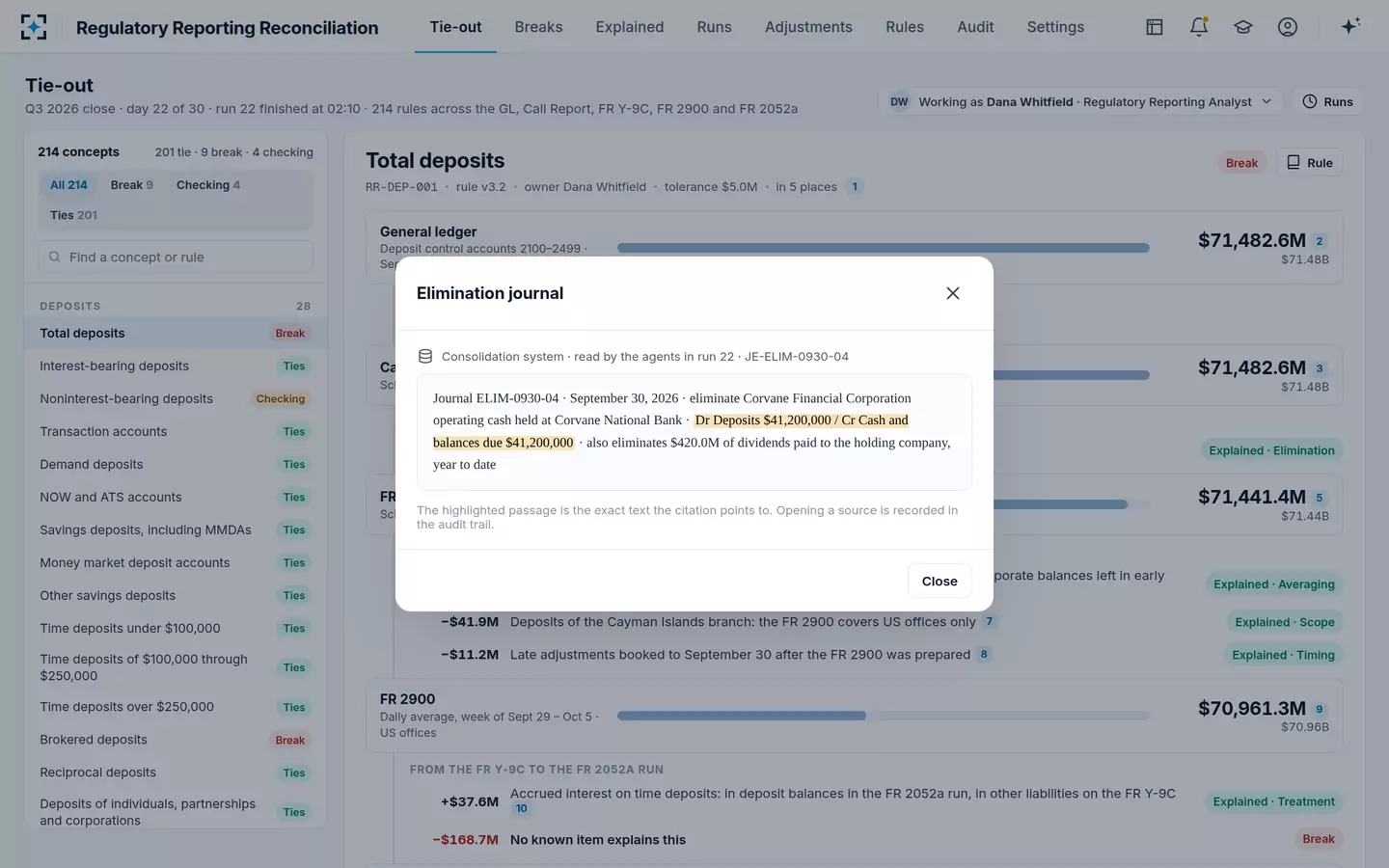
The second input is the list of known, legitimate differences between each pair, each with the source that proves it. A holding company elimination is proved by the elimination journal in the consolidation system. A weekly-average difference with the FR 2900 is proved by the daily balances. A scope difference is proved by the instruction that defines each report's scope. In the sample, 22 such items explain $6,312.3 million of differences in one run, sorted into six kinds: elimination, averaging, scope, timing, treatment and classification.
The basis is the input, not the amount. An amount copied from last quarter's explanation tab is a habit; an amount re-derived from its journal each run is evidence. The sample bank's agents re-derive every recurring item each night and hold any that moves against its documented basis, which is how a loan premium that rose when it should have fallen was caught.
A reconciling item is only as good as the source passage behind it
Input 3: an owner and a clock for every source system
The third input is a list of the source systems behind the reports, each with a named owner and an agreed response time. Without it, every break becomes an email asking who owns this. The sample bank names owners for the deposit system, the liquidity data mart, the loan subledger, the general ledger and investment accounting, gives each three business days from the moment a break is sent, and escalates to the manager after one business day late and to the head of regulatory reporting after two.
The OCC's description of good work papers explains why this belongs in the setup rather than the close: preparing them ties each reported figure back to the bank's own financial records and makes both accurate reporting and later checking easier (OCC Comptroller's Handbook, Regulatory Reporting; quoted in call report preparation, followed for one figure). A tie that ends in a system nobody owns is not one an examiner can follow. Who waits on whom when a break is open shows what the owners list does during a close.
Input 4: last quarter's breaks
The fourth input is the record of what went wrong last time: each break, its cause, its owner and how it closed. It does two jobs. It is the first test set, because a product that would not have found last quarter's breaks will not find next quarter's. And it shows which concepts break repeatedly and which were closed by adjustment rather than a fix, which is where the first months of work should go. The sample bank tests every change to its agents against the last quarter's 38 breaks before a manager and an administrator approve it.
The same software, without the inputs and with them
Without the bank's inputs: Shown as a number to investigate.
With them: Split into known items with their sources and one remainder, or none.
Without the bank's inputs: A default the vendor shipped.
With them: The bank's own, by area, tied to how it judges materiality.
Without the bank's inputs: Copied, or retyped by an analyst.
With them: Re-derived from its source each run; held if it drifts.
Without the bank's inputs: An email to whoever might know.
With them: A break to the named owner of the system the trace found, with a clock.
Without the bank's inputs: A demonstration on clean data.
With them: Last quarter's breaks found again, with their causes.
Does regulatory reporting software replace the general ledger?
No. Regulatory reporting software reads the general ledger; it does not replace it, and reconciliation software should not even write to it. The general ledger remains the book of record for the balances; the reporting system maps it to schedules; a reconciliation layer proves the result. In the sample bank the agents read every source and change nothing, fixes are made by the owners of the source systems under their own change tickets, and breaks open as tickets in the bank's existing issue management system.
The same holds for the reporting system itself. Regulatory Reporting Reconciliation reads the Call Report, FR Y-9C and FR 2900 drafts the reporting system produces; it does not prepare them, run the agencies' edits or submit them. A bank looking for the preparation side should look at Call Report Preparation, and at how to test call report preparation software on last quarter's filing, alongside this guide.
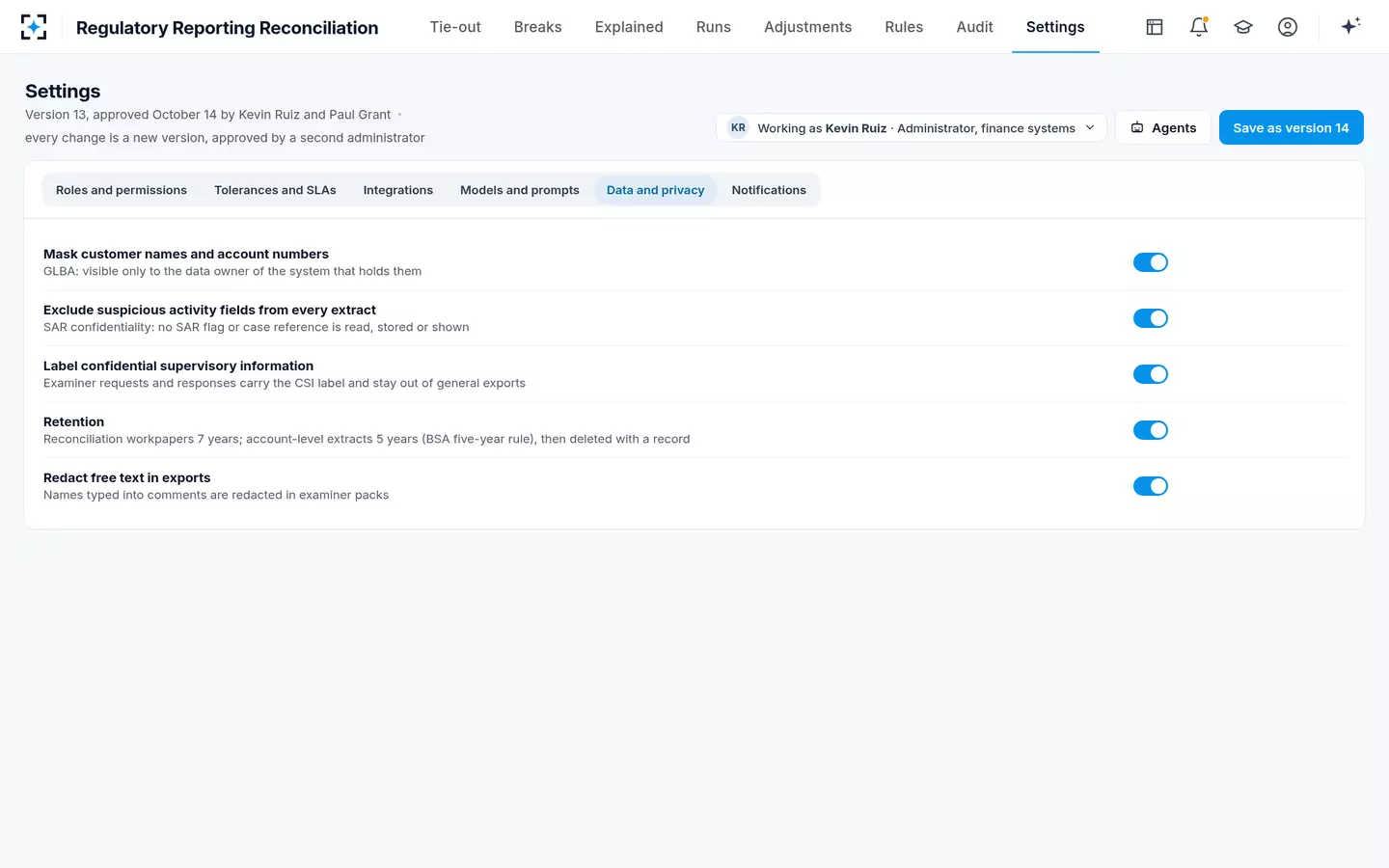
Settings an administrator brings to Regulatory Reporting Reconciliation, each version approved twice
How long does it take to implement regulatory reporting software?
The honest unit is a close, not a calendar month: a reconciliation product is ready when it has run one full quarter in parallel with the manual process and found the breaks the team found, with the same causes. How long that takes depends on the inputs more than the software. A bank whose rules live in maintained spreadsheets, whose reconciling items have written bases and whose source systems have named owners can load them quickly; one that must first agree who owns the liquidity data mart will spend its time there, with or without software.
A sensible plan follows the filing calendar. Load the inputs after a quarter is filed, rerun that quarter and compare the results with what the team found, then run the next close in parallel. For the September 30, 2026 report date, that means loading after the Call Report is filed (due October 30) and the FR Y-9C (due November 9), then running the December 31 close in parallel.
The calendar a first parallel run fits around
Oct 30
Call Report due for September 30, 2026; November 4 with more than one foreign office
Nov 9
FR Y-9C due for September 30, 2026, forty days after the report date
Feb 12027
option to file the December 31 Call Report, as its Saturday due date falls on a weekend
Day 45
FR Y-9C for December 31: Sunday, February 14, 2027, so it moves to the next business day
Where Regulatory Reporting Reconciliation fits beside your reporting system
Regulatory Reporting Reconciliation fits a bank or holding company that files several of the Call Report, FR Y-9C, FR 2900 and FR 2052a and has to show, each quarter, that they agree with the general ledger and with each other. It reads drafts and sources, explains known differences with their basis, traces what is left, and routes breaks to the owners who can fix them, under maker and checker. It does not prepare or file reports, replace the general ledger or the reporting system, or reconcile cash and operational accounts; reconciliation software for banks at the teller and ATM level is a different problem. To see the four inputs at work in the sample bank's close, start from Regulatory Reporting Reconciliation.
Questions people ask
What is a cross-report reconciliation rule?
A rule names one concept, the report lines on each side, the legitimate differences expected between them and a tolerance for what remains. The Federal Reserve's own comparison of FR 2900 demand deposits due to the public with Call Report items RCON2210 less RCON2202, RCONB551 and RCON2213 is an example. A bank writes the rest for its own report pairs.
What reports does regulatory reporting software cover?
It depends on the product and the bank. For a U.S. bank with a holding company, the reports that carry the same balances are the Call Report, the FR Y-9C, the FR 2900 and, from $100 billion, the FR 2052a; others, such as the parent-only FR Y-9LP, exist alongside them. Ask which a product produces, which it validates and which it reconciles to each other.
What regulatory reporting tools do banks need for reconciliation?
A way to read each report and the general ledger with their sources, a library of cross-report rules with tolerances, a list of reconciling items with their basis, a way to trace a remainder to accounts, and a workflow that routes breaks to owners and keeps maker and checker on every decision. The OCC lists reconciliation processes among what a bank's regulatory reporting policies generally address.
Can the software reconcile a credit union's 5300 Call Report?
Not this one: the reports it ties are the bank and holding company reports above. Credit unions file the NCUA's 5300 Call Report, which has its own form, instructions and deadline, and a different set of reports to reconcile against.
Who should own the reconciliation rules?
The regulatory reporting function should own them, with changes approved by someone other than their author. The sample bank's rules carry versions and owners, every settings change is a new version approved by a second administrator, and the rule library exports with the quarter's evidence for examiners and internal audit.