Automated account reconciliation software compares balances between systems and reports and lists what does not agree; for regulatory reporting, whether it pays for itself depends on one unit, the break. A break between the general ledger and the Call Report, or between the FR Y-9C and the FR 2052a, has to be found, lined up, explained, traced to its accounts, routed to the owner of the source, waited on, fixed, rerun, approved and documented, usually inside the 30 days the Call Report allows. The matching at the start is the cheapest step. The expensive breaks are the ones that never reach the source: closed under deadline pressure with a top-side adjustment, they come back next quarter and cost the same again. Botminds' Regulatory Reporting Reconciliation is built around that unit, and this guide prices it step by step, with Botminds' own estimate of where the time goes and an honest account of what no estimate can show.
The examples come from a fictional sample bank, about $92 billion in assets, closing its third quarter of 2026 in the solution. The agency figures are the agencies' own burden estimates, linked where they appear.
What the agencies count, before anyone reconciles anything
55.56hours
a quarter for an FFIEC 041 Call Report, on the agencies' estimate; 86.25 for the FFIEC 031
44.79hours
per FR Y-9C for holding companies of $5 billion or more outside the advanced approaches
121–221hours
per FR 2052a submission, monthly and daily filers
726,366hours
a year across all Call Report filers: our sum of the three agencies' totals
What is automated account reconciliation software?
Automated account reconciliation software is software that proves balances agree between two places and keeps the evidence, and in a bank it comes in three kinds that are easy to confuse. Balance sheet account reconciliation substantiates each general ledger account against a subledger, a statement or a schedule, with a preparer and a reviewer signing each one. Transaction matching pairs individual items between two files, such as a correspondent account and its statement. Cross-report reconciliation proves that the regulatory reports agree with the general ledger and with each other, or differ for a documented reason.
Regulatory reporting needs the third, and it often gets bought as the first. The OCC's examiner booklet frames the control in exactly these terms: "segregation of duties should be used when reconciling general ledger accounts to figures reported in quarterly and annual regulatory reports" (OCC Comptroller's Handbook, Regulatory Reporting). A tool that certifies every general ledger account to its subledger still says nothing about whether total deposits on the FR Y-9C, after eliminations, agrees with the FR 2052a run built from a different feed.
How much does a reconciliation break cost?
No public study prices a regulatory reconciliation break, so a bank has to build the number itself, and the build has four parts: the hours of everyone who touches it, the days of filing window it consumes, the chance it comes back next quarter, and the chance it ends in an amended report. Most business cases count only the first. The other three are where the money is, because they are what turns a two-day break into a quarterly cost or an examiner's finding.
The last part is not hypothetical. The Call Report instructions allow an agency to require an amended report for a significant error in how the bank classified an item, which is to say the line it reported it on (FFIEC 031/041 General Instructions, September 2026; quoted in call report preparation software, tested). Classification is exactly what a cross-report break usually is. When Republic First Bank amended three quarters of Call Reports in September 2023 and fell to "Adequately Capitalized", the Federal Home Loan Bank told it that a $100 million advance would not be renewed (FDIC OIG, EVAL-25-01). Few breaks end that way; the ones that do dwarf every analyst hour in the business case.
The cost of one break, step by step
A break passes through nine steps, and the cost of each depends less on arithmetic than on who has to be involved and how long they take to answer. The table follows one break from the sample bank, total deposits between the FR Y-9C and a parallel FR 2052a run, through the close by hand and in the solution.
Nine steps of one break, and what drives the cost of each
| Step | Who | By hand: what drives the cost | In the sample close |
|---|---|---|---|
| 1. Find the difference | Analyst | Exporting the general ledger and four reports into a workbook per report pair | Nightly run at 02:10, 214 rules, 9 breaks |
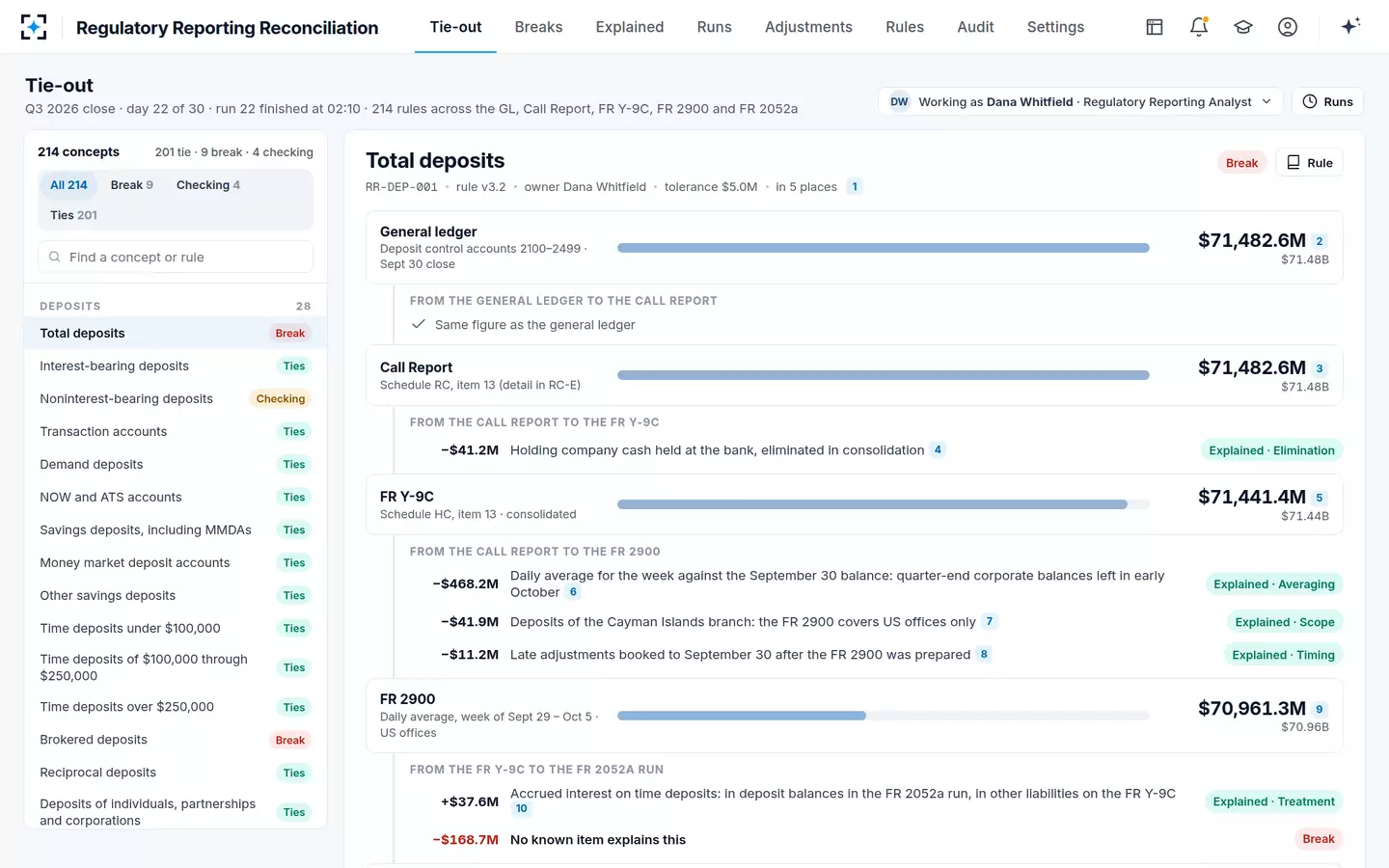
| 2. Line up the concept | Analyst | Matching line codes across schedules that use different captions | Total deposits stacked in five places on one screen |
| 3. Explain the known items | Analyst | Re-deriving eliminations, averaging, scope and timing from journals and daily balances | Five items, $600.1M, each cited; $168.7M left |
| 4. Trace the remainder | Analyst, data team | Pulling account-level files from two systems and matching millions of rows | 2,118 escrow accounts, one feed, one mapping row, by 09:15 |
| 5. Route to an owner | Analyst | Finding out who owns the feed, by email | Sent to the deposit data owner at 09:18 with a three-day clock |
| 6. Wait | Data owner | The owner's own queue of releases and incidents | Fixed at 14:40 the same day |
| 7. Fix at the source | Data owner | A mapping change under change control, tested by a second owner | Change ticket, mapping row corrected, feed reloaded |
| 8. Rerun and confirm | Analyst | Rebuilding the workbook to see whether it ties, and whether by fix or by adjustment | Rerun ties at the source, no adjustment on the concept |
| 9. Approve and document | Manager, audit | Assembling evidence when someone asks | Closure approved at 15:05, five business days before the Call Report was due |
Steps 5 and 6 are the ones a spreadsheet hides. They do not show up in anyone's timesheet as reconciliation, yet they consume the filing window, and the filing window is the scarce resource: for the September 30, 2026 report date the Call Report was due Friday, October 30 (FDIC FIL-62-2026), and the last days before it are reserved for review and signatures. A break that waits four days for an owner in week four is the break that ends with an adjustment.
The Regulatory Reporting Reconciliation tie-out: one concept, five places, every gap named
What does a recurring topside adjustment cost?
A recurring top-side adjustment costs the full approval cycle every quarter and leaves the error in the source indefinitely. In the sample bank, the consolidation system maps three derivative receivable accounts to trading assets; each quarter an analyst moves them to other assets on the FR Y-9C by adjustment: $5.9 million in the first quarter, $6.2 million in the second, $6.8 million in the third. Each time someone proposes it, a manager approves it, and the evidence is filed. The source change is scheduled for a later release.
The labour is the smaller cost. The larger one is exposure: the figure is right only in quarters when someone remembers. If the adjustment is missed once, the report goes out wrong, and the OCC tells examiners to assess misstatements "individually" and "in aggregate", noting that "a misstatement's materiality may change as a bank's financial condition changes." A growing adjustment that nobody fixes is a misstatement waiting for a bad quarter. What a top-side adjustment is, and why a recurring one means a broken feed follows that case in full.
Two breaks, two paths: fixed once, or adjusted three times
The cheapest break is the one fixed at its source the first time, and the sample bank's quarter has one of each kind to compare. The escrow break between the FR Y-9C and the FR 2052a run went through the nine steps once: one trace, one break sent, one mapping change, one rerun, one approval, all on October 22. The derivative receivables problem on the FR Y-9C has been through steps 1 to 3 and step 9 three times, and the source fix still has not landed.
The same nine steps, paid once or paid every quarter
| Escrow mapping, FR 2052a run | Derivative mapping, FR Y-9C | |
|---|---|---|
| Amount | $168.7M, one quarter | $5.9M, $6.2M, then $6.8M |
| How it was closed | Mapping row corrected at the source; rerun tied | Top-side adjustment each quarter; source fix scheduled for a release |
| Proposals and approvals | One closure, approved once | Three adjustments, each proposed, approved and documented |
| Break still open? | No: closed on evidence of a source fix | In effect yes: the consolidation mapping is still wrong |
| Exposure next quarter | None from this cause | The full amount, if the adjustment is missed |
| Reports that disagree meanwhile | None after the rerun | Any report built from the consolidation without the same adjustment |
The comparison is the business case in miniature. A product that makes the right-hand column quicker to approve has saved some hours. A process that turns the right-hand column into the left-hand one has removed a recurring cost and an open exposure, and that depends on a break reaching an owner who can change the source, which is why routing and owners matter more to the economics than matching speed.
Where an analyst's quarter goes, before and after
On Botminds' estimate, one analyst who owns a set of cross-report rules spends about twelve and a half working days a quarter on tie-outs by hand, and about five with the agents. The estimate is ours, built for the sample bank's analyst who owns 48 deposit and liquidity rules; it is not a measurement at any customer, and a bank should replace it with its own timings.
The work shrinks, and its shape changes: deciding becomes the largest share
By hand, about 12.5 days a quarter
- Exporting · 16%
- Lining up · 20%
- Re-explaining known items · 20%
- Chasing owners · 24%
- Evidence · 12%
- Deciding · 8%
With the agents, about 5 days a quarter
- Exporting · 10%
- Lining up · 10%
- Re-explaining known items · 20%
- Chasing owners · 20%
- Evidence · 10%
- Deciding · 30%
Two readings of the split matter for a business case. The first is that matching and lining up, the part every reconciliation product automates, is about a third of the manual work, so a product that only matches faster returns about a third of the time at best. The second is that the deciding row goes up, from one day to one and a half. That is deliberate. A close in which people approve faster because they see less is not cheaper; it moves the cost to the examination.
What is the ROI of reconciliation automation?
The return on reconciliation automation is the analyst time it releases plus the adjustments and amendments it prevents, minus what it costs to buy, run and keep the rules current. The first term is easy to estimate and usually small; the second and third are hard to estimate and usually large; the costs are routinely understated because they include other people's time.
The return on cross-report reconciliation, term by term
Analyst time released
Days saved per analyst per quarter × analysts × 4 × loaded day rate
On Botminds' estimate, about 7.5 days a quarter for an analyst who owns a set of rules.
Priced by the head of regulatory reporting
Recurring adjustments avoided
Recurring top-side adjustments × approval cycle cost × quarters until the source is fixed
Plus the exposure of the quarter in which one is missed.
Priced by the controller
Amendments avoided
Chance of an amended filing × its cost in staff time, examiner attention and consequences
Rare, and the term that can dominate when it happens.
Priced by the CFO and audit committee
Cost to run
Licence + implementation + data owners' time + keeping rules current each quarter
Instructions change often; someone has to update the rules.
Priced by finance systems
The cost term deserves the most care. Report instructions change often: for the September 30, 2026 report date alone, the agencies clarified the treatment of certain trust funds on Schedule RC-E and updated the instructions for all three Call Report forms for an interim final rule on reciprocal deposits (FDIC FIL-62-2026). Every such change can create or remove a legitimate difference between reports, and somebody has to update the rules and the reconciling items before the next close. A business case that prices the software but not that maintenance will disappoint in the second year.
What reconciliations should banks automate first?
Automate first where breaks recur and where a report sits furthest from the general ledger. Recurrence is where the adjustment cost compounds, and distance is where mapping errors hide: the FR 2052a run is built through its own feeds and mapping tables, and the FR Y-9C adds eliminations and subsidiaries the Call Report does not have. In the sample bank, half of the open breaks on day 22 of the close involved the FR 2052a run.
The second test is whether the comparison is already defined. The Federal Reserve publishes the exact line comparisons it runs between the FR 2900 and the Call Report and the legitimate reasons they differ, so those rules can be written once and checked against the agencies' own list. Deposits, which appear in all five places, are the obvious first concept for most banks; one deposit balance in five reports shows why.
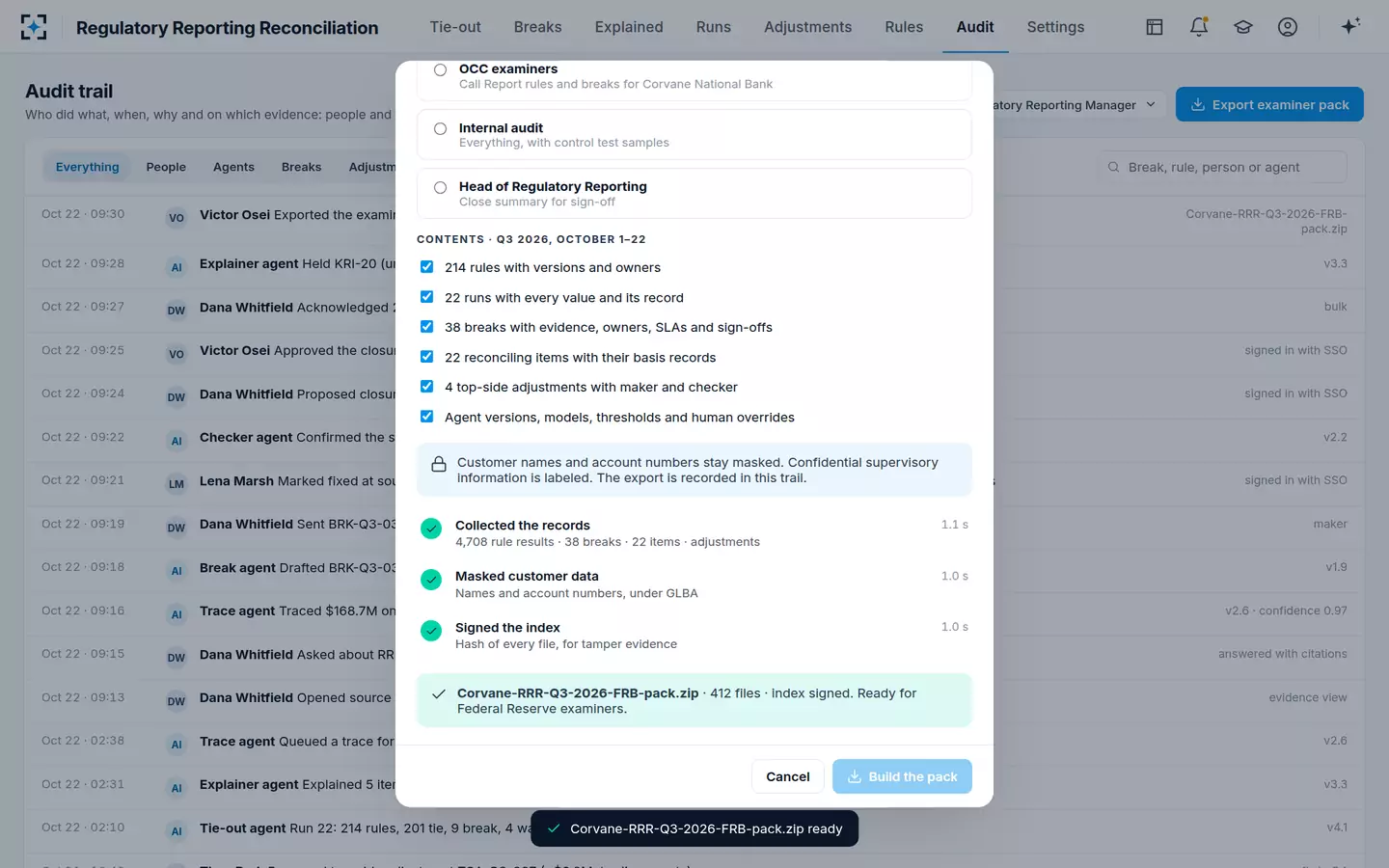
Answering an examiner from what Regulatory Reporting Reconciliation already kept
Where the savings do not come from
A reconciliation layer does not shorten report preparation, the data owners' fixes or the final review, and a business case that counts any of them is overstated. The agencies' burden estimates, about 56 hours a quarter for an FFIEC 041 Call Report, describe preparing and filing the report; a tool that reads the drafts after they are prepared leaves that time where it is. The data owner who corrects a mapping row spends the same time on the change, though far less on working out what to change. And the regulatory reporting manager's review gets more thorough, not shorter, which is the point of it.
The savings are in four places: exporting and lining up figures, re-explaining items already known, chasing owners without evidence, and assembling evidence afterwards. On Botminds' estimate those four save about 8 days per analyst per quarter, of which half a day goes back into deciding, for the net 7.5. The rest of the value, fewer recurring adjustments and fewer classification errors reaching a filed report, is real but has to be measured on the bank's own history, starting with a count of how many concepts tied only after an adjustment last year.
Account reconciliation software comparison: what to price
Compare account reconciliation software by the cost of a break through all nine steps, not by the price of a seat. A product that matches in seconds but leaves tracing, routing and evidence to people has priced only the first two steps. The questions below put the rest on the table.
Eight questions that price a break, not a licence
- Which of the nine steps does it do, and which does it leave to people?
Ask to see steps 3 to 8 on one of your own breaks from last quarter.
- Does it reconcile reports to each other, or only accounts to subledgers?
Cross-report rules over Call Report, FR Y-9C, FR 2900 and FR 2052a codes are a different product from account certification.
- Who maintains the rules when instructions change?
Count the hours each quarter, and whose they are.
- How much of the data owners' time does it assume?
Their time is a cost even when it is not in your budget.
- Does it record whether a break closed by a fix or by an adjustment?
Without that, recurring adjustments cannot be counted, let alone priced.
- What does the first quarter cost?
Rules, reconciling items with their basis, owners and last quarter's breaks have to be loaded first.
- What does an examiner request cost after go-live?
An export of what the close kept, or a week of assembly.
- What happens to the business case if no amendment is ever avoided?
If it only works with that term, it rests on the hardest number to prove.
The inputs behind the first quarter's cost are set out in what a bank brings to regulatory reporting software. To see the nine steps on the sample bank's close, start from Regulatory Reporting Reconciliation.
Questions people ask
How long does a reconciliation break take to fix?
The fix itself is often short; the wait for an owner is not. In the sample bank, a mapping break traced at 09:15 was fixed at the source at 14:40 the same day because it arrived with the accounts, the feed and the mapping row named and a three-business-day clock. Without that, the same fix waits for someone to work out whose it is.
Is it cheaper to adjust the report than to fix the source?
For one quarter, usually yes; over a year, usually no. An adjustment has to be proposed, approved and documented every quarter until the source is fixed, and in any quarter it is forgotten the report is wrong. In the sample, one adjustment grew from $5.9 million to $6.8 million over three quarters while the source change waited for a release.
What is the payback on reconciliation software?
It depends on how much of the business case is analyst time. On Botminds' estimate the time released is about 7.5 days per analyst per quarter, which a bank can price at its own rates; recurring adjustments and amended filings avoided are larger but harder to evidence. A payback that only works if an amendment is avoided rests on the hardest number to prove.
Do the agencies' burden hours include reconciliation?
The agencies' estimates count the time to gather and maintain the data, review the instructions and complete each report; they do not break out reconciliation between reports. They are useful for scale: the three agencies' December 2025 figures add up to about 726,000 hours a year for the Call Report alone.
Can automated reconciliation software prevent an amended Call Report?
It can make one less likely by finding classification and mapping errors before filing, which is when they are cheapest to fix. It cannot guarantee it: amendments also follow accounting judgements, such as the deferred tax valuation issue behind Republic First's 2023 amendments, that no reconciliation between reports would reveal.