The FR 2900 report is the Federal Reserve's Report of Deposits and Vault Cash. It collects selected deposits and vault cash from depository institutions as close-of-business figures for each day of a Tuesday-to-Monday week, and it is filed weekly. Its data, in the Federal Reserve's words, are "the primary source for constructing the U.S. monetary aggregates" and for indexing the reserve requirement exemption amounts each year (Federal Reserve, FR 2900). For a bank, though, the FR 2900 is also one of five places the same deposits appear: the general ledger, the Call Report, the holding company's FR Y-9C and, at the largest firms, the FR 2052a liquidity report all carry them, each under its own rules. Following one balance through all five shows why they differ and which differences are breaks. Botminds' Regulatory Reporting Reconciliation ties the five every night of the close and explains each gap from its source.
The balance below is total deposits at a fictional sample bank, about $92 billion in assets with one foreign branch, on September 30, 2026, as it appears in the solution. The bank sits just under the $100 billion line at which the FR 2052a becomes mandatory, so its FR 2052a figure comes from a parallel run.
One deposit balance in five places, and what separates each from the next
What is the FR 2900 report?
The FR 2900 is a weekly Federal Reserve report (OMB control number 7100-0087) of selected deposits, cash items in process of collection and vault cash, reported for each day of a Tuesday-to-Monday week. It exists to measure money, not to supervise a bank. Its legal roots are the Monetary Control Act of 1980 and the Garn-St Germain Act of 1982, which tied reporting to reserve requirements; the form page notes that "Effective March 26, 2020, the Board reduced the reserve requirement ratios applicable to all transaction accounts to zero percent, eliminating all reserve requirements." The report continued, because the deposit data feed the money stock measures.
It comes in versions for commercial banks, savings and loans, credit unions and U.S. branches and agencies of foreign banks, and institutions that hold deposits in foreign currencies at U.S. offices also file the FR 2915. The Federal Reserve's 2023 notice extending the collection estimated 59,168 burden hours a year for the FR 2900 and FR 2915 together (Federal Register, December 4, 2023).
Who has to file the FR 2900, and how often?
Under the instructions effective June 2024, the FR 2900 is required from every banking Edge and agreement corporation regardless of size and from "all other depository institutions with gross liquid deposits and small time deposits greater than or equal to the deposit reporting limit of $1.4 billion" (FR 2900 instructions). The Board evaluates institutions each July, using data from the fourth quarter of the previous year to the first quarter of the current one, makes panel changes in September, and says the threshold itself "will be evaluated annually". Reporters file weekly: each report carries every day of the Tuesday-to-Monday week, with a day the institution was closed reported at the preceding day's balance.
Filing is electronic, with the Federal Reserve Bank for the institution's district, through the Reserve Banks' Reporting Central service. The instructions describe what to report rather than a weekly deadline; the Federal Reserve's guide to comparing it with the Call Report notes that the FR 2900 "is usually prepared a day or two after the report as-of date" (Summary of Legitimate Interseries Differences, September 2024). An institution should take its exact schedule from its Reserve Bank.
The FR 2900 in four numbers
$1.4B
deposit reporting limit in the June 2024 instructions: gross liquid deposits plus small time deposits
7days
of close-of-business figures in every weekly report, Tuesday to Monday
5checks
the Federal Reserve runs against the Call Report each quarter, on the Call Report date
0%
reserve requirement on all transaction accounts since March 26, 2020
What the FR 2900 counts, and what it leaves out
The FR 2900 counts deposits of the institution's U.S. offices on its own definitions, and those definitions are where most of its differences with other reports begin. It consolidates the head office, branches in the 50 states and the District of Columbia, branches on U.S. military facilities wherever located, and majority-owned subsidiaries in the 50 states and DC. Banking Edge and agreement subsidiaries file their own reports and are not consolidated. Balances due to and from the institution's own non-U.S. branches are excluded from every item except reservable liabilities, while certain customer deposits at non-U.S. branches, such as those payable at a U.S. office, are included.
Three measurement rules matter as much as scope. Deposits are reported at "the reporting institution's contractual liability to its counterparty, which includes accrued interest", even where a bank carries deposits at fair value in its financial statements. Overdrawn accounts count as zero, not as negative deposits, unless covered by a bona fide cash management arrangement. And amounts are reported to the nearest thousand dollars. Each rule produces a predictable difference with the Call Report, and the Federal Reserve lists them.
Do deposits in the Call Report match the FR 2900?
No, not by design, and the Federal Reserve checks how far apart they are every quarter. Its staff run "interseries edits" for each Call Report filer that also files the FR 2900, and "Interseries edits are based on a single day's data from the two reports on the Call Report date" (Summary of Legitimate Interseries Differences). Where the figures differ, the bank should be able to say which legitimate difference explains the gap; the FR 2900 instructions add that Reserve Bank staff "may ask reporting institutions to explain movements in the data, and, if reported data are incorrect, staff will ask the institution to submit revisions" (FR 2900 instructions).
The legitimate reasons are specific: primary obligations that count as deposits on the FR 2900 only, Edge subsidiaries consolidated on one report and not the other, a narrower definition of the United States, suspense items placed differently, and late adjustments made after the FR 2900 was prepared. Reconciling items between regulatory reports sets out the Federal Reserve's full list and which report each difference should make larger.
The same teller's check on the FR 2900 and the Call Report
FR 2900, demand deposits due to the public: $1,000 deposit.
Call Report: $1,000 deposit.
FR 2900, demand deposits due to the public: Still $1,000: the check stays until it is paid.
Call Report: Removed: the deposit goes when the funds are remitted.
FR 2900, demand deposits due to the public: Removed.
Call Report: Nothing to remove.
FR 2900, demand deposits due to the public: Higher than the Call Report on days 2 to 6.
Call Report: A legitimate difference for five days, not a break.
The Federal Reserve's five interseries checks
The Federal Reserve compares five FR 2900 items with Call Report items, defined by their codes, and it publishes the formulas. Two of them, cash items in process of collection and vault cash, run only for FFIEC 031 filers and for FFIEC 041 filers that complete Schedule RC-A, which the guide describes as institutions with total assets of $300 million or more.
Five FR 2900 items, and the Call Report codes they are compared with
| FR 2900 item | Call Report codes | In words |
|---|---|---|
| A.1 Demand deposits due to the public | RCON2210 − RCON2202 − RCONB551 − RCON2213 | Total demand deposits less U.S. government, U.S. depository institutions and banks in foreign countries (RC-E) |
| A.2 Other liquid deposits | RCON2215 − RCON2210 + RCON6810 + RCON0352 | Transaction accounts less demand deposits, plus money market deposit accounts and other savings deposits (RC-E) |
| B.1 Cash items in process of collection | RCON0020 | RC-A, item 1.a |
| C.1 Small time deposits | RCON6648 | Time deposits of less than $100,000 (RC-E memoranda) |
| D.1 Vault cash | RCON0080 | Currency and coin, RC-A, item 1.b |
Two things follow for a bank's own reconciliation. The Federal Reserve compares domestic-office items, so a bank that ties its consolidated Call Report total to the FR 2900, as the sample bank does for total deposits, has to account for its foreign offices separately. And the comparisons are at the level of formulas over codes, which is the level at which a bank's own rules should be written: a deposit misclassified between demand and savings can leave total deposits untouched and still move A.1 and A.2.
One deposit balance in five reports
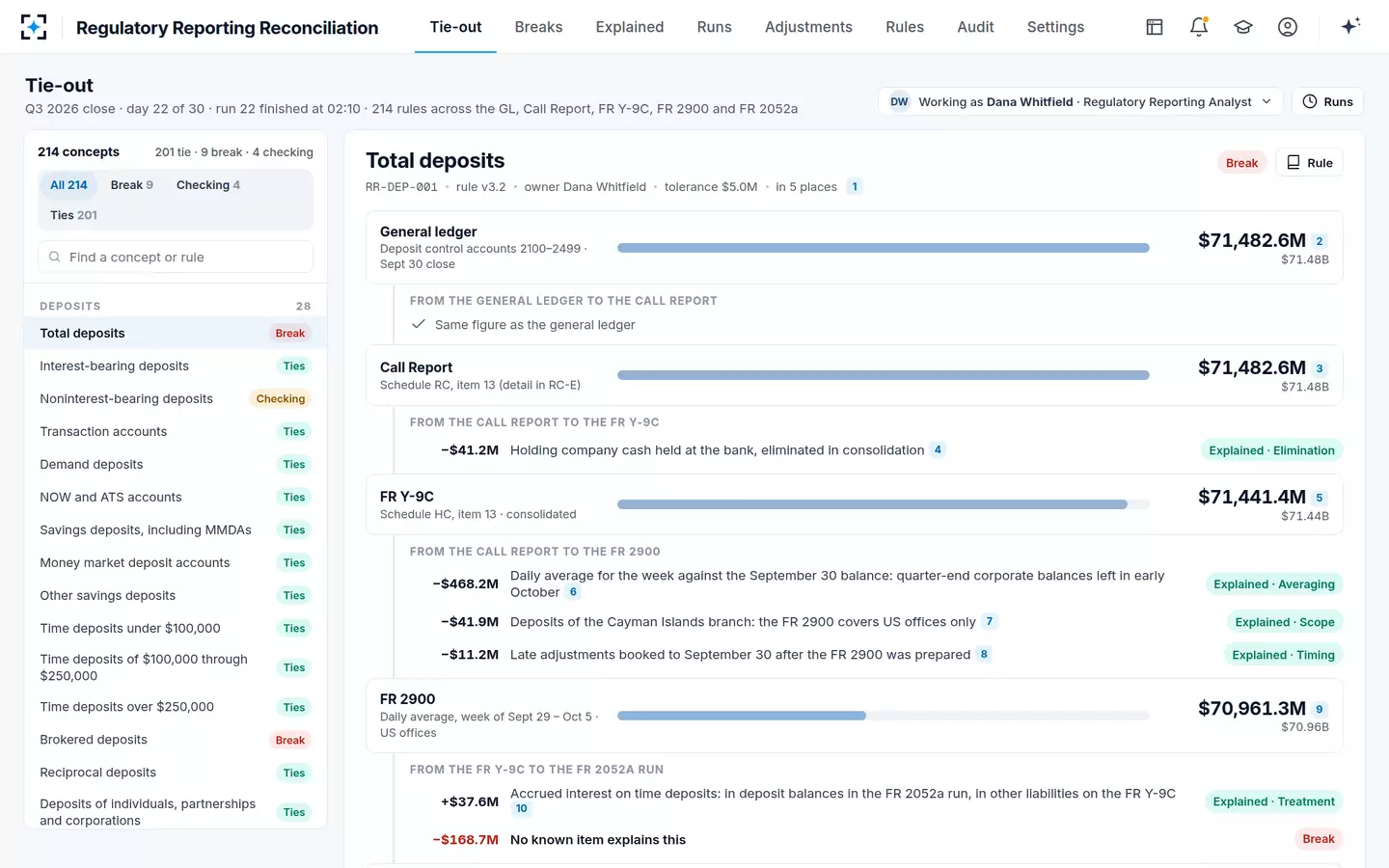
Read top to bottom, the sample's five figures show every kind of difference a deposit balance can carry. The general ledger and the Call Report agree to the hundred thousand: the Call Report is built from the close, and nothing separates them. The FR Y-9C is $41.2 million lower because the holding company's cash at the bank is a deposit to the bank and an intercompany balance to the group, eliminated in consolidation.
The FR 2900 is $521.3 million lower than the Call Report, and three items explain all of it. Most is averaging: the sample's own rule compares the week's average with the quarter-end balance, and corporate balances that arrived for quarter-end left in early October, a $468.2 million effect. The foreign branch's $41.9 million of deposits fall outside the FR 2900's consolidation. And $11.2 million of late adjustments were booked to September 30 after the FR 2900 was prepared. On the single day of September 30, the basis the Federal Reserve uses, the FR 2900 read $71,429.5 million against $71,440.7 million in domestic offices on the Call Report: exactly the late adjustments.
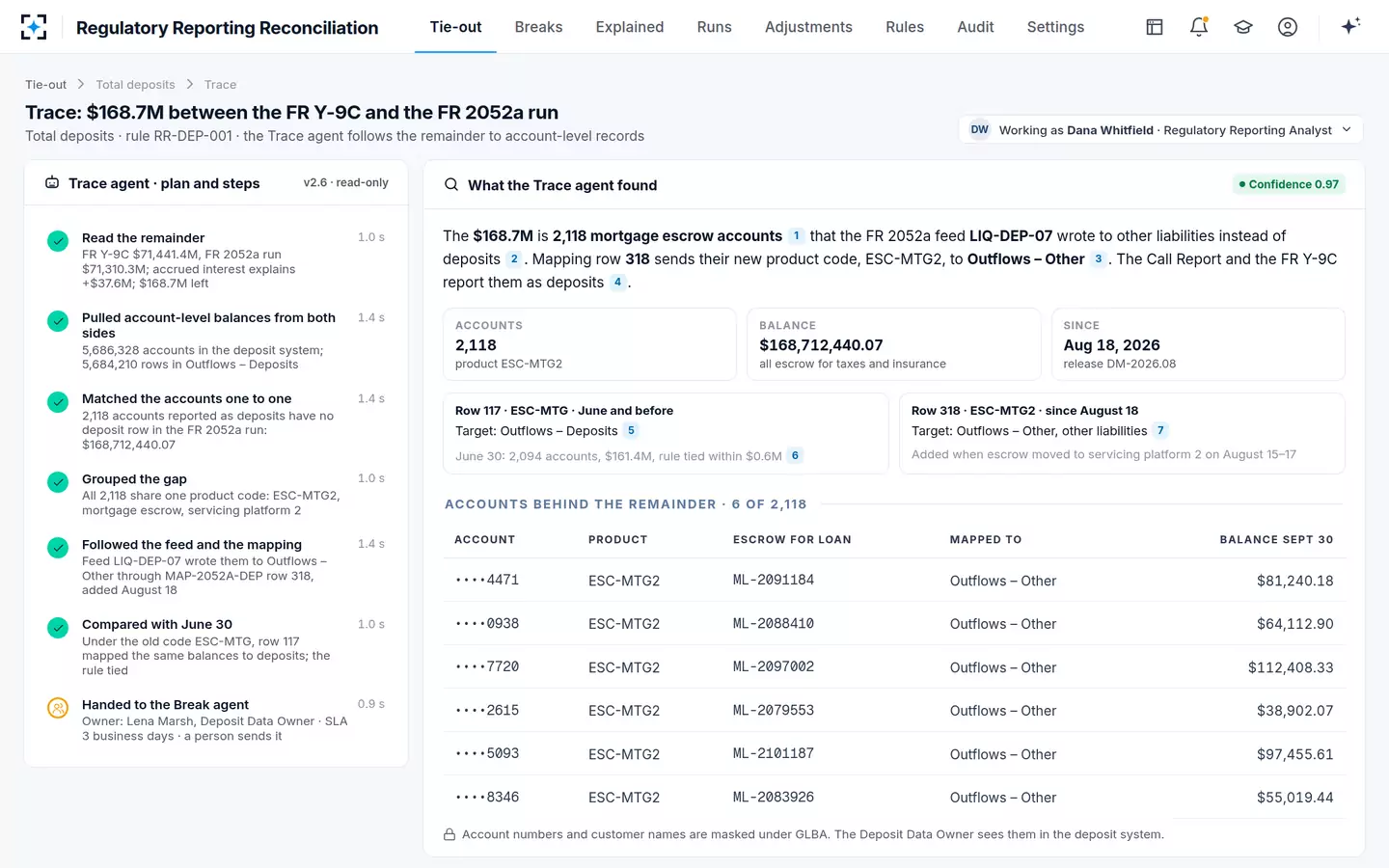
The FR 2052a run is where the break was. The FR 2052a's deposit products, including O.D.7 for operational escrow accounts, sit in its Outflows-Deposits table (FR 2052a instructions). After accrued interest, $168.7 million was missing from that table: 2,118 mortgage escrow accounts that a mapping row added in August sent to another table. The Call Report and the FR Y-9C counted them as deposits; the parallel run did not. That one is not a legitimate difference, and it was fixed at the source.
The five places on one Regulatory Reporting Reconciliation screen, each gap sourced
Which regulatory reports include deposits?
For a U.S. bank with a holding company, deposits appear in at least five places: the general ledger, the Call Report (the balance sheet, Schedule RC-E for deposit detail and Schedule RC-O for deposit insurance assessments), the FR Y-9C (Schedule HC and HC-E), the FR 2900, and, from $100 billion, the FR 2052a (Federal Reserve, FR 2052a). Each counts a different slice: RC-O, for example, must include subsidiaries' deposits that the balance sheet eliminates, and the FR 2052a splits deposits by counterparty and purpose for liquidity.
The slices change with the instructions. For the September 30, 2026 report date the agencies clarified that trust funds without beneficiary data belong on RC-E as deposits of individuals, partnerships or corporations, and updated the Call Report's treatment of certain reciprocal and custodial deposits as brokered (FDIC FIL-62-2026). A change in one report's definition can create a difference with another that did not exist the quarter before. The reconciliation work that follows is not the same as reconciling cash and custodial accounts in operations; the reconciliation process in banking for FBO accounts covers that side.
Where the break was, as Regulatory Reporting Reconciliation traced it: escrow sent to the wrong table
Is the FR 2900 a public report?
Only in aggregate. The Federal Reserve publishes aggregate FR 2900 data in its statistical release H.6, Money Stock Measures, and states that "Microdata are confidential" (Federal Reserve, FR 2900). That sets it apart from the Call Report and the FR Y-9C, whose data are largely public, and puts it with the FR 2052a, whose microdata are also confidential. For a reconciliation it means the evidence behind an FR 2900 difference should be handled as confidential supervisory material, not shared as freely as a Call Report comparison.
One balance, five reports and five rulebooks is the reason reconciliation is a standing job rather than a quarter-end chore. The Call Report and the FR Y-9C differ for their own reasons, and a topside adjustment is what tempts a team to make two of them agree when they should not. To see all five places tied on the sample bank's close, start from Regulatory Reporting Reconciliation.
Questions people ask
How often is the FR 2900 filed?
Weekly. Each report gives close-of-business figures for every day of a Tuesday-to-Monday week, so a reporter files about 52 reports a year, each with seven days of data. The Federal Reserve notes the report is usually prepared a day or two after its as-of date.
What is vault cash on the FR 2900?
It is line D.1, the currency and coin the institution holds, compared each quarter with Call Report Schedule RC-A, item 1.b, for filers of that schedule. The FR 2900 excludes foreign currency held in the vault and the Call Report includes it, so, other differences aside, the FR 2900 figure should be smaller by that amount.
What is the FR 2915?
It is the companion Report of Foreign (Non-U.S.) Currency Deposits. It collects the weekly average amount of deposits denominated in foreign currencies held at the U.S. offices of institutions that file the FR 2900, converted to U.S. dollars, and shows how much of selected FR 2900 items those deposits make up.
Do credit unions file the FR 2900?
Credit unions above the deposit reporting limit do, on a credit union version of the form. The Federal Reserve publishes separate FR 2900 forms for commercial banks, savings and loans, credit unions and U.S. branches and agencies of foreign banks, and describes legitimate differences against the NCUA 5300 as well as against the Call Report.
Are reserve requirements still calculated from the FR 2900?
Reserve requirement ratios have been zero since March 26, 2020, so no reserves are required. The FR 2900 still carries a reservable liabilities item and the Board still indexes the reserve requirement exemption amount and low reserve tranche each year, and the data remain the primary source for the money stock measures.