The reconciliation process in banking is the routine by which a bank proves that two records of the same money agree, explains every difference with evidence, and has a second person check the result before anyone relies on it. On an FBO (for benefit of) account, the custodial deposit account a sponsor bank holds for a fintech partner's customers, the two records are the bank's own balance for that one account and the sum of thousands or hundreds of thousands of individual balances kept in the partner's sub-ledger, and the proof is owed every business morning. It is hard because the money moves through four systems with four different clocks, and because a matching total says nothing about whether each customer's balance is right. Botminds' FBO Reconciliation exists to do the mechanical part of that proof overnight, with every step tied to its records, so the people on the desk spend their morning on decisions.
This page follows the desk seat by seat. The examples come from a fictional sample bank as it runs through the solution: Tessaly Community Bank, $3.4 billion in assets, six fintech partners and 412,000 end-user balances, attesting its reconciliation by 10:00 each morning. The rules and estimates come from regulators and are linked where they appear.
By hand, an FBO reconciliation morning needs more desk hours than the morning has
- Collecting files1 h
- Comparing totals and pairing entries1.5 h
- Explaining the difference1.5 h
- Checking end users1 h
- Partner follow-up45 min
- Attestation45 min
- All six steps, mostly exceptions and the attestation1 h 9 min
What is the reconciliation process in banking for an FBO account?
For an FBO account the reconciliation process in banking has five steps, repeated every business day: gather the records, pair them, explain what does not pair, check the individual balances, and sign. The first two are clerical, the third is investigation, the fourth is a data-quality review of every end user, and the fifth is a control in its own right, because it is where a second person takes responsibility for the first person's work.
The records come from four places. The core banking system holds the FBO account's balance at its nightly close and every posting to it. The payments hub holds the ACH batches, returns and wires that moved money in and out. The card processor holds authorizations and the settlement files that actually move the money, often hours later. And the fintech partner sends a file of its customers' balances, the sub-ledger, usually early in the morning and cut off at a time of its own choosing. At the sample bank, Plover Pay's books close at 4:00 pm Central while the core closes the FBO account at 9:00 pm, so five hours of activity sit on one side and not yet on the other every single day.
The FDIC's description of what a reconciliation must accomplish is short. In its 2024 proposal on custodial accounts, the agency would require banks to reconcile the beneficial-ownership records at least as of the close of business each day, and it accepts that timing differences exist as long as they are worked through under ordinary banking practice (FDIC, Recordkeeping for Custodial Accounts, 89 FR 80135). That proposal is not law. The current Unified Agenda lists it among the FDIC's long-term actions with the final rule "To Be Determined" (Unified Agenda, RIN 3064-AG07). But it describes the work that a careful sponsor bank's own policy already asks of its desk.
Where an FBO reconciliation morning goes, hour by hour
On a desk that works by hand, the morning is mostly spent before anyone makes a decision. Downloading the core statement, the payments files and six partner files, and lining them up in a spreadsheet, takes the first hour. Comparing totals and trying to pair entries takes another hour and a half, and because a busy partner's file can run to hundreds of thousands of rows, it is tempting to stop at the totals.
Then comes the explanation, which on most mornings is the longest step and the least reliable. A difference of $1,466.07 is "probably returns after the cut-off" or "card timing", and the items that were supposed to clear yesterday are rarely checked to see whether they did. The end-user review that would catch a negative balance or a balance with no owner gets whatever time is left before the deadline. That is the pattern the estimate above captures: six and a half desk hours of work in a two-hour window, with the judgment squeezed into the last half hour.
The fix is not to make each hour faster. It is to move the gathering, pairing and first explanation to the night, so that the desk arrives to differences that are already walked down, each step with the records behind it, and spends the morning on the items that need a person.
Who does bank reconciliation on an FBO desk? Six seats, one signature each
Bank reconciliation on an FBO desk is done by an analyst who prepares it and a second analyst who checks and files it, with four other seats around them that each own one decision. The titles vary from bank to bank; the separation does not. The table maps each seat at the sample bank to what it signs and to the text that asks for that separation.
Six seats on an FBO reconciliation desk, and what each one signs
| Seat | What it signs or decides | Where the separation comes from |
|---|---|---|
| Deposit reconciliation analyst, preparer | The day's reconciliation for each partner, the reason code on every exception, the draft attestation | Bank policy; the FDIC proposal would make a daily reconciliation a requirement |
| Second analyst, checker | Checks and files the attestation; cannot file work they prepared | OCC internal control: no one originates, processes and reconciles the same item |
| Fintech partner oversight manager | Sends every notice to a partner and owns the case until it closes | The program agreement; the bank's third-party risk program |
| Controller | Approves any funding or adjusting entry that touches the custodial account | OCC internal control on segregation; the bank's approval limits |
| BSA Officer | Decides on referrals of unusual end-user activity, out of the partner's sight | The bank's BSA program |
| Chief executive or chief operating officer | Would certify each year that the recordkeeping works | Proposed 12 CFR 375.4(b), not yet adopted |
Internal audit sits outside the six, read-only, and builds the pack an examiner asks for. It matters to the desk mostly in the negative: if the audit trail cannot show who prepared, who checked and what each opened, the desk's work is hard to defend however good it was.
The fintech partner is not a seat on the bank's desk, but it is the other half of every break. Its operations lead answers the notices, funds negative balances from its reserve and corrects its own files. After the Federal Reserve's 2024 action against Evolve Bank & Trust, a sponsor bank can expect an examiner to ask where the bank's bookkeeping duties end and the partner's begin: the order required Evolve to set out, in a written plan, how those duties are split between the bank and each fintech partner, and to keep the split working through a disruption (Federal Reserve Board, Evolve consent order, June 2024).
Why the analyst who prepares is never the one who files
The preparer and the checker are different people because the OCC's examiners are told to look for exactly that. The Comptroller's Handbook on internal control asks: "Is there segregation or rotation of duties to ensure that the same employee does not originate a transaction, process it, and reconcile it to the general ledger account?" (OCC, Internal Control). On an FBO desk the question has a sharper edge, because the preparer is also the person who chose how to explain the difference.
An explanation is an act of judgment. Calling $1,214.00 an ACH return batch that posted after the partner's cut-off is a claim about fourteen specific returns, their trace numbers and the minute they hit the account; if it is wrong, the reconciliation ties and the error moves into tomorrow. A checker who opens the same records, rather than reading the preparer's summary, is the only control between a plausible story and a filed one.
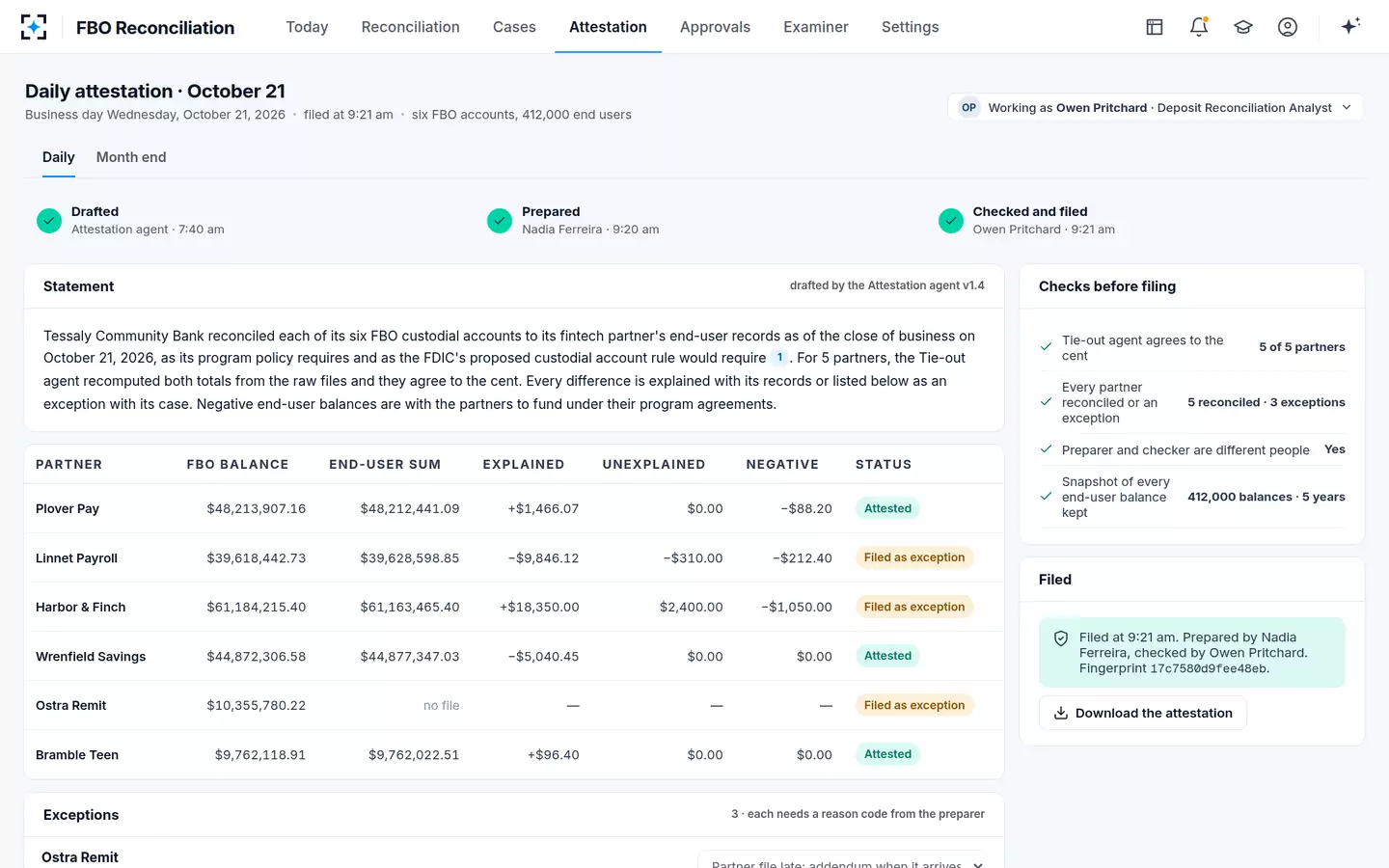
Small banks find this hard to staff, and the booklet's question already holds the small bank's answer: rotation of duties as well as segregation. Its examination procedures also ask whether each function is "independently checked and verified using an appropriate sample of transactions." Neither path leaves room for one person preparing, checking and approving the same day. The solution enforces the split in the software itself: on the sample day, Nadia Ferreira prepared the attestation at 9:20 am and the Check and file button was locked for her; Owen Pritchard checked and filed it at 9:21 am.
FBO Reconciliation's daily attestation: prepared by one analyst, checked and filed by another
How often should custodial accounts be reconciled? Every business day
Custodial accounts with transactional features should be reconciled every business day, and the FDIC's pending proposal would make that a floor rather than a practice. The reason is mechanical: when end users can send money to third parties from a pooled account, a mistake in the partner's books does not wait for month end. A balance that is too high today can be spent tomorrow, and a shortfall that is $88 on Tuesday can be a different number by Friday. The same cadence question, put from the program's side, is answered in the guide to FBO accounts at fintechs.
The FDIC's own cost estimate shows how far the agency thinks many banks are from that floor. It assumed about 2,200 hours to set up the records and daily reconciliation and about 1,100 hours a year to keep them running, for each affected bank together with its partners, and between 600 and 1,100 banks affected. Who pays for those hours, and how they fall on smaller banks, is worked through separately.
Daily also changes what the desk can say about yesterday. A reconciliation that is done every morning produces a dated, attested view of every end user's balance for every business day. When an examiner or a bankruptcy trustee asks what the bank knew on a particular Tuesday, the answer exists. A desk that reconciles weekly, or only totals, has to rebuild that Tuesday from old files.
The seats the FDIC proposal would add: a certifying executive and an independent validator
If the proposal were adopted as written, two seats would appear above and beside the desk. The first is the executive who certifies. Proposed § 375.4(b) would have the chief executive officer, the chief operating officer or the highest-ranking official sign each year that the bank has implemented and tested the recordkeeping, "attesting to the accuracy of the certification, made after due inquiry" (89 FR 80135, proposed § 375.4(b)). An executive who signs that sentence will want the daily attestations, the exceptions and their closures in one place.
The second is the validator. Where a partner or a third party keeps the beneficial-ownership records, the proposal would require at least an annual validation by someone independent of that third party, with the results sent to the bank. The proposal is explicit that this need not be an outside firm: "The independent validation could be performed by the IDI itself." In practice that pushes the work toward internal audit or a second-line team, and toward a desk whose daily output can be sampled and re-performed.
Neither seat exists by rule today. Both are worth designing for, because the alternative is to staff them in a hurry if a final rule arrives, and because both questions, who vouches for this and who checked the partner's books, are ones an examiner can already ask.
When a partner's file is late: the escalation clock
A late partner file should start a clock, not stop the day. At the sample bank, each partner's file is due by 5:00 am (5:30 am for one partner), and the escalation is a setting: a reminder to the partner one hour after the deadline, the oversight manager at two hours, the Controller at four. On October 21, Ostra Remit's transfer failed a certificate check at 4:48 am. The case reached the oversight manager at 7:00 am and the Controller at 9:00 am, exactly on that schedule.
What the desk must not do is attest the partner on the strength of a total. Ostra Remit's balance service showed a provisional figure of $10,355,140.22 against the core's $10,355,780.22, but a total is not 35,957 individual balances. The partner went into the attestation as an exception with a reason code, and an addendum follows when the file arrives. A desk that waits for the file risks missing the deadline for the other five; a desk that attests on the total signs something it has not checked.
What FBO Reconciliation changes at each seat
The solution does not remove a seat. It changes what each seat finds when it sits down. Seven agents read the files overnight, pair entries, explain what they can with the records attached, check every end user and recompute both totals on a separate path. People keep every signature.
Five seats at the sample bank, before and with FBO Reconciliation
Today
Starts at 8 am with six partners' files and a 10 am deadline, compares two totals in a spreadsheet and explains the difference from memory
With agents
Opens each partner's day with the difference already walked to zero, every step tied to its records
Still theirs: Reason codes on exceptions and the preparer's signature
Today
Chases partners by email about negative balances and late files, with no deadline and no trail
With agents
Checks and sends notices the agents drafted, citing the program agreement, the same morning; every case has an owner and a deadline
Still theirs: Sending every notice
Today
Wants to see the records and who proposed an entry before it touches a custodial account
With agents
Sees each funding or adjusting entry with its lines, the case and the proposer on one screen
Still theirs: Approving or returning every entry
Today
Needs to see an end user cycling money through a wallet without the partner learning of it
With agents
Receives referrals in a view no other role can open
Still theirs: The decision on each referral
Today
An examiner's request for a past day's balances means rebuilding it from old files
With agents
Picks a partner and a day and gets every balance from the attested snapshot, with who prepared and checked it
Still theirs: The examiner pack and its scope
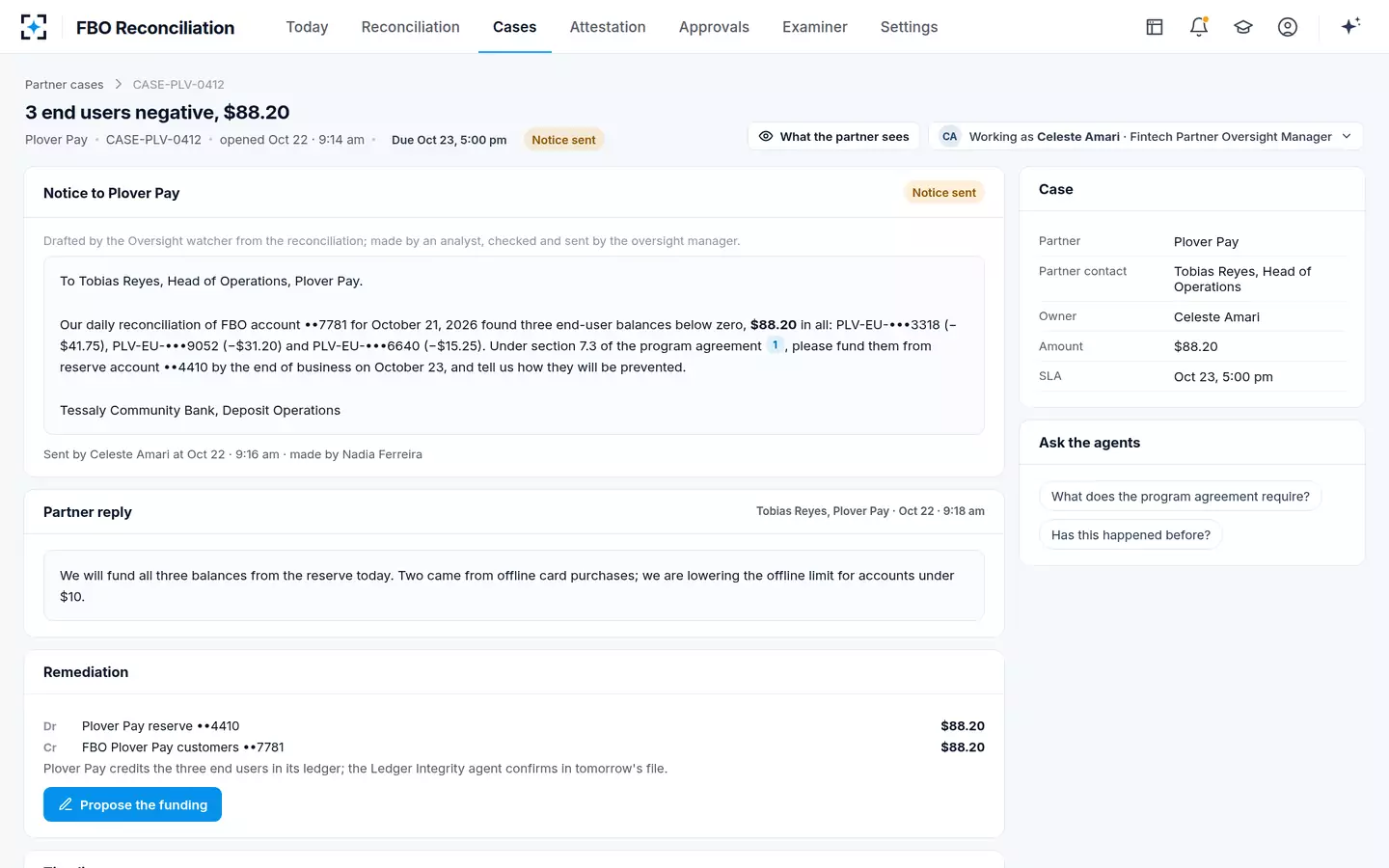
The oversight manager's seat shows the pattern most clearly. On October 22 the analyst opened a case for three negative end-user balances at Plover Pay, $88.20 in all, at 9:14 am. The notice had been drafted during the agents' early-morning run, citing section 7.3 of the program agreement; the analyst submitted it, the oversight manager checked and sent it at 9:16 am, and the partner replied two minutes later that it would fund all three from its reserve. The funding entry then waited for the Controller, because the person who proposes moving money cannot approve it.
A partner notice in FBO Reconciliation: drafted by an agent, made by the analyst, sent by the oversight manager
The same day, followed from the partner's cut-off to the filed report, shows how the seats hand work to one another minute by minute. And because agents now do part of the preparer's job, the separation between writing an explanation and checking it has to hold for software too; why the agent that explains a break never checks the totals follows that thread.
What an examiner can ask the desk for, any morning
A desk is well run when it can answer an examiner's questions from what it already produced that morning, without a project. The list below is ours, built from the proposal's requirements and the OCC's internal-control questions; it is a way to test a desk, not a regulatory checklist.
Seven things a well-run FBO reconciliation desk can show on any business day
- Yesterday's reconciliation for every FBO account, dated and signed
Each partner tied to the end-user level, or listed as an exception with a reason code.
- Two different names on every attestation
The preparer and the checker, with times; the system should make the same person filing their own work impossible.
- Every difference walked to its records
Each break with the return file, settlement file or partner entry behind it, and when it is expected to clear.
- Yesterday's timing items, cleared or aged
Each item promised to clear shown as cleared, or turned into an aged break with an owner.
- The end-user checks, not just the totals
Negative, duplicate and ownerless balances; missing fields; ownership codes.
- Every partner notice and funding entry with its maker and checker
Notices sent by the oversight manager; money moved only with the Controller's approval.
- Any past business day, rebuilt on request
Every end user's balance from the attested snapshot, in the layout the FDIC has proposed.
To see the desk work on a sample of your own partners' files, start from FBO Reconciliation.
Questions people ask
What is reconciliation in banking operations?
In banking operations, reconciliation is the daily or periodic proof that two records of the same balance agree, such as a correspondent account against its statement, a subsidiary ledger against the general ledger, or an FBO account against the fintech partner's customer balances. Every difference is either explained with evidence or carried as an open item with an owner. The OCC's examiners look for reconciliations that are timely, independent and reviewed.
Who should do bank reconciliation, finance or operations?
Either can, as long as the person who reconciles is not the person who originated or processed the items. For FBO accounts, deposit operations usually prepares and a second analyst checks, while finance, through the Controller, approves any entry that moves money. What matters to an examiner is the separation, not the department's name.
What does a deposit reconciliation analyst do?
On an FBO desk, the analyst ties each custodial account to its partner's customer balances, investigates the breaks, opens cases with partners for problems such as negative balances, and prepares the daily attestation with a reason code for every exception. At the sample bank one analyst prepares and a second analyst checks and files.
Who signs the FDIC custodial account certification?
Under the FDIC's 2024 proposal, the chief executive officer, the chief operating officer or the highest-ranking official would sign an annual certification that the bank has implemented and tested the recordkeeping, filed with the FDIC and the bank's primary federal regulator. The proposal is still pending, so no bank signs one today.
Can one person prepare and approve a reconciliation at a small bank?
Not as a matter of course. The OCC's internal-control booklet asks whether segregation or rotation of duties keeps one employee from originating, processing and reconciling the same items, and whether each function is independently checked on a sample. Where staff are few, rotating the preparer and checker roles and having someone outside the desk re-perform a sample are the answers those questions point to; a system that locks the preparer out of filing makes the split hold on busy days.