Account reconciliation vs bank reconciliation is a difference of direction. A bank reconciliation compares the cash balance in a set of books with the bank's statement and explains the items in transit. An account reconciliation is the wider discipline of proving any account's balance against the detail behind it, a subsidiary ledger against the general ledger, a suspense account against its open items. An FBO account, the custodial deposit account a sponsor bank holds for a fintech partner's customers, needs both at once: the bank's balance for the account must equal the total of the partner's customer balances, and that total must be the right sum of the right owners. The first test is easy to pass and the second is where customers are harmed. Botminds' FBO Reconciliation does both every business day, with the difference walked to zero and every end user checked.
The examples come from a fictional sample bank as it runs through the solution: Tessaly Community Bank, six fintech partners, 412,000 end users, on Wednesday, October 21, 2026. The rules are linked where they appear.
On the sample day, timing and partner errors made up most of each difference; the rest needed a person
Plover Pay, +$1,466.07
- ACH returns after the partner's cut-off · 83%
- Card settlement timing · 17%
Linnet Payroll, −$10,156.12
- Payroll batch loaded twice by the partner · 97%
- Unexplained, to a person · 3%
Harbor & Finch, +$20,750.00
- Explained items · 88%
- Aged wire recall, an exception · 12%
What is the difference between bank reconciliation and account reconciliation?
The difference between bank reconciliation and account reconciliation is what each one proves. A bank reconciliation proves that two independent records of the same cash, the depositor's books and the bank's statement, agree after timing items. An account reconciliation proves that a summary balance is supported by its detail. One is a comparison of two parties' records; the other is a comparison of a total with its parts.
Bank reconciliation, account reconciliation and an FBO reconciliation, side by side
Bank and account reconciliation: Bank rec: do my books agree with the bank statement? Account rec: does this balance equal the detail behind it?
An FBO reconciliation: Does the bank's balance for one custodial account equal the partner's total, and is that total the right sum of the right owners' balances?
Bank and account reconciliation: Books and statement; or a general ledger account and its subsidiary detail
An FBO reconciliation: The core's FBO balance and postings, and the partner's file of every end user's balance and entries
Bank and account reconciliation: Outstanding checks, deposits in transit, bank fees, posting errors
An FBO reconciliation: ACH returns after the partner's cut-off, card settlement timing, duplicate loads, wires recalled, partner booking errors
Bank and account reconciliation: Usually the reconciling items
An FBO reconciliation: Every end user: negative, duplicate and ownerless balances, missing fields, ownership codes
Bank and account reconciliation: Often monthly
An FBO reconciliation: Every business day, as the FDIC's 2024 proposal would require
Bank and account reconciliation: The company's own financial statements
An FBO reconciliation: End users who cannot be paid, and the bank that holds their money
What is account reconciliation in banking, on an FBO account?
In banking, account reconciliation is the control that ties each general ledger balance to the records that support it. The OCC's internal-control booklet puts the expectation plainly: "Bank personnel should maintain trial balances and subsidiary ledgers and reconcile those ledgers to general ledgers in a timely manner, investigate and resolve any differences noted, and ensure appropriate personnel review and approve completed reconcilements in a timely manner" (OCC, Internal Control).
On an FBO account the subsidiary detail is not the bank's. It sits in the fintech partner's books, or a middleware provider's, and arrives as a file. That turns account reconciliation into something closer to an audit of a third party's records every morning: the bank cannot simply trust the detail because it built the system that produces it. The FDIC's 2024 proposal describes the work in terms that fit both halves: "Reconciliations compare multiple data elements and, if differences are identified, actions are taken to bring the data elements into agreement. The reconciliation requirement is intended to address the completeness and accuracy of transaction processing" (FDIC, 89 FR 80135).
Completeness and accuracy are two different tests. Completeness asks whether every transaction that moved money through the account appears on both sides. Accuracy asks whether each one landed on the right customer for the right amount. A tie-out on totals tests neither directly; it tests whether the errors happen to cancel.
Why a tie-out on the totals is not enough
A tie-out on the totals is not enough because a sum can be right while its parts are wrong. Negative balances are the simplest case. When an end user overspends through an offline card purchase or spends an ACH deposit that is later returned, the partner's file shows a negative balance. In the sum, that negative offsets someone else's positive balance, so the total is lower than what the positive end users are owed.
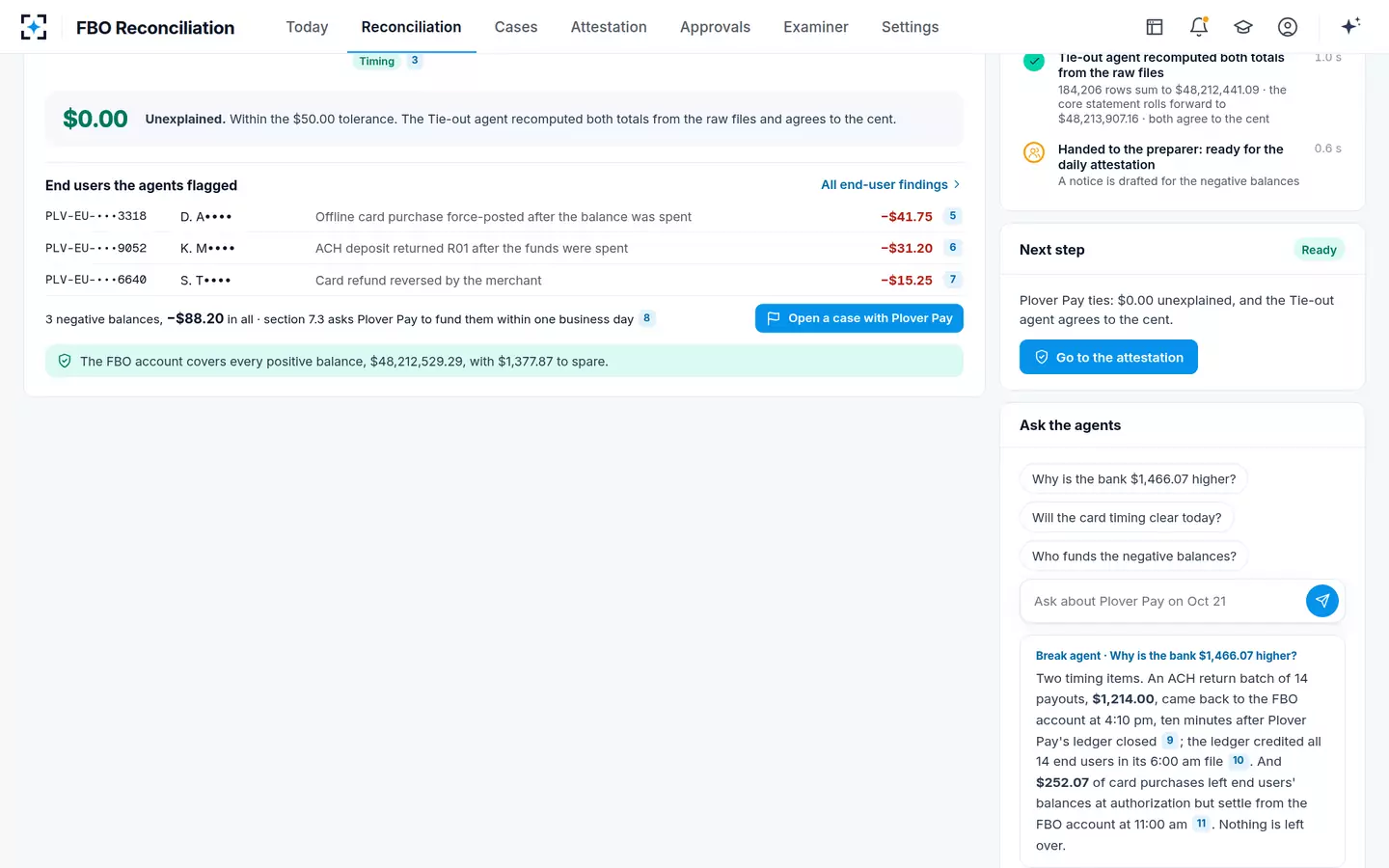
The useful test is coverage: does the FBO account hold at least the sum of every positive balance? At the sample bank, Plover Pay's difference walked to $0.00 unexplained, and the solution's independent recompute agreed to the cent. Inside the total, three end users were negative by $88.20 in all. The table shows why the coverage line, not the tie-out, is the one a controller should read.
Plover Pay on October 21: the tie-out and the coverage test give different answers
| Line | Amount | What it tells you |
|---|---|---|
| FBO account, core, 9:00 pm close | $48,213,907.16 | What the bank holds |
| Sum of 184,206 end-user balances | $48,212,441.09 | What the partner says it owes, net of negatives |
| Difference, walked to zero | +$1,466.07 → $0.00 | ACH returns after cut-off and card timing; the tie-out passes |
| Negative balances inside the sum | −$88.20 | Three end users who owe the program money |
| Sum of positive balances | $48,212,529.29 | What end users with money can claim |
| Coverage: FBO account minus positive balances | $1,377.87 | The account covers every positive balance, with that much to spare |
Here coverage held. But the arithmetic shows how it can fail with the totals still tying. Had the negatives been larger than the bank's timing surplus, the FBO account would have tied to the net total and still been short of what positive end users could withdraw. Nothing in a totals-only process would flag it.
What causes discrepancies in bank reconciliation of an FBO account?
Discrepancies in an FBO reconciliation come mostly from three causes: the two sides closing at different times, money moving through systems the partner does not see in real time, and errors in the partner's own books. The split at the top of this page shows the sample day: on Plover Pay, an ACH return batch that posted ten minutes after the partner's 4:00 pm cut-off and card purchases that settle from the account the next morning; on Linnet Payroll, a payroll batch the partner loaded twice; on Harbor & Finch, a wire recall that had aged past its expected clear time.
Timing items are not errors, but they are where errors hide. A timing item is a promise that a difference will clear by a known time; if nobody checks that it did, a real break can sit under the label "timing" for weeks. In the solution every timing item gets an expected clear time, and if it has not cleared one hour after that, it becomes an aged break with an owner. How each of these breaks moved through one business day is traced separately.
Why the per-owner balance is the one that counts
The per-owner balance counts because deposit insurance, and in practice a customer's access to money, is decided owner by owner. The FDIC starts from the bank's own records and presumes the money is owned the way those records say it is (12 CFR 330.5(a)(1)). For a pooled account, the regulation adds a rule that turns any shortfall into everyone's problem. Where custodial funds are commingled and placed on deposit without allocation, "the owner's insured interest in the deposit in any one insured depository institution would represent, at any given time, the same fractional share as his or her share of the total commingled funds" (12 CFR 330.5(a)(2)).
Read with a shortfall in mind, that sentence explains why per-owner records matter even when the total is close. If the pooled money is short, every owner's share is short in proportion, unless the records can show whose money is where. The CFPB's action against the middleware firm Synapse described the outcome when they cannot: partner banks found they held less than Synapse's records said consumers were owed, a shortfall of $60 million to $90 million by the Bureau's account, and some consumers were still short of their full balances when the Bureau acted (CFPB, Synapse Financial Technologies). What the records missed in the Synapse failure is covered in depth elsewhere.
The FDIC drew a further lesson for banks that share a partner. In its 2024 proposal it argued that daily reconciliation would help stop inaccurate recordkeeping at a fintech that uses several banks "from spreading to IDIs", so that a mismatch at one partner bank could be "resolved before the underlying issue causes mismatches at other of the account holder's partner IDIs" (89 FR 80135). A totals-only process catches none of that.
End-user problems a tie-out on the totals cannot see
Across the sample bank's six partners on one day, the end-user checks found problems in five categories, none of which moves the total. They range from a single pattern referred to the BSA Officer to 1,204 accounts with the wrong ownership code.
What FBO Reconciliation's end-user checks found on one day, none of it visible in the totals
Each category has a different owner and a different fix. Negative balances go to the partner with a notice citing its program agreement; at the sample bank, Plover Pay's agreement asks it to fund them within one business day. Balances without an owner, 41 at Linnet Payroll totalling $1,902.55, are restricted until the partner names them, an action that waits for the oversight manager's check. Missing fields go back to the partner for the next file. None of these is a reconciling item in the accounting sense, and all of them would survive a perfect tie-out.
FBO Reconciliation flags the end users inside a total that ties
Ownership codes: the error a reconciliation of totals will never find
An ownership code is the field that says in what capacity an end user owns a balance, single, joint, trust and so on. The FDIC's 2024 proposal would require one for every beneficial owner, from a list in its Appendix B. It never affects a total, so no tie-out can find it wrong. It does affect insurance, because the FDIC adds a balance to the owner's other deposits in the same category before it applies the limit.
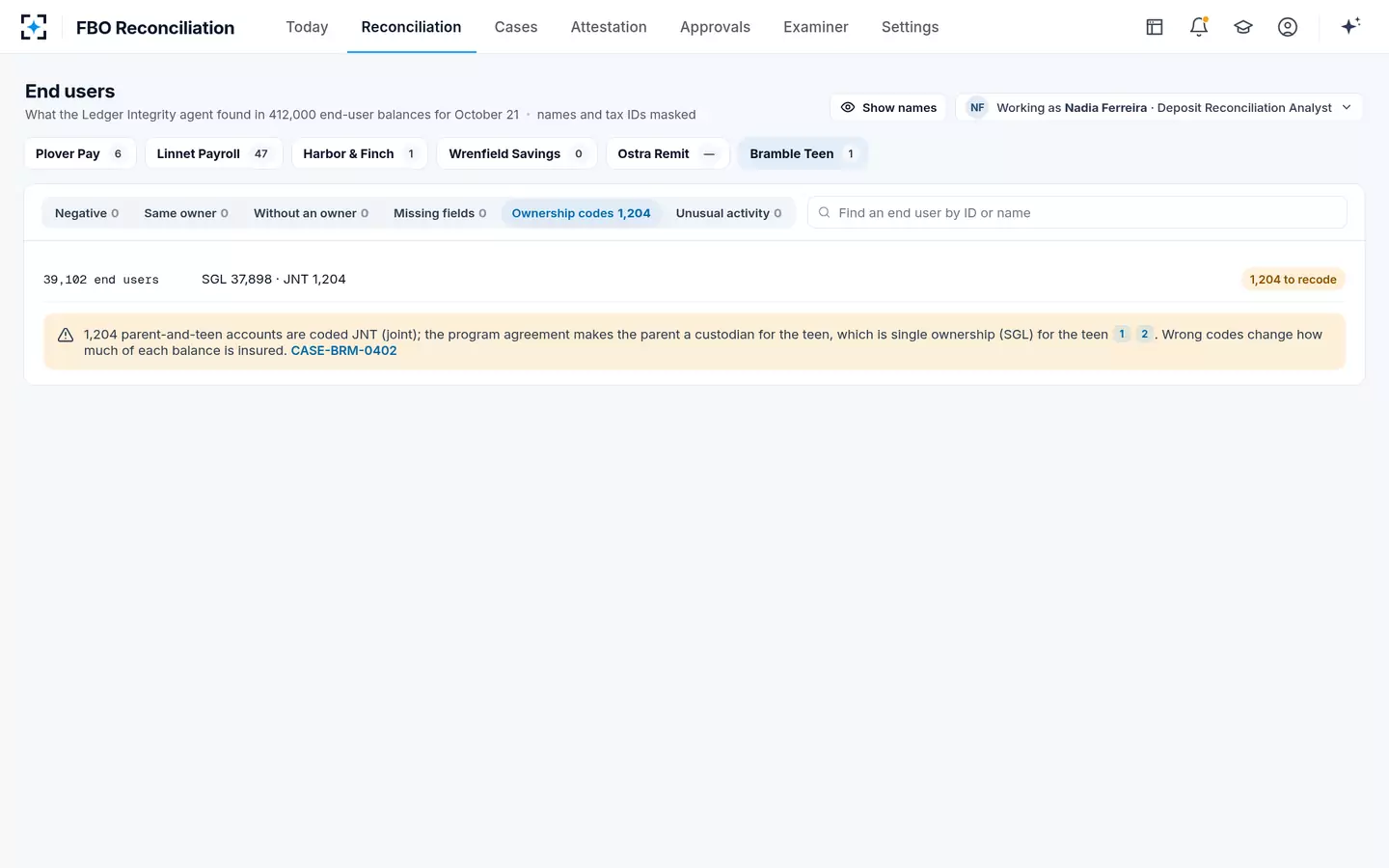
The sample bank's sixth partner, Bramble Teen, runs accounts for teenagers opened with a parent. Its file coded 1,204 of 39,102 end users as joint accounts. Its program agreement makes the parent a custodian for the teen. Under the FDIC's rules, funds a custodian holds for a minor under the Uniform Gifts to Minors Act are treated as an agency account and insured as the minor's (12 CFR 330.7(b)), which is single ownership in the teen's name, not joint ownership. The balances were right to the cent; the code that decides how they are insured was wrong.
FBO Reconciliation's ownership-code check on one partner's 39,102 end users
Why is a bank reconciliation performed, and what should a controller ask for?
A bank reconciliation is performed to show that cash recorded is cash held, and to surface errors and fraud while they are still small. On an FBO account the controller's question is wider: is every customer's money there, and could the bank prove it for any past day? The checklist below is what we would ask to see at month end.
Six things a controller should see from an FBO reconciliation, beyond a tie-out
- The coverage line for every partner, every day
FBO balance against the sum of positive end-user balances, not only against the net total.
- Timing items with expected clear times, and proof they cleared
Anything past its time shown as an aged break with an owner.
- An independent recompute of both totals
Computed from raw files on a separate path from the matching, able to block filing.
- End-user findings by category, with cases
Negative, duplicate and ownerless balances, missing fields and ownership codes, each with the partner's response.
- Every adjusting or funding entry with its maker and approver
No entry touching the custodial account approved by the person who proposed it.
- Any past day rebuilt from the attested snapshot
Every end user's balance and code for that day, with who prepared and checked it.
Ownership codes and the per-owner record are also what pass-through insurance rests on; the records the FDIC would need on failure day sets out each condition. The customer balances themselves are often called virtual accounts; what a virtual account is, and why it is not a deposit account, explains the structure. To see the coverage test and end-user checks on your own partners' files, start from FBO Reconciliation.
Questions people ask
What is a bank reconciliation in accounting?
In accounting, a bank reconciliation compares the cash balance in an entity's books with the balance on its bank statement for the same date and explains each difference, such as outstanding checks, deposits in transit, bank fees or errors. It is often prepared monthly, ideally by someone other than the person who records cash receipts and payments.
Cash reconciliation vs bank reconciliation: what is the difference?
A bank reconciliation compares books with a bank statement. A cash reconciliation is broader and can cover cash in drawers, vaults or ATMs as well as bank accounts, comparing counted or reported cash with what the books say should be there. For an FBO account the relevant one is a bank-style reconciliation of the custodial account, extended to every end user's balance.
What is the account reconciliation process?
Gather the balance and its supporting detail as of the same date, compare them, explain each difference with evidence, carry unexplained items with an owner and a date, and have a second person review and approve. The OCC's internal-control booklet expects reconciliations to be done continually, independently and on time, with outstanding items resolved and cleared.
Is a reconciliation that ties to the cent always right?
No. A reconciliation can tie because errors cancel, because a negative balance offsets a positive one, or because both sides share the same mistake. That is why an independent recompute of both totals and checks on each individual balance matter more on a custodial account than the tie itself.
What is a coverage test on an FBO account?
It compares the bank's balance for the FBO account with the sum of all positive end-user balances, leaving out the negatives. If the account holds less than that sum, positive end users could not all be paid in full even though the net total ties. At the sample bank the test showed $1,377.87 to spare on a $48.2 million account.