AI for bank reconciliation works when software does the reading, pairing and first explanation of every difference, and fails when the same software that wrote the explanation also decides that the reconciliation ties. On an FBO account, the custodial deposit account a sponsor bank holds for a fintech partner's customers, the work is a daily proof that one bank balance equals the sum of thousands of customer balances in the partner's sub-ledger, and it runs to hundreds of thousands of entries a morning. That volume is why banks look at AI, and it is also why the control design matters more than the model. Botminds' FBO Reconciliation is built on one rule: the agents that explain a difference are checked by a separate agent that recomputes both totals from the raw files on its own path, and only people prepare, check and file.
The examples on this page come from a fictional sample bank as it runs through the solution: Tessaly Community Bank, six fintech partners, 412,000 end users. The regulators' positions are linked where they appear.
In FBO Reconciliation, the agents that explain are checked by one that recomputes, and people sign
Agent
Intake agentReads the core's FBO balance, the payments hub's ACH and wire files, card settlement and each partner's file; checks arrival, control totals and format.
Never: loads a file whose control total or format fails, or edits a file.
Agent
Matching agentPairs each partner entry with the bank record behind it: ACH batches and returns, wires, card settlement, book transfers.
Never: forces a pair below 0.95 confidence; it leaves the item unpaired.
Agent
Break agentExplains each remaining difference with the records behind it and says when a timing item should clear, then checks that it did.
Never: calls a difference explained without a record; below 0.90 it hands the item to a person.
Agent
Tie-out agentRecomputes the end-user sum row by row and rolls the FBO balance forward from the opening balance and every posting.
Never: shares code or a data path with the Matching agent; if it disagrees by a cent, the attestation is blocked.
A person decides
Preparer, a reconciliation analystReviews each break, gives every exception a reason code and signs the attestation as preparer.
A person decides
Checker, a second analystOpens the same records, then checks and files the attestation.
Never: files work they prepared; the button is locked.
Can AI do bank reconciliation? The reading and pairing, yes; the sign-off, no
AI can do the parts of bank reconciliation that are reading, matching and drafting, and it can do them across every row rather than a sample. What it should not do, on any account that holds other people's money, is decide on its own that the reconciliation is complete. That is not a statement about how good the models are. It is the same rule banks already apply to people: the OCC's internal-control booklet counts account reconciliation among the bank's independent checks, and an independent check performed by the party whose work it checks is not independent (OCC, Internal Control).
Treasury's 2024 report on AI in financial services, which summarizes what firms told it in response to a request for information, captures both halves. It lists recordkeeping and advanced document search among the back-office work generative AI can automate, and in the same breath warns that these systems can produce confidently stated output that is wrong, the failure usually called hallucination, and that this creates new problems for AI governance (U.S. Treasury, AI in Financial Services, December 2024). A reconciliation explanation is exactly the kind of output that can be fluent, specific and wrong.
So the useful question for a buyer is not whether the AI can reconcile. It is which steps the software takes, what evidence it attaches to each, and what independent computation stands between its output and a filed attestation.
Why an FBO account is a harder test than a bank statement
A corporate bank reconciliation compares one statement with one cash account and a few hundred items. An FBO reconciliation compares one bank balance with the sum of every customer balance a fintech partner reports, and pairs the partner's entries with the bank-side records that moved the money. At the sample bank, a single partner, Plover Pay, sent 842,318 entries and 184,206 end-user balances for one business day; the agents paired 842,296 of them and left 22 card entries and one return batch for the Break agent.
Three features make the account hard for software and for people. The two sides close at different times: Plover Pay's books close at 4:00 pm Central and the bank's core at 9:00 pm, so every day carries timing items. The money moves through several systems, the core, the payments hub and the card processor, each with its own file and clock. And a total that ties can still hide end users who are wrong, which is why a tie-out on the totals is not enough for an account like this.
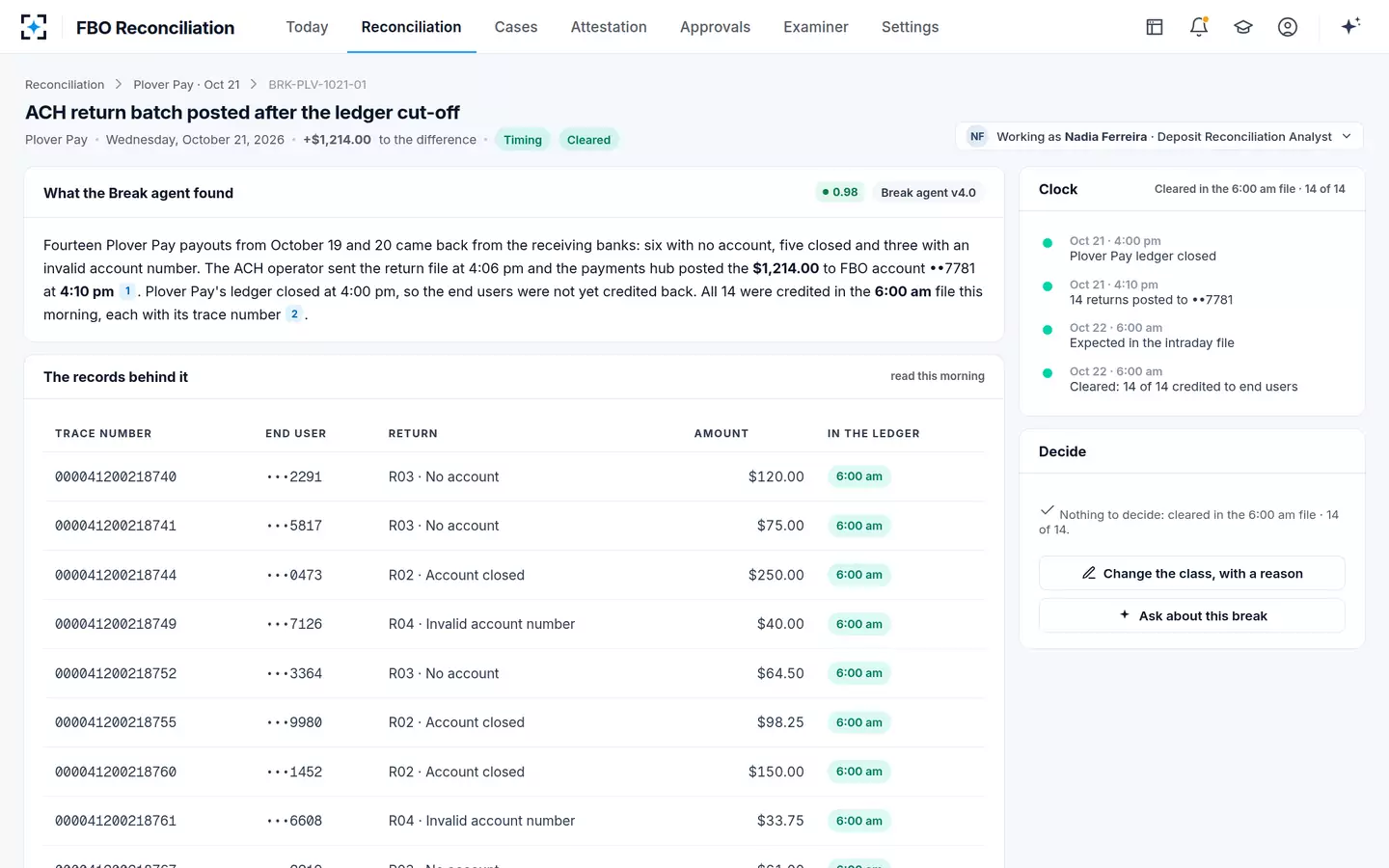
Those features are also where AI adds most. Pairing 842,318 entries is tedious but rule-bound. Explaining why fourteen ACH payouts came back after the partner's cut-off means opening the return file, reading the codes and the posting time, and finding the same fourteen credits in the next morning's partner file. That is reading and cross-referencing, work that agents can do in seconds and attach to the answer.
A break explained by FBO Reconciliation's Break agent, with the records and the clock
Is AI reconciliation accurate? Only an independent recompute can say
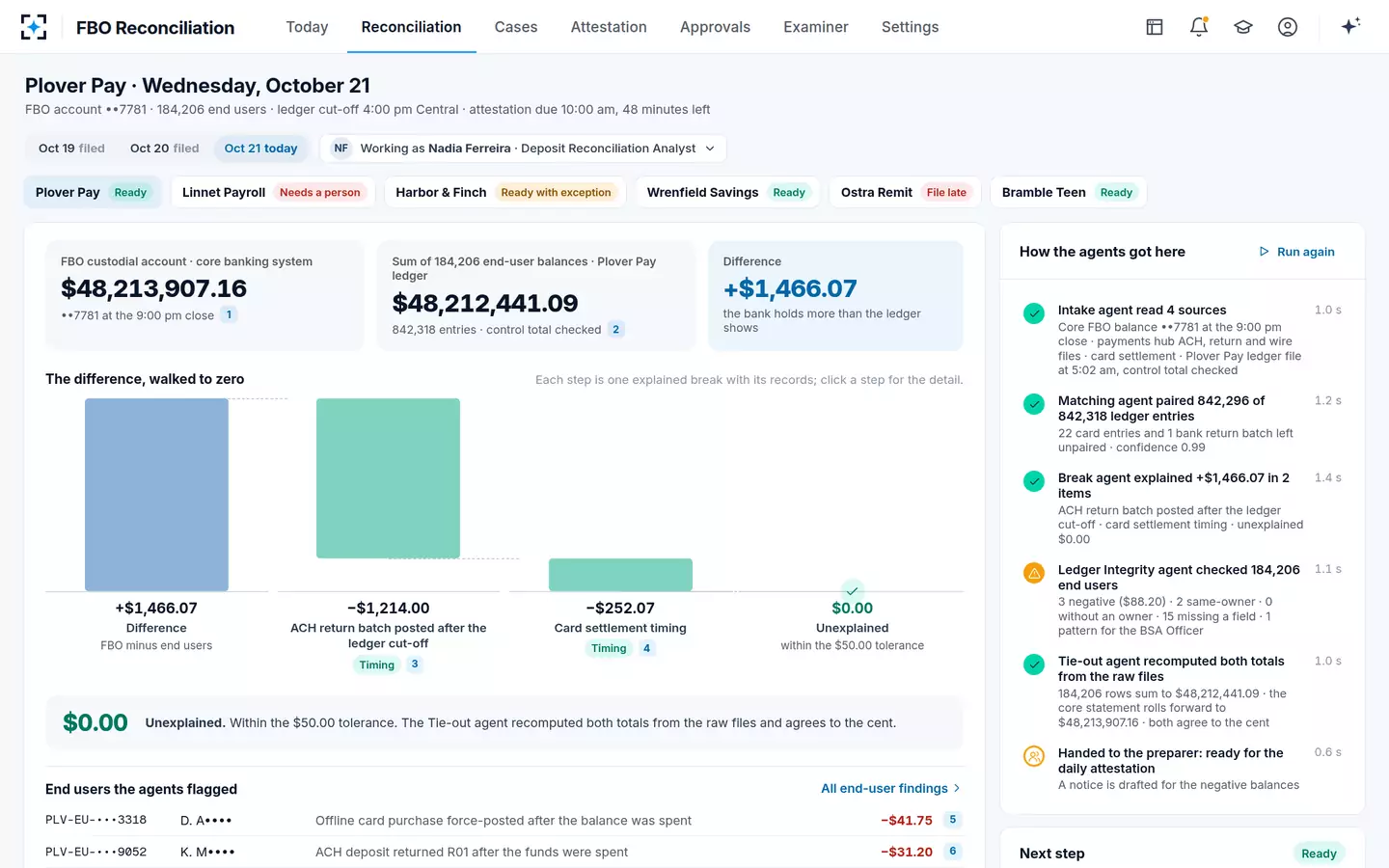
Whether AI reconciliation is accurate on a given day cannot be judged from its own explanation, however well cited. It can be judged by a second computation that reaches the same totals without using the first one's work. That is the role of the Tie-out agent: it sums the 184,206 end-user rows itself and rolls the FBO balance forward from the opening balance and every posting in the core statement. It shares no code or data path with the Matching agent, so a mistake in pairing cannot reappear in the check. If the two disagree by a cent, the attestation cannot be filed.
The pattern is old. Accountants foot a column a second way; auditors re-perform a sample rather than read the preparer's notes. What changes with agents is that the re-performance can cover every row every day. On the sample day, the recompute agreed to the cent for five of the six partners; the sixth had no file to recompute, and was filed as an exception rather than attested on a total.
Accuracy over time is a separate question, and it should be measured, not asserted. In the solution, every agent carries a version, a model, a confidence threshold, its limits and its last evaluation, and any change to an agent runs against a 60-day evaluation set before a second administrator approves it. A buyer should ask any vendor for the equivalent: what set of closed days the agents are tested on, who approves a change, and what happens to a threshold when results drift.
What the 2026 model risk guidance leaves to the bank
Until April 2026, the interagency reference point for model risk was the 2011 guidance, SR 11-7. That letter has been superseded. On April 17, 2026 the Federal Reserve, the OCC and the FDIC issued revised guidance, which the Board's letter SR 26-2 says "supersedes and replaces SR letter 11-7" and is expected to be most relevant to banking organizations with over $30 billion in total assets (Federal Reserve, SR 26-2). The revised text puts the newest tools outside its scope. In a footnote it treats generative and agentic AI models as too new and changing too fast to be covered, leaves their controls to the bank's own risk management and governance, and keeps its principles for traditional statistical and quantitative models and for AI that neither generates content nor acts on its own (revised guidance, footnote 3). The same scope line runs through every bank model, as the guide to AML customer risk-rating models shows. One idea the guidance does keep bears directly on agents that are meant to check one another.
"Aggregate risk reflects interactions and dependencies among models; reliance on common assumptions, data, or methodologies; and any other factors that could adversely affect several models and their outputs simultaneously."
Federal Reserve, OCC and FDIC, Supervisory Guidance on Model Risk Management, April 17, 2026
For a sponsor bank using agents, the exclusion moves the design burden onto the bank. There is no supervisory template for an agent that explains reconciliation breaks; there are the bank's own controls, and aggregate risk is the first thing they should be designed against. A matching agent and a checking agent that read the same extract, or run the same code, fail on the same day in the same way, and the check confirms the error. That is why the Tie-out agent has its own path to the raw files. The guidance's idea of effective challenge is the other half: a critical review by people expert enough to find the problem, independent enough to stay objective, and senior enough to force a change (revised guidance, 2026; how model validators apply it). An independent recompute and a second analyst are effective challenge built into the daily process rather than added once a year.
The GAO reached a similar conclusion from the supervisors' side in 2025: the financial regulators oversee AI mostly with the laws, rules, guidance and risk-based examinations already on their books (GAO-25-107197; the guide to AI audit software reads the same report for internal audit). For an FBO desk the existing rules are the ones on reconciliation, segregation of duties and recordkeeping. An AI design that satisfies those, with evidence a reviewer can open, is one an examiner can assess.
Can ChatGPT do bank reconciliation? What a general assistant cannot show you
A general-purpose chat assistant can help an analyst read one return file or draft an email to a partner. It cannot do an FBO bank reconciliation on its own, because the work depends on reading the bank's systems directly, holding hundreds of thousands of rows, keeping a dated trail of who opened what, and being checked by something it does not control. The difference is less about intelligence than about where the work happens and what it leaves behind.
A general chat assistant and a reconciliation built from agents, on the same FBO break
Pasting files into a general assistant: Whatever the analyst exports and pastes, often a sample or a total
Agents inside the reconciliation: The core statement, payments hub files, card settlement and the partner's full file, read where they live, with control totals checked
Pasting files into a general assistant: A paragraph that sounds right; the analyst must find the records to prove it
Agents inside the reconciliation: Each step carries a citation that opens the exact passage in the return or settlement file
Pasting files into a general assistant: The analyst re-reads the answer
Agents inside the reconciliation: A separate agent recomputes both totals from raw files; disagreement blocks filing
Pasting files into a general assistant: Rarely reached; too many rows to paste
Agents inside the reconciliation: Every balance checked for negatives, duplicates, missing owners, missing fields and ownership codes
Pasting files into a general assistant: A chat history on someone's screen
Agents inside the reconciliation: Who opened which source, who prepared, who checked, with times, kept with the day's snapshot
Pasting files into a general assistant: Customer names and tax IDs leave the bank's systems
Agents inside the reconciliation: Names and tax IDs masked on every screen; showing them needs a reason on the trail
An AI agent for bank reconciliation: five things it must never do
An AI agent for bank reconciliation should have written limits, and they should be enforced by the system rather than promised in a policy. These are the five that matter most on a custodial account, with the reason each one exists.
Five limits every reconciliation agent should have, written into the software
- Never call a difference explained without a record
An explanation without a source is a guess; it ties today and becomes tomorrow's unexplained break.
- Never force a match below its threshold
A pair the agent is not sure of should stay open for the explaining step or a person, not be closed to make a total look better.
- Never check its own work
The totals are recomputed on a separate path; the agent that paired entries does not decide whether the day ties.
- Never sign, file, send a notice or move money
Attestations, partner notices, funding from a partner's reserve and adjusting entries each need a person, and a second person to check.
- Never edit a source file
If a partner file is wrong, the partner corrects it; a reconciliation that alters its inputs has nothing left to prove.
Limits only work if a person sees when an agent stops. In the solution, an item the Break agent cannot tie to a record, or can explain only below 0.90 confidence, goes to the analyst with what it did find. On the sample day, Linnet Payroll's difference of −$10,156.12 was explained down to −$310.00 by a payroll batch loaded twice in the partner's books; the remaining $310.00, above the $50.00 tolerance, went to a person and into the attestation as an exception.
Best AI for bank reconciliation: questions to put to any vendor
The best AI for bank reconciliation is the one whose work your checker and your examiner can re-perform. Demonstrations tend to show the explanation; the questions below are about what stands behind it. They apply to us as much as to anyone.
Eight questions to ask before buying AI for an FBO reconciliation
| Ask | A good answer shows | Why it matters |
|---|---|---|
| What does the system read, and from where? | Named sources: core statement, payments hub, card processor, partner file, with control-total checks on arrival | A reconciliation built on exports is only as good as the export |
| How are both totals checked? | An independent recompute from raw files, on a separate path, that can block filing | Otherwise the system grades its own work |
| What happens below the confidence threshold? | The item goes to a named person with what the agent found | Silent auto-closure is how small errors age |
| Does it check every end user or only the total? | Negative, duplicate and ownerless balances, missing fields and ownership codes for every row | Pass-through insurance and customer harm turn on individual balances |
| Can one person prepare and file? | No; the system enforces a different checker | Segregation is an examination question |
| How is a past day rebuilt? | From a dated snapshot, with who prepared and checked it | Examiners and trustees ask about specific days |
| How are agent changes tested and approved? | An evaluation set of closed days and a second approver | Generative and agentic AI sit outside the 2026 model risk guidance |
| Where does customer data go? | Inside the bank's environment; names masked by default | Partner files carry names and tax IDs for every end user |
FBO Reconciliation's agents' run beside the difference they walked to zero
Where FBO Reconciliation fits, and where it does not
The solution fits a sponsor bank, or a bank with custodial deposit accounts held for a program manager's customers, that receives a customer balance file from each partner and has to tie it to the bank's own records every business day. It reads the core, the payments hub, card settlement and each partner's file where they already are, and writes back only approved adjusting entries to the general ledger. How it sits beside the systems an FBO account already runs on is laid out separately.
It does not replace those systems, and it is not a general accounts-payable or corporate bank statement tool. It cannot reconcile what a partner does not send: a partner that provides only a daily total, as Ostra Remit's balance service did on the sample day, gets an exception, not an attestation. And it does not take decisions off the desk. The agents explain, check and draft; people decide what an unexplained difference is, what to tell a partner and whether money moves. One full business day, from the partner's cut-off to the filed report, shows where each of those decisions falls.
To see the agents on a sample of your own FBO accounts and partner files, start from FBO Reconciliation.
Questions people ask
Can AI reconcile accounts on its own?
AI can pair entries, explain differences and draft the reconciliation, but on an account holding customers' money it should not be the one that decides the day ties. The decision belongs to a separate recompute and to two people, a preparer and a checker. That split is what lets an examiner rely on the result.
Is a reconciliation a detective control?
Yes. A reconciliation finds differences after transactions have posted, which makes it detective rather than preventive; the OCC's internal-control booklet lists account reconciliation among a bank's independent checks. Its value depends on timeliness: a daily reconciliation detects a partner's error before customers can spend it, a monthly one detects it after.
Does model risk guidance cover AI agents?
Not the 2026 interagency guidance. The revised Supervisory Guidance on Model Risk Management, issued April 17, 2026, states that generative and agentic AI models are not within its scope and that a bank's own risk management should decide their governance and controls. It applies to traditional statistical models and non-generative, non-agentic AI.
What confidence threshold should an AI reconciliation use?
There is no regulatory figure; it is a bank setting that should be tested on closed days. The sample bank pairs entries only above 0.95 and lets the Break agent explain only above 0.90, with anything lower going to a person. A threshold that has never been tested against past breaks is a guess.
Will AI replace reconciliation analysts?
On an FBO desk the work moves rather than disappears. Gathering, pairing and first explanations go to agents; the analyst's time goes to exceptions, partner cases and the attestation, and a second analyst still has to check. By Botminds' estimate the desk's morning falls from about six and a half hours across six partners to a little over one.