FBO account structure is the set of choices that turns one bank account into a home for many customers' money: whose name goes on the account, how many accounts a program uses, who keeps the sub-ledger of customer balances, when each side closes its books, and who funds a shortfall. An FBO (for benefit of) account is a custodial deposit account a sponsor bank holds for a fintech partner's customers, and its structure is usually settled in a program agreement long before anyone reconciles it. That is a mistake, because each choice produces a predictable kind of break in the daily reconciliation, from timing items to duplicate loads to balances with no owner. Botminds' FBO Reconciliation reads every structure a sponsor bank runs; this page is about designing the structure so that there is less to read.
The examples come from a fictional sample bank as it runs through the solution: Tessaly Community Bank, six fintech partners with six different setups, 412,000 end users. Rules and orders are linked where they appear.
FBO account structure options: five decisions that set up every daily break
1Whose name is on the account
- The bank, for the benefit of the partner's customers
- The partner, for the benefit of its customers
- A program manager or middleware firm, for several partners
What it changesDecides who the account holder is, what the title must disclose, and whether there is more than one layer to disclose
2How many accounts
- One per partner
- Several per partner, by product
- One partner's customers spread across several banks
What it changesDecides what one reconciliation covers, and whether a partner's error shows up at one bank or several
3Who keeps the sub-ledger
- The fintech
- A middleware firm
- The bank
What it changesDecides whose file the bank reconciles to, and who it must reach if that party fails
4When each side closes
- Partner cut-off, e.g. 4:00 or 5:00 pm
- Core close, e.g. 9:00 pm
- Card settlement the next morning
What it changesDecides how many timing items appear every day, and when each should clear
5Who funds problems
- A partner reserve account at the bank
- A deadline in the program agreement
- The bank, then recovery
What it changesDecides how fast a negative balance or shortfall is fixed, and who approves the money moving
How do FBO accounts work? One account, many owners
FBO accounts work by pooling: the bank holds one deposit account, the money of many customers sits in it together, and a separate set of books records how much belongs to each. Customers see their own balance in an app; the bank's core sees one balance for the whole program. Payments in and out of a customer's balance move money in and out of the pooled account, through the bank's ACH, wire and card systems. The guide to FBO accounts at fintechs follows the arrangement from the fintech's side; this page is about the choices that decide what the bank reconciles each morning.
The bank regulators described the arrangement in their 2024 request for information: a fintech can reach the bank "directly between banks and fintech companies or indirectly through the use of an intermediate platform provider," and among the key functions such a party may perform is "maintaining end-user ledgers" (OCC, Federal Reserve and FDIC, 89 FR 61577). Who performs that function is the most consequential structural choice a program makes, and the one most often left implicit.
What is a for benefit of account, and how is an FBO account named?
A for benefit of account is a deposit account opened by one party and held for others, its title saying so: in an FBO program, the custodian holds the account "for the benefit of" the customers. The title matters because deposit insurance can pass through to the customers only if the bank's own records disclose the custodial relationship.
Titles take two common shapes, and the FDIC has said which party it treats as the account holder in the less obvious one. Its 2024 proposal observes that "some businesses establish accounts at IDIs for the benefit of their customers, but the account is titled in the name of the IDI itself for benefit of the business's customers. In such instances, the FDIC would interpret the “account holder” under the proposed rule to be the business that contracted with the IDI to establish the custodial deposit account" (FDIC, 89 FR 80135). Either way, the title is the first line of the structure, and getting it right once does not keep it right through program changes and renamed partners.
Who keeps the sub-ledger: the fintech, a middleware firm or the bank
The sub-ledger of customer balances is kept by the fintech in many programs, by a middleware firm in others, and by the bank in a few, and the choice sets who the bank depends on every morning. The FDIC's account of the Synapse arrangements is the sharpest description of the risk. There, the fintech companies "developed user interfaces and application logic, and importantly, maintained the ledgers of their customers, including the deposit amounts attributed to each individual customer" (89 FR 80135). When the middleware between them and the banks failed, the banks could not readily tell whose money was whose.
Four parties in an FBO structure: what each keeps, and what a daily reconciliation asks of it
Today
Holds the FBO account, the bank-side records of every ACH, wire and card movement, and the program agreement
With agents
Has its balance tied to the partner's total every business day and each customer checked by agents; keeps the attested day
Still theirs: Responsibility for the account, whoever keeps the books
Today
Runs the app, sets the cut-off for its books and often keeps the customer balances
With agents
Sends a complete customer file by a set time; gets agent-drafted notices, sent by the oversight manager, the same morning
Still theirs: Its customers and its own books
Today
Connects the fintech to the bank, may keep the sub-ledger, sometimes for many fintechs and banks
With agents
Has its records read daily by the bank's agents, and must be named in the bank's records as a layer
Still theirs: The technology between them
Today
Sees an account number and a balance in an app
With agents
Is one row the agents check every day: balance, name, tax ID and ownership code
Still theirs: Ownership of the money
A middleware layer brings a specific rule into play. Where there is more than one level of fiduciary relationship, one way to satisfy the pass-through conditions is to "Expressly indicate, on the deposit account records of the insured depository institution, the existence of each and every level of fiduciary relationships" and to disclose at each level the names and interests of those on whose behalf that level acts (12 CFR 330.5(b)(3)). The FDIC's proposal would also have banks' controls "consider multi-layer relationships, where applicable," naming the case "where an account holder, such as an intermediary, collects and places deposits on behalf of other firms, which themselves collect deposits from individual depositors."
The supervisors have also made the split a matter of written controls. The Federal Reserve's June 2024 order against Evolve Bank & Trust required a plan whose controls set out which books the bank and which its fintech partners keep, and keep that split working through a disruption; the same plan made the board, or a committee of it, sign off in writing before that division took on any new fintech partner or customer (Federal Reserve Board, Evolve consent order; the Cross River consent order guide sets the two orders side by side). Other banking-as-a-service enforcement actions are collected on a sibling page.
How the structure decides the daily breaks
Every structural choice shows up in the morning's reconciliation as a recognizable kind of break. The table maps the most common ones to the choice that produces them, with an example from the sample bank's day.
The structure choice, the break it produces, and an example from one sample day
| Structure choice | Break it tends to produce | Sample day, October 21 |
|---|---|---|
| Partner closes its books before the core closes | Timing items every day for anything posted in the gap | Plover Pay closed at 4:00 pm; 14 ACH returns posted at 4:10 pm, $1,214.00, credited in the 6:00 am file |
| Card purchases reduce balances at authorization | Card timing until settlement the next morning | Plover Pay, 22 purchases, $252.07, settling at 11:00 am |
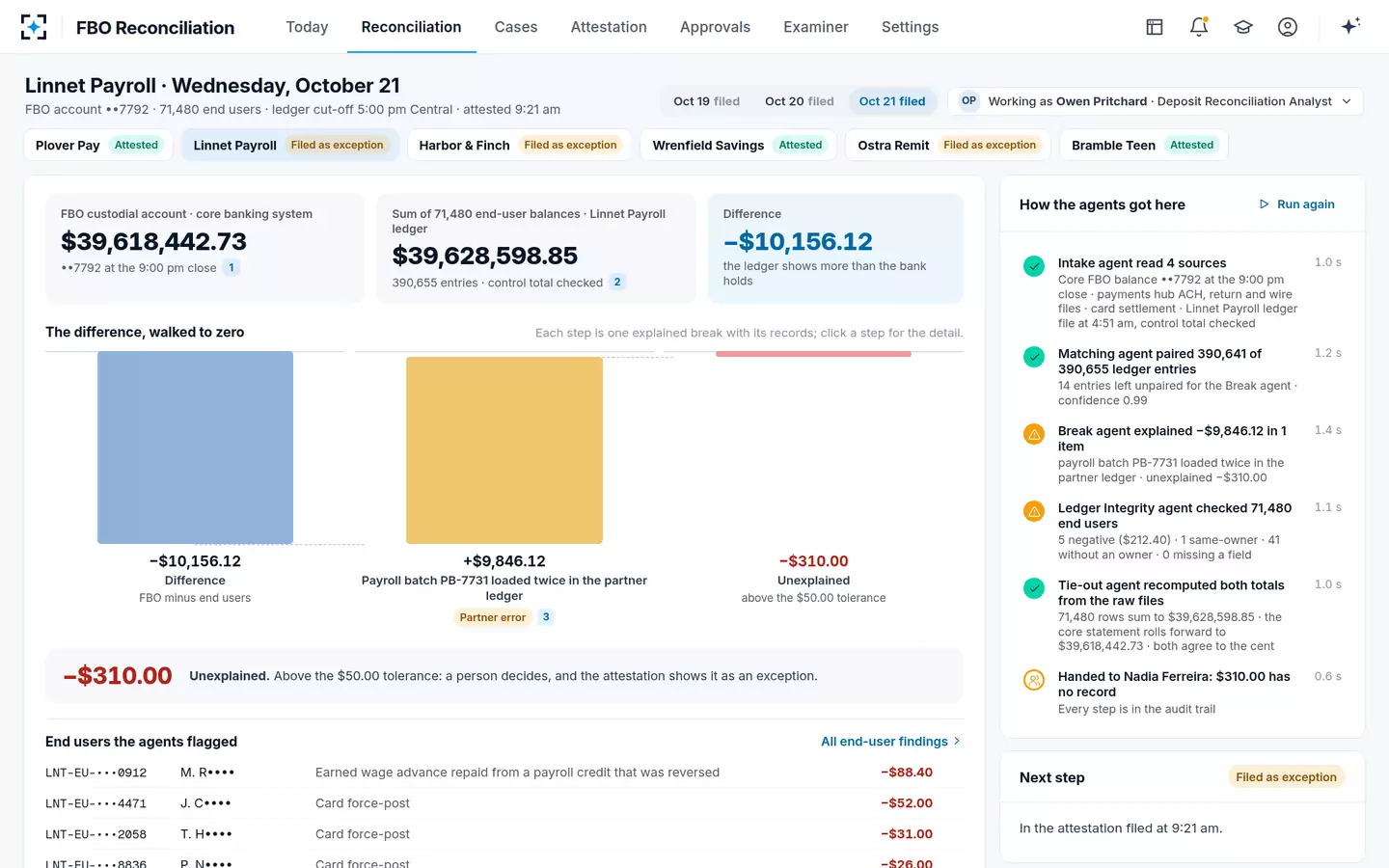
| Partner loads payroll or funding batches into its own books | Duplicate or missing loads | Linnet Payroll loaded batch PB-7731 twice, $9,846.12, a partner error |
| Wires with recall rights | Items that age past their expected clear time | Harbor & Finch, a $2,400.00 wire recall filed as an exception |
| Partner file sent by secure transfer at a set time | Late or missing files | Ostra Remit's transfer failed a certificate check at 4:48 am |
| Spending allowed before money clears | Negative end-user balances | Plover Pay, three balances, $88.20 in all |
| Customers moved between programs | Balances with no owner | Linnet Payroll, 41 sub-accounts without an owner, $1,902.55, restricted until named |
| Products for minors opened with a parent | Wrong ownership codes | Bramble Teen, 1,204 accounts coded joint, single under the agreement |
Some of these can be designed out and some cannot. A partner whose books close at the same time as the bank's core will produce fewer timing items, but card settlement will always lag authorization. Duplicate loads can be prevented by control totals the bank checks before loading a file. Ownerless balances can be prevented by a migration plan that names every customer before balances move. The ones that remain are the ones the daily reconciliation exists for.
One account per partner or several banks per partner?
The number of accounts, and of banks, is the other structural choice that changes what a reconciliation can see. The FDIC set out the range when it explained why it did not base its proposal on transaction thresholds: "some financial technology products or intermediaries working on behalf of financial technology companies may deposit end-user funds across multiple custodial deposit accounts at a single IDI, while others may deposit funds from multiple end-users into a single custodial deposit account, and others may spread funds across more than one IDI" (89 FR 80135).
Spreading a program across banks is a real risk for each bank in it. A partner's error affects every bank that holds its customers' money, and each bank sees only its share. The FDIC argued that a daily reconciliation at each bank would let a mismatch be caught at one bank before it spread to the others. A sponsor bank should know whether its partners use other banks and, if they do, how the partner allocates customers among them; without that, the bank cannot tell whether the total it receives is its customers' total or a slice of a larger one.
FBO accounts vs trust accounts
FBO accounts and trust accounts both hold money for others, but they are insured and governed differently. An FBO account is a custodial or agency account: the owners' money is insured to each owner on a pass-through basis if the conditions are met. A trust account is held under a trust, and the FDIC insures trust deposits by a separate formula based on the number of beneficiaries.
FBO accounts vs trust accounts at a bank
FBO (custodial) account: A custodian or agent, often for thousands of unrelated customers
Trust account: A trustee, under a trust agreement or as a payable-on-death designation
FBO (custodial) account: Pass-through to each owner, 12 CFR 330.7, if the records conditions in 330.5 are met
Trust account: Trust rules, 12 CFR 330.10: up to $250,000 per beneficiary, for at most five beneficiaries per grantor
FBO (custodial) account: Each customer, through the custodian, many times a day
Trust account: The trustee, under the trust's terms
FBO (custodial) account: The account against every customer's balance
Trust account: Governed by the trust's own accounting
FBO (custodial) account: Covered, if the owners can direct transfers to third parties
Trust account: Accounts holding only trust deposits are exempt
FBO accounts for businesses
FBO accounts for businesses follow the same rules, with two wrinkles. A business that owns money in an FBO program is insured in the business category, and its share is added to the business's other deposits at the bank. And where a business is itself holding money for others, a payroll company holding employers' and employees' money, for example, the structure has another layer, which must be disclosed and reconciled like any other.
At the sample bank, the payroll partner Linnet Payroll shows both wrinkles in one day. Its customers' balances moved through payroll batches it loaded into its own books, and one batch was loaded twice. Its file also held 41 balances with no owner, $1,902.55 in all, which the bank moved to restrict until the partner names them. Neither problem would show in the program agreement; both show in the reconciliation.
One structure's breaks in FBO Reconciliation: a duplicate load and $310.00 no record explains
How to set up an FBO account so it can be reconciled
To set up an FBO account that can be reconciled, write the reconciliation into the structure before the first customer arrives. The checklist below is ours, built from the questions regulators ask and the breaks a sponsor bank sees; most items are clauses in the program agreement.
Eight things to settle when setting up an FBO account, so the daily reconciliation works
- A title that discloses the custodial relationship, and every layer
Including any middleware or program manager between the fintech and the bank.
- Who keeps the sub-ledger, in writing
And what happens to it, and to the bank's access, if that party fails.
- A daily customer file, by a set time, in a set format
Every customer's balance and entries, with a control total the bank checks before loading.
- The partner's cut-off and the bank's close, written down
So that timing items have an expected clear time from the first day.
- The fields every customer record must carry
Name, tax ID, address and ownership code; the FDIC's proposed 30-field layout is a useful template.
- A reserve account and a funding deadline
For negative balances and shortfalls; the sample bank's agreements set one business day.
- Notice and escalation terms
Who at the partner receives notices, how fast they must answer, and what happens when a file is late.
- Rules for moving customers between programs
So no balance arrives without an owner.
What FBO Reconciliation does with six different structures
FBO Reconciliation reads each partner's structure as a set of settings rather than a separate project: the partner's cut-off, its file deadline, its tolerance, its funding deadline and its escalation path. At the sample bank no two of the six partners are set up alike. Plover Pay closes its books at 4:00 pm, Linnet Payroll and Ostra Remit at 5:00 pm; five files are due at 5:00 am and one at 5:30; one partner has a $100.00 tolerance where the others have $50.00.
FBO Reconciliation when a partner's file never arrives
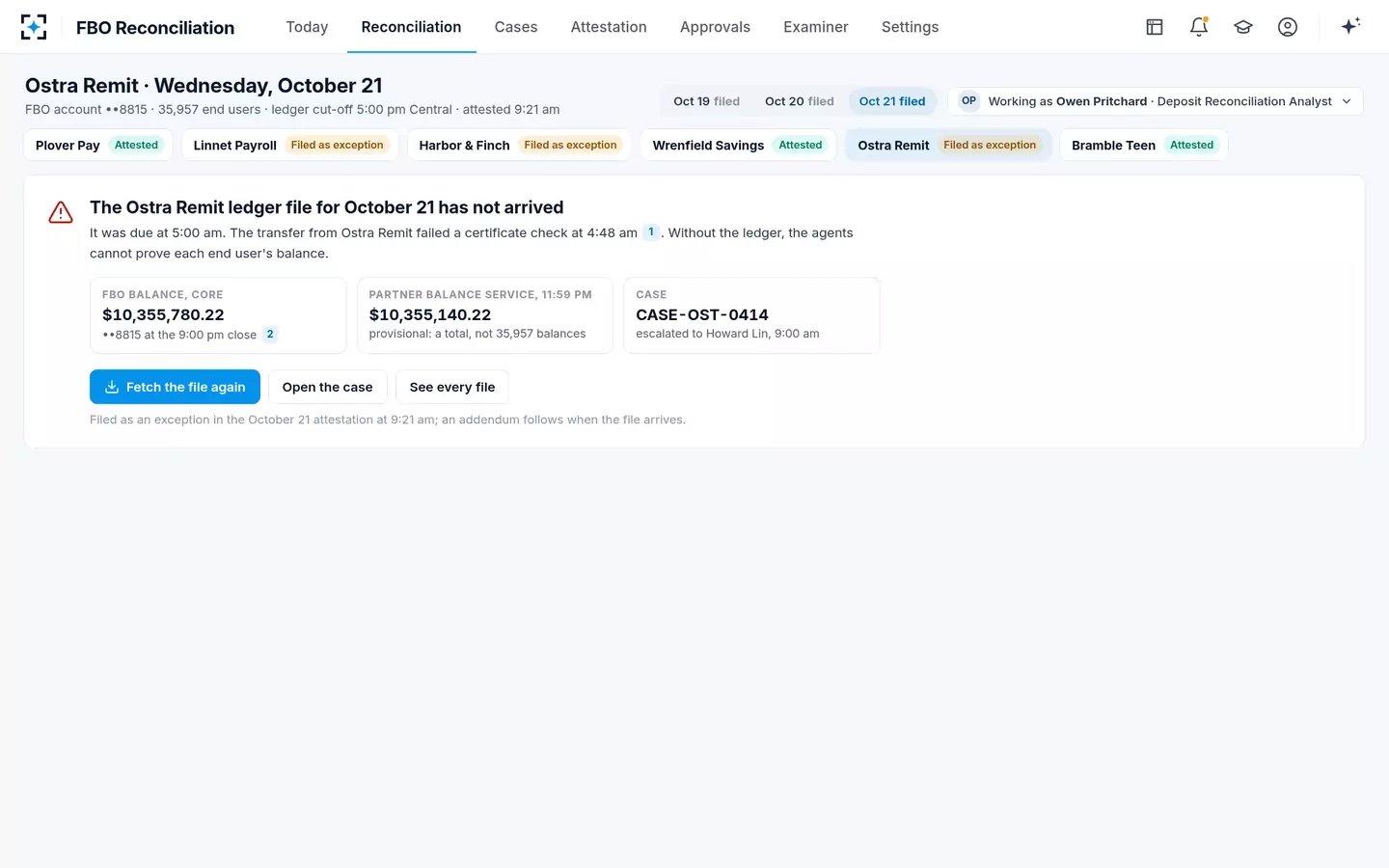
The structure also decides how much a reconciliation can prove. A partner that sends a full customer file can be tied to the end-user level; a partner that sends only a total cannot. What the customers' balances are, legally and practically, and how the reconciliation sits beside the bank's existing systems, are covered separately. To see your own partners' structures run through the solution, start from FBO Reconciliation.
Questions people ask
What is an FBO account example?
A savings app's customers each see a balance in the app, while the money sits in one account at a sponsor bank titled for the benefit of the app's customers. The app, or a firm working for it, keeps the record of each customer's share, and the bank reconciles the account to that record every business day.
Who owns the money in an FBO account?
The customers do, not the fintech or the bank, if the arrangement is genuine. The bank holds the deposit, the account holder is the custodian, and each customer is a beneficial owner of a share. Deposit insurance can pass through to each customer only if the bank's records disclose the arrangement and each customer's interest can be traced.
Can one fintech use several banks' FBO accounts?
Yes, and the FDIC noted that some programs spread customers' funds across more than one bank. Each bank then holds part of the program and sees only its share, which is why each needs its own daily reconciliation to the customers whose money it holds.
Does the bank or the fintech keep the records for an FBO account?
The bank keeps the account and its own transaction records; the customer-level records are often kept by the fintech or a middleware firm. Under the FDIC's 2024 proposal, not yet final, the bank would have to keep those records itself or have direct, continuing access to them in a set format.
What did the Evolve order require about fintech records?
The Federal Reserve's June 2024 consent order required Evolve Bank & Trust to submit a plan whose controls set out the bookkeeping responsibilities of the bank and each fintech partner, and keep them working through a disruption, along with board approval before onboarding new fintech partners.